For decades, Chicago’s literary and scholarly artifacts were scattered across temporary facilities, lacking a permanent central sanctuary. The origin story of the harold washington library transcends mere civic infrastructure; it represents a modern resurrection of the ancient temple of wisdom. Commissioned in the late 1980s and opened in 1991, the building’s postmodern facade hides a deeply symbolic blueprint. By examining the mythological motifs, esoteric geometry, and historical struggle behind its creation, we uncover how architects and city planners engineered a physical monument dedicated to the spiritual and intellectual elevation of the public.
The Wandering Archive: Harold Washington Library Origins
Before the central branch opened its doors in October 1991, Chicago held the dubious distinction of being the largest city in the United States without a central public library. For over three decades, the city’s primary collection was relegated to temporary, makeshift spaces, including an abandoned water pumping station and a repurposed department store. This transient existence fractured the archival continuity necessary for deep historical and esoteric research.
The push for a permanent sanctuary gained momentum in 1982 when Mayor Harold Washington championed the initiative to construct a monumental repository of human knowledge. The site chosen—a full city block bounded by State, Dearborn, Congress, and Van Buren streets—was historically significant, sitting atop the former grounds of the Dearborn Station train shed. Transforming this space required an architectural vision that could anchor the civic landscape while serving as a metaphysical bridge between the public and the accumulated wisdom of the ages.
The 1987 Design Competition: A Postmodern Temple
To determine the physical form of this new temple of knowledge, the city launched an international design competition in 1987. The jury sought a structure that rejected the sterile, glass-box modernism of the mid-20th century, favoring instead a design that communicated permanence, history, and intellectual weight. The winning submission came from the Chicago-based firm Hammond, Beeby and Babka, led by architect Thomas H. Beeby. Beeby’s design was a masterclass in postmodern classicism, deliberately invoking the architectural language of ancient Greek and Roman temples, as well as the 1893 World’s Columbian Exposition’s 'White City'.
Synthesizing Antiquity and the Chicago School
The facade of the building is a rigorous study in material symbolism. The base is clad in rusticated limestone, grounding the structure to the earth and representing the foundational nature of historical truth. Rising above the limestone is a massive expanse of deep red brick, a deliberate homage to the Chicago School of architecture and the city’s industrial resilience. According to the Chicago Architecture Center, this juxtaposition of classical stone and regional brick creates a dialogue between universal mythological archetypes and localized civic identity. The building does not merely store books; it physically embodies the tension between eternal wisdom and earthly endeavor.
The Aluminum Owls and Mythological Guardians
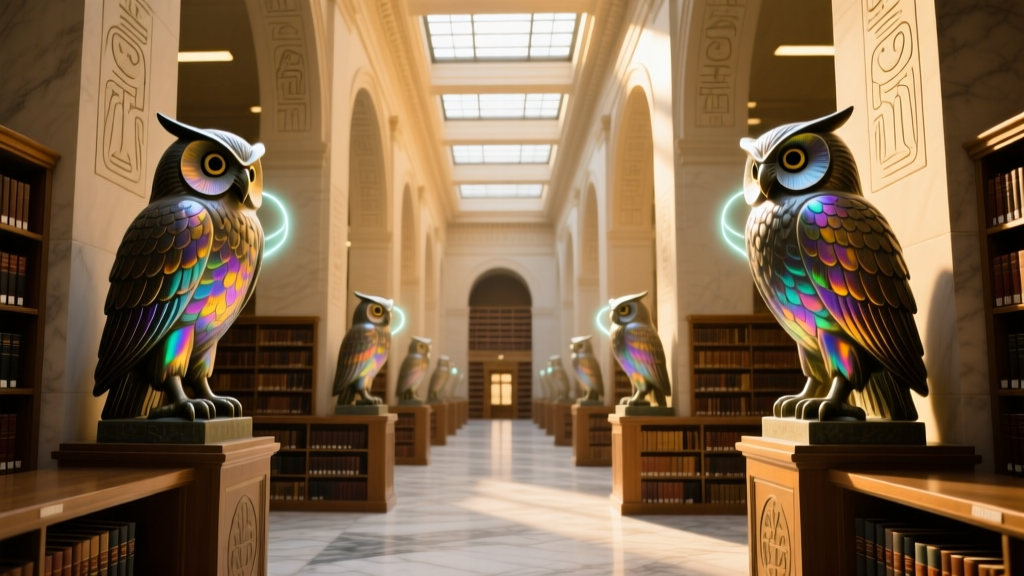
The most striking and heavily debated features of the building are the massive aluminum owls perched along the roofline and the smaller bronze owls adorning the lower cornices. Designed by sculptor Kent Bloom, these towering avian sentinels are direct references to the Little Owl (Athene noctua), the sacred companion of Athena, the Greek goddess of wisdom, strategy, and esoteric knowledge. In mythological traditions, the owl’s ability to see through the darkness serves as a potent metaphor for the clairvoyant scholar piercing the veil of ignorance.
The Facade's Mythological Bestiary
- The Acroteria Owls: Standing nearly 40 feet tall, the rooftop owls act as spiritual guardians, watching over the city and warding off intellectual stagnation.
- The Bronze Festoons: Draped across the limestone base, these sculpted garlands feature cornucopias and shields, symbolizing the abundance of knowledge and the defense of truth against misinformation.
- The Gorgoneion Motifs: Subtle shield-like medallions echo the Aegis of Athena, offering protective energy to the archives housed within.
By integrating these mythological guardians, the architects transformed the library from a secular municipal building into a consecrated space of learning. The Chicago Public Library officially recognizes these elements as vital components of the building's identity, bridging ancient allegory with modern public service.
Architectural Symbols and Esoteric Meanings
| Architectural Element | Mythological Origin | Esoteric & Symbolic Function |
|---|---|---|
| Rooftop Aluminum Owls | Athena’s Little Owl | Clairvoyance, piercing the veil of ignorance, guarding hidden knowledge. |
| Rusticated Limestone Base | Classical Antiquity Temples | Grounding energy, foundational truth, connection to the earth element. |
| Red Brick Superstructure | Chicago School Pragmatism | Human endeavor, industrial alchemy, the fire element of transformation. |
| Ninth-Floor Winter Garden | The Celestial Sphere | Ascension of thought, divine illumination, connection to the ether. |
The Winter Garden: Sacred Geometry and Illumination
Ascending to the ninth floor reveals the Winter Garden, a breathtaking vaulted space enclosed by a sweeping glass ceiling. In esoteric architecture, the ascent to the highest accessible point of a structure represents the soul’s journey toward enlightenment. The Winter Garden functions as the spiritual apex of the building. The geometric arrangement of the glass panes and the steel armature creates a lattice that filters natural light, casting shifting, mandala-like shadows across the mosaic floors throughout the day.
This space is heavily influenced by the concept of the Axis Mundi, the world center that connects the terrestrial realm with the heavens. The vaulted ceiling mimics the ribcage of a great beast or the hull of an inverted ship, symbolizing the vessel that carries the seeker across the ocean of collective consciousness. Surrounded by the specialized collections of Chicago history and genealogy, researchers working in the Winter Garden are physically positioned beneath the sky, reinforcing the hermetic maxim 'as above, so below.' The integration of natural light into the reading spaces reduces reliance on artificial illumination, aligning the act of reading with the natural circadian rhythms of the sun.
Numerological Significance of the Nine Stories
The structural numerology of the building is not accidental. The library spans nine primary stories above ground. In Pythagorean numerology and various mystical traditions, the number nine represents completion, universal wisdom, and the culmination of a cycle of learning. It is the highest single-digit number, containing the experience of all numbers that precede it. By capping the public and archival spaces at the ninth level, the architectural blueprint subtly reinforces the idea that the pursuit of knowledge is a journey toward ultimate wholeness.
Furthermore, the building’s footprint occupies a perfect geometric rectangle, a shape associated with stability, order, and the material manifestation of divine laws. The strict symmetry of the State and Dearborn street facades imposes a sense of rational balance, providing a psychological anchor for visitors navigating the often chaotic and overwhelming volumes of information housed inside.
Legacy of the Harold Washington Library
The successful realization of this monumental project required overcoming immense political and financial hurdles, culminating in its opening just months after the untimely death of the mayor whose name it bears. Today, the building stands as a testament to the belief that access to information is a fundamental human right, and that the spaces we build to house that information must reflect the sacredness of the endeavor. The synthesis of postmodern design, mythological iconography, and civic utility ensures that the library operates not just as a warehouse for paper, but as an active, living temple dedicated to the perpetual expansion of human consciousness.