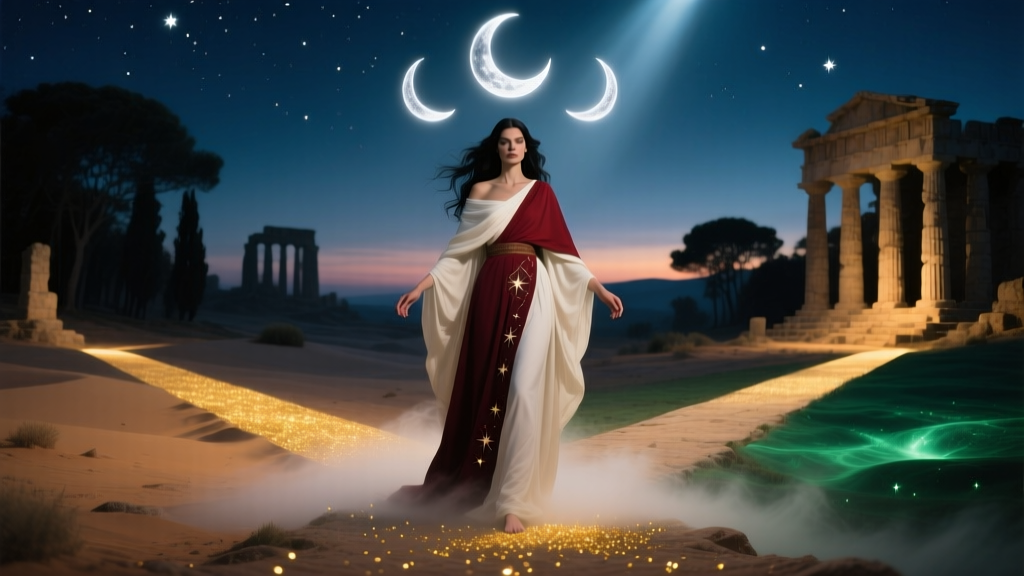
When studying ancient Greek mythology, the Hecate goddess stands out as a profoundly complex figure. Unlike the Olympians who resided in celestial heights, Hecate operated in the liminal spaces—the crossroads, the thresholds, and the shadows. Despite her prominence in classical antiquity, modern pop culture and neo-pagan syncretism have heavily distorted her original profile. This guide addresses the most frequent questions and dismantles persistent myths surrounding her domain, separating classical historical fact from modern fictional overlays. Understanding the true nature of this deity requires stripping away centuries of misinterpretation and examining the primary sources.
Origins of the Hecate Goddess: Beyond the Underworld
Historically, Hecate’s origins are pre-Olympian, likely stemming from the Carians of Anatolia before being integrated into the Greek pantheon. In Hesiod’s Theogony (c. 700 BCE), she is not relegated to the underworld. Instead, Zeus honors her above all others, granting her a share in the earth, the sea, and the starry sky. She is a universal force of bestowal, capable of granting wealth, wisdom, and victory in athletic contests. According to Hesiod's Theogony via ToposText, she is a Kourotrophos (nurse of the young) and a protector of fishermen and shepherds. This benevolent, cosmic authority is often entirely ignored in modern portrayals that reduce her to a mere patroness of dark witchcraft.
Three Common Misconceptions About Hecate (Debunked)
Misconception 1: The 'Maiden-Mother-Crone' Triad
One of the most pervasive modern myths is that Hecate represents the 'Crone' aspect of a Triple Goddess (Maiden, Mother, Crone). This framework is not found in classical antiquity. It is a 20th-century invention popularized by Robert Graves in his 1948 book The White Goddess and later adopted by Wiccan traditions. In ancient Greece, Hecate’s 'triplicity' was spatial, not chronological. She was worshipped as Trivia (the three-way crossroads) and depicted in later classical art as three identical young women standing back-to-back, holding torches and keys, representing her omnidirectional sight at thresholds, not three distinct ages of womanhood.
Misconception 2: She is Strictly a 'Dark' or Malevolent Deity
Modern media frequently casts the Hecate goddess as a villainous figure associated exclusively with curses, necromancy, and black magic. While she did possess chthonic (underworld) associations and was a psychopomp who accompanied Persephone, her primary civic role was protective. She was revered as Soteira (The Savior) and Apotropaios (Averter of Evil). Ancient Greeks placed her statues, known as Hecataea, at the entrances of their homes and city gates specifically to ward off malevolent spirits and plague. To view her solely as a dark witch ignores her vital role as a guardian deity of the household and the state.
Misconception 3: Hecate and Artemis are the Exact Same Entity
While later philosophical texts, such as the Chaldean Oracles, and some regional cults syncretized Hecate with Artemis and Selene (the moon), they were distinct entities in classical Greek religion. Artemis was primarily associated with the wilderness, the hunt, and childbirth, operating in the untamed natural world. Hecate, conversely, was a goddess of the built environment's boundaries—the city gates, the doorstep, and the literal crossroads. Conflating them erases Hecate’s unique jurisdiction over human-made thresholds and civic liminality.
Hecate vs. Other Liminal Deities: A Comparative Analysis
To understand Hecate's specific niche, it is helpful to compare her with other deities who governed boundaries and transitions. The table below outlines the distinct domains of liminal deities in classical mythology.
| Deity | Primary Liminal Domain | Key Symbols | Direction of Influence |
|---|---|---|---|
| Hecate | Thresholds, crossroads, spiritual boundaries | Twin torches, keys, hounds, Strophalos | Guarding the boundary; mediating between mortal and spirit realms |
| Hermes | Roads, travel, commerce, transitions of state | Caduceus, winged sandals, herms | Moving across boundaries; guiding souls and travelers |
| Janus (Roman) | Doorways, beginnings, endings, time transitions | Two-faced visage, keys, staff | Opening and closing passages; initiating new cycles |
As noted by scholars at the Theoi Project, while Hermes guides the traveler along the road, Hecate guards the intersection where the traveler must make a choice. Her domain is the moment of decision and the spiritual weight of the threshold itself.
Frequently Asked Questions About Hecate
What are the sacred symbols of the Hecate goddess?
Beyond the well-known twin torches (representing illumination in darkness) and keys (kleidouchos, the key-bearer who unlocks the mysteries of the underworld), her most esoteric symbol is the Strophalos, or Hecate’s Wheel. Originating from the 2nd-century Chaldean Oracles, the Strophalos is a labyrinthine circle enclosing a serpent and a central Iynx (a wryneck bird). It represents the emanation of divine thought into the material world and was used in ancient theurgic rituals to induce prophetic visions. Furthermore, the black dog and the polecat (or weasel) were considered her sacred animals, often linked to shape-shifting myths involving her priestesses.
What was Hecate's Deipnon in antiquity?
The Deipnon (Hecate’s Supper) was a monthly household ritual observed on the night of the dark moon (the new moon). According to Britannica's historical archives on Hecate, families would prepare a meal consisting of raw eggs, garlic, leeks, onions, and fish, and place it at the local crossroads or outside their front doors. This served a dual purpose: it honored Hecate as the protector of the household, and it functioned as a charitable offering to the restless dead and the impoverished, who were known to scavenge these meals after nightfall. It was strictly forbidden to look back at the offering once placed, as doing so was believed to invite the wrath of the wandering spirits.
Is Hecate a Titan or an Olympian?
Taxonomically, Hecate is a Titaness. She is the daughter of the Titans Perses and Asteria. However, she is unique among her generation because she actively supported Zeus during the Titanomachy (the war between the Titans and Olympians). As a reward for her allegiance, Zeus allowed her to retain her ancient powers and granted her a universal domain that bridged the heavens, earth, and the underworld, effectively making her an honored guest within the Olympian hierarchy without being an Olympian herself.
Actionable Guidance: Honoring Hecate in Modern Practice
For modern practitioners of Hellenism or esoteric traditions seeking to work with the Hecate goddess accurately, aligning practices with historical precedent yields deeper symbolic resonance than relying on modern pop-culture tropes.
- Observe the Dark Moon: Align your rituals with the astronomical new moon. This is the traditional time for the Deipnon, focusing on banishing, cleansing, and setting boundaries rather than manifestation or growth.
- Curate a Traditional Shrine: Incorporate historical symbols. A pair of iron keys, a statue of a hound, and beeswax candles are historically accurate. Avoid using 'crone' imagery or cauldrons, which are Celtic and medieval European motifs, not Greek.
- Prepare Authentic Offerings: If leaving an offering at a threshold or crossroads, use traditional items: garlic, raw eggs, honey, and dark wine. Do not consume the offering yourself, and walk away without looking back to respect the boundary between the living and the dead.
- Focus on Liminality: Direct your petitions toward transitions. Hecate is the ideal deity to approach when facing a major life decision, moving to a new home, or navigating a psychological threshold, as she holds the keys to opening and safely closing doors.
By discarding modern overlays and returning to her classical roots, practitioners and scholars alike can engage with Hecate as she was truly understood: a formidable, protective, and deeply necessary force governing the critical thresholds of human existence.