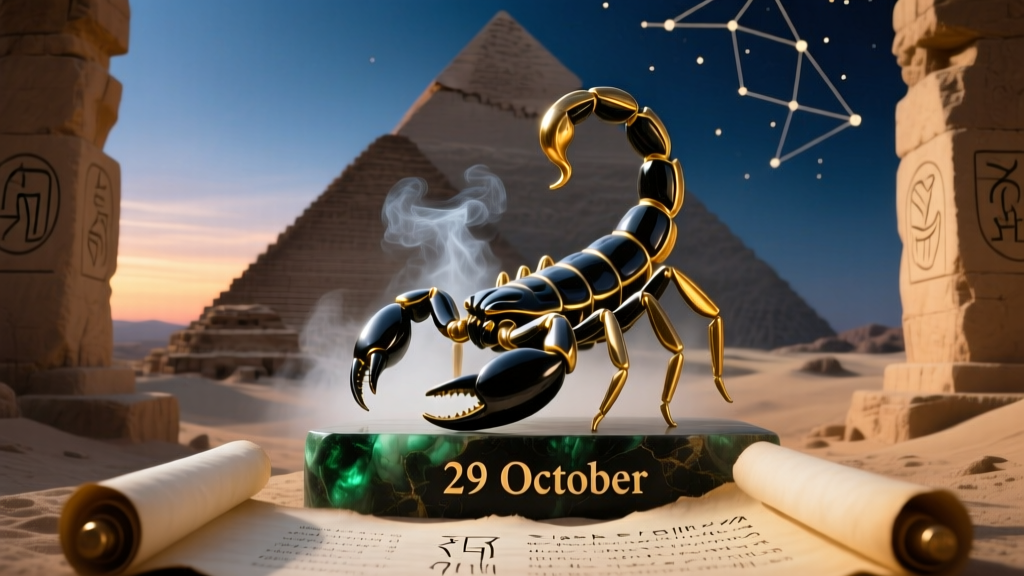
The 29 Oct zodiac falls squarely within the tropical sun sign of Scorpio, specifically positioning the Sun at approximately 6 degrees of this fixed water sign. While modern pop astrology often reduces this date to mere personality traits or daily horoscopes, the historical and mythological origins of this zodiacal placement reveal a complex tapestry of ancient astronomy, underworld mythology, and agricultural calendars. To understand the true genesis of the 29 October zodiac archetype, we must excavate the Mesopotamian star catalogs, Hellenistic mythmaking, and the ancient Celtic festivals that defined late autumn. The identity of this date is not a modern invention; it is a psychological and spiritual inheritance spanning over four millennia.
The Babylonian Genesis: GIR.TAB and the Scorpion Men
The earliest recorded origins of the Scorpio constellation date back to ancient Mesopotamia. In the MUL.APIN, a comprehensive Babylonian star catalog compiled around 1000 BCE, the constellation was designated as GIR.TAB, which translates directly to "the scorpion" or "the one who stings." According to the World History Encyclopedia, Babylonian astronomers were meticulous in mapping the ecliptic, and GIR.TAB was recognized as a formidable celestial entity associated with the underworld god Nergal.
Beyond mere astronomy, the scorpion held profound mythological weight in the region. In the Epic of Gilgamesh, the hero encounters the Girtablilu—terrifying Scorpion Men who guard the Mashu mountains and the tunnel through which the sun god Shamash travels every night. These mythological guardians possessed the power to kill with a single glance and were the ultimate threshold guardians between the mortal realm and the divine underworld. This ancient narrative established the foundational archetype for the late October zodiac: the guardian of hidden realms, the survivor of profound darkness, and the master of liminal spaces.
The Hellenistic Shift: Artemis, Orion, and the Celestial Hunt
As Babylonian astronomy was absorbed and adapted by the ancient Greeks, the mythological narrative of the scorpion was dramatically rewritten to fit the Hellenistic pantheon. The Greeks retained the constellation's imagery but embedded it within the tragic myth of Orion, the giant huntsman. According to classical mythology, Orion boasted that he possessed the strength to kill every beast on Earth. This hubris angered Gaia (the Earth goddess), who sent a giant scorpion to strike him down.
Following Orion's death, Zeus placed both the hunter and the scorpion in the heavens. However, to prevent their eternal rivalry from disrupting the cosmic order, Zeus positioned them on opposite sides of the celestial sphere. As the constellation Scorpius rises in the east, Orion flees below the western horizon. This celestial choreography, documented extensively by historians and referenced in Britannica's archives on classical constellations, embedded the "death and rebirth" motif into the zodiacal identity. For those born on October 29, this ancient Greek origin story manifests as an innate psychological understanding of cycles, endings, and the inevitable consequences of ego and hubris.
The Severed Claws: The Astronomical Redrawing of the Heavens
One of the most fascinating historical developments affecting the late October zodiac is the astronomical separation of Scorpio and Libra. In early antiquity, the constellation of the scorpion was massive. Its claws extended far beyond its current boundaries, encompassing the stars that we now recognize as the constellation Libra.
During the Roman era, and later formalized by the astronomer Claudius Ptolemy in his seminal work Tetrabiblos during the 2nd century CE, the "claws" (known in Latin as Chelae) were severed from the scorpion to create the constellation of Libra, representing the scales of justice. This historical redrawing of the heavens fundamentally altered the astrological interpretation of the autumnal equinox and the subsequent weeks. The 29 Oct zodiac sign retained the "sting" and the Plutonic depth of the scorpion's body but lost the "weighing" aspect of the claws. This historical severing intensified the archetype's association with raw transformation, psychological excavation, and martial strategy, rather than judicial balance or diplomatic mediation.
Late October in Antiquity: Samhain and the Veil of the Underworld
The calendar date of October 29 cannot be historically analyzed without examining the seasonal festivals that surrounded it in the ancient world. In the Celtic calendar, late October marked the approach of Samhain (celebrated from sunset on October 31 to sunset on November 1). Samhain was the most significant of the four quarter-day festivals, marking the end of the harvest and the beginning of the "darker half" of the year.
According to historical analyses of Celtic traditions, Samhain was a period when the veil between the physical world and the Otherworld was believed to be at its thinnest, allowing spirits and deities to cross over. This ancient agricultural and spiritual calendar perfectly mirrors the astrological rulership of Scorpio. The planetary rulers of Scorpio—Mars (the warrior/separator) and Pluto (the lord of the underworld)—govern the exact themes celebrated during Samhain: death, ancestral communion, the stripping away of the superfluous, and the descent into the dark to secure the seeds for future rebirth. The 29 October birthday sits precisely on the precipice of this ancient threshold.
Historical Evolution of the Late October Archetype
The following table illustrates how the astrological and mythological identity of the late October period evolved across different ancient cultures, shifting from a literal guardian monster to a complex psychological archetype.
| Era / Culture | Designation | Core Mythos & Function | Associated Deity / Ruler |
|---|---|---|---|
| Babylonian (c. 1000 BCE) | GIR.TAB | Threshold guardians; protectors of the sun god's nightly descent. | Nergal (Underworld) |
| Hellenistic (c. 300 BCE) | Skorpios | The divine instrument of hubris; the eternal celestial hunter. | Gaia / Artemis |
| Roman (c. 150 CE) | Scorpius (Claws severed) | Agent of martial transformation; stripped of judicial balancing. | Mars |
| Celtic (Seasonal Context) | Samhain Approach | Thinning of the veil; communion with ancestors and the unseen. | The Morrígan / Cernunnos |
Decoding the 29 Oct Zodiac: The 6th Degree of Scorpio
To achieve true astrological specificity, we must look beyond the general sign of Scorpio and examine the exact degree the Sun occupies on October 29. On this date, the Sun typically rests at the 6th degree of Scorpio. In the Hellenistic and Chaldean traditions, the zodiac was divided into decans (10-degree segments), each carrying its own distinct historical flavor and sub-rulership.
The Chaldean Decan and the Crocodile
The 6th degree falls within the first decan of Scorpio (0° to 10°). Unlike the later degrees of Scorpio, which are heavily influenced by Pluto's slow, generational, and psychological undertones, the first decan is traditionally co-ruled by Mars. This gives the 29 Oct zodiac a distinctly martial, pioneering, and outwardly expressive historical energy.
In ancient astrological texts and the Picatrix, the first decan of Scorpio is symbolized not just by a scorpion, but by a figure holding a crocodile or a serpent. This specific imagery represents the mastery over base, primal instincts and the ability to navigate treacherous emotional waters without being consumed by them. Historically, individuals born under this specific decan were viewed as strategists and survivors—those who could face the "monsters" of the underworld and emerge with their sovereignty intact. This Chaldean origin provides a highly specific framework for understanding the 29 October archetype: it is not merely about experiencing trauma or depth, but about the active, martial conquest of the shadow self.
The history of the 29 October zodiac is a testament to humanity's enduring attempt to map the psychological descent into the unknown. From the Scorpion Men guarding the tunnels of the Babylonian sun god to the Celtic recognition of the thinning veil, this date represents a historical convergence of mythology, astronomy, and seasonal survival. Understanding these ancient origins provides a profound, actionable framework for navigating the intense, transformative energies inherent to this specific placement in the natal chart.