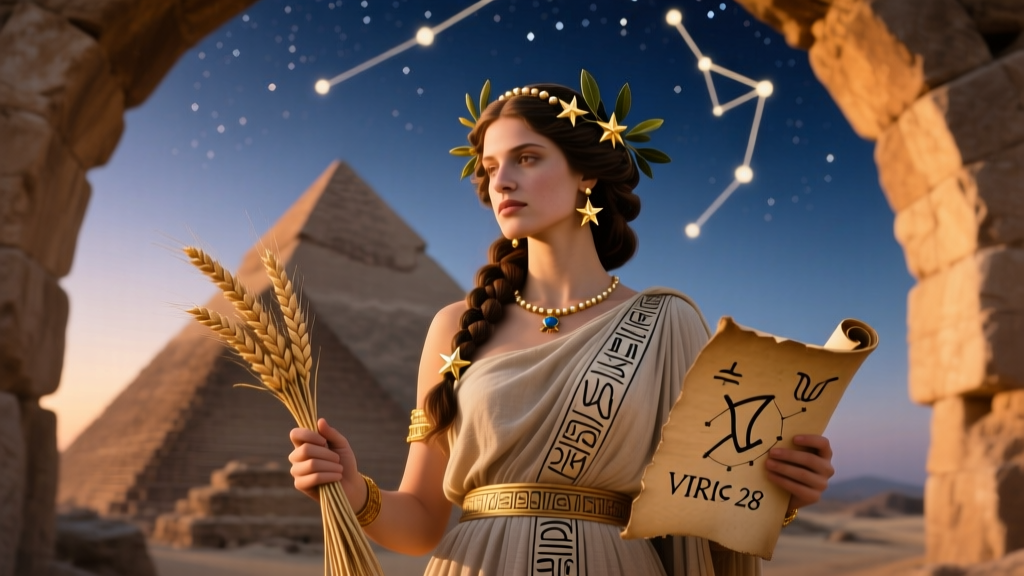
Individuals born under the zodiac of August 28 fall within the early degrees of Virgo, an earth sign steeped in millennia of agricultural and celestial history. Far beyond modern pop-astrology tropes of perfectionism, the historical origins of this specific zodiacal placement trace back to ancient Mesopotamian harvest catalogs and Hellenistic star lore. To understand the zodiac of August 28 is to examine the evolution of the Maiden constellation—from the Babylonian Furrow to the Greek goddesses of justice and grain. This analysis unpacks the primary historical texts, mythological avatars, and astronomical mechanics that forged this specific astrological identity. By examining primary sources like Ptolemy’s Tetrabiblos, we reveal the esoteric foundations of this earth sign.
Babylonian Origins: The MUL.APIN and the Goddess Shala
The earliest documented origins of the Virgo constellation do not depict a maiden, but rather an agricultural tool and a harvest deity. In the MUL.APIN, a comprehensive Babylonian astronomical catalog compiled around 1000 BCE, the stars that currently comprise Virgo were primarily associated with the Furrow (Še-ga). This celestial region represented the planting and harvesting cycles critical to Mesopotamian survival.
At the heart of this constellation lies Spica, the brightest star in the region. Historically, Spica was depicted as an ear of grain held by the goddess Shala, a Sumerian and Akkadian deity of grain and compassion. Shala’s iconography directly influenced later Hellenistic depictions of Virgo. The agricultural imperative of the Babylonians meant that the heliacal rising and setting of these stars dictated the literal survival of the empire. For those studying the zodiac of August 28, recognizing this foundational connection to the earth, the harvest, and the goddess Shala provides a grounded, material context to the sign's modern analytical reputation.
Hellenistic Syncretism: From Grain to Justice
When Babylonian astrology was absorbed by the Greeks during the Hellenistic period (circa 3rd century BCE), the constellation underwent significant mythological syncretism. The Greeks merged the agricultural aspects of Shala with their own deities, primarily Demeter and her daughter Persephone. According to historical star lore archives, the ear of grain (Spica) was reinterpreted as the wheat stalk Demeter carried while searching the earth for her abducted daughter.
However, a parallel mythological tradition emerged, identifying the constellation as Astraea or Dike, the goddess of justice. In the works of the Roman poet Manilius, specifically his epic poem Astronomica, Virgo is described as the celestial judge who weighs the harvest and the deeds of humanity. Manilius notes that those born under this sign possess an innate drive for order, equity, and the meticulous sorting of truth from falsehood. The scholar Eratosthenes, in his Catasterismi, further complicated the lore by suggesting the constellation represented Erigone, a maiden who hanged herself in grief after her father Icarius was killed. This tragic narrative added a layer of melancholic devotion and meticulous care for the vulnerable to the sign's psychological profile. This dual heritage—agricultural sustenance and judicial fairness—forms the psychological bedrock of the early Virgo native.
Astronomical Mechanics: The Tropical Zodiac of August 28
To pinpoint the exact historical astrology of August 28, one must understand the mechanics of the tropical zodiac. In the tropical system, established by Hellenistic astrologers and formalized by Claudius Ptolemy in the 2nd century CE, the zodiac is anchored to the vernal equinox rather than the physical constellations. August 28 consistently falls at approximately the 5th or 6th degree of Virgo, depending on the precise solar ingress of the given year.
The First Decan and Mercurial Rulership
In the Hellenistic and later Chaldean decan system, the zodiac was divided into 36 ten-degree segments. The first decan of Virgo (0° to 10°) is traditionally ruled by Mercury. This creates a unique astrological signature for the August 28 native: a dual Mercurial influence. Virgo is already the nocturnal earth sign ruled by Mercury in the domicile system. When placed in the Mercury-ruled first decan, the intellectual, analytical, and communicative traits of the planet are grounded deeply into the physical earth.
Renaissance astrologer Heinrich Cornelius Agrippa, in his Three Books of Occult Philosophy, described the first decan of Virgo as governing sowing, planting, and the meticulous ordering of resources. This historical esoterica confirms that the August 28 placement is fundamentally about the systematic organization of the material world.
Cross-Cultural Evolution of the Maiden
The archetype of the Virgo constellation shifted dramatically across different ancient civilizations. The table below tracks the historical evolution of the stars governing the zodiac of August 28, illustrating how different cultures projected their societal values onto this region of the ecliptic.
| Culture / Era | Name / Designation | Primary Symbolism | Key Deity or Figure |
|---|---|---|---|
| Sumerian / Babylonian | Še-ga (The Furrow) | Agriculture, Harvest, Survival | Shala (Goddess of Grain) |
| Hellenistic Greek | Parthenos (The Maiden) | Purity, Agriculture, Underworld cycles | Demeter / Persephone |
| Roman | Virgo / Astraea | Justice, Equity, Moral Order | Astraea / Dike |
| Hindu (Vedic) | Kanya | Unmarried Girl, Purity, Resources | Ashok Sundari / Parvati |
| Medieval Arabic | Al-Adhra | The Innocent Maiden, Harvest | Syncretic Astrological Lore |
Applying Historical Astrology to the August 28 Native
Understanding the ancient origins of this placement provides highly specific, actionable frameworks for modern astrological practice. Rather than relying on superficial daily horoscopes, practitioners and individuals born on this date can utilize historical data to refine their personal or professional development.
First, lean into the Mercurial-Earth synthesis. The Chaldean decan system highlights that the 5th degree of Virgo is optimized for resource management, logistical planning, and editorial precision. Historically, this was the energy used to audit the harvest; today, it translates to data analysis, financial auditing, and systems architecture. Furthermore, the historical emphasis on the Furrow dictates that early Virgo natives require tangible, physical results from their intellectual labor. Abstract theories are insufficient; the Babylonian roots demand that the harvest be measurable, stored, and practically applied to sustain the community.
Second, integrate the Astraea justice archetype. The Hellenistic association with Dike suggests that early Virgo natives possess a historical mandate to correct systemic imbalances. When facing career decisions, individuals born under the zodiac of August 28 will find the most historical resonance in fields that require ethical oversight, quality assurance, or legal compliance.
Finally, acknowledge the Spica fixed star influence. While precession has shifted the physical star Spica into the tropical sign of Libra, its historical and mythological roots remain tethered to the Virgo archetype. Studying the traditional lore of Spica—which promises brilliance, honor, and a legacy tied to intellectual or agricultural abundance—offers a potent focal point for meditation and intention-setting for those born in the early degrees of this earth sign.