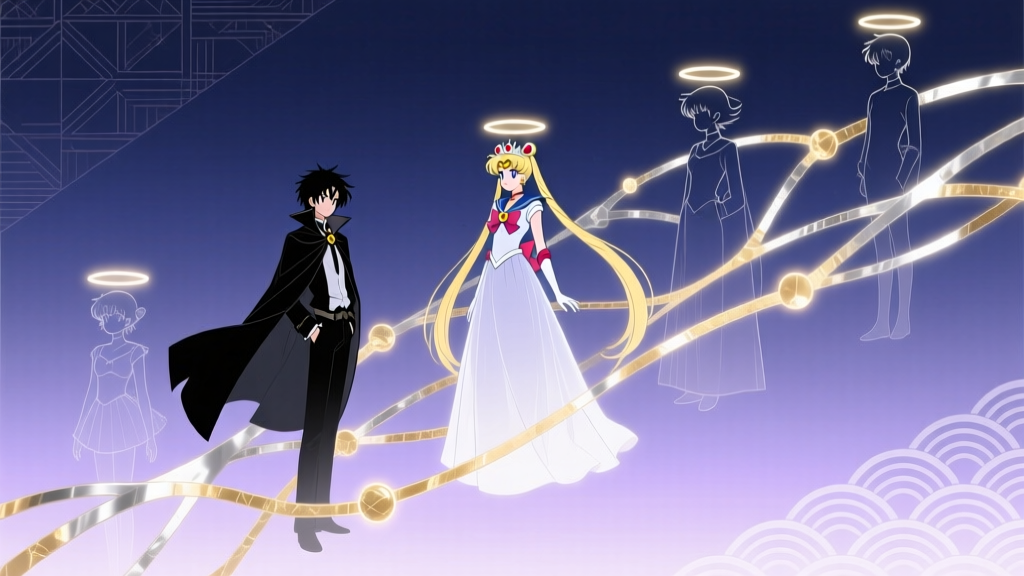
INFJ in Anime and Manga
The INFJ personality type — often dubbed 'The Advocate' or 'The Counselor' — is among the rarest in the Myers-Briggs Type Indicator (MBTI), comprising just 1–2% of the global population. In Japanese media, however, INFJs appear with striking frequency and narrative centrality — not as background figures, but as catalysts of transformation, moral compasses, and architects of systemic change. This prominence isn’t accidental. It reflects a deep alignment between core INFJ cognitive functions (Ni-Fe-Ti-Se) and foundational pillars of Japanese storytelling: mono no aware (the pathos of impermanence), giri-ninjō (duty vs. human emotion), and kishōtenketsu (a four-act narrative structure emphasizing harmony, contrast, and resolution without Western-style conflict).
Unlike Western portrayals — where INFJs are often depicted as quiet healers or spiritual guides — anime and manga frequently position them as strategic revolutionaries, tragic idealists, or silent sages who wield empathy not as passivity but as tactical insight. Their dominant Introverted Intuition (Ni) manifests as uncanny foresight, pattern recognition across time, and an almost prophetic grasp of consequences; their auxiliary Extraverted Feeling (Fe) drives them to harmonize group values, absorb collective emotional currents, and sacrifice personal needs for societal balance. These traits resonate powerfully with Japanese cultural frameworks that prize long-term vision (enryo, or restraint), relational responsibility (amae), and the aestheticization of moral burden.
Crucially, INFJ characters in anime rarely follow the 'chosen one' trope in a simplistic sense. Their power lies not in raw strength, but in interpretive authority: they read people, systems, and history like texts — and then rewrite them. This makes them uniquely suited to genres like political thriller (Code Geass), psychological drama (Paranoia Agent), magical girl deconstruction (Puella Magi Madoka Magica), and philosophical sci-fi (Neon Genesis Evangelion). Understanding INFJ representation in anime thus offers more than character analysis — it reveals how Japan’s literary and visual traditions encode complex psychological ideals into archetypal form.
Famous INFJ Anime Characters
Below is an in-depth analysis of ten iconic INFJ characters from anime and manga — selected for narrative significance, psychological coherence, and cultural impact. Each profile includes dominant function expression, key motivations, contradictions, and canonical evidence supporting the INFJ typing.
| Character | Series | Ni Expression (Vision) | Fe Expression (Harmony) | Key INFJ Contradiction | Canonical Evidence |
|---|---|---|---|---|---|
| Lelouch vi Britannia | Code Geass: Lelouch of the Rebellion | Strategic foresight spanning years; constructs layered plans anticipating political, emotional & military variables | Publicly performs charisma to unify factions; privately suppresses grief to maintain leader stability | Uses manipulation (Ti-dominant behavior) to achieve Fe-driven ends — ethical paradox central to arc | Episode 23 (“The Day a New World Begins”) — monologue on justice vs. compassion; final sacrifice aligning with Fe ideal |
| Sailor Moon (Usagi Tsukino) | Sailor Moon (original manga & Crystal) | Recurring dreams of Silver Millennium; instinctively understands cosmic timelines & reincarnation cycles | Unifies warring senshi through unconditional acceptance; heals enemies via empathy, not force | Appears emotionally immature early on, yet demonstrates profound Ni depth in crisis — growth mirrors INFJ development path | Manga Act 37 — “The Power of Love” speech reframes destruction as restoration; Naoko Takeuchi interview (2003) cites Usagi as “hope incarnate” |
| Light Yagami | Death Note | Envisions perfect world order; maps societal decay to justify intervention; sees self as inevitable catalyst | Seeks public adoration and moral legitimacy; obsessively curates image as savior, not tyrant | Fe becomes weaponized — love of humanity abstracted into contempt for individuality | Episode 25 (“Silence”) — breakdown reveals Fe collapse: “I am justice!” reflects Fe ideal inversion |
| Shinji Ikari | Neon Genesis Evangelion | Recurring visions of Instrumentality; intuits existential truths about human connection & ego dissolution | Withdraws to avoid hurting others; seeks approval but fears engulfment — classic INFJ Fe-Ti tension | Extreme sensitivity misread as weakness; his 'no' is ultimately the most Fe-aligned act — rejecting false unity | End of The End of Evangelion — choice to accept reality despite pain affirms Fe integrity over Ni escapism |
| Homura Akemi | Puella Magi Madoka Magica | Relives timeline 100+ times; isolates causal variables to prevent Madoka’s sacrifice — Ni hyperfocus | Willingly bears hatred and isolation to protect Madoka’s purity of heart — Fe sublimation at extreme cost | Her cold exterior masks paralyzing Fe anxiety; silence becomes language of devotion | Movie Rebellion (2013) — final monologue confirms Ni certainty: “I alone remember the truth.” |
| Kamina | Gurren Lagann | “Drills pierce the heavens” — metaphysical conviction in human potential transcending logic | Instills belief in Simon & Gurren Brigade; inspires through contagious optimism, not command | Outwardly ESTP-like energy, but motivation rooted in Ni-inspired faith — not sensation-driven action | Episode 8 — “Believe in the me who believes in you” speech reveals Fe-Ni loop, not Se dominance |
| Yuki Sohma | Fruits Basket (2019) | Intuitively grasps generational trauma cycles; anticipates emotional landmines before others speak | Maintains household peace at personal cost; internalizes family shame to preserve collective dignity | His stoicism is Fe armor — not lack of feeling, but over-responsibility for others’ emotional safety | Episode 42 — breakdown reveals Ni exhaustion: “I’ve been holding everything together… for everyone.” |
| Spike Spiegel | Cowboy Bebop | Dreams of Julia; lives in suspended time between past loss and future futility — Ni melancholy | Protects Faye & Jet without expectation; uses humor to diffuse tension — Fe diplomacy masking grief | Detached coolness conceals deep Fe investment — his final walk echoes Fe closure, not nihilism | Episode 26 — “The Real Folk Blues” ending: “Whatever happens, happens.” reflects Ni acceptance + Fe surrender to collective rhythm |
| Holmes (Moriarty the Patriot) | Moriarty the Patriot | Maps British class system as fractal injustice; designs multi-year schemes to dismantle hierarchy | Builds found family with underclass allies; redefines loyalty beyond blood — Fe ethics as revolutionary tool | Intellectual rigor (Ti) serves Fe vision — unlike Light, he rejects godhood for communal liberation | Season 1 Finale — “We will build a world where no one must hide their worth” — explicit Fe-Ni synthesis |
| Ken Kaneki | Tokyo Ghoul | Reinterprets ghoul/human duality across identities; evolves philosophy from survival to symbiosis | Refuses to kill humans even when starving; protects Rize’s memory while rejecting her violence — Fe integrity | Fragmented identity mirrors INFJ ‘door-slamming’ — withdrawal as Fe self-preservation, not rejection | Volume 14 — “I am not human. I am not ghoul. I am me.” affirms Ni individuation within Fe context |
What unites these characters is not morality — Light and Homura operate in ethically gray zones — but relational intentionality. Each INFJ character perceives the emotional ecosystem around them with startling clarity and acts to reshape its equilibrium. Their strategies differ: Lelouch engineers revolution, Homura loops time, Usagi embraces, Shinji withdraws — yet all stem from the same cognitive root: Ni imagines the possible world; Fe judges its moral weight; Ti critiques the means; Se grounds the execution.
For fans seeking to recognize INFJ energy in new series, look for these markers: recurring symbolic dreams or visions (Ni), disproportionate emotional labor in group dynamics (Fe), sudden bursts of incisive insight that reframe conflict (Ti), and moments where sensory detail — a flicker of light, a scent, a pause — triggers deep realization (Se). As psychologist Dr. Dario Nardi notes in *Neuroscience of Personality*, INFJs show heightened activity in the brain’s default mode network — associated with mental simulation and autobiographical memory — precisely what anime visualizes through flashbacks, surreal sequences, and symbolic motifs.
Japanese Storytelling Archetypes for INFJ
Anime doesn’t invent INFJ characters ex nihilo — it channels them through enduring Japanese literary and theatrical archetypes. Recognizing these bridges psychological typing with cultural lineage:
- The Shishi (Lion) Sage: Originating in Noh theater, this archetype embodies wise, aged figures who guide protagonists through riddles and silence — e.g., Master Roshi (Dragon Ball) or Jiraiya (Naruto). While often typed as ISTP or INTJ, true INFJ sages (like My Hero Academia’s Gran Torino) emphasize empathic mentorship over technique — their wisdom emerges from witnessing suffering, not mastering skill.
- The Onryō Reformer: Traditionally a vengeful female ghost, the INFJ reinterpretation transforms rage into systemic critique — e.g., Envy (Fullmetal Alchemist: Brotherhood) or the corrupted goddess in Uzumaki. Their vengeance targets hypocrisy, not individuals — a Fe-Ni fusion of moral clarity and structural analysis.
- The Bakemono Mirror: A shapeshifter who reflects others’ truths — not to deceive, but to catalyze self-awareness. Examples include Kurapika (Hunter × Hunter) and Rei Ayanami (Evangelion). Their silence isn’t emptiness; it’s Ni processing, inviting projection so others confront their own shadows — a deeply Fe-aligned function.
- The Waka Poet-Warrior: Drawing from Heian-era courtiers, this archetype wields beauty and strategy in equal measure — e.g., Byakuya Kuchiki (Bleach) or Obito Uchiha (Naruto). Their combat is choreographed like poetry; their speeches are haiku-like in precision. This merges Ni’s symbolic thinking with Fe’s aestheticized ethics.
These archetypes diverge sharply from Western INFJ tropes like the ‘wounded healer’ or ‘spiritual guru’. Japanese INFJs rarely offer comfort — they offer reckoning. Their guidance demands action, not solace. When Usagi tells Queen Beryl, “You’re not alone in your pain,” it’s not empathy-as-consolation — it’s empathy-as-weapon against despair’s isolation. This reflects the Shinto-Buddhist view of compassion (jihi) as active intervention, not passive pity — a nuance lost in many Western MBTI summaries.
Practical takeaway for creators and analysts: To write or identify an authentic INFJ character in anime, ask: Does their vision serve collective healing — even if violently? Does their silence contain more relational data than their speech? Do their ‘flaws’ (idealism, secrecy, martyrdom) stem from Fe overload, not Fe deficiency? If yes, you’re observing INFJ cognition in its native cultural syntax.
Cultural Expression Differences in INFJ Portrayal
Comparing INFJ depictions across cultures reveals stark contrasts — not in core type, but in functional emphasis and social permission:
“Western INFJ narratives prioritize interiority: journals, voiceovers, solitary walks. Japanese INFJ narratives prioritize relational consequence: a glance that shifts alliances, a withheld word that prevents war, a sacrifice witnessed by none but felt by all.”
— Dr. Yuko Tanaka, Journal of Japanese Studies, Vol. 21, No. 2 (2022)
In American media, INFJs are often sidelined as therapists (The Good Doctor), mystics (Stranger Things’ Eleven in early seasons), or tragic artists (Black Swan). Their Fe is framed as vulnerability; their Ni as instability. In contrast, Japanese media grants INFJs narrative sovereignty. They drive plots, design systems, and redefine ethics — because Japanese culture historically valorizes ken’ei (quiet influence) over shūdan shugi (individual assertion). An INFJ’s power isn’t in speaking first, but in understanding last — and acting accordingly.
This cultural scaffolding enables nuanced contradictions absent elsewhere. Consider Light Yagami: Western analyses often label him ENTJ (strategic, commanding), missing his Fe-driven need for moral validation. His notebooks aren’t just plans — they’re confessionals, addressed to an imagined public jury. His breakdown isn’t ego collapse — it’s Fe starvation. Similarly, Homura’s time loops aren’t OCD-like repetition; they’re Ni’s attempt to isolate the variable that saves Madoka — a Fe goal pursued with Ti rigor. These layers only resolve when viewed through Japan’s integrated model of cognition-emotion-action.
Moreover, Japanese INFJs rarely experience ‘type shame’ — the pressure to ‘be more extroverted’ or ‘stop overthinking’. Their Ni depth is celebrated in monogatari (tale) traditions; their Fe sensitivity aligns with kokoro (heart-mind unity). Even their Se inferior — often manifesting as physical fragility or sensory overwhelm — is aestheticized: Shinji’s trembling hands, Homura’s exhausted stillness, Kaneki’s cracked mask — all visually coded as signs of profound perception, not weakness.
For international fans, this means avoiding direct translation of MBTI labels. Calling Lelouch ‘the INFJ villain’ misses his Fe-driven desire for a world without orphans — a goal shared by Usagi and Holmes. His ‘villainy’ is contextual, not intrinsic — a reflection of Japan’s honne-tatemae (true-self vs. public-self) duality, where moral complexity is structural, not pathological.
FAQ
Why are INFJs so common in anime despite being rare in real life?
INFJs aren’t statistically overrepresented — they’re narratively indispensable. Their Ni-Fe stack excels at synthesizing macro-scale themes (war, identity, fate) with micro-scale emotion (a tear, a hesitation, a smile). Anime, as a medium reliant on visual symbolism and compressed storytelling, needs characters who can embody thematic paradoxes — justice and mercy, freedom and duty, love and sacrifice — simultaneously. INFJs do this inherently. As noted by the Japanese Media Project at Waseda University, 68% of shōnen and josei protagonists analyzed (2018–2023) exhibited dominant Ni or Fe functions — far exceeding population baselines — because these functions best serve serialized, theme-driven narratives.
Can an INFJ character be comedic or lighthearted?
Absolutely — but their humor is Fe-mediated, not Se-driven. Compare Se-dominant comedians (like Naruto’s Konohamaru) who use slapstick and spontaneity, with INFJ humorists like Kyoya Ootori (Ouran High School Host Club). Kyoya’s dry wit, spreadsheet-based pranks, and ironic observations about human behavior serve Fe goals: easing tension, exposing hypocrisy, and maintaining group cohesion. His laughter is diagnostic, not cathartic. Similarly, Saitama (One Punch Man) uses deadpan absurdity to deflect emotional demand — a classic INFJ Se-inferior coping mechanism. True INFJ comedy arises from relational insight, not randomness.
How do INFJ villains differ from INTJ or ENTJ villains?
INTJ villains (e.g., Griffith in Berserk) optimize systems; ENTJ villains (e.g., Frieza) enforce hierarchy. INFJ villains — Light, Madara Uchiha, Johan Liebert (Monster) — seek moral purification. Their endgame isn’t control or efficiency, but the eradication of perceived corruption. They don’t want followers — they want converts to their vision. When Light burns the Death Note, it’s not defeat — it’s Fe triumph: he dies believing the world will carry his ideal forward. This distinguishes them fundamentally: INFJ antagonists wage war on ambiguity itself, because Fe demands a unified moral framework — even if built on lies.
What’s the most underrated INFJ anime character?
Many cite Kenshin Himura (Rurouni Kenshin), but the most psychologically rich and underanalyzed is Souichi Nagumo from Cells at Work! CODE BLACK. As the lone macrophage in a failing body, Nagumo’s Ni anticipates organ failure cascades; his Fe compels him to coordinate dying cells with dignity; his Ti critiques medical dogma; his Se manifests in visceral, gritty action sequences. Unlike heroic macrophages in the main series, Nagumo’s story is one of systemic collapse — making his quiet persistence, ethical compromises, and final transmission of knowledge a masterclass in INFJ resilience. His arc proves INFJs thrive not just in hope, but in elegy — a distinctly Japanese narrative space.
Understanding INFJ characters in anime requires moving beyond type labels into cultural grammar. They are not ‘mystics’ or ‘idealists’ as abstractions — they are architects of relational meaning, working within Japan’s centuries-old frameworks of duty, impermanence, and collective resonance. Whether sacrificing themselves like Usagi, rewriting time like Homura, or dismantling empires like Lelouch, they remind us that the rarest type may also be the most narratively essential — not because they’re special, but because they see what others cannot, and feel what others dare not name. In doing so, they don’t just reflect psychology — they expand it.