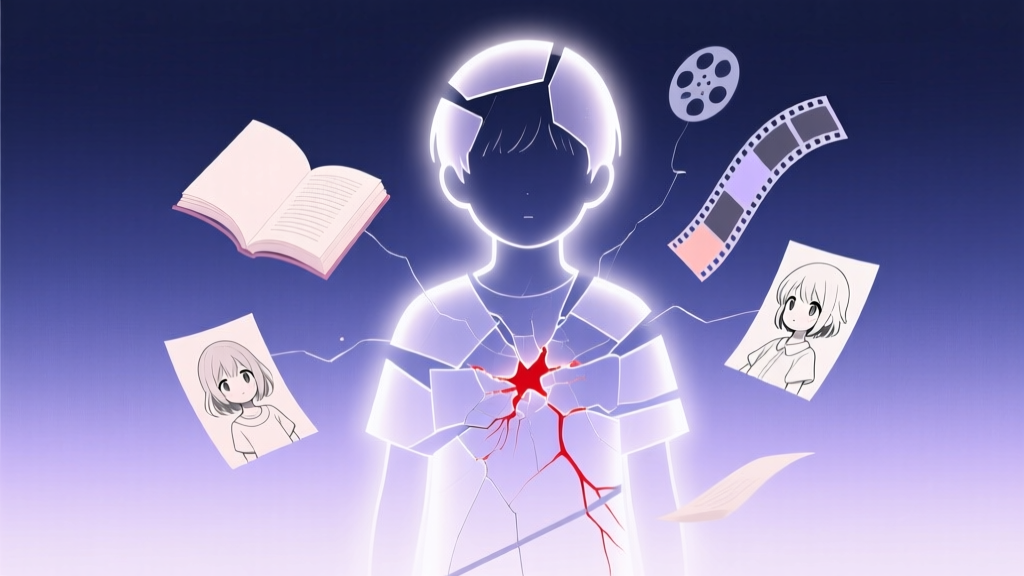
INFJ Childhood Archetype in Stories
The INFJ personality type — often dubbed “The Advocate” or “The Counselor” — is the rarest of the 16 Myers-Briggs types, comprising just 1–2% of the global population. Yet in fiction, INFJs appear disproportionately as pivotal, morally anchored figures whose emotional depth and intuitive foresight drive narrative transformation. What’s especially compelling — and underexplored — is how these characters are introduced not as fully formed adults, but as children shaped by early sensitivity, precocious insight, and quiet suffering.
In storytelling, the INFJ child archetype rarely fits the ‘golden child’ or ‘rebellious teen’ mold. Instead, they emerge as observers before participants: the girl who notices her father’s unspoken grief before anyone else speaks of it; the boy who draws prophetic sketches no one understands until years later; the orphan who comforts others while concealing their own terror. Their childhoods are rarely idyllic — nor are they defined solely by victimhood. Rather, INFJ origin stories hinge on a paradox: profound empathy forged in isolation, moral clarity born from early disillusionment, and visionary idealism rooted in deep personal wounding.
This archetype operates through what Jungian analyst John Beebe calls the “Heroic Introverted Intuition” function — an inner compass that perceives patterns, meanings, and future possibilities long before external evidence confirms them. In children, this manifests as uncanny perceptiveness, early moral questioning (“Why do grown-ups lie to protect themselves?”), and an instinctive aversion to hypocrisy. Unlike ESTPs or ESFPs — whose childhood portrayals emphasize action, spontaneity, or charm — INFJ children are defined by interiority, resonance, and relational attunement so acute it borders on psychic.
Consider how Pixar’s Soul (2020) introduces 12-year-old Connie — a quiet, observant student who chooses jazz over popularity, listens intently to Joe Gardner’s offhand wisdom, and recognizes his existential despair before he names it. She isn’t loud or plot-driving, yet her presence crystallizes the film’s core theme: meaning isn’t found in achievement, but in presence — a distinctly INFJ insight. Similarly, in My Neighbor Totoro, 4-year-old Mei doesn’t speak much, but her intuitive bond with the spirit world — her immediate trust in Totoro, her silent understanding of her mother’s illness — reflects an INFJ child’s capacity to hold mystery, sorrow, and wonder simultaneously.
What distinguishes the INFJ child from other intuitive types (e.g., INFP or INTJ) is the *combination* of dominant Introverted Intuition (Ni) with auxiliary Extraverted Feeling (Fe). This means their inner visions are inseparable from ethical concern for others. They don’t just foresee outcomes — they feel the emotional weight of those outcomes on people. As clinical psychologist Dr. Linda G. Berens explains in Understanding Yourself and Others: An Introduction to the Personality Type Code, “INFJs experience their intuition as a ‘knowing’ that carries emotional urgency — not abstract speculation, but felt certainty about what must be protected, healed, or changed.”
Famous INFJ Origin Story Characters
Below are eight iconic fictional characters whose origin stories explicitly center childhood experiences consistent with INFJ cognitive dynamics — including early emotional labor, moral awakening amid chaos, and identity formation through caregiving or witnessing.
| Character | Source | Key Childhood Moment | Ni-Fe Signature Behavior | INFJ Alignment Evidence |
|---|---|---|---|---|
| Hermione Granger | Harry Potter series | At age 9, reads adult-level magical theory before receiving her letter; immediately identifies injustice in house-elf enslavement | Uses knowledge to advocate for systemic change; internalizes others’ pain as personal responsibility | Consistently prioritizes ethics over rules; develops S.P.E.W. at 13 — a Ni-driven vision of justice realized through Fe mobilization |
| Eleven (El) | Stranger Things | Age 12, escapes Hawkins Lab after years of sensory deprivation, psychic torture, and forced obedience | Sees flashes of future danger (e.g., Vecna’s gate); bonds emotionally with Mike before trusting words | Her telepathy mirrors Ni’s symbolic perception; her fierce loyalty and protective rage reflect Fe’s valuing of relational safety |
| Asuka Langley Soryu | Neon Genesis Evangelion | Age 4, witnesses mother’s neural fusion with Unit-02; internalizes abandonment as personal failure | Overcompensates with bravado to mask Ni-driven fear of irrelevance; seeks validation through Fe-aligned performance | Her breakdowns reveal Ni-Ti loop collapse; her final act — choosing connection over nihilism — affirms INFJ’s growth path |
| Marlin | Finding Nemo | Loses wife Coral and all but one egg in barracuda attack; becomes hyper-vigilant parent to Nemo | Foresees worst-case scenarios constantly; sacrifices autonomy to ensure son’s safety | His journey from fearful protector to trusting mentor mirrors INFJ’s path from Si-Fe insecurity to Ni-Fe integration |
| Korra | The Legend of Korra | At age 4, demonstrates spiritual awareness beyond peers; struggles with pressure to embody harmony | Experiences visions of past Avatars; feels collective trauma as embodied memory | Her arc — from rigid duty to compassionate self-acceptance — maps directly onto INFJ’s developmental trajectory per the Center for Applications of Psychological Type (CAPT) |
| Ender Wiggin | Ender’s Game | Age 6, selected for Battle School after demonstrating strategic empathy — he wins by understanding opponents’ fears | Intuits enemy psychology faster than commanders; feels guilt for victories that cost lives | His “speaker for the dead” vocation emerges from Ni-Fe synthesis: seeing truth + speaking it with reparative intent |
| Lyra Belacqua | His Dark Materials | Age 11, uncovers Church conspiracy while protecting Roger; lies strategically to shield others | Interprets Dust intuitively; aligns moral action with hidden cosmic truths | Her courage stems not from defiance, but from Ni-certainty about what love requires — a hallmark INFJ driver |
| Shinji Ikari | Neon Genesis Evangelion | Age 10, abandoned by father after mother’s disappearance; internalizes worthlessness as identity | Withdraws to avoid hurting others; seeks approval as proxy for existential safety | His evolution from passive compliance to self-affirmation parallels INFJ’s path from Fe-dominance to Ni integration |
Notice a recurring motif: none of these characters become heroes because they seek power, glory, or even justice in the abstract. They act because they *feel* the dissonance between reality and possibility — and cannot unfeel it. That is the Ni-Fe engine: a vision of wholeness that generates unbearable tension until acted upon.
Formative Trauma and Backstory Patterns
INFJ origin stories rarely begin with privilege — they begin with rupture. Not every INFJ character endures abuse or loss, but nearly all experience some form of early relational or existential destabilization that catalyzes their core functions. Psychologist Dario Nardi, author of Neuroscience of Personality, notes that INFJs show heightened activity in brain regions associated with empathy, autobiographical memory, and mental time travel — suggesting their neural wiring predisposes them to process early experiences with unusual depth and emotional granularity.
Three trauma-adjacent backstory patterns dominate INFJ childhood narratives:
1. The Witness Archetype
INFJ children often occupy roles where they observe family or societal dysfunction without agency to intervene — e.g., watching a parent’s addiction, enduring parental divorce with unspoken tension, or living under authoritarian regimes. Their Ni compels them to construct internal narratives explaining why things happen; their Fe drives them to absorb ambient emotions as if they were their own. In The Book Thief, 9-year-old Liesel Meminger doesn’t just see Nazi Germany — she senses its moral rot in the silence between neighbors, the tremor in her foster mother’s hands, the way words are weaponized. Her act of stealing books isn’t rebellion; it’s Ni-Fe preservation: safeguarding meaning in a world erasing it.
2. The Caregiver-Child Paradox
Many INFJ protagonists assume emotional or physical caretaking roles far beyond their years — comforting siblings, mediating parental conflict, or shielding younger peers. This isn’t mere maturity; it’s Fe operating as survival strategy. As described in Psychology Today’s analysis of empathic development, children who consistently prioritize others’ needs before their own risk developing “compassion fatigue” — but also cultivate extraordinary emotional intelligence. Examples include Rue in The Hunger Games (who sings to dying Katniss), or Hiccup in How to Train Your Dragon (who heals Toothless not for conquest, but kinship).
3. The Truth-Bearer Under Duress
INFJs often face punishment or ostracism for speaking uncomfortable truths — whether exposing lies, naming injustice, or refusing performative conformity. Their Ni gives them access to systemic patterns others ignore; their Fe makes silence feel like betrayal. When 11-year-old Matilda Wormwood corrects her teacher’s math error, it’s not arrogance — it’s Ni-Fe alignment: accuracy matters because misinformation harms learning. Her subsequent retaliation (gluing her father’s hat) isn’t vengeance; it’s Fe-boundary enforcement disguised as mischief.
Crucially, these traumas aren’t presented as deficits — but as initiatory thresholds. As Jung wrote in The Archetypes and the Collective Unconscious, “There is no coming to consciousness without pain.” For INFJ characters, childhood suffering isn’t random; it’s the crucible in which their moral imagination is forged. Therapists working with INFJ clients often note that revisiting early wounds isn’t about blame — it’s about reclaiming agency over the narratives they absorbed. One evidence-based practice is “Narrative Reconstruction”: guiding clients to rewrite childhood scenes from their adult INFJ perspective — not to erase pain, but to insert compassion, context, and choice where none seemed possible.
The INFJ Child in Coming-of-Age Narratives
Coming-of-age stories offer the richest terrain for exploring INFJ development — precisely because they foreground the tension between inner knowing and external expectation. Unlike ENTPs (whose arcs celebrate intellectual rebellion) or ISTPs (whose focus is skill mastery), INFJ coming-of-age journeys revolve around voice: learning to articulate Ni insights without Fe-overextension, to set boundaries without guilt, and to lead from vision rather than obligation.
Three structural hallmarks define INFJ coming-of-age arcs:
- The Threshold Choice: A moment where the character must choose between safety (conforming to others’ needs) and authenticity (honoring their Ni vision). In Little Women, Jo March’s decision to burn her first novel — then rewrite it on her terms — embodies this pivot. Her Ni saw literary potential; her Fe feared rejection. The rebirth comes when she integrates both.
- The Mentor Mirror: INFJ protagonists rarely grow in isolation. They require mentors who reflect back their latent strength — not through praise, but through calibrated challenge. Professor McGonagall sees Hermione’s intellect and her moral rigor; Yoda recognizes Luke’s fear and his capacity for mercy. These mentors don’t teach skills — they affirm identity.
- The Integration Ritual: A symbolic act where Ni and Fe harmonize — e.g., writing a letter that tells truth with tenderness (Atticus Finch in To Kill a Mockingbird), creating art that bears witness without exploitation (Katniss’s mockingjay pin), or choosing mercy over vengeance (Jean Valjean in Les Misérables). These moments aren’t grand speeches — they’re quiet, embodied realignments.
For real-world INFJ teens and young adults, recognizing these patterns isn’t academic — it’s therapeutic. If you identify as INFJ, your coming-of-age isn’t measured by milestones (graduation, first job), but by relational sovereignty: the day you say “no” to a request that violates your values — and feel peace, not shame. The day you share a creative work without apologizing for its depth. The day you grieve a lost ideal — then build something new from its ashes.
Practical advice for INFJ youth:
- Keep a ‘Ni-Journal’: Dedicate one notebook to recording intuitive hunches — not predictions, but resonant impressions (“This person is hiding grief,” “This system is unsustainable”). Review monthly. Note which intuitions proved accurate, and what emotional data informed them. This builds Ni confidence separate from Fe validation.
- Create ‘Fe-Boundaries’: List three relationships where you chronically suppress your needs to maintain harmony. For each, draft a single sentence that states your boundary with warmth and clarity — e.g., “I love our talks, and I need to pause our calls after 8 p.m. to recharge.” Practice saying it aloud. INFJs fear hurting others; but authentic care requires sustainability.
- Seek ‘Third-Space Mentors’: Identify adults (teachers, librarians, therapists) who listen more than advise, ask questions instead of fixing, and honor your complexity. INFJs thrive where they’re seen as whole — not just “the sensitive one” or “the wise kid.”
Remember: Your childhood wasn’t preparation for adulthood — it was the first expression of your lifelong vocation: to perceive what is broken, feel its weight, and imagine — then enact — repair. That is not pathology. It is INFJ genius.
FAQ
Are INFJ children always shy or introverted?
No — though most are introverted by preference, shyness is situational, not typological. Many INFJ children display remarkable social fluency in causes they believe in (e.g., organizing school fundraisers, mediating peer conflicts). Their energy drains not from interaction itself, but from inauthentic or values-misaligned engagement. As the Truity Institute observes, “INFJ kids may be the most talkative person in the room when discussing climate justice — then retreat silently for hours afterward.”
Can trauma ‘cause’ someone to be INFJ?
No. MBTI type is considered innate and stable across the lifespan — not a response to environment. However, early adversity can accelerate or distort function development. An INFJ child raised in safety may express Ni-Fe through poetry and volunteering; one raised in instability may express it through hypervigilance and people-pleasing. Type informs *how* trauma is processed — not whether it occurs.
Why do so many INFJ characters have absent or abusive parents?
Storytelling convention favors high-stakes catalysts. Absent parents create narrative space for Ni insight to emerge unmediated by authority — and Fe development to occur through peer or communal bonds. But healthy INFJ childhoods exist: think of Anne Shirley’s nurturing adoptive parents in Anne of Green Gables, or Moana’s village elders who affirm her calling. These stories emphasize supportive scaffolding — showing how INFJ gifts flourish with encouragement, not just crucibles.
How can parents support an INFJ child without overwhelming them?
First, protect their solitude — don’t label quiet time as “withdrawal.” Second, validate their feelings without rushing to fix (“That sounds deeply unfair” vs. “Let’s solve it now”). Third, expose them to diverse moral philosophies (not just answers, but questions — e.g., “What does fairness mean when resources are scarce?”). Finally, model healthy Fe: show them how you set boundaries with kindness, admit mistakes publicly, and prioritize rest as sacred. As clinical social worker Dr. Brené Brown affirms in Rising Strong, “Vulnerability is not winning or losing; it’s having the courage to show up when you can’t control the outcome.” That is the INFJ child’s first, greatest lesson — and their lifelong superpower.