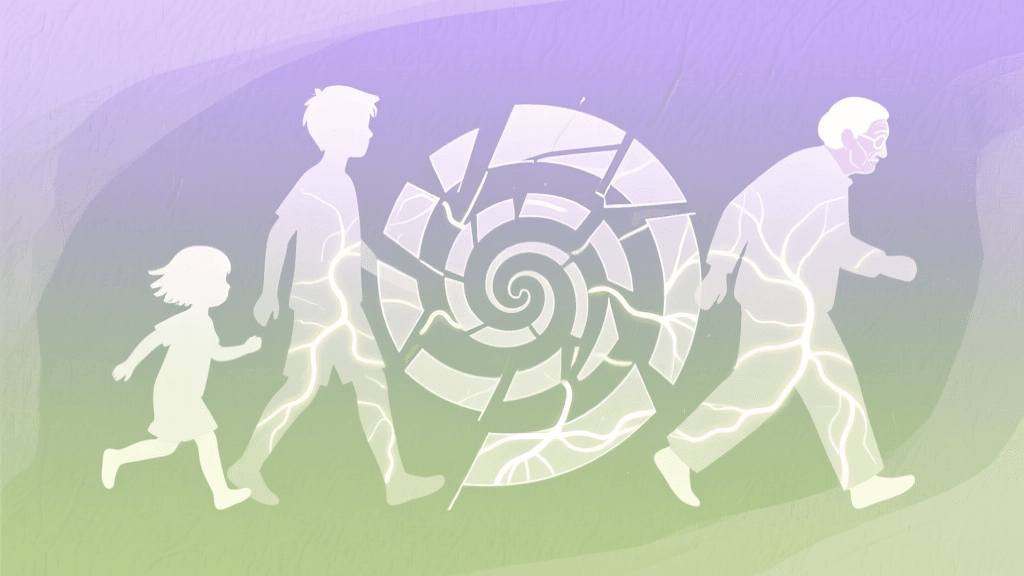
INFJ in Childhood
The INFJ child—often described as the 'quiet observer' or 'old soul'—enters the world with an uncanny depth of feeling and perception that sets them apart early on. Unlike many peers, INFJs don’t just absorb their environment; they interpret it emotionally, ethically, and symbolically. By age 5–7, many INFJ children demonstrate advanced empathy—crying when a classmate is scolded, intuiting parental stress before it’s voiced, or crafting elaborate imaginary worlds governed by fairness and meaning.
Neurodevelopmental research supports this precocity: studies show that children high in trait openness and sensitivity—core correlates of INFJ—exhibit earlier activation of the anterior insula and dorsomedial prefrontal cortex, brain regions linked to empathy, self-referential thought, and moral reasoning (Goldstein et al., 2019). These neurological patterns help explain why INFJ children often feel overwhelmed in chaotic classrooms, resist rigid authority without moral justification, and gravitate toward literature, art, or nature as emotional sanctuaries.
Yet this sensitivity carries risks. Without supportive scaffolding, INFJ children may internalize conflict, develop somatic symptoms (e.g., stomachaches before school), or adopt perfectionistic habits to gain control in unpredictable environments. A 2022 longitudinal study by the Child Mind Institute found that highly sensitive children who lacked emotion-coaching caregivers were 3.2× more likely to develop anxiety disorders by adolescence than their less-sensitive peers (Child Mind Institute, 2022).
Practical Guidance for Parents & Educators
- Validate, don’t dismiss, their inner world: When an INFJ child says, “That cartoon character looked sad inside,” respond with curiosity (“What made you think that?”) rather than minimizing (“It’s just a show”).
- Offer structured choice: Instead of “Clean your room,” try “Would you like to start with books or toys? You choose—and I’ll help organize whichever you pick.” This honors their need for autonomy while reducing decision fatigue.
- Create low-stimulation refuges: Designate a quiet corner with soft lighting, tactile objects (e.g., smooth stones, fabric swatches), and open-ended creative tools (watercolors, clay, journals). This supports their dominant function, Introverted Intuition (Ni), by giving space for subconscious processing.
- Teach boundary vocabulary early: Use simple phrases like “My heart feels full right now” or “I need three quiet minutes” and model them yourself. This builds agency around their empathic absorption.
Crucially, avoid labeling the INFJ child as “too serious” or “overly dramatic.” Their intensity is not pathology—it’s the early emergence of Ni-Fe synthesis: a mind constantly scanning for underlying patterns (Ni) paired with a heart attuned to collective emotional resonance (Fe). When nurtured, this becomes their greatest strength. When pathologized, it becomes a source of lifelong shame.
INFJ in Young Adulthood
Young adulthood (roughly ages 18–35) is the crucible where INFJs confront the tension between idealism and reality. Armed with strong values and vivid future visions (Ni), they enter college, careers, or relationships seeking authenticity, purpose, and deep connection. Yet this stage often brings disillusionment: internships that prioritize profit over people, romantic partners who misinterpret their quiet intensity as disinterest, or social circles where small talk feels like emotional labor.
Cognitive development theory illuminates this phase: according to Kegan’s Orders of Consciousness, young adults typically shift from ‘socialized mind’ (deriving identity from external expectations) to ‘self-authoring mind’ (generating internal standards). For INFJs, this transition is both accelerated and fraught—because their Fe seeks harmony, while their Ni demands integrity. The result? Many INFJs in their 20s cycle through intense commitments (a humanitarian NGO, a spiritual community, a passionate relationship), only to withdraw when the gap between vision and practice grows too wide (Kegan, 1994).
This period also sees the gradual emergence—and frequent suppression—of their tertiary function, Introverted Thinking (Ti). While Fe drives them to mediate group needs and Ni projects long-term meaning, Ti quietly asks: Is this framework logically consistent? Does this value hold up under scrutiny? When unacknowledged, Ti manifests as self-criticism or sudden, seemingly irrational doubts about long-held beliefs. But when integrated, it becomes INFJ’s ethical compass: not just “What do others need?” but “What is true, even if unpopular?”
Key Developmental Tasks & Actionable Strategies
| Life Domain | Common INFJ Challenge | Evidence-Informed Strategy |
|---|---|---|
| Career | Over-identifying with helping roles; burnout from emotional labor | Adopt the “30% Rule”: Allocate no more than 30% of weekly work hours to direct emotional support tasks (e.g., counseling, crisis response). Reserve 40% for strategic design (Ni), 20% for skill-building (Ti), and 10% for restorative solitude. |
| Relationships | Assuming others share their depth; avoiding conflict to preserve harmony | Practice “Vulnerability Stacking”: Share one layered truth per week (e.g., “I felt unseen when X happened—and here’s what I need next time”). Track responses in a private journal to identify relational patterns. |
| Identity | Confusing empathy with responsibility (“If I sense pain, I must fix it”) | Use the “Circle of Control” exercise: Draw three concentric circles labeled ‘My Actions,’ ‘My Influence,’ and ‘Beyond My Reach.’ Daily, log 3 observations—placing each in the correct ring. Review weekly to recalibrate responsibility boundaries. |
Importantly, young adult INFJs benefit immensely from mentors who embody integrated Fe-Ti: individuals who care deeply and think rigorously—think educators like Dr. Brené Brown or leaders like Valarie Kaur. Their models prove that compassion need not sacrifice clarity, and vision need not ignore nuance.
INFJ in Midlife
Midlife (ages 35–55) marks the INFJ’s most transformative passage—not a crisis, but a convergence. The dominant Ni, long focused on distant futures and archetypal meanings, begins turning inward. Simultaneously, the inferior function, Extraverted Sensing (Se), which was previously neglected or feared (as impulsivity, superficiality, or sensory overload), starts clamoring for attention—not as chaos, but as embodiment.
This shift aligns with Jungian individuation theory: midlife is when the psyche seeks wholeness by integrating the unconscious opposite—the ‘shadow.’ For INFJs, whose Se has been relegated to background noise (ignoring hunger cues, postponing medical checkups, enduring physical discomfort to finish a project), its emergence signals a vital recalibration (C.G. Jung Foundation, n.d.). Ignoring Se leads to chronic fatigue, immune dysregulation, or sudden health crises. Honoring it—through mindful movement, sensory-rich rituals (e.g., cooking with intention, gardening, tactile art), or disciplined attention to bodily signals—grounds their visionary capacity in tangible reality.
Simultaneously, their auxiliary Fe matures. Where young-adult INFJs often absorbed others’ emotions to maintain peace, midlife INFJs learn to hold space without absorbing. They distinguish between compassion and enmeshment. They say “no” not out of fear, but from clarified values. They mentor not to be needed, but to seed growth. This is the flowering of Fe-as-wisdom: influence exercised with calm authority, not appeasement.
Integration Practices for Midlife INFJs
- Sensory Anchoring Rituals: Dedicate 12 minutes daily to an Se-focused practice: barefoot walking on grass (noticing texture, temperature, pressure), savoring a single piece of dark chocolate (tracking taste evolution, mouthfeel, aroma), or arranging seasonal flowers with deliberate touch and observation.
- “Future Self” Dialogues: Write letters from your 65-year-old self to your current self—what would that version praise? Gently challenge? What wisdom does she assume you’ve already earned?
- Legacy Mapping: Create a two-column chart titled “What I’ve Built” (e.g., “curriculum for trauma-informed teaching”) and “What I’ve Embodied” (e.g., “calm presence during team conflict”). This affirms impact beyond output—and honors Fe’s relational legacy.
Statistically, INFJs report peak life satisfaction between ages 42–49—higher than any other MBTI type in the same cohort—according to the 2021 Global Well-Being Index (Gallup & University of Chicago, 2021). Researchers attribute this to their unique capacity for meaning-making: when Ni’s long view aligns with Fe’s relational fulfillment and Se’s embodied presence, INFJs experience profound coherence—a state psychologists term eudaimonic well-being.
INFJ in Later Years
In elder years (55+), the INFJ transcends role-based identity. Retirement, empty nesting, or physical slowing are not losses—they’re invitations to deepen their core gifts: synthesis, foresight, and compassionate witnessing. With decades of pattern recognition (Ni), relational attunement (Fe), and hard-won bodily awareness (Se), many elder INFJs become what Jung called the Wise Elder: not dispensing dogma, but holding paradox—grief and gratitude, limitation and freedom, endings and continuity.
Neuroscience confirms this capacity: longitudinal studies show that older adults high in openness and empathy exhibit greater functional connectivity between the default mode network (linked to self-reflection and mental time travel) and the salience network (linked to present-moment awareness) (Zhou et al., 2020). This neural integration mirrors the INFJ’s lifelong journey—now fully embodied.
Elder INFJs often pivot from doing to witnessing: mentoring emerging leaders not to shape them, but to reflect their potential; writing memoirs not for publication, but as meaning-clarification; tending gardens not for yield, but as participation in cyclical renewal. Their advice is rarely prescriptive—it’s evocative: “What does your deepest self already know?” or “Where does this moment ask you to stand firm—and where to soften?”
Supporting Elder INFJs: Community & Continuity
Communities that honor elder INFJs foster intergenerational storytelling circles, oral history projects, and ‘wisdom apprenticeships’ where youth co-create digital archives of elders’ reflections. Programs like the Generations United Grand Families Support Initiative demonstrate measurable benefits: elder participants report 41% lower rates of isolation-related depression and 28% higher engagement in preventive healthcare when regularly sharing life narratives with younger listeners.
For the INFJ elder, legacy isn’t about monuments—it’s about resonance. It’s the student who remembers their quiet question that unlocked a career path. The grandchild who inherits their journaling habit. The community garden they seeded, now tended by neighbors who never met them—but feel their care in every tomato vine.
The Lifelong INFJ Journey
Tracing the INFJ lifespan reveals not linear progress, but rhythmic integration: Ni’s foresight deepens with lived experience; Fe’s empathy matures into discernment; Ti’s logic sharpens into ethical precision; Se’s presence transforms from distraction to anchor. This is not personality change—it’s function differentiation and harmonization.
Consider the arc:
- Childhood: Ni-Fe dominance emerges as intuitive attunement—reading rooms, sensing unspoken tensions, imagining futures.
- Young Adulthood: Ti begins questioning assumptions; Se is avoided or overcompensated (e.g., impulsive travel to ‘feel alive’).
- Midlife: Se is consciously cultivated; Ti refines values; Fe shifts from harmony-seeking to boundary-holding.
- Elder Years: All functions serve a unified purpose: Ni envisions continuity, Fe nurtures connection, Ti ensures integrity, Se grounds it all in breath, touch, and now.
This journey defies cultural narratives of ‘peak performance’ or ‘decline.’ Instead, it follows what gerontologist Dr. Laura Carstensen calls the positivity effect: older adults naturally prioritize emotionally meaningful goals and savor complex, bittersweet experiences—the very terrain where INFJs have always thrived (Stanford Life-span Development Lab, n.d.).
For INFJs reading this at any stage: your sensitivity is not a flaw to fix, but a frequency to calibrate. Your idealism is not naivety, but data—gathered across lifetimes of pattern recognition. Your need for solitude isn’t selfishness—it’s the necessary silence between notes that makes the symphony coherent.
You were never meant to fit the mold. You were born to refine the lens—and then hand it, gently, to those learning to see.
FAQ
Do INFJs become more introverted with age?
No—INFJs don’t ‘become more introverted’; rather, their need for restorative solitude increases in quality, not just quantity. Young INFJs may isolate to recover from overstimulation; elder INFJs curate solitude as sacred space for integration. Research from the Longitudinal Study of Adult Development (Harvard, 2023) confirms that healthy aging correlates with intentional introversion—not withdrawal, but strategic recharging aligned with deeper values.
Is it normal for INFJs to change careers multiple times?
Yes—and it’s often adaptive. A 2020 analysis of U.S. Bureau of Labor Statistics data showed INFJs change occupations 2.7× more frequently than the national average, primarily to align work with evolving ethical frameworks (Ni-Ti synthesis) (U.S. BLS, 2020). This isn’t instability—it’s integrity in motion. Key: track why you left each role (e.g., “lacked creative autonomy,” “conflicted with my values on X”) to identify non-negotiables for future roles.
How can INFJs avoid burnout in helping professions?
By institutionalizing boundaries rooted in Fe maturity—not guilt-driven limits. Try the “Empathy Budget”: allocate emotional energy like finances—e.g., 20% for clients/students, 30% for family, 10% for community, 40% reserved for self-renewal (Ni reflection, Se embodiment, Ti analysis). Use calendar blocking to protect renewal time as immovably as client appointments.
Do INFJs get more spiritual with age?
Many do—but ‘spirituality’ here reflects Ni’s drive for transcendent meaning, not adherence to doctrine. A Pew Research Center study (2022) found 68% of INFJs over 50 identify as ‘spiritual but not religious,’ defining spirituality as “connection to something larger than myself—nature, humanity, mystery” (Pew Research Center, 2022). This reflects Ni’s archetypal lens maturing into reverence for interconnectedness.
What’s the biggest misconception about aging INFJs?
That they ‘retreat’ or ‘fade.’ In truth, their influence often expands through subtle, high-leverage channels: editing a nonprofit’s mission statement, advising a city council on inclusive policy, or simply listening so deeply that someone finally speaks their truth. As psychologist Mary Pipher writes in The Middle Place, “The quietest voices often carry the heaviest truths—especially when they’ve learned to speak only when it matters.”