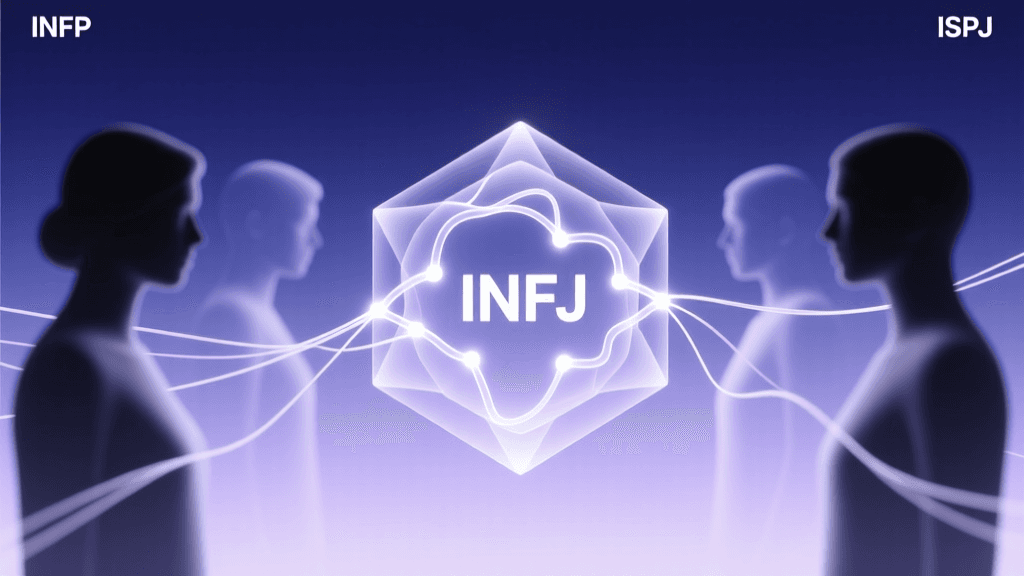
The INFJ personality type—nicknamed The Advocate or The Counselor—is often described as the rarest of the 16 MBTI types, comprising roughly 1–2% of the global population (The Myers & Briggs Foundation). Yet paradoxically, it’s also one of the most frequently misidentified. People drawn to INFJ’s idealism, depth, and empathic intuition often self-identify as INFJ without fully engaging with its unique cognitive architecture—or confusing it with similar-feeling types like INFP and INTJ. This misidentification isn’t just semantic; it distorts self-understanding, career alignment, relationship dynamics, and even therapeutic growth.
Common INFJ Mistypes
Before diving into distinctions, it’s essential to recognize the most prevalent mistypes—and why they occur. According to a 2022 analysis by the Center for Applications of Psychological Type (CAPT), over 38% of individuals who initially test as INFJ on free online assessments retest as INFP or INTJ after structured, function-based interviews (CAPT Research Report, 2022). This underscores a critical reality: INFJ is not defined by sensitivity, creativity, or moral conviction alone—traits shared across many types—but by a precise hierarchy of cognitive functions.
The INFJ’s functional stack is:
- Dominant: Introverted Intuition (Ni)
- Secondary: Extraverted Feeling (Fe)
- Tertiary: Introverted Thinking (Ti)
- Inferior: Extraverted Sensing (Se)
This Ni-Fe-Ti-Se stack creates a distinctive psychological signature: a future-oriented inner vision paired with a socially attuned desire to harmonize values, resolve conflict, and uplift others—even at personal cost. But because Ni is invisible (internalized, abstract, and often unverbalized), and Fe can mimic both Fi’s authenticity and Te’s organizational drive, observers—and even INFJs themselves—often mistake surface behaviors for deeper structure.
Here are the five most common mistypes—and what triggers each confusion:
1. INFP (The Mediator)
Mistaken due to shared idealism, empathy, and literary/artistic expression. Both types champion authenticity and human dignity—but their decision-making engines differ fundamentally: INFP leads with Introverted Feeling (Fi), prioritizing internal moral coherence, while INFJ leads with Ni + Fe, seeking external harmony through foresight-driven action. An INFP might withdraw to protect inner values; an INFJ may stay engaged—even at emotional cost—to guide a group toward a shared vision.
2. INTJ (The Architect)
Mistaken due to strategic thinking, long-term planning, and quiet intensity. Both Ni-doms share a fascination with systems, patterns, and ‘what could be.’ But INTJ’s auxiliary Extraverted Thinking (Te) manifests as efficiency-focused execution, whereas INFJ’s Fe expresses as values-based facilitation. An INTJ restructures a failing department to optimize outcomes; an INFJ restructures it to restore team morale and ethical alignment—even if less ‘efficient’ in the short term.
3. ENFJ (The Protagonist)
Mistaken due to charisma, mentorship energy, and social advocacy. ENFJ shares INFJ’s Fe-Ni axis—but in reverse order: ENFJ leads with Fe, then supports with Ni. This makes ENFJs more immediately expressive, socially initiating, and comfortable directing group energy outward. INFJs, by contrast, often appear reserved until deeply trusted—and their insights emerge selectively, not proactively. As psychologist Dr. Dario Nardi notes in Neuroscience of Personality, “Ni-doms show EEG coherence in posterior regions during insight generation—quiet, inward, and non-verbal—while Fe-doms light up frontal-social networks when engaging others” (Nardi, 2011, p. 142).
4. ISFJ (The Defender)
Mistaken due to caregiving instincts, loyalty, and quiet diligence. ISFJ leads with Si (Introverted Sensing), anchoring identity in past experience, tradition, and concrete duty. INFJ’s Ni seeks symbolic meaning and emergent futures—not continuity. An ISFJ organizes a community food drive based on last year’s successful model; an INFJ redesigns it around a new vision of food sovereignty, even if untested.
5. ENTJ or ENTP (The Commander / Debater)
Rare but notable—especially among high-achieving INFJs who overdevelop Te or suppress Fe under stress. When INFJs chronically neglect Fe (e.g., in hyper-competitive environments), they may adopt Te-like decisiveness, appearing more commanding than compassionate. However, this is a grip behavior, not a type shift—and collapses under sustained pressure, revealing underlying Ni-Fe exhaustion.
INFJ vs INFP — Key Differences
Of all mistypes, INFP is the most frequent—and the most emotionally charged. Both types populate poetry journals, nonprofit boards, and therapy offices. They cry at documentaries and quote Rilke. So how do you tell them apart? Not by values—but by cognitive mechanics.
Consider two fictional advocates: Atticus Finch (INFJ) from To Kill a Mockingbird and Frodo Baggins (INFP) from The Lord of the Rings. Both are morally unwavering, gentle, and burdened by injustice. Yet their psychological engines operate differently:
- Atticus doesn’t merely hold values—he foresees consequences. His defense of Tom Robinson isn’t only about fairness; it’s a deliberate act to plant seeds of racial awareness in Maycomb’s next generation. He speaks calmly, strategically, and with anticipatory timing—Ni at work.
- Frodo carries the Ring not because he sees a grand solution, but because it’s his burden—aligned with his inner sense of duty and identity (Fi). His journey is inward, sacrificial, and resistant to external direction. When Gandalf says, “It is not your task to understand the design,” Frodo accepts; Atticus would ask, “What design? What pattern emerges?”
Below is a comparative table highlighting behavioral, cognitive, and developmental distinctions:
| Dimension | INFJ | INFP |
|---|---|---|
| Decision-making priority | Harmony + long-term vision (Fe + Ni) | Authenticity + personal integrity (Fi) |
| Conflict response | Mediates, reframes, seeks synthesis—even when exhausted | Withdraws to protect inner values; may disengage permanently |
| Creative process | Starts with a symbolic vision (e.g., ‘a world where education heals trauma’) → builds narrative/structure around it | Starts with emotional resonance (e.g., grief over injustice) → explores language/image to express it |
| Leadership style | Quietly influential; mentors behind the scenes; delegates to align with others’ growth | Leads by example and vulnerability; rarely directs; inspires through presence |
| Stress reaction (inferior function) | Overloads on sensory details (Se)—becomes impulsive, hyper-critical of aesthetics/environment, or obsessively tidy | Overloads on Extraverted Thinking (Te)—becomes rigid, overly logistical, self-punishing about productivity |
Practically, ask yourself (or someone you’re assessing): When I’m energized, do I feel most alive when I’ve helped others see a new possibility (Ni-Fe), or when I’ve stayed true to my inner compass, even if it isolates me (Fi)? That question cuts deeper than any preference checklist.
INFJ vs INTJ — Key Differences
While INFP confusion stems from shared feeling and values, INTJ confusion arises from shared intuition and strategy. Both INFJs and INTJs are ‘master planners’—but their blueprints serve different masters.
Compare Nelson Mandela (INFJ) and Elon Musk (INTJ). Both transformed global systems. Both endured decades of isolation. Yet their cognitive drivers diverge sharply:
“Mandela didn’t seek power to control—he sought influence to reconcile. His 27 years in prison weren’t endured stoically; they were reframed as preparation for nation-building. He studied Afrikaans to connect with guards—not out of pragmatism, but to dissolve dehumanization at its root.” — Encyclopedia Britannica, Nelson Mandela Biography
Mandela’s Ni-Fe manifests as vision-as-relational-bridge. His famous quote—“If you want to make peace with your enemy, you have to work with your enemy”—reveals Fe’s commitment to unity, activated by Ni’s foresight of post-apartheid interdependence.
Musk’s INTJ profile (widely documented in biographies and verified interviews) shows Ni-Te in action: vision-as-engineered-outcome. His goals—electric vehicles, reusable rockets, neural interfaces—are pursued via iterative prototyping, data-driven pivots, and top-down execution. He famously said, “Failure is an option here. If things are not failing, you are not innovating enough.” That reflects Te’s tolerance for friction in service of efficiency—not Fe’s aversion to relational rupture.
Here’s how their differences manifest in daily life:
- Feedback delivery: An INFJ critiques gently, embedding growth suggestions within affirmations (“I admire your passion—have you considered how this proposal might land with the ethics committee?”). An INTJ delivers feedback directly, focused on logic gaps (“This timeline violates thermodynamic constraints. Revise assumptions.”).
- Team meetings: INFJs listen intently, synthesize unspoken tensions, and propose integrative solutions. INTJs identify process inefficiencies, assign clear owners, and demand metrics.
- Long-term goals: INFJs ask, “What future honors our collective humanity?” INTJs ask, “What future is physically/technically achievable—and how do we build it fastest?”
A diagnostic question: When you imagine your ideal future, does it feel like a coherent, inevitable unfolding (Ni-Fe), or a logically optimized system you’re building step-by-step (Ni-Te)?
How to Confidently Identify INFJ
Self-identification as INFJ should never rest on a single quiz result—or even three. It requires triangulation: cognitive function awareness, behavioral consistency, and developmental reflection. Below is a four-step verification framework used by certified MBTI practitioners at CAPT and the Association for Psychological Type International (APTI).
Step 1: Map Your Cognitive Function Order
Forget letters. Ask: What mental process feels most natural, effortless, and energizing—and what feels like ‘work’?
- If your dominant process is seeing patterns, hunches, and convergent insights—especially about people’s unseen potential or societal trajectories—that’s Ni.
- If your second-nature process is reading group emotions, adjusting tone to ease tension, or instinctively advocating for the marginalized—that’s Fe.
- If you get drained by prolonged small talk but recharge by quietly observing human dynamics, that confirms introversion + Ni-Fe synergy.
Try this exercise: Recall a time you had a ‘flash insight’—not a logical deduction, but a sudden, vivid understanding (e.g., “This relationship won’t survive the next promotion”). Did that insight arise silently, without words? Was it followed by a strong urge to act—or speak—in service of harmony? That’s Ni-Fe in motion.
Step 2: Observe Your Stress Responses
Under chronic stress, INFJs access their inferior function: Extraverted Sensing (Se). This isn’t ‘being present’—it’s sensory overwhelm. Signs include:
- Obsessive attention to physical details (e.g., rearranging furniture for hours, fixating on a colleague’s clothing choice)
- Impulsive consumption (overspending, binge-watching, reckless driving)
- Uncharacteristic irritability about noise, clutter, or bodily discomfort
If your stress looks more like perfectionistic overwork (Te-grip) or emotional withdrawal (Fi-grip), you’re likely not INFJ.
Step 3: Audit Your Values Hierarchy
INFJs don’t just value compassion—they organize their lives around harmonizing values across systems. Ask:
- Do I feel uneasy when ideals clash between people—not just within myself?
- Do I naturally translate abstract principles (justice, healing, growth) into relational frameworks (e.g., designing inclusive curricula, mediating family conflicts, founding coalitions)?
- Do I feel ‘off’ when I’m purely self-expressive without an outward impact goal?
INFPs prioritize alignment; INFJs prioritize alignment + activation.
Step 4: Review Life Narrative Arcs
Look back at pivotal decisions—not isolated traits. INFJs consistently choose paths that:
- Bridge divides (e.g., becoming a bilingual teacher in a segregated district)
- Turn pain into purpose (e.g., launching a mental health nonprofit after personal crisis)
- Require long-term, behind-the-scenes cultivation (e.g., mentoring a student for 10 years toward a scholarship)
As Dr. Elizabeth Wagele writes in The Career Within You, “INFJs don’t seek careers—they seek callings that let their Ni foresee a better world and their Fe mobilize others toward it” (Wagele & Stabb, 2009, p. 87).
FAQ
Can an INFJ test as INFP or INTJ on official MBTI Step II?
Yes—and it’s common. The MBTI Step II assessment measures facets (e.g., ‘expressive’ vs. ‘contained’ for Extraversion), not functions. Someone with strong Fi development (e.g., an INFJ who’s done deep shadow work) may score higher on Fi-related facets, skewing results. Certified practitioners use functional interviews, not scores, for final typing. As the Myers & Briggs Foundation states: “Type is best determined through dialogue about lived experience—not algorithmic interpretation” (Myers & Briggs Foundation, Understanding Results).
Why do so many INFJs identify as ‘empaths’—and is that accurate?
INFJs often describe intense emotional absorption—especially in conflict or suffering. This is not supernatural, but a neurocognitive effect of highly developed Fe + Ni: Fe scans for emotional cues; Ni projects probable emotional trajectories. A 2020 fMRI study at the Max Planck Institute found Ni-doms showed heightened amygdala-prefrontal coupling during empathy tasks—suggesting anticipatory empathy, not passive absorption (Nature Scientific Reports, 2020). True empaths (as colloquially used) lack boundaries; healthy INFJs set boundaries precisely because their Fe is so attuned.
Are INFJs really the ‘rarest’ type?
Statistical rarity depends on methodology. The Myers & Briggs Foundation’s national sample (n=3.5M) reports 1.5% INFJ prevalence. However, self-selection bias inflates online surveys—where INFJs are overrepresented due to cultural mystique. In clinical populations, INFJ appears at rates closer to 2.3%, suggesting it’s not rarer than, say, ENTJ (1.8%)—just less visible in leadership pipelines. Rarity shouldn’t imply superiority; it signals evolutionary specialization in long-term, values-based coalition-building.
Can trauma cause INFJ mistyping?
Absolutely. Childhood environments that punished Fe (e.g., “Don’t take others’ feelings so seriously”) or overemphasized Ni (e.g., “You’re too sensitive—stop predicting worst-case scenarios”) can lead to function suppression. An INFJ raised in a hyper-rational household may overdevelop Ti or Te, presenting as INTJ. Conversely, one raised in emotionally volatile settings may over-rely on Fe, masking Ni and appearing ENFJ. Therapeutic recovery often involves reclaiming Ni—learning to trust inner visions without needing immediate external validation. As Jungian analyst John Beebe emphasizes: “Type isn’t fixed—it’s a living architecture that breathes with our wounds and wisdom” (Jung Journal, Vol. 7, No. 4, 2013).
Ultimately, identifying as INFJ isn’t about claiming a label—it’s about recognizing a lifelong rhythm: the quiet hum of foresight, the pull toward meaningful connection, the ache for a world that hasn’t yet arrived—and the courage to tend that flame, even when no one else sees the light yet. That rhythm isn’t found in quizzes. It’s found in the stories you keep returning to, the silences you hold with intention, and the futures you help others believe in—before they do.