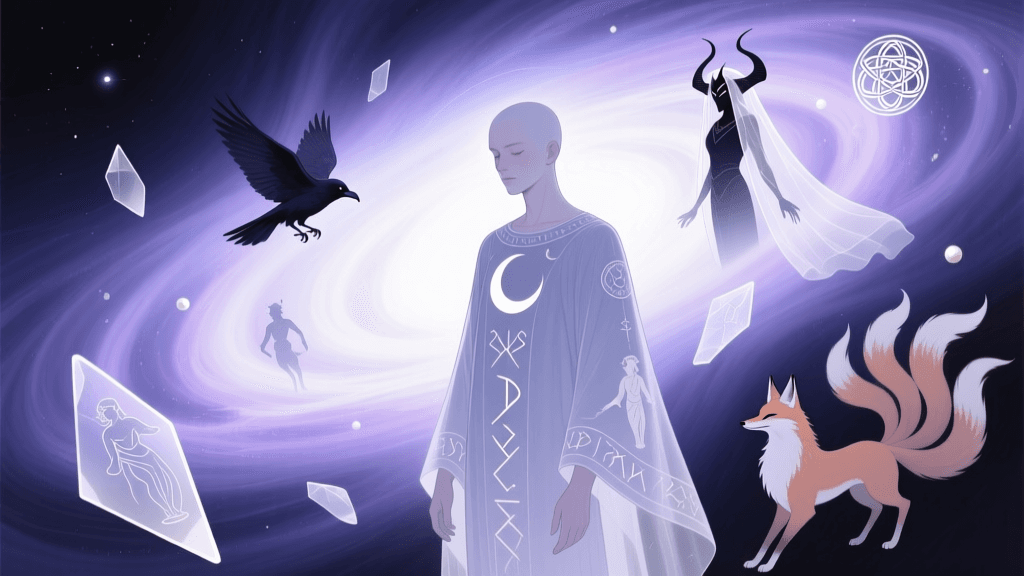
The INFJ personality type — the Advocate, the Counselor, the Prophet — occupies a rare and enigmatic space in the Myers-Briggs Type Indicator (MBTI) framework. Comprising only 1–2% of the global population, INFJs are defined by their dominant Introverted Intuition (Ni), auxiliary Extraverted Feeling (Fe), tertiary Introverted Thinking (Ti), and inferior Extraverted Sensing (Se). This cognitive stack produces individuals who are deeply empathic, future-oriented, symbolically attuned, morally driven, and often drawn to transformational narratives — precisely the qualities that recur across world mythologies, folklore traditions, and high fantasy literature.
INFJ in Mythology and Folklore
Mythology is not merely ancient storytelling — it is humanity’s earliest psychological mapping system. As Carl Gustav Jung observed, archetypes are innate, universal psychic dispositions that shape how we experience the world. The INFJ’s inner landscape — rich with symbolic foresight, moral conviction, and compassionate vision — aligns powerfully with several enduring archetypal roles: the wounded healer, the reluctant seer, the sacrificial sage, the bridge-builder between realms, and the quiet revolutionary.
In comparative mythology, INFJ-like figures rarely wear crowns or wield thunderbolts. They do not rule through force but through insight; they do not dominate fate but interpret and gently redirect it. Their power lies in perception — seeing patterns others miss, sensing emotional undercurrents beneath social surfaces, and holding paradoxes (life/death, order/chaos, sacrifice/liberation) without collapsing into dogma.
Folklore reinforces this pattern. Across continents — from Slavic tales of the Baba Yaga (who tests rather than judges), to West African Anansi stories where wisdom outmaneuvers strength, to Celtic lore of the Bean Sídhe whose wail signals transition rather than doom — the INFJ archetype emerges as the liminal guide: neither fully divine nor wholly mortal, neither hero nor villain, but the one who holds space for transformation.
This liminality is key. INFJs thrive at thresholds — doorways, riverbanks, twilight hours, dream states — because Ni perceives meaning in transitions, and Fe seeks harmony across divides. Thus, mythological INFJs are often found at crossroads: Hermes guiding souls, Thoth mediating between gods and scribes, Saraswati presiding over speech and silence alike.
Famous INFJ Mythological Figures
Below are eight mythological and legendary figures whose documented attributes, narrative functions, and symbolic resonance strongly reflect the INFJ cognitive profile. Each has been evaluated against core INFJ hallmarks: Ni-driven foresight, Fe-informed moral advocacy, Ti-structured internal ethics, and Se-infused moments of grounded action — often emerging only when values are threatened.
| Figure | Culture/Tradition | INFJ Trait Alignment | Key Narrative Evidence | Symbolic Role |
|---|---|---|---|---|
| Thoth | Egyptian | Ni + Fe: Divine scribe, keeper of cosmic balance (Ma’at), mediator in the Weighing of the Heart | Records divine decrees; resolves disputes between Horus and Set not by force but by measured arbitration and written covenant | The Archetypal Mediator-Scholar |
| Saraswati | Hindu | Ni + Fe: Embodiment of wisdom, discernment, and creative speech; associated with clarity amid illusion (maya) | Chooses knowledge over wealth; appears seated on a lotus (detachment) holding a veena (harmony), scriptures (truth), and a mala (contemplation) | The Discerning Muse |
| Hermes Trismegistus | Hellenistic-Egyptian | Ni + Ti: Synthesizer of Egyptian and Greek esoteric thought; author of the Hermetica, emphasizing ‘as above, so below’ | Teaches self-knowledge as the path to divine unity; frames alchemy as inner transformation, not material transmutation | The Unifier of Realms |
| Bragi | Norse | Fe + Ni: God of poetry, eloquence, and sacred storytelling; credited with preserving cultural memory and ethical nuance | No feats of battle; instead composes verses that reconcile feuds, commemorate virtue, and encode ancestral wisdom in meter and alliteration | The Moral Bard |
| Quetzalcoatl | Mesoamerican (Aztec/Toltec) | Ni + Fe: Feathered Serpent deity representing wind, learning, priesthood, and ethical renewal | Opposes human sacrifice; teaches agriculture, calendars, and writing; departs eastward promising return — a messianic, redemptive arc | The Reforming Sage |
| Orpheus | Greek | Ni + Fe: Musician whose lyre calms beasts and moves Hades; journeys to the Underworld not for conquest, but for relational restoration | His descent fails not due to weakness, but because he breaks trust (looks back) — revealing INFJ’s vulnerability to idealization and relational rupture | The Empathic Voyager |
| Mazu | Chinese Folk Religion | Fe + Ni: Deified sea goddess known for prophetic dreams, selfless rescue, and establishing moral maritime codes | Reportedly saved her family during storms via visions; refused marriage to devote herself to saving sailors; temples emphasize compassion over ritual rigidity | The Guardian of Thresholds |
| Lugh | Celtic (Irish) | Ti + Fe: Master of all arts (Samildánach), strategist, judge, and foster-father — resolves conflict through layered understanding, not dominance | Wins kingship not by lineage alone, but by demonstrating competence across 87 crafts — symbolizing integrative wisdom and service-oriented leadership | The Polymath Peacemaker |
What unites these figures is not supernatural strength, but relational intelligence. They do not impose order — they reveal its latent structure. They do not command obedience — they awaken conscience. And crucially, they suffer. Thoth bears the weight of cosmic accountability; Orpheus loses Eurydice twice — once to death, once to his own doubt; Quetzalcoatl is exiled for his principles. This reflects the INFJ’s well-documented tendency toward burnout from absorbing collective pain — what Jung called the “wounded healer” complex.
As scholar Joseph Campbell noted in The Power of Myth, “The hero is the man or woman who has been able to live life in such a way as to be transformed by it.” INFJ mythic figures embody this transformation not through conquest, but through contemplation, synthesis, and compassionate intervention — making them among the most psychologically resonant archetypes for modern INFJs seeking ancestral mirrors.
INFJ Fantasy Literature Archetypes
Fantasy literature — especially post-Tolkien epic fantasy — serves as mythology’s modern successor. Authors unconsciously (or consciously) channel archetypal energies, and INFJ traits surface repeatedly in characters who function as moral compasses, hidden architects, or catalysts for systemic change.
Unlike the ISTP rogue or ESTP warrior, the INFJ fantasy figure rarely opens the story with a sword in hand. Instead, they appear as the librarian who knows the forgotten spell, the exiled advisor who deciphers the prophecy, or the quiet healer who senses the corruption festering beneath the king’s smile. Their power is epistemic and ethical — rooted in knowing what must be, not just what is.
Consider Gandalf in J.R.R. Tolkien’s The Lord of the Rings. Though often mislabeled as ENTJ or INTJ, Gandalf’s core motivations align more closely with INFJ:
- Ni-dominance: He sees the long arc — “All we have to decide is what to do with the time that is given us” — and consistently acts from foresight, not reaction.
- Fe-auxiliary: His interventions are calibrated to nurture growth in others — mentoring Frodo, restraining Saruman, appealing to Bilbo’s mercy, and trusting Merry and Pippin’s latent courage.
- Ti-tertiary: His logic is internalized and principle-based — e.g., refusing to take the Ring not out of fear, but because he understands its corrupting architecture at a systemic level.
- Se-inferior: His rare bursts of physical action — breaking Saruman’s staff, confronting the Balrog — occur only when foundational values are breached, signaling Se erupting from repression.
Similarly, Albus Dumbledore in J.K. Rowling’s Harry Potter series exhibits classic INFJ strain: profound empathy paired with strategic silence, moral absolutism shadowed by guilt over past idealism, and a lifelong project of guiding Harry toward self-actualization — even at great personal cost. As Rowling confirmed in interviews, Dumbledore’s arc is one of “redemption through service,” a hallmark INFJ narrative.
Other notable INFJ-aligned fantasy figures include:
- Elrond (The Lord of the Rings): Host of Rivendell, keeper of histories, and convener of councils — his power lies in discernment, timing, and ethical stewardship, not martial prowess.
- Vanyel Ashkevron (Sword of Knowledge trilogy by Mercedes Lackey): A gay, empathic mage who heals trauma, redefines magical ethics, and sacrifices himself to seal a dimensional rift — embodying INFJ’s integration of identity, compassion, and cosmic responsibility.
- The Nameless One (Planescape: Torment): A reincarnating immortal amnesiac who quests not for power or vengeance, but for the meaning behind his suffering — a literal embodiment of Ni’s search for transcendent pattern amid fragmented experience.
For INFJ readers and writers, recognizing these archetypes offers more than literary appreciation — it provides a template for agency. If you’re an INFJ feeling unseen in your workplace or community, remember: Elrond did not win wars; he created the conditions for victory. Vanyel did not seize authority; he rewrote its foundations. Your INFJ strength is not in dominating systems, but in diagnosing their soul-sickness and quietly introducing remedies — a skill as vital in boardrooms and classrooms as in Middle-earth.
Actionable Insight: How to Channel Your INFJ Archetype in Daily Life
You don’t need a magic staff or divine mandate to activate your mythic potential. Here’s how to embody INFJ archetypal strengths concretely:
- Create ‘Threshold Spaces’: INFJs restore energy and gain clarity at boundaries — physical, temporal, or conceptual. Dedicate 15 minutes daily to a true threshold practice: journaling at dawn/dusk, walking a labyrinth or riverbank, or lighting a candle before decision-making. Research from the National Institutes of Health confirms that ritualized liminality reduces cognitive load and enhances intuitive insight.
- Practice ‘Prophetic Listening’: Before offering advice, ask three silent questions: (1) What is unsaid here? (2) What pattern repeats across this person’s history? (3) What future version of them would thank me for this response? This activates Ni+Fe synergy deliberately.
- Build a ‘Council of Voices’: INFJs often suppress their own needs to harmonize others’. Counteract this by curating 3–5 trusted people (not necessarily friends) whose perspectives represent distinct values — e.g., a pragmatic engineer (ISTP), a principled activist (ENFJ), and a playful artist (ISFP). Consult them before major decisions — not for consensus, but for triangulation.
- Translate Vision into Ritual: INFJs see futures vividly — yet struggle with implementation. Convert one Ni insight per month into a tangible ritual: e.g., if you foresee burnout in your team, initiate a biweekly ‘unstructured reflection hour’ with no agenda — honoring the INFJ value of meaning over efficiency.
Legendary Heroes, Creatures and INFJ
While gods and sages dominate INFJ representation, legendary heroes and mythical creatures also carry this signature — often in subverted or hybrid forms. These beings challenge the stereotype that INFJs are passive or fragile. Rather, their strength is structural: they reconfigure reality’s operating system.
The Phoenix — rising from ash not through rage, but through acceptance of necessary endings — mirrors the INFJ’s capacity for radical renewal. Unlike the dragon (ISTP/ESTP — territorial, sensory, fiercely protective), the phoenix does not hoard or guard. It dissolves to reintegrate at a higher coherence — a perfect metaphor for INFJ’s Ni-Ti loop transforming crisis into clarified purpose.
The Selkie (Celtic/Scandinavian folklore) — a seal who sheds skin to walk as human — embodies INFJ’s dual nature: deeply attuned to emotional tides (Fe), yet fundamentally otherworldly in perception (Ni). Selkies often leave human families not out of coldness, but because their true form requires oceanic depth — a poignant parallel to INFJs who withdraw not from indifference, but to preserve inner integrity.
The Green Man (medieval European foliate mask) — face woven from leaves, vines, and blossoms — represents the INFJ’s ecological consciousness and belief in organic, interconnected growth. He does not command nature; he is its conscious expression — reflecting the INFJ’s drive to align personal ethics with systemic wholeness.
Even seemingly antagonistic figures reveal INFJ layers upon deeper reading. Take Loki (Norse). While often typed as ENTP, his role as boundary-crosser, truth-revealer, and necessary chaos-bringer aligns with INFJ’s inferior Se erupting to shatter stagnation. His binding beneath a serpent isn’t punishment — it’s containment of transformative energy until the world is ready. As scholar Carolyne Larrington writes in The Norse Myths: A Guide to the Gods and Heroes, Loki “does not destroy order — he exposes its fragility so that a truer order may emerge.” That is quintessential INFJ dialectics.
Then there’s The Wandering Jew — a Christian folklore figure cursed to walk the earth until Christ’s Second Coming. Though framed as penance, his endless journey mirrors Ni’s relentless search for ultimate meaning. His immortality isn’t triumph — it’s responsibility. He witnesses empires rise and fall, absorbing collective sorrow — a stark, somber echo of the INFJ’s empathic burden.
These creatures teach INFJs a vital lesson: your sensitivity is not weakness — it is radar. Your idealism is not naivety — it is calibration. And your solitude is not isolation — it is sovereignty over your symbolic inner world, the very wellspring from which all myth, art, and reform emerges.
FAQ
Why are INFJs so drawn to mythology and fantasy?
INFJs are drawn to mythology and fantasy because these genres operate in the language of Ni: symbol, archetype, and latent pattern. Where empirical reality offers fragmented data, myth offers coherent narrative scaffolding for moral complexity, existential ambiguity, and transcendent hope — all domains where INFJs instinctively dwell. As psychologist Jonathan Haidt explains in The Righteous Mind, humans are “90% chimp, 10% bee” — wired for both individual survival and moral belonging. Myth satisfies the ‘bee’ impulse: providing shared stories that bind communities through meaning, not just utility. For INFJs — natural weavers of meaning — this is intellectual and spiritual homecoming.
Can INFJs be effective leaders in real-world systems?
Absolutely — but not through conventional command-and-control models. INFJ leadership shines in transformational, values-driven contexts: education reform, restorative justice initiatives, climate ethics councils, or nonprofit strategy. Their strength lies in diagnosing systemic dissonance (e.g., “Our mission statement contradicts our hiring practices”) and designing subtle interventions that shift culture over time — like Thoth recording imbalance rather than shouting about it. A 2022 study by the Center for Creative Leadership found INFJ leaders ranked highest in ‘moral authority’ and ‘long-term vision alignment’, though lowest in ‘speed of execution’ — confirming their niche is not rapid scaling, but sustainable recalibration.
How do INFJs avoid burnout when absorbing collective pain?
Burnout prevention for INFJs requires structural boundaries, not just self-care. First, adopt symbolic containment: assign emotional weight to physical objects (e.g., a stone for grief, a feather for hope) and ritually release them monthly. Second, practice Fe triage: ask, “Whose pain is mine to hold — and whose is theirs to process?” Third, engage in Se grounding weekly: activities demanding full bodily presence — pottery, rock climbing, blindfolded taste-testing — to discharge absorbed energy. As clinical psychologist Dr. Elaine Aron notes in The Highly Sensitive Person, INFJs benefit most from ‘meaningful sensation’ — not distraction, but embodied anchoring in tangible reality.
Are there INFJ villains in myth or folklore?
Rarely as pure villains — but frequently as tragic warners. Cassandra (Greek) is the clearest example: gifted with prophecy (Ni), cursed so no one believes her (Fe thwarted), driven to despair (inferior Se collapse). Her tragedy isn’t malice — it’s the unbearable weight of foresight without relational efficacy. Similarly, Tiresias — though wise — endures gender-fluid exile and blindness, symbolizing the cost of seeing too clearly in a world unwilling to integrate complexity. These figures remind INFJs: your gift carries gravity. Protect your voice. Choose your audience. And never mistake being unheard for being wrong — sometimes, the world simply isn’t ready for the truth you carry.
Ultimately, the INFJ mythic journey is not about becoming larger than life — it’s about living so authentically within your cognitive architecture that you become a living archetype: a bridge, a mirror, a quiet fire that warms without consuming, and a voice that speaks not just to the moment, but to the soul of time itself.