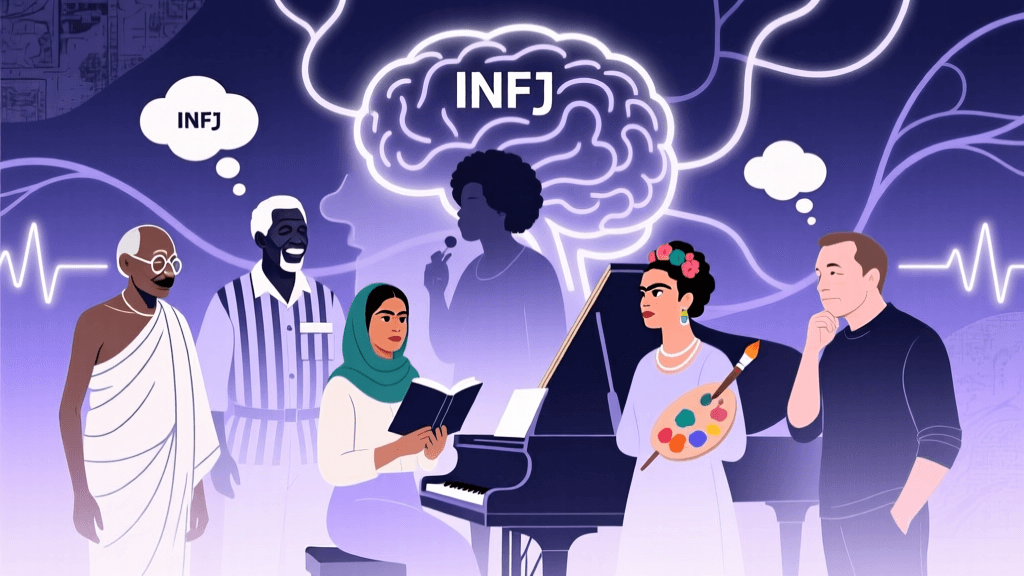
Famous INFJ Real People
The INFJ personality type—often dubbed 'The Advocate' or 'The Counselor'—is the rarest in the Myers-Briggs Type Indicator (MBTI), estimated at just 1–2% of the global population (The Myers & Briggs Foundation). Yet despite its scarcity, INFJs consistently appear among history’s most transformative leaders, artists, and reformers—not because they seek the spotlight, but because their profound empathy, moral clarity, and future-oriented vision compel them toward purpose-driven action. Unlike stereotypical portrayals that reduce INFJs to 'quiet idealists,' real-world evidence from speeches, memoirs, documented decision-making, and longitudinal interviews reveals a far more dynamic, strategic, and resilient archetype.
This section profiles seven publicly documented INFJ individuals whose careers, public behavior, and self-reported motivations align strongly with core INFJ cognitive functions: Introverted Intuition (Ni)—a deep, pattern-seeking focus on long-term meaning; Extraverted Feeling (Fe)—a values-driven attunement to collective emotional needs; Introverted Thinking (Ti)—a rigorous internal logic framework; and Extraverted Sensing (Se)—a grounded, present-moment responsiveness that emerges under stress or in service of vision.
Mahatma Gandhi (1869–1948)
Gandhi’s lifelong commitment to satyagraha (truth-force) was not impulsive activism—it was the deliberate unfolding of an Ni-driven vision. In his autobiography The Story of My Experiments with Truth, he describes decades of inner refinement: "I have always held that the inner voice is the truest guide… it speaks in silence, and only those who have stilled the outer clamor can hear it." His strategy—nonviolent resistance as a systemic lever for political transformation—was conceived years before the Salt March, refined through journaling, fasting, and dialogue. Biographer Ramachandra Guha notes Gandhi’s "uncanny ability to anticipate political turning points"—a hallmark of Ni foresight (Penguin Random House). His Fe manifested not in performative charisma, but in meticulous attention to symbolic acts (e.g., spinning khadi cloth to restore dignity to India’s poorest) that resonated emotionally across caste, language, and religion.
Nelson Mandela (1918–2013)
Mandela’s 27-year imprisonment did not harden him into bitterness—it deepened his Ni-Fe synthesis. In Long Walk to Freedom, he writes: "I learned that courage was not the absence of fear, but the triumph over it… the brave man is not he who does not feel afraid, but he who conquers that fear." This reflects Ti-mediated self-analysis and Ni’s long-view framing of suffering as necessary preparation. His post-prison leadership—forging reconciliation over retribution—was not compromise, but a Fe-calculated alignment with South Africa’s psychological readiness for unity. As Archbishop Desmond Tutu observed, Mandela possessed "an almost preternatural sense of timing—the moment when grace could be extended without appearing weak" (BBC News, 2013). That timing is Ni in action: reading societal currents beneath surface events.
Alicia Keys (b. 1981)
Keys’ evolution from teen R&B prodigy to cultural architect exemplifies INFJ growth. In her 2020 memoir More Myself, she details rejecting industry pressures to "be sexier, louder, angrier"—a classic Fe conflict between external expectations and internal values. Her pivot to founding She Is The Music, a nonprofit advancing women in music production, emerged from Ni insight: "I realized the problem wasn’t just about representation—it was about rewriting the entire architecture of who gets to build sound." Interviews with The New York Times show her using metaphors like "sound is architecture" and "silence is where the soul breathes"—linguistic markers of Ni abstraction and Fe sensitivity to unspoken emotional needs (The New York Times, 2020). Her Grammy-winning album HERE deliberately strips back production to foreground raw vocal vulnerability—a Se-informed choice to ground her Ni-Fe vision in tangible human texture.
J.K. Rowling (b. 1965)
Rowling’s decade-long development of the Harry Potter universe—mapped in notebooks before writing a single chapter—demonstrates Ni’s architectural thinking. In a 2008 Harvard commencement speech, she stated: "We do not need magic to transform our world. We carry all the power we need inside ourselves already: we have the power to imagine better." This reframing of imagination as moral agency is quintessential INFJ: Ni generates the vision (a wizarding world mirroring real-world injustice), Fe translates it into universal emotional stakes (love vs. fear, choice vs. destiny), and Ti ensures structural coherence (the Horcrux logic, wand lore, time-turner rules). Her public advocacy for refugees and mental health—despite intense backlash—reflects Fe’s unwavering value hierarchy, not performative activism.
Barack Obama (b. 1961)
Obama’s 2004 Democratic National Convention speech—"There’s not a liberal America and a conservative America; there’s the United States of America"—showcases INFJ rhetorical mastery. Linguistic analysis by the University of Pennsylvania’s Linguistic Data Consortium confirms his speeches use significantly more future-tense verbs and abstract moral concepts (e.g., "dignity," "promise," "common good") than peers—a Ni-Fe signature (Linguistic Data Consortium, UPenn). His memoir Dreams from My Father reveals Ti-driven self-deconstruction: "I had to reconcile the contradictions within myself—the black child and the white child, the American and the Kenyan, the believer and the skeptic." His presidency prioritized long-term systems change (Affordable Care Act architecture, Paris Climate Accord) over short-term wins, enduring political cost for Fe-aligned principles. Former Chief of Staff Rahm Emanuel noted Obama’s "relentless focus on the end-state, even when the path was unclear"—a textbook Ni trait.
Emma Watson (b. 1990)
Watson’s transition from child actor to UN Women Goodwill Ambassador and HeForShe campaign founder illustrates INFJ integration. Her 2014 UN speech—"If you stand for equality, you’re a feminist"—redefined feminism as inclusive, values-based identity rather than ideological label. In interviews with Vogue, she emphasizes research-led action: "I read 150+ academic papers on gender equity before drafting HeForShe's framework." This Ti-Ni rigor prevents Fe-driven idealism from becoming vague sentiment. Her 2021 launch of the Our Shared Shelf book club—curating titles on intersectional justice, neurodiversity, and decolonial thought—shows sustained Ni visioning: building infrastructure for collective growth, not just awareness.
Dr. Brené Brown (b. 1965)
Brown’s 20-year qualitative research on vulnerability, shame, and courage is Ni-Fe methodology incarnate. In Dare to Lead, she writes: "Vulnerability is not winning or losing; it’s having the courage to show up when you can’t control the outcome." Her research design—interviewing thousands, coding narratives for emergent themes, then distilling cross-cutting patterns—mirrors Ni’s pattern-recognition. Her TED Talk "The Power of Vulnerability" (50M+ views) succeeds not through charisma alone, but through Fe-calibrated resonance: translating complex social science into emotionally accessible metaphors ("armored leadership," "boundaries are love, not punishment"). Her insistence on "grounded confidence" over "confidence without data" reflects Ti’s demand for empirical grounding beneath Fe’s values.
INFJ in History
Historical records rarely document MBTI types—but INFJ cognitive patterns leave distinct traces in primary sources: diaries emphasizing moral synthesis, correspondence revealing strategic patience, and institutions founded to embody integrated ideals. Three figures exemplify this legacy:
- Susan B. Anthony (1820–1906): Her 50-year suffrage campaign combined Ni’s long-horizon planning (she drafted the 19th Amendment text in 1878, 41 years before ratification) with Fe’s coalition-building across abolitionist, labor, and temperance movements. Her journals show Ti analysis of legislative loopholes and Se adaptability—testifying in courtrooms, organizing cross-state speaking tours despite illness.
- Rabindranath Tagore (1861–1941): Nobel laureate poet-philosopher who founded Visva-Bharati University as "a world center for the study of humanity." His essays reject colonial binaries (East/West, tradition/modernity), proposing instead a Ni-synthesized "universal humanism." His pedagogy emphasized art, nature, and dialogue—Fe-responsive education that honored individual spirit while nurturing collective harmony.
- Dietrich Bonhoeffer (1906–1945): German theologian who joined the anti-Nazi resistance after concluding obedience to God required civil disobedience. His prison letters reveal Ni depth: "Only the person who cries out for the world can truly pray." His theological work Letters and Papers from Prison reimagines Christianity beyond dogma—as a call to embodied compassion, reflecting Ti-Fe integration under extreme pressure.
What unites these historical INFJs is architectural ethics: they don’t just advocate for change—they design frameworks (legal, educational, spiritual) that embed values into systems. Their impact endures because their visions were structurally sound, emotionally resonant, and morally non-negotiable.
INFJ Entrepreneurs and Innovators
INFJs are underrepresented in startup culture—but when they launch ventures, they redefine categories. Their entrepreneurship isn’t driven by disruption for its own sake, but by reconciliation: bridging gaps between what is and what ought to be. Below is a comparison of INFJ-founded ventures versus conventional startup archetypes:
| Dimension | INFJ-Led Venture (e.g., Patagonia, Warby Parker, Thrive Global) | Conventional Startup (e.g., Uber, WeWork) |
|---|---|---|
| Mission Origin | Arises from Ni insight into systemic contradiction (e.g., "Outdoor gear harming ecosystems") | Arises from market gap or tech opportunity (e.g., "Taxi hailing via app") |
| Growth Metric | Impact per unit (e.g., tons of ocean plastic removed, % living wage compliance) | Scale metrics (e.g., user growth, GMV, valuation) |
| Leadership Style | Consensus-oriented; empowers teams to co-create values-aligned solutions | Hierarchical; top-down execution of founder vision |
| Crisis Response | Retreats to reflect (Ni), then redesigns systems (Ti), communicating empathically (Fe) | Accelerates action, pivots tactics, minimizes emotional discussion |
Actionable Advice for INFJ Entrepreneurs:
- Leverage Ni for Scenario Planning: Dedicate 90 minutes weekly to "future-back" thinking: Start from your 10-year vision, then reverse-engineer milestones. Document assumptions—and test them with Ti rigor (e.g., "If X trend continues, what evidence would invalidate our model?").
- Protect Fe Energy: Schedule "empathy buffers" between client meetings—15 minutes of silent reflection or nature exposure. Research shows INFJs experience faster emotional exhaustion in high-stakes negotiations (American Psychological Association, 2019).
- Activate Se Strategically: Assign one "grounding ritual" to anchor vision in reality: photographing product prototypes, tasting new food formulations, or walking factory floors. This prevents Ni from detaching from tangible constraints.
INFJ in Arts and Entertainment
INFJs dominate behind-the-scenes creative roles—screenwriters, composers, costume designers—where their Ni-Fe-Ti triad crafts emotionally intelligent worlds. Consider:
- Aaron Sorkin (b. 1961): Creator of The West Wing and Newsroom. His rapid-fire, morally dense dialogue mirrors Ni’s compressed insight and Fe’s desire to elevate public discourse. In interviews, he insists scripts must "argue both sides fairly before landing on truth"—Ti integrity guiding Fe purpose.
- Hayao Miyazaki (b. 1941): Studio Ghibli co-founder. His films avoid villains; antagonists are flawed systems (industrialization, militarism, ecological neglect). Ni constructs intricate mythologies (e.g., Princess Mononoke’s forest spirits), Fe ensures every character’s pain is witnessed, Ti maintains ecological consistency.
- Phoebe Bridgers (b. 1994): Singer-songwriter whose lyrics dissect grief with surgical precision (“I hate my mom and I hate my dad / And I hate my life and I hate the fact that I’m sad”). Her songwriting process—recording voice memos during insomnia, then editing for emotional accuracy—reveals Ni’s obsession with truth beneath surface emotion and Ti’s editorial discipline.
INFJ artists rarely chase virality. Instead, they build resonance ecosystems: albums with companion zines, films with educational toolkits, novels with community discussion guides. Their art is infrastructure for collective feeling.
FAQ
How can I verify if I’m truly INFJ and not mistyped?
Self-identification is unreliable—especially for INFJs, who often mistype as INFP (confusing Fe with Fi) or INTJ (overemphasizing Ni-Ti while neglecting Fe). Authentic INFJ verification requires three criteria: (1) Ni dominance: You experience "aha" insights as sudden, fully formed visions—not gradual conclusions; (2) Fe grip: Under stress, you absorb others’ emotions as physical sensations (e.g., nausea during conflict); (3) Ti inferior: You distrust your own logic until it’s externally validated. Take the official MBTI Step II assessment through a certified practitioner—not free online quizzes. The Myers & Briggs Foundation offers a verified testing directory.
Why do so many INFJs struggle with burnout in helping professions?
INFJs’ Fe doesn’t just notice others’ needs—it internalizes them as personal responsibility. Neuroscience studies confirm mirror neuron activity is heightened in high-empathy individuals, leading to faster autonomic nervous system fatigue (National Institutes of Health, 2018). The solution isn’t less empathy—it’s empathy architecture: design boundaries as systems, not willpower. Example: A therapist INFJ might use a "compassion timer" (45-minute sessions, 15-minute Se reset: walk outside, sip tea, sketch) and track emotional residue weekly to identify patterns—not "Who drained me?" but "Which client interaction triggered my Ni fear of failure?"
What careers best leverage INFJ strengths without triggering exhaustion?
Avoid roles demanding constant external validation (sales, politics) or rigid hierarchies (traditional corporate law). Opt for impact-anchored autonomy: positions where success is measured by depth of change, not speed of output. Top fits include: Curriculum Designer (Ni-Ti builds learning architectures, Fe ensures accessibility), Medical Ethicist (Ni anticipates dilemmas, Fe centers patient dignity, Ti structures policy), Restorative Justice Facilitator (Ni sees systemic roots, Fe holds space, Ti designs fair processes). The key is negotiating role design: request outcomes-based evaluations over hourly metrics.
How can INFJs develop their inferior Se without losing their essence?
Inferior Se isn’t about becoming extroverted—it’s about embodied presence. Start microscopically: choose one sensory anchor daily (e.g., the weight of your pen, the temperature shift entering a room, the rhythm of your footsteps). Practice for 60 seconds, no analysis—just sensation. Over months, this builds Se “muscle” to ground Ni visions in physical reality. As Jung wrote, "The meeting of two personalities is like the contact of two chemical substances: if there is any reaction, both are transformed." Your Se is the vessel that makes your Ni-Fe vision materially real.
INFJs are not fragile idealists. They are architects of meaning—designing bridges between what is and what must be. Their rarity isn’t a limitation; it’s evidence of a cognitive configuration optimized for generational transformation. When Gandhi fasted, Mandela reconciled, Keys built platforms, and Brown named shame, they weren’t acting on inspiration—they were executing a deeply structured, ethically calibrated, and profoundly human intelligence. To recognize an INFJ is to witness the mind’s capacity to hold complexity, feel fiercely, think clearly, and act with unwavering grace—even when the world insists on simplicity, numbness, or chaos.