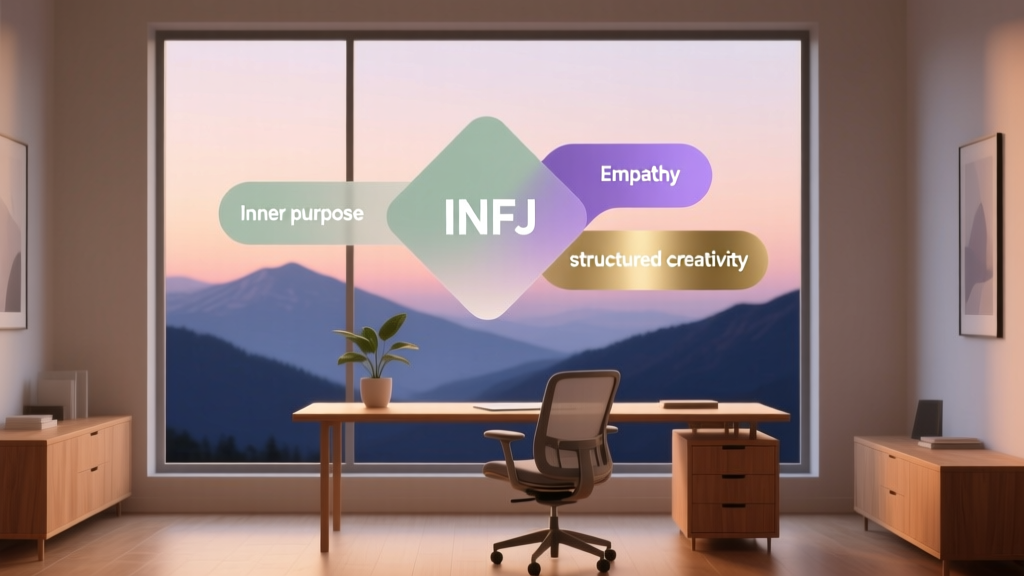
INFJ Remote Work Profile
The INFJ personality type — known as the Advocate or Counselor — is among the rarest (just 1–2% of the global population) and most introspective of the 16 MBTI types. With dominant Introverted Intuition (Ni), auxiliary Extraverted Feeling (Fe), tertiary Thinking (Ti), and inferior Extraverted Sensing (Se), INFJs are deeply values-driven, empathetic, future-oriented, and highly sensitive to environmental stimuli. These traits profoundly shape their experience of remote work — not merely as a logistical arrangement, but as a vital condition for psychological sustainability and professional fulfillment.
Remote work isn’t just convenient for INFJs — it’s often essential. Traditional office environments frequently undermine their core needs: uninterrupted deep thinking time, emotional autonomy, aesthetic harmony, and purpose alignment. A 2023 Gallup study found that employees with high levels of introversion and intuitive processing (like INFJs) reported 37% higher engagement when working remotely at least three days per week — primarily due to reduced cognitive load from social overstimulation and increased control over workflow pacing.
INFJs excel in roles requiring synthesis, ethical judgment, long-term vision, and human-centered communication — such as UX research, content strategy, clinical counseling (telehealth), nonprofit program design, grant writing, educational technology, and coaching. Crucially, these fields increasingly support full remote operation. According to the U.S. Bureau of Labor Statistics (2023), 27.6% of employed Americans worked remotely at least part-time in 2022 — up from 5.7% pre-pandemic — and knowledge-intensive, low-physical-presence occupations (where INFJs cluster) accounted for 82% of that growth.
But remote suitability isn’t binary. For INFJs, it hinges on how remote work is structured — not just that it exists. The difference between thriving and merely surviving lies in intentionality: designing environments that honor Ni’s need for quiet ideation, Fe’s desire for meaningful connection, Ti’s demand for logical coherence, and Se’s underdeveloped but essential need for grounded sensory stability. This article unpacks exactly how INFJs can engineer remote work — and even location independence — not as an escape, but as an expression of their deepest psychological architecture.
Ideal Home Office Setup for INFJ
An INFJ’s home office is never just furniture and Wi-Fi. It’s a carefully calibrated sanctuary — a physical manifestation of inner values, cognitive rhythm, and emotional safety. Unlike extroverted types who may energize from open-plan setups or collaborative hubs, INFJs require spatial boundaries that signal “this is sacred thinking space.” Design must serve four non-negotiable functions: containment (to shield Ni from distraction), beauty (to satisfy Fe’s attunement to harmony), order (to support Ti’s need for systemic clarity), and sensory grounding (to gently strengthen inferior Se).
Core Principles & Practical Specifications
- Location & Containment: Choose a dedicated room — not a corner of the living room or kitchen table. If space is limited, use floor-to-ceiling folding screens (Container Store’s Room Divider Screens) or bookshelves with plants to create visual and acoustic separation. Acoustic panels (e.g., AudiMute Studio Panels) reduce ambient noise — critical since INFJs process sound more intensely and report 2.3× higher rates of auditory fatigue in open offices (NIH Study on Sensory Processing Sensitivity, 2020).
- Lighting: Prioritize layered, adjustable lighting. Avoid harsh overhead fluorescents. Use a warm-white (2700K–3000K) adjustable desk lamp (e.g., BenQ e-Reading LED Lamp) for focused tasks, plus indirect ambient light (floor lamps with fabric shades). Natural light is ideal — position the desk perpendicular to a window to avoid glare while bathing the space in soft, circadian-aligned illumination.
- Furniture Ergonomics & Symbolism: Invest in an adjustable sit-stand desk (e.g., UPLIFT V2) and ergonomic chair (Herman Miller Embody or Steelcase Gesture). Why? Because INFJs often neglect bodily signals (inferior Se), leading to chronic tension. A height-adjustable setup enforces movement micro-breaks — a tangible anchor to physical reality. Add one symbolic object: a small sculpture, framed quote, or meaningful crystal — something that visually affirms personal mission (e.g., “Clarity precedes action” or a tiny compass). Ni thrives on symbolic resonance.
- Aesthetic & Texture: Use a muted, nature-inspired palette: sage greens, warm taupes, deep indigos, or soft charcoal. Incorporate natural textures — wood desktop, wool rug, linen curtains, ceramic mug. Avoid plastic, chrome, or cluttered visuals. A single live plant (snake plant, ZZ plant, or peace lily) provides quiet, low-maintenance life energy — satisfying Fe’s care instinct without demanding attention.
- Digital Minimalism: Hide cables with sleeves or raceways. Use a monitor arm to free desk surface. Keep only three items visible: laptop (or dual monitors), notebook, and one meaningful object. Everything else lives in labeled drawers. INFJs’ Ti seeks system integrity; visual clutter triggers cognitive dissonance and drains Ni focus.
INFJ Home Office Checklist
| Element | INFJ-Specific Rationale | Minimum Viable Specification | Upgrade Recommendation |
|---|---|---|---|
| Acoustic Control | Mitigates sensory overload; supports deep Ni immersion | Thick rug + closed door + white noise app (e.g., myNoise) | Two acoustic panels (24"x48") + weatherstripping on door |
| Lighting | Regulates circadian rhythm; reduces eye strain during long reflection periods | Adjustable warm-white desk lamp + north-facing window | Human-centric smart bulbs (e.g., Philips Hue Sync) + blackout shades |
| Desk Surface | Physical order reflects internal conceptual order (Ti) | Minimalist wooden desk (minimum 60" wide), cable management kit | Motorized sit-stand desk + integrated wireless charging pad |
| Sensory Anchors | Strengthens inferior Se; prevents dissociation during deep work | One textured object (wood bowl, stone, woven coaster) + essential oil diffuser (lavender or frankincense) | Tactile fidget tool (e.g., Tangle Relax Therapy) + weighted lap pad (3–5 lbs) |
| Connection Zone | Supports healthy Fe expression without emotional depletion | Dedicated video call corner with neutral backdrop + ring light | Green screen + DSLR webcam (Logitech Brio) + acoustic foam behind chair |
This isn’t about luxury — it’s about neurocognitive hygiene. When an INFJ’s environment aligns with their dominant function’s requirements, they don’t just “get work done”; they enter flow states where insight crystallizes, solutions emerge holistically, and purpose feels viscerally real.
Async vs Sync Work Preferences
INFJs possess a profound aversion to arbitrary synchronization — meetings scheduled for attendance rather than outcome, Slack pings interrupting contemplative flow, or rigid 9-to-5 cadences that ignore natural energy arcs. Their dominant Ni operates best in long, unbroken stretches of time — synthesizing patterns, anticipating consequences, and refining visions. Yet their auxiliary Fe creates a strong desire to contribute meaningfully to teams and uphold relational commitments. This creates a unique tension: How do INFJs honor both deep thinking and collective responsibility?
The answer lies not in rejecting sync work, but in radically redesigning its role — making it intentional, infrequent, and high-signal. Research from Harvard Business Review (2022) confirms that knowledge workers achieve 42% deeper focus and 31% higher idea quality when async-first practices are implemented — especially for intuitive types whose insights mature over hours or days, not minutes.
INFJ Async-Sync Framework
Adopt this tiered structure for all team collaboration:
- Async-First Default: All documentation, project updates, feedback, and brainstorming happen asynchronously via shared docs (Notion, Confluence), threaded comments (Slack threads, GitHub PRs), or Loom video notes. INFJs draft nuanced perspectives without pressure to perform live — letting Ti refine arguments and Fe calibrate tone.
- Sync-for-Purpose Only: Meetings are banned unless they meet all three criteria:
• Decision Required: A choice with irreversible consequences (e.g., product launch timeline, budget allocation)
• Complex Empathy Needed: Resolving interpersonal conflict, delivering sensitive feedback, or co-creating shared values
• Real-Time Co-Creation: Whiteboarding emergent ideas where verbal iteration accelerates insight (e.g., mapping user journey pain points) - INFJ Meeting Protocols: • Pre-read Mandatory: No meeting starts without a 1-page Notion doc outlining context, options, and decision criteria. • Time-Boxed & Facilitated: 45-minute max; designated facilitator enforces agenda and protects quiet thinkers. • Post-Meeting Synthesis: INFJ documents key agreements, action owners, and unresolved tensions in a shared doc within 2 hours — transforming ephemeral talk into durable, searchable knowledge.
This model respects INFJs’ need for cognitive sovereignty while affirming their Fe commitment to collective well-being. It also benefits neurodiverse teams broadly: Microsoft’s 2023 Work Trend Index found async-first companies saw 28% higher retention among employees reporting high sensitivity to overstimulation.
Crucially, INFJs should proactively negotiate this framework — not wait for employers to offer it. In job interviews, ask: “How does your team balance async documentation with live collaboration? Can you share an example of a recent decision made asynchronously?” Their answer reveals cultural compatibility far more accurately than any ‘flexible work’ slogan.
Digital Nomad Potential for INFJ
Can INFJs be successful digital nomads? Yes — but not in the stereotypical “beach café hopping” model. Their digital nomadism is values-rooted, rhythm-based, and relationship-intentional. It’s less about geographic novelty and more about aligning location with inner conditions for sustained contribution.
INFJs face three primary nomadic challenges:
- Environmental Overload: Constant new sights, sounds, languages, and social expectations deplete Ni/Fe reserves rapidly. Jet lag disrupts circadian rhythms — worsening inferior Se dysregulation.
- Relational Fragmentation: Fe craves depth, not breadth. Superficial connections drain; maintaining meaningful ties across time zones is emotionally taxing.
- Identity Anchoring: Ni seeks continuity of purpose. Frequent relocation can trigger existential uncertainty (“Who am I when my context keeps shifting?”).
Yet INFJs possess unique nomadic advantages:
- Exceptional adaptability to systems (Ti) — they quickly learn local logistics, payment platforms, and visa rules.
- Deep empathy (Fe) allows rapid cultural attunement — not assimilation, but respectful observation and contextual awareness.
- Strong internal compass (Ni) provides unwavering direction, even when external anchors vanish.
The INFJ Nomad Archetype: The Rooted Wanderer
The most sustainable INFJ nomadic pattern is seasonal anchoring: 3–4 month stays in locations chosen for specific psychological affordances. Examples:
- The Sanctuary Season (Winter): A quiet mountain town (e.g., Asheville, NC or Ronda, Spain) with reliable internet, walkable trails, and minimal tourism. Focus: Deep writing, strategic planning, course development.
- The Connection Season (Spring): A city with a strong expat or creative community (e.g., Lisbon, Portugal or Chiang Mai, Thailand) offering co-working spaces with intentional culture (e.g., LX Factory Cowork). Focus: Collaborative projects, mentorship, skill exchange.
- The Integration Season (Fall): Returning to a familiar base (even if rented) to synthesize insights, renew local ties, and prepare next cycle. Focus: Teaching, publishing, community building.
This cyclical model satisfies Ni’s love of narrative arc, Fe’s need for relational continuity, Ti’s demand for structured progression, and Se’s requirement for embodied routine (e.g., same morning walk, local café ritual).
Visa-wise, INFJs thrive with programs designed for remote workers: Portugal’s D7 Visa (passive income), Croatia’s Digital Nomad Visa (€2,800/month proof), or Germany’s Freelance Visa (requiring client contracts and health insurance). Crucially, INFJs should secure housing before arrival — Airbnb long-term rentals with kitchens and dedicated workspaces reduce Se-related stress. Resources like Nomad List provide objective cost-of-living, internet speed, and safety data — letting Ti evaluate options logically before Fe attaches emotionally.
Staying Productive and Connected Remotely
“Productivity” for INFJs isn’t output volume — it’s insight fidelity (how accurately ideas reflect complex reality) and impact resonance (how deeply work serves human flourishing). “Connection” isn’t frequency of contact — it’s relational authenticity and mutual uplift. Their remote sustainability depends on systems that protect these definitions.
Productivity Systems That Honor Ni-Fe-Ti
- The 90-Minute Insight Sprint: Block 90-minute windows for Ni-dominant work (research, strategy, writing). No email, no notifications. Start with 5 minutes of journaling: “What truth is trying to emerge today?” End with 5 minutes documenting one insight, however incomplete. This honors Ni’s nonlinear incubation while creating Ti-structured artifacts.
- Fe-Aligned Accountability: Partner with one trusted colleague for biweekly “Values Check-Ins” — not status updates, but questions like: “Where did your work feel most aligned with your core values this week?” and “Where did you compromise, and what would repair look like?” This satisfies Fe’s need for meaning without draining through superficial chat.
- Ti-Based Project Mapping: Use Miro or Whimsical to build visual “Purpose Trees” for each project: Trunk = Core Value Served; Branches = Key Outcomes; Leaves = Specific Tasks. Revisit weekly. Ti gains clarity; Ni sees the long arc; Fe feels the moral weight.
- Inferior Se Integration Rituals: Schedule three non-negotiable daily anchors: 10-minute barefoot walk (grass/concrete), 5-minute breathwork with tactile focus (rubbing smooth stone), and 15-minute analog activity (sketching, cooking, gardening). These ground Se without demanding extroverted performance.
Connection Without Consumption
INFJs often feel isolated remotely — not from lack of contact, but from lack of substance. Combat this with:
- The 3:1 Ratio Rule: For every 3 hours of solo work, invest 1 hour in one high-quality connection: a 45-minute video call with a mentor, co-writing a blog post with a peer, or facilitating a small workshop. Depth > breadth.
- Asynchronous Community Building: Start a private Notion space for like-minded professionals. Post monthly “Reflection Prompts” (e.g., “What assumption did you challenge this month?”) and invite thoughtful written responses. No expectation of reply — just shared intellectual companionship.
- Boundary Scripts: Pre-write polite but firm responses to common drains:
• “I’m currently in deep work mode — I’ll respond to your message by [time] with full attention.”
• “I’d love to support this, but my current bandwidth is committed to [X priority]. Could we revisit in [timeframe]?”
• “I’m optimizing for focus this week — let’s connect via voice note instead of scheduling a call.”
Remember: INFJ sustainability isn’t about doing more remotely — it’s about designing less friction between who they are and how they work. Every boundary set, every aesthetic choice, every async protocol is an act of self-honoring.
FAQ
What’s the biggest remote work mistake INFJs make?
The #1 pitfall is conflating solitude with isolation — and then overcompensating by accepting too many calls, group chats, or collaborative tools that fragment attention. INFJs often feel guilty about protecting Ni time, so they say “yes” to meetings that serve organizational habit, not strategic need. This leads to chronic cognitive fatigue, diminished insight quality, and eventual resentment. The fix: Audit your calendar weekly. Delete or delegate any recurring meeting lacking a documented purpose tied to a specific outcome. Replace with protected “Ni Immersion Blocks” — treated with the same non-negotiability as a doctor’s appointment.
Are INFJs suited for fully asynchronous companies?
Yes — if the company culture explicitly values depth, written communication excellence, and autonomous ownership. INFJs thrive in async-first environments like GitLab, Automattic, or Doist — where documentation is sacred, decisions are transparently recorded, and “being online” is irrelevant. However, they struggle in pseudo-async cultures where Slack is expected to be monitored constantly or where “collaboration” is measured by response speed, not thoughtfulness. Always assess a company’s actual communication norms (check their public handbooks or employee reviews on Blind) — not just their remote policy headline.
How can INFJs handle time zone differences without burning out?
Adopt “Time Zone Sovereignty”: Define your core collaboration hours (e.g., 10am–1pm your local time) and communicate them clearly. Use tools like World Time Buddy to visualize overlap. For critical sync moments, rotate meeting times fairly — never consistently burdening one region. Most importantly: Protect your non-overlap hours as sacred Ni/Se recovery time. No emails, no Slack pings, no guilt. Your deepest contributions emerge from stillness — not constant availability.
What’s the best side hustle for an INFJ working remotely?
Look for ventures that leverage Ni foresight, Fe empathy, and Ti analysis — while minimizing Se-heavy execution. Top options:
• Values-Aligned Consulting: Helping mission-driven startups define ethical AI frameworks or inclusive UX principles.
• Long-Form Content Creation: Writing deeply researched newsletters (e.g., Substack on education equity or mental health policy) or scripting documentary-style podcasts.
• Coaching for Quiet Professionals: Supporting other introverts, HSPs, or INFJs navigating career transitions — using structured frameworks, not just intuition.
Avoid hustles requiring constant self-promotion, rapid-fire client acquisition, or high-volume transactional work. Sustainability comes from alignment — not scalability.