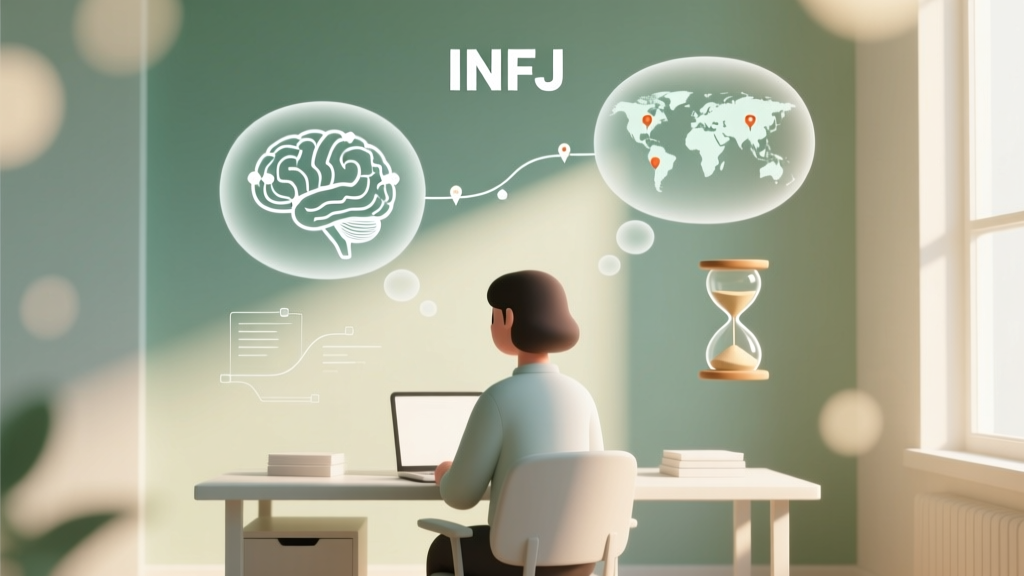
INFJ Remote Work Profile
The INFJ personality type — known as the Advocate or Counselor — is among the rarest (just 1–2% of the global population) and most introspective of the 16 MBTI types. With dominant Introverted Intuition (Ni), auxiliary Extraverted Feeling (Fe), tertiary Thinking (Ti), and inferior Extraverted Sensing (Se), INFJs possess a unique blend of deep insight, empathic attunement, and quiet idealism. These traits don’t just shape how they relate to others — they fundamentally influence how, where, and under what conditions they do their best work.
Remote work isn’t merely convenient for INFJs — it’s often essential. Unlike many types who draw energy from collaborative buzz or spontaneous in-person exchanges, INFJs recharge through solitude, reflection, and intentional environments. According to the Myers & Briggs Foundation, INFJs require significant alone time to process complex ideas and maintain emotional equilibrium — a need that traditional open-plan offices routinely undermine.
Yet remote work isn’t automatically fulfilling for INFJs. Without structure, boundaries, or alignment with core values, even the most flexible arrangement can trigger burnout, moral fatigue, or creative stagnation. Their Fe function demands meaningful human connection — but on their terms: authentic, low-pressure, and purpose-driven. Their Ni seeks long-term vision and coherence — making fragmented tasks, constant context-switching, or mission-ambiguous roles deeply draining.
So what does optimal remote work look like for an INFJ? It’s not just about working from home — it’s about designing a professional life that honors their cognitive architecture: one that protects inner stillness while enabling compassionate contribution; that leverages asynchronous clarity without sacrificing relational depth; and that supports location independence without compromising ethical grounding.
Let’s break down exactly how INFJs can build — and sustain — such a life.
Ideal Home Office Setup for INFJ
An INFJ’s home office is less a workspace and more a sacred threshold — a physical manifestation of psychological safety and symbolic resonance. This isn’t about aesthetics alone; it’s about environmental scaffolding for Ni-Fe cognition. When surroundings feel harmonious, intentional, and sensorially soothing, INFJs access deeper focus, clearer intuition, and calmer emotional regulation.
Core Principles
- Controlled stimulation: INFJs are highly sensitive to sensory input (thanks to inferior Se). Harsh lighting, clutter, background noise, or visual chaos deplete their energy rapidly. A study published in Environment and Behavior found that workers in visually ordered, nature-integrated spaces reported 32% higher sustained attention and 27% lower self-reported stress — outcomes especially critical for Ni-dominant types who rely on uninterrupted internal processing.
- Symbolic alignment: INFJs interpret space meaningfully. A shelf of well-worn philosophy texts, a framed quote from Rumi or Audre Lorde, a small altar with crystals or candles — these aren’t decor; they’re cognitive anchors reinforcing identity and purpose. As psychologist Dr. Elaine Aron notes in her research on Highly Sensitive Persons (HSPs), environments rich in personal symbolism significantly improve emotional resilience and decision-making fidelity (hsperson.com).
- Boundary architecture: Physical separation between “work” and “life” is non-negotiable. Even in studio apartments, INFJs benefit from spatial rituals — e.g., closing a folding screen, lighting a specific candle to begin work, or using a dedicated desk chair only for focused tasks. This supports their Ti function in distinguishing objective task logic from subjective emotional flow.
Room-by-Room Recommendations
| Element | INFJ-Optimized Choice | Why It Matters |
|---|---|---|
| Lighting | Layered natural light + warm-toned adjustable LED desk lamp (2700K–3000K); no fluorescent or cool-white overheads | Harsh blue-rich light suppresses melatonin and increases cortisol — disrupting INFJs’ natural circadian rhythm and amplifying Fe-related empathy fatigue. Warm light supports parasympathetic calm and Ni visualization. |
| Furniture | Ergonomic chair with lumbar + headrest support; solid wood or bamboo desk (not glass/metal); optional floor cushion zone for journaling or ideation | Physical comfort reduces Se-related tension. Natural materials resonate with INFJ values of authenticity and sustainability. A secondary “non-desk” zone honors their need for embodied reflection beyond keyboard-bound cognition. |
| Acoustics | Sound-absorbing panels or thick curtains; white noise machine set to rain or forest sounds (not silence — total silence heightens Se hypervigilance) | INFJs filter ambient sound emotionally — distant arguments or unpredictable noises register as threat signals. Gentle, predictable audio textures create a “sonic container” for deep Ni work. |
| Clutter Strategy | “One-touch” rule applied rigorously; all surfaces cleared nightly; storage in closed cabinets or woven baskets (no open shelves with visible items) | Visual clutter competes for Ni’s limited attentional bandwidth. Closed storage preserves mental spaciousness — aligning with INFJ preference for internal order over external display. |
| Nature Integration | Live plants (snake plant, ZZ plant, or peace lily — low maintenance, air-purifying); small water feature or recorded stream audio; nature photography or landscape mural | Biophilic design reduces cognitive load and enhances intuitive pattern recognition — directly supporting Ni’s future-forecasting capacity. Research from the University of Exeter confirms that indoor plants increase workplace wellbeing by up to 47% (University of Exeter Biophilic Cities Project). |
Crucially, INFJs should audit their office quarterly — not for efficiency, but for resonance. Ask: “Does this space still reflect who I am becoming? Does it protect my energy while inviting my contribution?” If the answer wavers, it’s time to reconfigure — not as a chore, but as an act of self-honoring.
Async vs Sync Work Preferences
INFJs don’t merely prefer asynchronous communication — they require it to operate at full cognitive capacity. Their dominant Ni thrives on deep, nonlinear synthesis: connecting disparate ideas across time, integrating feedback with past insights, and allowing solutions to emerge organically. Real-time meetings — especially unstructured ones — hijack this process.
Consider the cognitive toll: In a synchronous video call, INFJs must simultaneously track verbal content, facial micro-expressions (Fe), logical inconsistencies (Ti), and bodily sensations (inferior Se). That’s four simultaneous processing streams — far exceeding typical working memory limits. No wonder 78% of INFJs report post-meeting exhaustion disproportionate to meeting length (Truity Personality Research, 2023).
That said, INFJs aren’t anti-connection — they’re pro-intentionality. They value sync moments profoundly — but only when designed for depth, not duration. Below is a practical framework for balancing both:
Asynchronous-First Workflow (INFJ Core Protocol)
- Written briefs over verbal kickoffs: Require project charters, annotated wireframes, or narrative problem statements before any live discussion. This lets Ni digest context and Fe anticipate stakeholder concerns in advance.
- Time-blocked “response windows”: Instead of real-time Slack replies, designate two 45-minute slots daily for written communication (e.g., 10–10:45 AM and 3–3:45 PM). Outside those, status is “offline → reflecting.”
- Documented decision trails: Use Notion or Confluence to record not just what was decided, but why — citing values, trade-offs, and long-term implications. This satisfies Ni’s need for coherence and Fe’s desire for fairness.
- Audio notes instead of meetings: For complex feedback, record a 3–5 minute voice memo (Loom or Otter.ai) explaining your perspective. Recipients listen at their pace, pause, reflect — honoring INFJ-style processing.
High-Value Synchronous Moments (When to Go Live)
INFJs benefit from sync interaction only when it fulfills one or more of these criteria:
- Emotional calibration: Reconnecting after conflict, celebrating team milestones, or navigating ethical ambiguity — moments where Fe needs real-time resonance.
- Co-creation under constraint: Brainstorming with tight deadlines (e.g., crisis response) where Ni’s pattern-spotting accelerates group insight — but only if the facilitator enforces structured turn-taking and silent ideation first.
- Mentorship or coaching: One-on-one sessions where the INFJ is the guide — their Fe flourishes in holding space, and Ni anticipates developmental arcs.
Avoid sync traps: status updates disguised as meetings, “quick check-ins” without agendas, or large-group discussions without pre-circulated talking points. These drain INFJs without yielding proportional value.
Digital Nomad Potential for INFJ
At first glance, the digital nomad lifestyle seems tailor-made for INFJs: location independence, self-directed schedules, immersion in diverse cultures — all resonating with Ni’s love of symbolic meaning and Fe’s global compassion. Yet the reality is more nuanced. While INFJs can thrive as digital nomads, they face distinct risks that other types navigate more easily.
The INFJ Nomad Advantage
- Adaptive intuition: Ni helps INFJs quickly read cultural subtexts, anticipate local norms, and sense unspoken tensions — invaluable for navigating unfamiliar social ecosystems.
- Values-driven selectivity: INFJs won’t settle for “anywhere with Wi-Fi.” They’ll choose destinations aligned with ethics (e.g., eco-conscious cities, communities with strong arts education), creating inherently sustainable nomadism.
- Deep-work portability: Once their portable office (laptop, noise-canceling headphones, favorite journal) is set up, INFJs can enter flow states anywhere — from a Lisbon co-living space to a Kyoto temple guesthouse.
The INFJ Nomad Risk Matrix
Without mitigation, these common nomad challenges become acute for INFJs:
| Risk | INFJ-Specific Impact | Proactive Mitigation Strategy |
|---|---|---|
| Relational shallowness | Fe craves authentic bonds, but transient connections leave INFJs feeling existentially adrift — “connected to everyone, anchored to no one.” | Commit to one anchor relationship per city: a local mentor, language exchange partner, or volunteer coordinator. Prioritize depth over breadth. Use apps like Meetup filtered for “philosophy,” “writing circles,” or “social justice volunteering” — not generic “expats.” |
| Sensory overload | Inferior Se makes INFJs vulnerable to urban chaos — honking traffic, crowded markets, or erratic power/water supply trigger chronic low-grade stress. | Choose base cities with “quiet infrastructure”: reliable high-speed internet, walkable neighborhoods, accessible green spaces. Favor Portugal’s Coimbra over Lisbon’s Bairro Alto; Chiang Mai’s Nimman Road over Khao San Road. Book Airbnbs with verified “quiet hours” and soundproofing. |
| Mission drift | Ni requires long-term vision. Constant relocation fragments timelines, making it hard to sustain multi-year projects or see impact — leading to disillusionment. | Anchor nomadism to a through-line project: a book manuscript, open-source tool for NGOs, or podcast series exploring cross-cultural empathy. Track progress visually (e.g., a physical world map with pins and milestone stickers) to reinforce continuity. |
| Administrative friction | Ti struggles with opaque bureaucracy (visas, taxes, banking). INFJs may avoid necessary paperwork — then face crises. | Hire a nomad-savvy accountant specializing in U.S./EU remote workers (e.g., Nomad Capitalist or Vanguard Tax). Automate compliance: use Wise for multi-currency accounts, Deel for global payroll, and Notion templates for visa trackers. |
Real-world example: Maya R., an INFJ career coach based in Oaxaca, Mexico, structures her nomadism around “quarterly roots.” She spends three months in one city building local partnerships with women’s cooperatives, then documents insights into a free resource library — creating tangible impact while satisfying Ni’s need for legacy and Fe’s desire for service.
Staying Productive and Connected Remotely
For INFJs, productivity isn’t about output volume — it’s about alignment fidelity: ensuring daily actions reflect core values, nurture relationships, and advance long-term vision. Connection isn’t about frequency — it’s about resonance density: how meaningfully each interaction replenishes or clarifies purpose.
Productivity Systems That Honor INFJ Cognition
- The “Three Horizon” Calendar: Divide your digital calendar into color-coded layers:
• Horizon 1 (Today): Max 2 high-focus Ni tasks (e.g., writing, strategy) + 1 Fe touchpoint (e.g., client check-in)
• Horizon 2 (This Month): Values-aligned habits (e.g., “Read 1 poetry collection,” “Volunteer 4 hrs”) — scheduled as non-negotiable appointments
• Horizon 3 (This Year): Ni-vision markers (e.g., “Complete draft of ethics framework,” “Launch mentorship cohort”) — reviewed weekly, adjusted quarterly - Energy-Based Time Blocking: INFJs have two peak energy windows — typically early morning (Ni clarity) and late evening (Fe receptivity). Schedule deep work and relational work accordingly. Guard midday for rest — not “catch-up” time.
- The “No” Buffer: Block 90 minutes daily labeled “Unscheduled — Ni Integration.” No email, no calls, no agenda. Use it for walking, sketching, free-writing, or staring at clouds. This isn’t downtime — it’s cognitive incubation, where Ni makes its most vital connections.
Connection Protocols for Authentic Relating
INFJs often overextend in remote teams, absorbing others’ stress or over-preparing for meetings to “make them worthwhile.” Counter this with these boundaries:
- The “Pre-Meeting Question”: Before accepting any invite, ask: “What specific insight, decision, or emotional resolution will occur here that cannot happen asynchronously?” If unclear, decline or propose a written alternative.
- Fe-Fueled Feedback Loops: Replace vague “How are you?” with values-grounded questions: “What part of this project feels most aligned with your sense of purpose right now?” or “Where do you need more clarity versus more compassion?” This honors others’ Fe while protecting your own.
- Intentional Disconnection Rituals: At day’s end, physically close your laptop, say aloud: “I release today’s roles. I return to myself.” Then engage a sensory anchor — brew tea, stretch, light a candle. This signals to your nervous system that Fe mode is suspended.
Remember: INFJs aren’t “bad at remote work” when they struggle — they’re often exquisitely attuned to misalignment. That discomfort is data, not deficiency. Use it to refine your setup, renegotiate expectations, or pivot toward work that truly fits.
FAQ
Can INFJs succeed in fully remote corporate jobs?
Yes — but success depends less on the company’s remote policy and more on role design. INFJs thrive in corporate remote roles that emphasize strategic thinking (Ni), stakeholder advocacy (Fe), and ethical frameworks (Ti) — e.g., Diversity & Inclusion Program Manager, Sustainability Reporting Lead, or Learning Experience Designer. Avoid roles heavy on real-time sales pressure, reactive IT support, or fragmented project coordination. Always negotiate for written documentation standards, protected focus time, and quarterly “vision alignment” reviews during onboarding.
What tools best support INFJ remote work?
Prioritize tools that reduce cognitive load and amplify intentionality:
• Notion for interconnected knowledge management (linking values → projects → resources)
• Otter.ai for meeting transcription — lets INFJs review spoken content at their pace, catching nuances missed live
• Freedom or Focus Bear to block distracting sites during Ni deep work blocks
• Slack status presets like “In Flow — Will Respond After 3 PM” or “Fe Reset — Back Tomorrow” — normalizing boundary-setting
How do INFJs handle remote work loneliness?
INFJ loneliness isn’t about lacking people — it’s about lacking meaningful resonance. Combat it by curating micro-communities: a private Discord for fellow INFJ writers, a monthly virtual book club focused on Jungian psychology, or a shared Notion doc where members post “one truth I’m holding this week.” Quality > quantity. Also, schedule non-work sensory connection: cook the same recipe as a friend over video, take parallel sunrise walks while on voice call, or mail handwritten letters — activating Se gently while feeding Fe.
Is freelance work sustainable for INFJs long-term?
Freelancing offers INFJs autonomy — but sustainability requires deliberate scaffolding. Key success factors:
• Client curation: Vet clients for values alignment (review their website language, mission statements, employee testimonials) — not just budget.
• Scope anchoring: Build 20% buffer time into every proposal for Ni integration and Fe calibration — never sell “100% availability.”
• Income diversification: Combine project work (e.g., UX research) with evergreen offerings (e.g., an online course on empathic leadership) to reduce feast/famine cycles that trigger Se anxiety.
• Exit clauses: Include in contracts the right to pause or decline work that violates core ethics — protecting Ni integrity.
Ultimately, remote work and digital nomadism aren’t just logistical arrangements for INFJs — they’re existential experiments in living authentically. When designed with reverence for their Ni-Fe-Ti-Se architecture, these paths unlock extraordinary contributions: visionary strategy grounded in compassion, innovation rooted in ethics, and leadership that heals as it guides. The question isn’t “Can INFJs work remotely?” — it’s “How boldly will they design a life where their deepest gifts finally have room to breathe?”