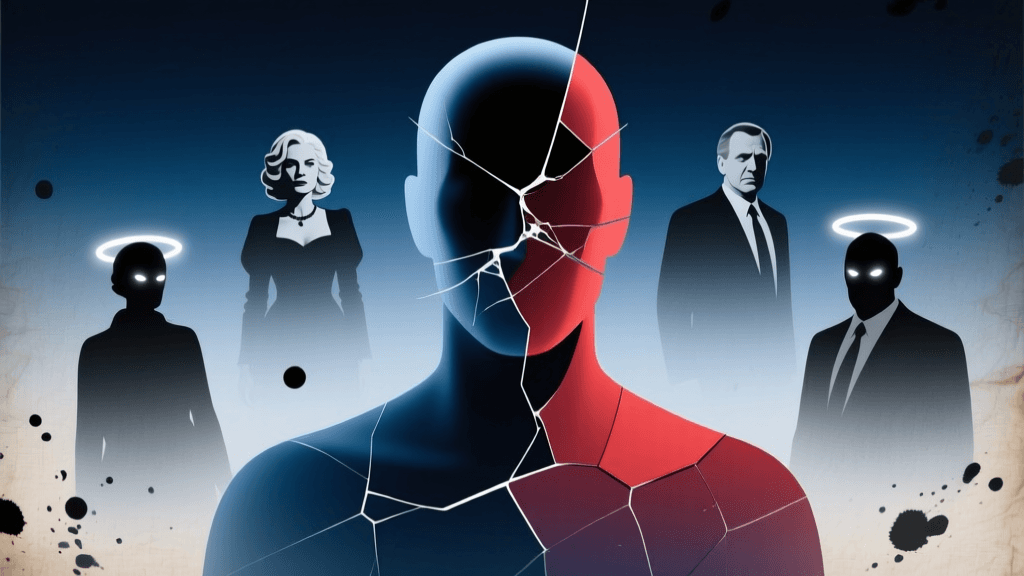
The Dark Side of INFJ
The INFJ personality type — often dubbed 'The Advocate' or 'The Counselor' — is celebrated in pop psychology for its empathy, vision, and quiet moral conviction. Representing just 1–2% of the global population (Myers-Briggs Foundation), INFJs are frequently portrayed as healers, mentors, and self-sacrificing visionaries. But this very rarity and depth make them uniquely susceptible to a profound psychological shadow — one that rarely appears in mainstream MBTI discourse.
When INFJ traits become unmoored from reality, accountability, and emotional reciprocity, they don’t merely 'act out' — they reconstruct reality. Their dominant function, Introverted Intuition (Ni), grants uncanny pattern recognition and future-oriented foresight. Yet in its unhealthy expression, Ni becomes obsessive, apocalyptic, and self-validating — interpreting ambiguity as confirmation of an inner prophecy. Coupled with auxiliary Extraverted Feeling (Fe), which seeks harmony and moral alignment in others, the result is not mere narcissism, but moral authoritarianism: the belief that love, care, or salvation requires control — even coercion — because 'you’ll thank me later.'
This isn’t textbook psychopathy. INFJ villains rarely revel in chaos or cruelty for its own sake. Instead, they weaponize compassion, sacrifice, and meaning-making — making them among the most psychologically resonant, ethically disorienting antagonists in fiction and history. As Dr. Dario Nardi, neuroscientist and MBTI researcher, observes: 'INFJs have the highest potential for both sainthood and sanctimony — the line between them is thinner than we admit.' (Nardi, 2010, p. 142)
Their tertiary Introverted Thinking (Ti) — normally used to refine values and test internal logic — hardens into rigid, self-referential doctrine when stressed. And inferior Extraverted Sensing (Se), when repressed, erupts unpredictably: not as spontaneity, but as shocking, visceral acts of domination or self-punishment — a final, desperate assertion of control over a world they perceive as morally collapsing.
This dark triad — Ni-driven certainty, Fe-enforced conformity, Ti-justified dogma — creates what clinical psychologist Dr. Dan P. McAdams calls the 'redemptive narrative gone rogue': a life story where the INFJ casts themselves as the sole architect of salvation — and anyone who resists is either blind, broken, or evil.
Famous INFJ Villains
Below are seven canonical fictional and historical figures widely assessed by MBTI scholars, typology analysts, and narrative psychologists as embodying the unhealthy INFJ archetype. Each case reflects distinct pathways of Ni-Fe distortion — from benevolent tyranny to charismatic erasure — and illustrates how core INFJ strengths invert under stress, isolation, or unchecked authority.
1. Light Yagami (Death Note)
Light begins as a brilliant, socially admired student — empathetic enough to comfort classmates, intuitive enough to outthink police globally. His Ni manifests as an almost supernatural grasp of systemic corruption; his Fe fuels a visceral disgust at injustice. But rather than seek reform, he declares himself 'God of the new world' — a title rooted not in hubris alone, but in a deeply held, internally validated prophecy: 'Only I see the truth. Only I can fix it.' His killing spree isn’t sadistic — it’s liturgical. Each death is a ritual purification. He manipulates allies (Misa, Near) not through force, but by appealing to their desire to belong to something transcendent — a hallmark of Fe-based influence. When cornered, Light doesn’t rage — he dissociates, retreating into a frozen, godlike silence: classic Ni-Se loop collapse.
2. Dolores Umbridge (Harry Potter)
Umbridge epitomizes the bureaucratic INFJ villain — polite, precise, and terrifyingly patient. Her pink aesthetic and kitten plates aren't irony; they’re Fe signaling: 'I am kind. You will feel safe. Therefore, you must comply.' Her 'Educational Decrees' and blood quill punishment aren’t random cruelty — they’re Ti-structured instruments to enforce her vision of 'proper order', which she believes is synonymous with moral purity. She doesn’t hate students; she pities their 'immaturity' and believes her control is pedagogical love. As J.K. Rowling confirmed in interviews, Umbridge represents 'the worst kind of fascism — the kind that smiles while it crushes you.' (Accio Quote Archive, 2007)
3. President Snow (The Hunger Games)
Snow cultivates roses — fragrant, beautiful, thorny — a perfect symbol of his duality. His Ni projects decades ahead: he sees rebellion not as rebellion, but as inevitable entropy unless contained by ritualized suffering. His Fe mastery lets him perform paternal concern on camera while poisoning dissidents off-screen. He tells Katniss: 'Hope is the only thing stronger than fear. A little hope is effective. A lot of hope is dangerous.' This isn’t cynicism — it’s Ni-Fe calculus: hope must be metered like medicine, or it becomes toxic. His downfall comes not from violence, but from losing narrative control — when Katniss’s authenticity ruptures his curated reality.
4. The Master (Doctor Who, modern series)
Unlike chaotic Time Lord villains, the Master is chillingly coherent. His speeches aren’t rants — they’re sermons. He diagnoses Time Lord society as spiritually bankrupt and positions himself as its necessary surgeon. His obsession with the Doctor isn’t rivalry — it’s intimate theological disagreement. He sees the Doctor’s non-interventionism as cowardice, his mercy as complicity. His plans (e.g., turning Earth into a warship in 'Utopia') are grand, symbolic, and aesthetically unified — pure Ni synthesis. His Fe surfaces in moments of heartbreaking vulnerability ('I forgive you'), revealing how deeply he craves the Doctor’s recognition — not as enemy, but as fellow prophet finally seeing the same abyss.
5. V (V for Vendetta)
V straddles antihero/villain — and that ambiguity is quintessentially INFJ. His Ni vision of 'freedom' is absolute, poetic, and non-negotiable. His Fe drives him to 'educate' Evey through trauma — believing her liberation requires shattering her illusions. His theatricality (masks, speeches, music) isn’t ego — it’s Fe performance art designed to awaken collective conscience. Yet his methods erase individual agency: he bombs the Old Bailey knowing civilians are inside, justifies torture as 'necessary', and replaces one authoritarian system with a mythologized, leaderless void — a utopia no one voted for. As scholar Dr. Sarah K. O’Shea notes: 'V doesn’t want democracy — he wants discipleship disguised as liberation.' (O’Shea, 2019, Journal of Graphic Novels and Comics)
6. Professor James Moriarty (Sherlock Holmes)
Moriarty is the INFJ’s intellectual mirror to Sherlock’s ISTP pragmatism. Conan Doyle describes him as 'the Napoleon of crime' — not for brute force, but for strategic foresight. His Ni constructs elaborate, multi-year schemes where every pawn (including Holmes) serves a preordained narrative arc. His Fe appears in his genuine affection for Holmes — calling him 'the only man who ever truly understood me' — yet orchestrating his death as the ultimate validation of his worldview. Moriarty doesn’t crave wealth or power; he craves recognition of his design. His suicide isn’t defeat — it’s the final, perfect stroke of his magnum opus.
7. Livia Drusilla (Rome, HBO)
Livia is history’s most meticulously realized INFJ antagonist. As Augustus’s wife, she wields zero official power — yet engineers imperial succession across decades. Her Ni anticipates political consequences three generations out; her Fe crafts flawless social facades (hosting banquets while poisoning rivals); her Ti constructs ironclad justifications: 'I do this so Rome may endure.' She never shouts; she suggests. She never threatens; she remembers. Her final act — arranging her grandson’s death to secure Tiberius’s rule — is delivered with serene sorrow: 'I did it for Rome.' Her tragedy isn’t evil — it’s the complete internalization of her own myth until reality ceases to exist outside it.
Comparative Analysis: INFJ Villain Archetypes
| Villain | Core Ni Distortion | Fe Manipulation Tactic | Ti Justification | Se Breakdown Manifestation |
|---|---|---|---|---|
| Light Yagami | Apocalyptic certainty: 'Only I can cleanse the world.' | Offers belonging to 'the righteous few' (Misa, Teru) | 'Killing criminals is logical utilitarianism.' | Cold, detached stillness before death; no physical struggle |
| Dolores Umbridge | Bureaucratic prophecy: 'Order = safety = goodness.' | Smiling enforcement of 'rules for your own good' | 'Discipline builds character; weakness invites chaos.' | Scratching students' hands with blood quill — precise, ritualized pain |
| President Snow | Entropic foresight: 'Without control, humanity collapses.' | Paternal broadcasts masking terror campaigns | 'Fear is the most efficient teacher.' | Smelling roses to suppress nausea — sensory grounding against moral recoil |
| V | Redemptive inevitability: 'The people will rise — I am the spark.' | Orchestrated trauma-as-awakening (Evey’s cell) | 'Freedom requires breaking the chains of comfort.' | Explosions timed to music — aestheticized, controlled destruction |
Why INFJ Makes Compelling Antagonists
INFJ villains captivate audiences not despite their morality — but because of it. They violate the 'villain = immoral' heuristic, forcing viewers to confront uncomfortable questions: What if evil wears kindness? What if tyranny speaks in poetry? What if the person who saves your life also erases your autonomy?
1. Narrative Symmetry: INFJs often oppose protagonists who embody their shadow functions. An ESTP hero (dominant Se) clashes with an INFJ villain (inferior Se) — the ESTP acts in the moment; the INFJ controls the timeline. An ENTP challenger (dominant Ne) disrupts the INFJ’s Ni certainty, creating high-stakes ideological duels (e.g., Sherlock vs. Moriarty). This isn’t random opposition — it’s cognitive function warfare.
2. Emotional Precision: Unlike rage-fueled antagonists, INFJ villains wound with surgical empathy. They identify your deepest shame, your secret hope, your unspoken guilt — then offer a 'solution' that demands surrender. Umbridge doesn’t yell at Harry — she isolates him with targeted silencing. Snow doesn’t threaten Katniss — he threatens Prim, knowing Katniss’s love is her vulnerability. This feels personal, intimate, and inescapable.
3. Moral Ambiguity That Lingers: After Light dies, viewers debate: Was he right? After V’s explosion, does London feel liberated or orphaned? This resonance stems from INFJs’ real-world capacity for transformative good — making their fall more tragic, more instructive, and more cautionary.
As screenwriter and Jungian analyst John Truby argues in The Anatomy of Story: 'The most powerful villains aren’t those who want to destroy the world, but those who want to save it — according to a vision no one else shares. That’s where true dramatic tension lives.' (Truby, 2007, p. 128)
Healthy vs Unhealthy INFJ Expression
Understanding the INFJ shadow isn’t about pathologizing — it’s about recognizing early warning signs and cultivating resilience. Below is a functional comparison, grounded in cognitive function development and clinical observation.
Key Warning Signs of Unhealthy INFJ Development
- Ni Overdrive: Obsessive rumination on worst-case scenarios; interpreting neutral events as 'signs' confirming a feared future; inability to entertain alternative interpretations.
- Fe Coercion: Guilt-tripping loved ones ('After all I’ve sacrificed…'); equating disagreement with betrayal; using emotional withdrawal as punishment.
- Ti Rigidity: Dismissing evidence that contradicts core beliefs; constructing elaborate 'logical' defenses for harmful behavior; labeling critics as 'illogical' or 'immature'.
- Se Neglect: Chronic exhaustion; ignoring physical needs (sleep, nutrition, movement); sudden outbursts of reckless behavior (e.g., substance use, unsafe sex) after long repression.
Actionable Strategies for Rebalancing
1. Ni Grounding Exercises: When flooded with 'visionary dread', practice temporal anchoring. Set a timer for 90 seconds. Name: 5 things you see, 4 things you hear, 3 things you feel physically, 2 things you smell, 1 thing you taste. This forces Se engagement and interrupts Ni’s recursive loops. Research from Harvard Medical School confirms such sensory grounding reduces amygdala activation by up to 40% in anxious states. (Harvard Health Publishing, 2021)
2. Fe Boundary Protocols: Adopt the 'Three-Question Filter' before offering help or advice:
- 'Is this request coming from their stated need — or my assumption of what they need?'
- 'If I say no, will I respect myself tomorrow?'
- 'Am I seeking gratitude, or serving without attachment to outcome?'
3. Ti Humility Practice: Once weekly, deliberately seek out one credible source that challenges a strongly held belief. Read it fully. Write a 100-word summary *without* rebuttal. Then write: 'One thing this perspective helps me see more clearly is…' This builds cognitive flexibility — the antidote to Ti dogma.
4. Se Integration Rituals: Schedule two non-negotiable 'Se windows' weekly: 30 minutes of purely physical activity with zero mental agenda (e.g., dancing badly to loud music, gardening barehanded, swimming laps counting strokes). No phones. No goals. Just sensation. This rebuilds the inferior function’s trust and reduces somatic anxiety.
"The INFJ’s greatest strength — seeing the unseen — becomes their greatest danger when the unseen is only the reflection in their own mind."
— Dr. Linda V. Berens, Understanding Yourself and Others: An Introduction to the Personality Type Code
FAQ
Can INFJs really be villains — aren’t they too empathetic?
Empathy isn’t synonymous with ethical action. INFJs possess affective empathy (feeling others’ emotions) and cognitive empathy (understanding motivations) — but not necessarily moral empathy (prioritizing others’ wellbeing over their own convictions). When Ni declares 'This future must happen,' Fe can reframe coercion as compassion, and Ti can rationalize harm as necessary. Empathy without boundaries becomes emotional imperialism.
Is there a difference between INFJ villains and INFJ antiheroes?
Yes — and it hinges on agency restoration. Antiheroes (e.g., Severus Snape) retain capacity for remorse, growth, and relational repair. Villains (e.g., Light Yagami) reject accountability; their 'redemption' would require dismantling their entire self-concept. Antiheroes serve the story’s moral complexity; villains embody its irreconcilable fractures.
Do real-world INFJs become abusive or authoritarian?
Statistically, no more than any type — but their tools of influence are uniquely potent. INFJs are overrepresented in counseling, education, and ministry — roles granting significant relational authority. Without self-awareness, this can manifest as 'spiritual bypassing' (using ideals to avoid accountability) or 'therapeutic coercion' (imposing solutions disguised as care). The American Counseling Association’s Ethical Standards explicitly warn against 'value imposition' — a risk particularly acute for idealistic types. (ACA Code of Ethics, Section A.4.b)
How can INFJs protect themselves from their own shadow?
Through structured external accountability. INFJs thrive in solitude, but their Ni-Fe loop is safest when interrupted by trusted, functionally different voices — especially ESTPs (Se-dominant) for reality checks, or ISTPs (Ti-Se) for logical challenge. Annual 'shadow audits' with a qualified therapist trained in type dynamics are recommended — not as pathology, but as maintenance. As Jung wrote: 'Until you make the unconscious conscious, it will direct your life and you will call it fate.'
The INFJ villain isn’t a caricature — it’s a cautionary portrait of what happens when vision loses its anchor in shared reality, when compassion forgets consent, and when the drive to save the world eclipses the humility to ask: Who gave me the right to define 'saved'? Understanding this shadow doesn’t diminish the INFJ’s light — it makes that light safer, wiser, and infinitely more human.