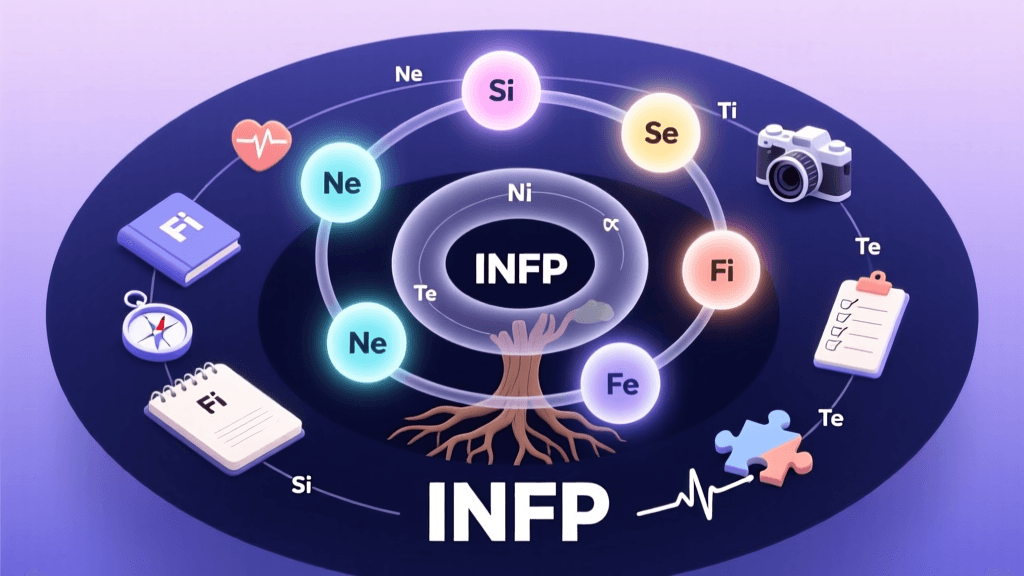
INFP Cognitive Function Stack Overview
The INFP personality type — often dubbed the Mediator or Healer — is one of the 16 types in the Myers-Briggs Type Indicator (MBTI®) framework. Yet beneath its popular label lies a rich, dynamic architecture rooted not in four-letter preferences, but in an ordered hierarchy of eight cognitive functions: four conscious (dominant to inferior) and four unconscious (the 'shadow' stack). Understanding this full stack — especially how Ni, Ne, Si, Se, Ti, Te, Fi, and Fe operate *within the INFP’s psyche* — unlocks deeper self-awareness, healthier relationships, and more intentional personal development.
Contrary to common misconception, INFPs do not lead with intuition (Ne) — though many assume so due to their open-ended curiosity and imaginative storytelling. In reality, the INFP’s dominant function is Introverted Feeling (Fi), followed by auxiliary Extraverted Intuition (Ne). This pairing forms the core of their identity: Fi anchors values, authenticity, and inner moral compass; Ne explores possibilities, metaphors, and latent meanings in the outer world. The tertiary and inferior functions — Introverted Sensing (Si) and Extraverted Thinking (Te) — mature later in life and often surface under stress or during pivotal growth phases.
But what about the other four functions — Ni, Se, Ti, and Fe? These belong to the INFP’s shadow stack: unconscious, less accessible, and typically activated under duress, fatigue, or unresolved trauma. When overused or misapplied, they manifest as distortions — e.g., Ni-driven catastrophizing, Se-fueled impulsivity, Ti-based hyper-analysis, or Fe-induced people-pleasing collapse. Recognizing these patterns isn’t about pathologizing them; it’s about reclaiming agency through functional literacy.
This article walks through each of the eight cognitive functions in the INFP’s full stack — not as abstract theory, but as lived psychological mechanisms. We’ll define each function with behavioral markers, illustrate with concrete examples (e.g., how Fi processes grief vs. how Te would approach the same event), explain developmental trajectories across the lifespan, and provide actionable strategies for integrating shadow functions healthily. You’ll also find a comparative table clarifying functional differences — especially between similar-sounding functions like Ni vs. Ne or Fi vs. Fe — grounded in peer-reviewed typology research.
Dominant Function Deep Dive: Introverted Feeling (Fi)
Core Purpose: To evaluate experience through an internal value system — authentic, deeply personal, and morally resonant. Fi is the INFP’s psychological bedrock: quiet, persistent, and fiercely protective of integrity.
How It Operates: Unlike Extraverted Feeling (Fe), which prioritizes group harmony and shared emotional norms, Fi asks: “Does this align with who I am? Does it feel true in my bones?” It doesn’t seek consensus — it seeks congruence. Decisions aren’t made via logic alone (Ti) or external metrics (Te), nor by social expectation (Fe), but by visceral resonance. A writer may abandon a lucrative book deal because the story compromises their ethical stance. A teacher might leave a well-funded school district after realizing its policies contradict their belief in inclusive pedagogy — even without a clear alternative lined up.
Real-Life Example: Consider Maya, a 28-year-old INFP graphic designer. Her team proposes a campaign for a fast-fashion brand known for labor violations. Colleagues see it as ‘just work’; Maya feels physically unsettled — tight chest, loss of appetite — before she can articulate why. Days later, she traces the discomfort to her lifelong commitment to sustainability and human dignity. She declines the project not with anger, but with calm resolve: “I can’t lend my creativity to something that violates my core.” That somatic signal → value retrieval → boundary-setting sequence is classic Fi-in-action.
Growth Tip — Strengthening Fi:
- Maintain a Values Journal: Not a gratitude log, but a dedicated space to record moments when you felt deeply aligned (or misaligned) — noting physical sensations, thoughts, and underlying principles. Over time, patterns emerge: e.g., “I consistently feel energized when mentoring newcomers” → signals a value of empowerment.
- Practice Fi-anchored ‘No’ Scripts: Pre-write compassionate but unambiguous boundaries: “I care about this project, but I can’t take on the timeline — it conflicts with my commitment to thoughtful, unhurried work.” Fi grows stronger when exercised with kindness and clarity.
- Avoid Fi-Confusion Traps: Fi is often mistaken for moodiness or indecisiveness. But hesitation isn’t absence of values — it’s Fi rigorously cross-checking options against layered convictions. Honor that process; don’t rush it.
Research confirms Fi-dominant types show heightened neural activity in brain regions linked to self-referential processing and moral reasoning. A 2021 fMRI study published in Neuropsychologia found that individuals scoring high on Fi-related scales exhibited significantly greater activation in the ventromedial prefrontal cortex during value-based decision tasks — underscoring Fi’s biological grounding in identity-integration.
Auxiliary Function Deep Dive: Extraverted Intuition (Ne)
Core Purpose: To generate connections, possibilities, and symbolic interpretations from external stimuli — seeing ‘what could be’ in people, ideas, and situations.
How It Operates: Ne is the INFP’s exploratory lens — playful, associative, and future-oriented. Where Fi holds the center, Ne casts wide nets: a single line in a poem sparks three novel metaphors; a friend’s offhand comment triggers reflections on systemic injustice, childhood memory, and potential art projects. Ne doesn’t seek closure — it thrives in open-endedness. For INFPs, Ne serves Fi: it scouts the world for experiences, narratives, and paths that could express inner values.
Real-Life Example: David, a 34-year-old INFP counselor, listens to a teen client describe feeling ‘invisible’ at school. Ne instantly links this to: (1) a documentary on adolescent alienation he watched last month, (2) his own high-school experience of being labeled ‘quiet,’ (3) Jung’s concept of the ‘persona,’ and (4) a local mural project seeking youth voices. Rather than jumping to advice, he reflects: “When you say ‘invisible,’ I wonder — is it about being unseen, or unheard? Or something else entirely?” That question opens space for the client’s authentic voice — a direct service of Ne supporting Fi’s commitment to depth and dignity.
Growth Tip — Harnessing Ne Constructively:
- Ne ‘Possibility Mapping’: When overwhelmed by options (e.g., career pivot), list 5–7 directions Ne suggests — then filter each through Fi: “Which option feels most aligned with my values of creativity, autonomy, and service?” This prevents Ne from spinning into paralysis.
- Anchor Ne in Concrete Output: Set micro-deadlines for turning Ne-generated ideas into tangible form — e.g., ‘Spend 20 minutes drafting the opening paragraph of that novel idea.’ Without scaffolding, Ne’s abundance remains unrealized.
- Notice Ne Distortions: Under stress, Ne can spiral into ‘catastrophe branching’ (‘What if this fails? What if I’m exposed? What if it ruins everything?’). Counter with grounded questions: ‘What’s one small, observable fact right now?’
Ne’s role in creative cognition is well documented. A landmark study by the American Psychological Association on divergent thinking identified Extraverted Intuition as the strongest predictor of originality in artistic and literary domains — particularly when paired with strong intrapersonal awareness (Fi), as in INFPs.
Tertiary and Inferior Functions
While Fi and Ne form the INFP’s conscious ‘driver and navigator,’ the tertiary and inferior functions — Introverted Sensing (Si) and Extraverted Thinking (Te) — constitute the ‘rearview mirror and spare tire’: less fluent, more effortful, yet vital for balance and resilience.
Introverted Sensing (Si) — Tertiary Function
Role: Stores and compares sensory data against past experiences — a repository of ‘what has worked,’ bodily rhythms, traditions, and nostalgic resonance.
INFP Expression: Si emerges most clearly in mid-to-late 20s and beyond. It manifests as comfort in ritual (morning tea, re-reading beloved novels), attention to physical well-being (noticing fatigue patterns), or reverence for meaningful objects (a journal from college, a gift from a mentor). Unlike ISTJs (Si-dominant), INFPs don’t use Si for rigid consistency — they curate it selectively, filtering memories and routines through Fi’s value-lens.
Under Stress: Si can harden into rigidity — clinging to outdated self-narratives (“I’ve always been bad at math, so why try now?”) or resisting change that threatens familiar emotional safety.
Extraverted Thinking (Te) — Inferior Function
Role: Organizes the external world via logic, efficiency, cause-effect analysis, and objective standards.
INFP Expression: Te is the INFP’s least developed function — often appearing late (30s–40s) and inconsistently. Healthy Te shows up as pragmatic project planning, learning Excel for a nonprofit grant application, or calmly negotiating deadlines. It’s not about becoming ‘logical’ instead of ‘feeling’ — it’s about deploying structure to serve Fi’s vision.
Under Stress (‘Grip’ Experience): When overwhelmed, INFPs may ‘flip’ into immature Te: harsh self-criticism (“I’m incompetent. I failed. Everyone sees it.”), obsessive scheduling, or cold, detached problem-solving that ignores emotional impact. This isn’t ‘being Te’ — it’s Te hijacked by fear.
| Function | Position in INFP Stack | Healthy Expression | Stressed/Grip Expression | Developmental Timeline |
|---|---|---|---|---|
| Fi | Dominant | Values-based boundaries; deep empathy rooted in self-knowledge | Self-righteousness; emotional withdrawal; martyrdom | Emerges strongly in adolescence |
| Ne | Auxiliary | Creative brainstorming; finding meaning in complexity | Paralysis by possibility; catastrophizing; scattered focus | Strengthens through 20s |
| Si | Tertiary | Rituals that nourish; learning from past patterns | Nostalgic idealization; resistance to necessary change | Integrates gradually from late 20s onward |
| Te | Inferior | Effective execution of Fi-aligned goals; fair systems-thinking | Grip: harsh self-judgment; authoritarian control attempts; burnout-driven overwork | Matures significantly post-35 with conscious practice |
How INFP Functions Develop Over Time
Cognitive function development isn’t linear — but research in lifespan psychology reveals predictable arcs. Isabel Briggs Myers herself emphasized that type development unfolds across decades, shaped by environment, trauma, education, and deliberate practice.
Adolescence (12–19): Fi crystallizes as identity forms — intense self-reflection, moral questioning, and sensitivity to hypocrisy. Ne flourishes in creative outlets and philosophical exploration. Si and Te remain largely unconscious; teens may dismiss routine (Si) or reject ‘cold logic’ (Te) as ‘inauthentic.’
Early Adulthood (20–29): Ne expands outward — INFPs experiment with careers, relationships, and worldviews. Fi becomes more discerning, shedding external expectations. Si begins whispering: noticing which habits restore energy, which friendships deepen self-trust. Te may appear as frustration with inefficiency — but rarely as skill.
Midlife (30–45): The critical integration phase. With maturity, INFPs learn to invite Te — not suppress it. They build systems that honor Fi (e.g., a writing schedule protecting creative flow) rather than fighting structure. Si deepens into wisdom: recognizing patterns in burnout, understanding their body’s signals, preserving meaningful traditions. This is where INFPs often shift from ‘searching for purpose’ to ‘incarnating purpose’ — launching values-driven ventures, mentoring, or committing to long-term causes.
Later Adulthood (45+): Integration peaks. Fi and Ne harmonize — vision and compassion are steady, not volatile. Si provides grounding continuity; Te enables impactful action. The shadow functions (Ni, Se, Ti, Fe) become more accessible and less threatening — used with discernment, not compulsion. As psychologist James H. Reynierse notes in Journal of Psychological Type, ‘The fully developed type manifests not as rigid preference, but as functional fluency — the ability to access any function when context demands it.’
FAQ
Is INFP really Fi-Ne, or could it be Ni-Fe?
No — INFP is definitively Fi-Ne. Confusion arises because some INFPs report strong Ni-like insights (e.g., sudden realizations about life direction). However, these are products of Fi-Ne synergy, not Ni dominance. Fi’s deep value processing + Ne’s pattern-spotting can yield profound, seemingly ‘foreseeing’ conclusions — but they emerge from internal resonance and external association, not Ni’s singular, convergent ‘aha’ focused on ultimate meaning. The MBTI® Manual (3rd ed.) and the Center for Applications of Psychological Type (CAPT) confirm Fi-Ne as the empirically validated stack for INFP.
Why do INFPs sometimes seem ‘unfeeling’ or overly logical?
This usually signals inferior Te activation under stress — not absence of feeling. When overwhelmed, the INFP’s usual Fi-Ne flow shuts down, and Te rushes in as a crude, anxiety-driven ‘fix-it’ mode: “Just solve this. Be efficient. Stop feeling.” It’s a protective collapse, not a trait. Recovery involves gentle Fi re-engagement: rest, values reflection, and compassionate self-talk.
Can INFPs develop their shadow functions healthily?
Yes — through conscious, low-stakes practice. For example:
- Ni (shadow dominant): Practice ‘future-self journaling’ — write a letter from your 70-year-old self offering wisdom about current struggles. This accesses Ni’s depth without letting it dominate.
- Se (shadow auxiliary): Engage in mindful sensory activities — pottery, hiking barefoot, cooking with full attention to textures and aromas — to ground Ne/Fi in the present moment.
- Ti (shadow tertiary): Study formal logic or debate ethics with a trusted friend — not to ‘win,’ but to clarify your own Fi positions through rigorous examination.
- Fe (shadow inferior): Volunteer in structured group settings (e.g., community garden teams) where emotional labor is shared and defined — building Fe capacity without Fi erosion.
How is Fi different from Fe — and why does it matter for INFPs?
Fi and Fe both process feelings — but their orientation differs fundamentally. Fi is introverted: it filters emotion through a private value system (“How does this affect my integrity?”). Fe is extraverted: it attunes to the emotional climate of the group and adjusts to maintain harmony (“How does this affect everyone’s comfort?”). An INFP using Fe healthily might host a gathering with warmth and attentiveness — but will decline hosting if it depletes their Fi reserves. Confusing the two leads INFPs to overextend (Fe) or isolate (Fi). Clarity here prevents burnout and supports authentic contribution.
Do INFPs ever use Ti or Te effectively — or are they ‘bad at logic’?
INFPs aren’t ‘bad at logic’ — they prioritize different kinds of truth. Fi seeks moral coherence; Ti seeks logical consistency; Te seeks pragmatic effectiveness. An INFP can master statistics (Te) to analyze climate data for an advocacy campaign — because Te serves Fi’s value of ecological justice. Or they may use Ti to deconstruct a philosophical text, not to ‘win’ an argument, but to refine their own ethical framework. The key is function alignment: logic becomes powerful when it serves the heart’s conviction.
Understanding the INFP cognitive stack isn’t about boxing oneself in — it’s about claiming sovereignty over one’s inner architecture. When Fi knows itself, Ne has direction, Si offers stability, and Te builds bridges — the INFP moves from seeking meaning to embodying it. As the poet Rainer Maria Rilke wrote in Letters to a Young Poet, ‘Live the questions now. Perhaps you will then gradually, without noticing it, live along some distant day into the answer.’ For the INFP, cognitive literacy is the quiet, courageous practice of living those questions — with precision, compassion, and unwavering fidelity to the self.