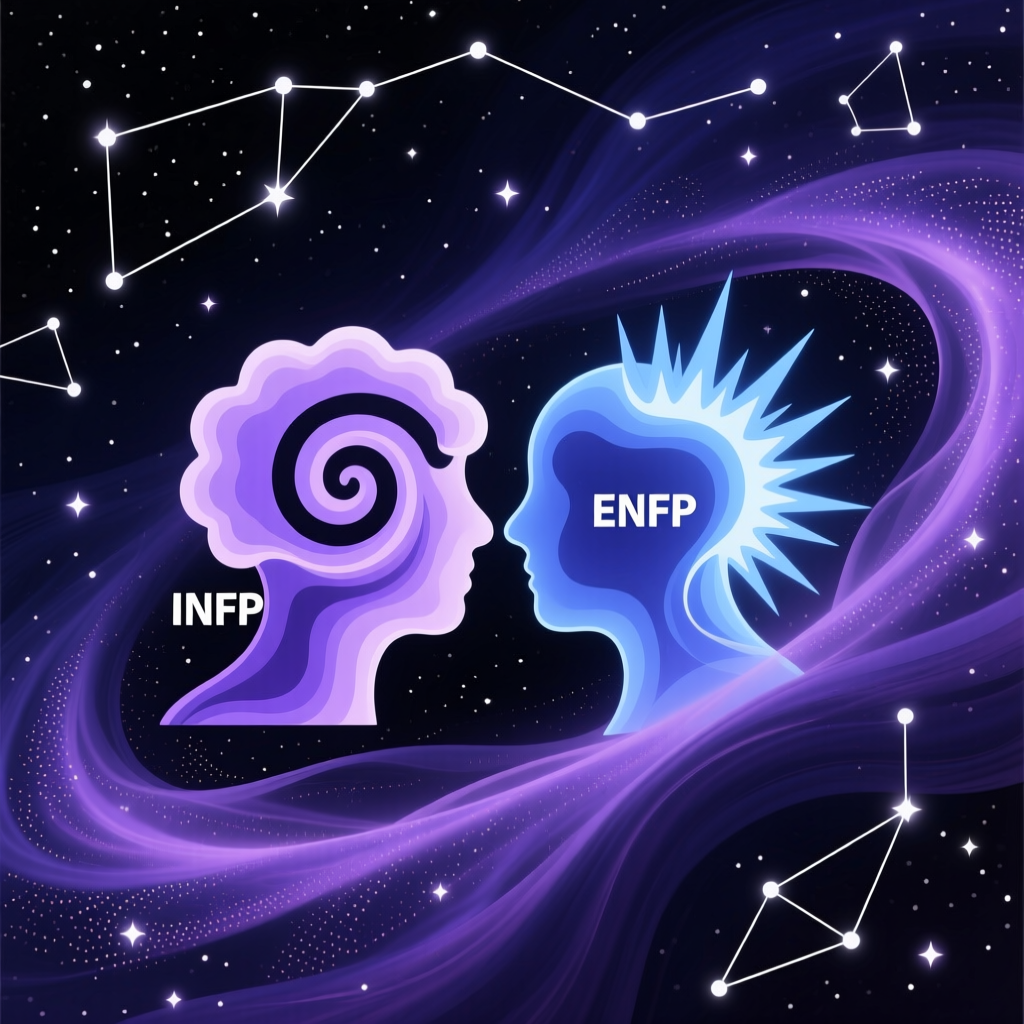
When an INFP and an ENFP come together, something remarkable happens. Two of the most imaginative, idealistic, and emotionally attuned personality types in the Myers-Briggs system find in each other a kindred spirit who speaks the same intuitive language. This pairing is often described as one of the most naturally harmonious matches in the MBTI framework — and for good reason. Both types lead with intuition, prioritize personal values, and approach life with a sense of wonder that most other types struggle to match.
But creative chemistry is about more than simply getting along. It is about the spark that ignites when two minds collide in ways that produce something neither could have generated alone. The INFP brings depth, introspection, and a richly layered inner world. The ENFP brings expansiveness, infectious enthusiasm, and a gift for connecting ideas across seemingly unrelated domains. Together, they form a creative partnership that can feel almost magical — whether in romance, friendship, or collaborative work.
This article explores the full spectrum of INFP and ENFP compatibility, examining the cognitive machinery that drives their connection, the areas where they thrive, the challenges they may face, and practical strategies for making this already powerful pairing even stronger.
The Cognitive Function Interplay: Why INFPs and ENFPs Click So Deeply
To truly understand the creative chemistry between an INFP and an ENFP, you need to look beneath the surface-level type letters and examine the cognitive function stacks that drive each personality. This is where the real magic reveals itself.
The INFP function stack is Introverted Feeling (Fi), Extroverted Intuition (Ne), Introverted Sensing (Si), and Extroverted Thinking (Te). The ENFP stack is Extroverted Intuition (Ne), Introverted Feeling (Fi), Extroverted Thinking (Te), and Introverted Sensing (Si). Notice anything? They share the exact same four cognitive functions — just in a slightly different order.
This shared function palette means that INFPs and ENFPs process the world through fundamentally compatible lenses. Both types prioritize authenticity and personal values through Fi. Both types explore possibilities and generate novel ideas through Ne. Both types have a complicated relationship with structure and efficiency through their lower Te and Si functions. The difference lies primarily in which functions take the lead.
For the INFP, Introverted Feeling is the dominant function. This means they filter everything through a deeply personal value system. They ask, "Does this align with who I am and what I believe?" Their Extroverted Intuition serves as the auxiliary function, helping them explore possibilities that resonate with their inner values. The ENFP leads with Extroverted Intuition, making them natural explorers of ideas, patterns, and possibilities. Their Introverted Feeling sits in the auxiliary position, providing a value-based compass that guides which possibilities feel worth pursuing.
This complementary arrangement is what creates the signature INFP-ENFP dynamic. The ENFP casts a wide net of ideas and possibilities. The INFP evaluates those possibilities against a refined internal value system. Together, they form a creative feedback loop that is both expansive and discerning — generating ideas that are not only innovative but also meaningful and authentic.
Romantic Dynamics: When Two Dreamers Fall in Love
In romantic relationships, the INFP and ENFP pairing can feel like stepping into a novel that neither partner knew they were writing. There is an almost uncanny sense of being understood — of finding someone who not only tolerates your quirks but actively celebrates them. This is a relationship characterized by deep emotional intimacy, shared idealism, and a mutual desire to explore the deeper dimensions of human experience.
The early stages of an INFP-ENFP romance are often electric. The ENFP's natural charisma and enthusiasm draw the more reserved INFP out of their shell, while the INFP's depth and sincerity give the ENFP a sense of emotional grounding they may not have known they were craving. Conversations flow effortlessly, often lasting deep into the night as both partners explore topics ranging from philosophy and art to their personal dreams and fears.
One of the greatest strengths of this romantic pairing is the mutual respect for individuality. Both Fi-dominant and Fi-auxiliary types place enormous value on personal authenticity. Neither partner is likely to pressure the other into conforming to external expectations or social norms. The INFP needs space for solitude and introspection, and the ENFP — while more socially oriented — generally understands and respects this need because their own Fi function gives them insight into why that alone time matters.
However, the romantic dynamic is not without its challenges. Both types can struggle with practical day-to-day responsibilities. Household management, financial planning, and routine maintenance tasks may fall through the cracks when both partners are more interested in exploring ideas than organizing their living space. Additionally, the ENFP's need for external stimulation and social interaction can sometimes overwhelm the INFP, who may need more downtime than their partner realizes.
Emotional intensity is another double-edged sword in this pairing. Both types feel deeply, and both can be prone to taking things personally. When conflicts arise, the INFP may withdraw into their inner world to process their feelings, while the ENFP may want to talk things out immediately. Navigating these different processing styles requires patience and explicit communication — something we will explore further in the conflict resolution section below.
For more insights on how intuitive feelers approach love, explore our broader MBTI compatibility guide to see how other type pairings compare.
Friendship Patterns: A Bond Built on Imagination and Authenticity
As friends, INFPs and ENFPs often form bonds that feel less like ordinary friendships and more like creative partnerships or soul connections. These are the friendships where you lose track of time during conversations, where you text each other obscure articles and art at two in the morning, and where you feel genuinely seen in ways that are rare in most social relationships.
The ENFP typically takes the role of the social catalyst in this friendship. They are the ones who introduce the INFP to new people, new experiences, and new ideas. They drag their INFP friend to events, gatherings, and adventures that the INFP might never have pursued on their own — and more often than not, the INFP ends up grateful for the push. The ENFP's enthusiasm is genuinely contagious, and their ability to see potential in people and situations helps the INFP expand their comfort zone in ways that feel safe rather than threatening.
The INFP, in turn, offers the ENFP something equally valuable: a sanctuary of depth and authenticity. In a social world that often rewards surface-level interactions, the INFP friend is the one who will ask the ENFP how they really feel beneath their cheerful exterior. They notice when the ENFP's enthusiasm is masking exhaustion or sadness, and they create a safe space for vulnerability that the ENFP may not find elsewhere. This emotional attunement is one of the most treasured aspects of the INFP-ENFP friendship.
Creative collaboration is where this friendship truly shines. Whether they are writing together, making art, brainstorming business ideas, or simply engaging in imaginative conversation, the INFP and ENFP bring out the best in each other's creative instincts. The ENFP generates a cascade of possibilities — wild, unconventional, sometimes impractical — and the INFP instinctively gravitates toward the ones that carry the most emotional truth and depth. Together, they refine raw ideas into something genuinely original.
One potential friction point in this friendship is the difference in social energy. ENFPs recharge through interaction and may want to spend more time together than the INFP can comfortably provide. If the INFP begins pulling away without explanation, the ENFP may interpret this as rejection or disinterest. Clear communication about social needs and boundaries is essential for maintaining the long-term health of this friendship.
Learn more about how INFPs and ENFPs approach their social worlds in our individual type profiles.
Workplace Synergy: Turning Vision into Meaningful Impact
In professional settings, the INFP and ENFP pairing can be extraordinarily productive — provided they are working on projects that align with their shared values and allow room for creative expression. These are not the types who thrive in rigid, highly structured corporate environments with little room for innovation. But give them a meaningful mission, creative autonomy, and each other as collaborators, and the results can be remarkable.
The ENFP in the workplace is typically the idea generator, the networker, and the enthusiastic presenter. They excel at seeing the big picture, connecting disparate concepts, and inspiring others with their vision. They are natural brainstormers who can generate twenty ideas in the time it takes most people to articulate one. Their energy is infectious, and they have a gift for getting teams excited about new directions and possibilities.
The INFP in the workplace serves as the conscience and the deep thinker. They evaluate ideas not just for their novelty or market potential but for their alignment with core values and their potential human impact. They ask the questions that others overlook: Who does this serve? Is this ethical? Does this feel right? Their contributions may be quieter than the ENFP's, but they are often the ones that give a project its soul and its staying power.
When these two types collaborate on creative projects — whether in writing, design, marketing, counseling, education, or social impact work — the synergy is palpable. The ENFP pushes the project forward with momentum and enthusiasm, while the INFP ensures that every element carries meaning and authenticity. The ENFP handles the external communication and relationship-building, while the INFP handles the deep, focused work that gives the project substance.
Challenges in the workplace arise primarily around execution and follow-through. Both types are stronger at generating ideas than at implementing them. Deadlines, administrative details, and routine maintenance tasks can become significant pain points. This pairing benefits enormously from either developing stronger systems and habits around execution or partnering with types who excel in those areas — such as ISTJs or ESTJs, who can provide the structural support that INFPs and ENFPs need to bring their visions to life.
Another potential workplace challenge is conflict avoidance. Both INFPs and ENFPs tend to dislike confrontation and may avoid addressing issues directly until they have grown into much larger problems. Creating a culture of open, honest feedback — even when it feels uncomfortable — is critical for this pairing to succeed professionally over the long term.
Communication Styles: Speaking the Same Intuitive Language
One of the most immediately noticeable aspects of the INFP-ENFP connection is how naturally their communication flows. Both types are intuitive processors who think in patterns, metaphors, and possibilities rather than linear, step-by-step logic. This means they can leap between topics, make abstract connections, and understand each other's tangents in ways that would leave more concrete types bewildered.
The ENFP's communication style is typically expressive, animated, and externally processed. They think out loud, using conversation as a tool for exploring and refining their ideas. They jump between subjects rapidly, fueled by associations that make perfect sense to them even if others struggle to follow the thread. Their enthusiasm is evident in their tone, their body language, and their tendency to use vivid, colorful language.
The INFP's communication style is more measured, reflective, and carefully chosen. They tend to process internally before speaking, which means their contributions to conversations are often more polished and deeply considered. They have a gift for finding precisely the right word to capture a complex emotion or abstract concept, and they appreciate nuance in ways that make conversations with them feel rich and rewarding.
Together, these complementary communication styles create a dynamic where the ENFP's rapid-fire ideation is balanced by the INFP's thoughtful reflection. The ENFP throws out ideas and the INFP catches the ones that resonate, examining them from multiple angles and adding layers of meaning. This back-and-forth can produce insights that neither type would have reached independently.
A key communication challenge in this pairing revolves around the INFP's tendency to withdraw during emotional stress. When hurt or overwhelmed, the INFP may go silent, retreating into their inner world to process their feelings alone. The ENFP, who prefers to process emotions externally through conversation, may interpret this silence as rejection or passive aggression. Understanding that these are simply different — but equally valid — processing styles is crucial for both partners.
Both types also share a tendency toward idealistic communication. They speak in terms of what could be, what should be, and what they hope will be. While this makes for inspiring conversations, it can sometimes mean that practical, concrete details get lost in the exchange. Making a conscious effort to ground their communication in specifics — timelines, action steps, measurable outcomes — can help this pairing translate their shared vision into tangible reality.
Conflict Resolution: Navigating the Emotional Depths Together
Conflict in an INFP-ENFP relationship tends to be less frequent than in many other type pairings, largely because both types are naturally empathetic, accommodating, and averse to confrontation. However, this same conflict-avoidant tendency can create a different kind of problem: unresolved issues that simmer beneath the surface until they reach a breaking point.
When disagreements do arise, they typically center around a few recurring themes. The ENFP's desire for social engagement and external stimulation may clash with the INFP's need for solitude and quiet. The INFP's deeply held values may conflict with the ENFP's more flexible, exploratory approach to beliefs and commitments. And both types' tendency to take things personally can turn minor misunderstandings into emotionally charged situations.
The key to effective conflict resolution for this pairing is creating explicit agreements about how to handle disagreements before they occur. This might include establishing a "cooling off" period that gives the INFP time to process internally while reassuring the ENFP that the conversation will resume. It might involve agreeing to address issues within a specific timeframe rather than letting them fester. And it almost certainly requires both partners to practice direct communication — saying what they mean rather than expecting the other person to intuitively pick up on subtle cues.
One powerful strategy is for both types to leverage their shared Fi function during conflicts. Because both INFPs and ENFPs are fundamentally driven by personal values and a desire for authenticity, they can often find common ground by returning to the question: "What matters most to each of us here?" When both partners articulate their core needs and values — rather than arguing about surface-level behaviors — resolution becomes much more achievable.
The ENFP can support healthier conflict resolution by giving the INFP space to process and by resisting the urge to fill every silence with words. The INFP can contribute by making an effort to verbalize their feelings, even when it feels uncomfortable, rather than expecting the ENFP to read their emotional state. Both partners benefit from remembering that their shared empathy and mutual respect are powerful tools — not just for avoiding conflict but for transforming it into an opportunity for deeper understanding.
For a broader perspective on how different types handle disagreement, check out our article on MBTI conflict resolution strategies across all personality pairings.
Practical Tips for Strengthening the INFP-ENFP Connection
Whether you are an INFP and ENFP in a romantic relationship, a close friendship, or a professional partnership, the following strategies can help you maximize your creative chemistry while minimizing the friction points that commonly arise between these two types.
Create shared creative rituals. Dedicate regular time to collaborative creative activities — whether that is journaling together, brainstorming projects, visiting art galleries, attending live music events, or simply having deep conversations over coffee. These shared experiences feed both types' need for meaning and imagination and strengthen the bond between you.
Establish practical systems. Acknowledge that neither of you is naturally inclined toward routine, organization, or administrative tasks. Rather than pretending these things will take care of themselves, create simple systems that reduce the cognitive load. Shared calendars, automated bill payments, meal planning apps, and weekly check-ins can prevent practical neglect from undermining an otherwise beautiful connection.
Honor different social needs. The ENFP should feel free to pursue social activities independently without feeling guilty, and the INFP should feel empowered to decline invitations without offering elaborate justifications. A healthy INFP-ENFP relationship allows both partners to meet their social needs without forcing the other into uncomfortable situations.
Practice direct emotional communication. Both types are intuitive enough to pick up on emotional undercurrents, but neither should rely on this ability as a substitute for clear, verbal communication. Make a habit of stating your feelings, needs, and concerns explicitly. Phrases like "I am feeling..." and "I need..." go a long way in preventing misunderstandings.
Balance dreaming with doing. It is easy for this pairing to get lost in the intoxicating world of ideas and possibilities. Set aside specific times to review your shared goals and assess what concrete steps you have taken toward achieving them. Celebrate progress, not just vision.
Support each other's growth edges. The INFP can gently encourage the ENFP to develop greater follow-through and commitment. The ENFP can gently encourage the INFP to take more risks and engage more fully with the external world. When delivered with love and respect, these nudges help both types become more well-rounded versions of themselves.
Seek complementary partnerships when needed. Recognize that there are areas where neither of you excels — and that is perfectly fine. Building relationships with more structured, practical types can provide the support system you need to bring your shared visions to life. Explore our compatibility resources to understand how other type dynamics can complement your INFP-ENFP connection.
Frequently Asked Questions
Are INFPs and ENFPs considered a highly compatible match?
Yes, INFPs and ENFPs are widely regarded as one of the most naturally compatible pairings in the MBTI system. Their shared cognitive functions — Fi, Ne, Te, and Si — mean they process the world through remarkably similar lenses. They share core values around authenticity, creativity, and personal growth, and they intuitively understand each other's emotional landscapes in ways that many other type pairings cannot. While no relationship is without challenges, the INFP-ENFP pairing has a strong foundation of mutual understanding and complementary strengths that gives it excellent long-term potential in romance, friendship, and creative collaboration alike.
What are the biggest challenges INFPs and ENFPs face together?
The most common challenges for INFP-ENFP pairings revolve around practical execution, conflict avoidance, and differing social needs. Both types tend to prioritize ideas and emotions over logistics, which can lead to neglected responsibilities, missed deadlines, and disorganized living or working environments. Their shared aversion to confrontation means that unresolved issues can accumulate over time, creating emotional distance. Additionally, the ENFP's higher need for external stimulation and social interaction can sometimes clash with the INFP's need for solitude and quiet reflection. Addressing these challenges proactively — through systems, open communication, and mutual respect for different needs — is essential for long-term harmony.
How do INFPs and ENFPs handle emotional intimacy differently?
While both types value emotional intimacy deeply, they approach it from different directions. The ENFP tends to pursue intimacy through shared experiences, enthusiastic self-disclosure, and verbal expression. They process emotions externally and feel closest to others when they are actively engaging in deep conversation or shared activities. The INFP, by contrast, builds intimacy more slowly and internally. They need to feel safe before opening up, and they often express closeness through quiet presence, thoughtful gestures, and carefully chosen words rather than through constant verbal affirmation. Both styles are deeply authentic — they simply operate on different timelines and through different channels. Understanding and respecting these differences is key to building lasting emotional connection.
Can INFPs and ENFPs maintain a successful long-term relationship?
Absolutely. INFPs and ENFPs have excellent potential for lasting, fulfilling long-term relationships when both partners are committed to personal growth and open communication. Their shared values, mutual empathy, and complementary cognitive functions provide a strong foundation that many other pairings lack. The key to long-term success lies in addressing their shared weaknesses proactively — particularly around practical responsibilities and conflict resolution — while continuing to nurture the creative and emotional connection that brought them together. Couples who establish healthy systems, practice direct communication, and support each other's individual growth often find that their bond deepens and enriches over time, making the INFP-ENFP pairing one of the most rewarding matches in the MBTI framework.