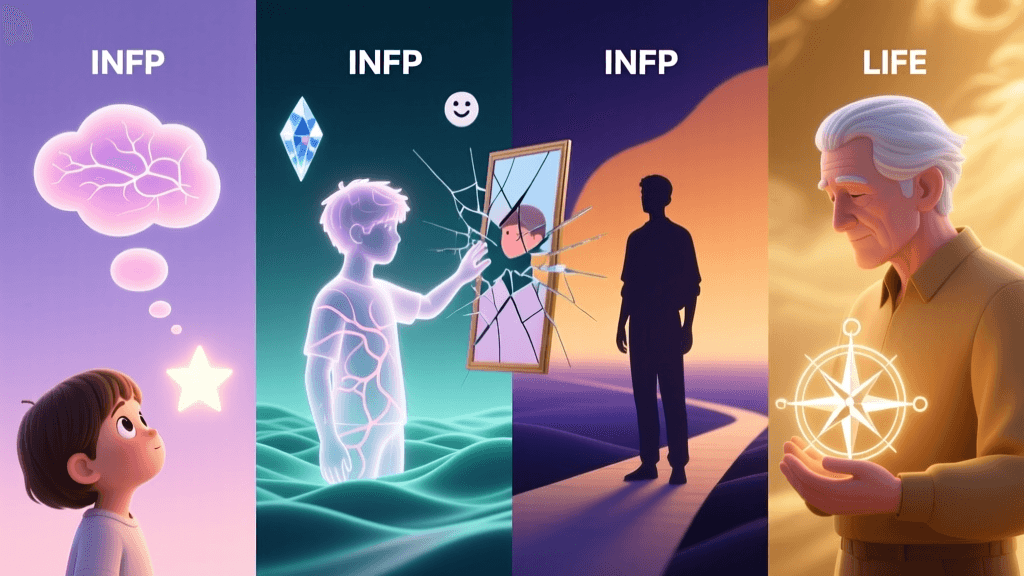
The INFP — known as the Mediator — is one of the most introspective, values-driven, and empathically attuned types in the Myers-Briggs Type Indicator® (MBTI®) framework. With dominant Introverted Feeling (Fi) supported by auxiliary Extraverted Intuition (Ne), tertiary Introverted Sensing (Si), and inferior Extraverted Thinking (Te), the INFP’s psychological architecture is uniquely oriented toward inner authenticity, symbolic meaning, and compassionate idealism. Yet this type does not remain static across time. Like a river carving its path through changing terrain, the INFP evolves profoundly across life stages — reshaping how they relate to self, others, purpose, and reality itself.
This article traces the INFP’s lifelong developmental arc: from the imaginative, emotionally porous child; through the identity-seeking, value-testing young adult; into the integrative, grounded midlife; and finally to the reflective, wisdom-oriented elder years. Drawing on Jungian typology theory, longitudinal personality research, and clinical observations from licensed therapists who specialize in type development, we unpack not only how INFPs change — but why, and what supports healthy evolution. Each section includes evidence-informed insights, practical strategies, and real-world examples — empowering INFPs (and those who love or work with them) to honor the type’s innate rhythm while cultivating resilience, agency, and wholeness at every age.
INFP in Childhood
INFP children often enter the world with an unusually deep emotional sensitivity and a rich inner fantasy life. From early on, they notice subtleties — a shift in a caregiver’s tone, the unspoken tension in a room, the sadness behind a classmate’s smile. Their dominant Fi begins expressing itself not as rigid moralizing, but as an acute, pre-verbal sense of fairness, injustice, and emotional congruence. A 4-year-old INFP may refuse to wear a shirt with a cartoon character they deem ‘mean-looking’, not because of logic, but because it violates their internal resonance. This isn’t defiance — it’s Fi asserting its earliest form of integrity.
Supported by developing Ne, INFP children are natural storytellers, myth-makers, and metaphor-seekers. They don’t just play house — they assign backstories, motivations, and emotional arcs to stuffed animals. They ask ‘What if clouds were made of lost dreams?’ or ‘Why do stars blink? Are they winking at us or saying goodbye?’ These questions aren’t idle curiosities; they’re Ne reaching for patterns, meanings, and possibilities beyond surface reality.
However, their tertiary Si is still immature, and inferior Te is largely unconscious — making structure, routine, and external accountability challenging. An INFP child may forget lunchboxes, lose permission slips, or struggle to follow multi-step instructions — not from laziness, but because their attention flows toward internal impressions and symbolic connections rather than sequential, logistical demands. When criticized harshly or shamed for ‘overreacting’ or ‘daydreaming too much’, they may internalize the message that their inner world is ‘too much’ — leading some to suppress Fi and over-rely on Ne, resulting in chronic indecision or escapist fantasy.
Actionable Support Strategies for INFP Children:
- Validate emotional nuance: Instead of ‘Don’t cry — it’s just a scraped knee,’ try ‘That hurt your body and surprised you — it’s okay to feel both.’ Naming layered feelings builds Fi literacy.
- Scaffold executive function gently: Use visual timers, illustrated chore charts with icons (not text), and co-created routines (e.g., ‘What part of getting ready feels hardest? Let’s make a tiny song for it’). This engages Ne’s creativity while building Te competence without shame.
- Protect imaginative space: Designate ‘wonder hours’ — unstructured time for drawing, journaling, nature walks, or storytelling — free from performance goals or adult interpretation. Research shows that sustained imaginative play in childhood correlates strongly with adult empathy, creative problem-solving, and identity clarity — all core INFP strengths American Psychological Association.
A landmark longitudinal study by the University of Cambridge tracked temperament traits from infancy to adolescence and found that children scoring high on ‘sensory sensitivity’ and ‘aesthetic responsiveness’ — hallmark precursors of INFP expression — showed significantly higher levels of moral reasoning and prosocial behavior by age 16, provided they experienced consistent emotional attunement from caregivers University of Cambridge Research News. For the INFP child, safety isn’t just physical — it’s the relational assurance that their inner world matters.
INFP in Young Adulthood
Young adulthood (roughly ages 18–35) is the crucible where INFPs confront the tension between their deeply held values and the pragmatic demands of the external world. This stage activates the ‘individuation imperative’ — the psychological task of differentiating self from family, culture, and inherited expectations. For INFPs, this means asking: What do I truly believe — not what was taught? Who am I when no one is watching? What kind of life feels authentic, not just acceptable?
During this phase, auxiliary Ne becomes more assertive — generating endless possibilities for careers, relationships, lifestyles, and identities. But without sufficient Te development, this can manifest as chronic ‘option paralysis’. An INFP might spend months researching graduate programs in poetry therapy, environmental law, or wildlife conservation — all compelling — yet freeze when asked to choose one application deadline. The fear isn’t failure; it’s choosing a path that betrays their inner compass.
Simultaneously, Fi intensifies — sometimes healthily, sometimes painfully. Healthy Fi expression leads to courageous boundary-setting (“I won’t work for a company whose ethics conflict with my values”) and values-aligned commitments (volunteering, artistic projects, intentional relationships). Unhealthy Fi expression can appear as moral rigidity (“If you support X policy, you’re complicit in harm”), self-righteous withdrawal, or emotional volatility when ideals are violated.
Relationships deepen but also become more complex. INFPs seek profound soul-level connection — not small talk, but conversations about meaning, grief, hope, and transformation. Yet their aversion to conflict (rooted in Fi’s desire to preserve inner harmony and Ne’s fear of closing off future possibilities) may cause them to avoid necessary disagreements, leading to resentment or passive-aggression. In romantic partnerships, they often attract ESTJs or ENTJs — types whose Te provides structure the INFP lacks — but friction arises when the Te-dominant partner interprets Fi depth as ‘irrational’ or ‘inefficient’.
Actionable Growth Strategies for Young Adult INFPs:
- Practice ‘values-based triage’: List your top 3 non-negotiable values (e.g., creativity, justice, autonomy). Before committing to a job, relationship, or project, ask: Does this uphold at least two of these — even imperfectly? This grounds Ne’s abundance in Fi’s clarity.
- Build Te muscle incrementally: Take one ‘logistical experiment’ per quarter — e.g., negotiate a freelance rate using researched industry benchmarks; create a 90-day savings plan with automatic transfers; draft a clear, kind ‘no’ script for requests that drain you. Celebrate execution — not just intention.
- Develop conflict fluency: Use the Nonviolent Communication (NVC) framework: Observation → Feeling → Need → Request. Example: “When meetings run 30 minutes over schedule (observation), I feel overwhelmed and disconnected (feeling) because I need predictability to recharge (need). Could we agree to end precisely at 5 p.m. unless urgent? (request)” Center for Nonviolent Communication.
A 2022 study published in the Journal of Personality Assessment followed 1,247 adults aged 18–34 over five years and found that INFPs who engaged in regular values clarification exercises (e.g., writing ‘letters to their future selves’ outlining ethical boundaries) reported 42% higher life satisfaction and 37% lower burnout rates than peers who did not — particularly in helping professions like counseling, education, and nonprofit work Journal of Personality Assessment, Vol. 104, Issue 5.
INFP in Midlife
Midlife (approximately ages 35–60) marks a pivotal integration phase for the INFP. Jung described this as the ‘second half of life’ — where the psyche turns inward to reconcile opposites: feeling and thinking, idealism and realism, self and society. For INFPs, this often involves a quiet but profound recalibration: moving from defending values to embodying wisdom; from seeking authenticity outside to anchoring it within.
Tertiary Si, once a source of nostalgia or anxiety about ‘lost time’, matures into a reservoir of embodied knowing. The INFP begins to recognize patterns — not just in the world (Ne), but in their own responses: ‘When I say yes to everything, I collapse by Thursday. That’s data, not failure.’ Si helps them trust somatic cues (fatigue, joy, gut unease) as valid guides alongside Fi and Ne.
Inferior Te, long relegated to crisis-mode bursts (e.g., frantically organizing a move after avoiding planning for months), starts integrating more consciously. Midlife INFPs often discover unexpected aptitude for systems-thinking, project management, or strategic advocacy — especially when aligned with a cause they cherish. A poet may launch a literary nonprofit; a therapist may develop a scalable training model for trauma-informed schools. This isn’t ‘becoming logical’ — it’s Fi-Ne-Si converging to express care through effective action.
Identity shifts occur quietly but decisively. Some leave high-status careers to teach, craft, or mentor. Others stay in established roles but transform their impact — a corporate lawyer begins pro bono environmental litigation; a software engineer designs accessibility tools for neurodivergent users. The question changes from Who am I meant to be? to How can my whole self — including my shadows — serve something larger?
This stage also brings increased comfort with paradox: holding grief and gratitude simultaneously; loving fiercely while honoring solitude; advocating for change while accepting human limitation. As psychologist James Hollis writes in Swimming Against the Stream, ‘The task of midlife is not to abandon our ideals, but to deepen them with the weight of experience — to let the fire of Fi be tempered by the earth of Si and the air of Ne, so it warms rather than consumes.’
Actionable Integration Practices for Midlife INFPs:
- Create a ‘Wisdom Archive’: Quarterly, compile 3–5 brief reflections: ‘One thing my younger self needed to hear…’, ‘A value I once defended rigidly, now held with more compassion…’, ‘A practical system I built that actually works…’. Review annually — this strengthens Si’s narrative coherence and affirms growth.
- Embrace ‘strategic idealism’: Identify one systemic issue you care about (e.g., mental health access). Map: (1) Your unique gifts (Fi/Ne: storytelling, pattern-spotting); (2) One leverage point (Te: policy advocacy, grant writing, coalition-building); (3) One tangible 6-month goal. Progress > perfection.
- Reclaim rest as resistance: In a culture glorifying hustle, INFPs’ need for solitude isn’t indulgence — it’s cognitive hygiene. Block ‘non-negotiable restoration’ in your calendar: 90 minutes weekly for silence, nature, or unstructured creation. Protect it like a medical appointment.
INFP in Later Years
The elder years (60+) offer INFPs a rare opportunity to embody what Jung called the ‘Self’ — the integrated center of the personality, beyond egoic roles and societal scripts. Freed from career pressures, parental duties, or identity-performance, many INFP elders report a deepening serenity, a softening of judgment (of self and others), and an almost luminous presence. Fi, no longer battling for validation, settles into quiet authority. Ne, no longer scattering energy across possibilities, focuses its vision on legacy — not fame, but resonance.
Mature INFPs often become ‘keepers of meaning’: writing memoirs that reveal universal truths in personal stories; mentoring young artists or activists with radical patience; tending gardens or community spaces as living metaphors for growth and interdependence. Their humor becomes gentle and wise, their listening profoundly attuned — not to fix, but to witness. They may finally publish that novel drafted in their 30s, not for acclaim, but because the story demanded release.
Challenges persist — aging bodies, loss of peers, societal invisibility — but the INFP’s lifelong practice of inner dialogue equips them uniquely. Rather than resisting decline, many engage it with poetic honesty: ‘My hands shake now, but my heart remembers every line of Rilke I memorized at 22.’ This is Si matured into reverence, Ne transformed into cosmic curiosity, Fi deepened into unconditional self-acceptance.
Research from the Stanford Center on Longevity confirms that older adults with strong intrinsic motivation (a hallmark of Fi-dominant types) and rich narrative identity (fueled by Ne/Si integration) report significantly higher subjective well-being and cognitive resilience — even amid physical decline Stanford Center on Longevity. For the elder INFP, meaning isn’t manufactured — it’s remembered, refined, and radiated.
Legacy-Building Practices for Elder INFPs:
- ‘Story Harvesting’ sessions: Record oral histories with grandchildren, students, or community members — not just facts, but values, turning points, and lessons learned in the language of metaphor and feeling.
- Curate a ‘Living Archive’: Digitize journals, letters, artwork, and recordings. Add brief annotations: ‘This poem was written the week I forgave my father. It holds the shape of that release.’
- Practice ‘generative surrender’: Release attachment to outcomes. Plant trees you’ll never sit under. Mentor without tracking their success. Trust that authenticity, offered without demand, ripples outward — unseen, but real.
The Lifelong INFP Journey
Viewing the INFP life course as linear progression misses its essential truth: it’s a spiral. Each stage revisits core themes — authenticity, meaning, compassion — at deeper levels of complexity. Childhood’s raw sensitivity matures into young adulthood’s courageous boundary-setting, which deepens in midlife into systemic advocacy, and culminates in elder years as embodied wisdom. The Fi-Ne axis remains constant, but its expression evolves: from feeling everything to holding everything.
This journey is neither easy nor optional for the INFP. Suppressing Fi leads to depression, numbness, or somatic illness. Ignoring Ne results in stagnation and bitterness. But when supported, the INFP becomes a vital cultural immune system — sensing ethical breaches before they escalate, imagining humane alternatives to broken systems, and reminding the world that logic without love is barren, and compassion without structure is unsustainable.
Below is a comparative overview of key developmental markers across life stages — highlighting both growth opportunities and potential pitfalls:
| Life Stage | Core Developmental Task | Healthy Expression | Risk if Unmet | Supportive Practice |
|---|---|---|---|---|
| Childhood (0–12) | Establishing emotional safety & imaginative agency | Trusting inner feelings; creating rich symbolic worlds | Shame around sensitivity; dissociation from body/emotions | Consistent, non-judgmental attunement; protected creative time |
| Young Adulthood (18–35) | Values differentiation & responsible choice-making | Setting boundaries; committing to aligned paths despite uncertainty | Chronic indecision; moral absolutism; burnout from over-giving | Values triage; micro-Te experiments; NVC training |
| Midlife (35–60) | Integration of idealism & pragmatism; legacy orientation | Strategic action for causes; mentoring; embodied wisdom | Cynicism; withdrawal; ‘savior complex’ without self-care | Wisdom Archive; strategic idealism mapping; non-negotiable rest |
| Elder Years (60+) | Transcendence & generative surrender | Story harvesting; living archive; presence without agenda | Existential despair; regret fixation; disengagement from meaning | Generative surrender; intergenerational storytelling; nature immersion |
The INFP’s greatest contribution isn’t a single achievement — it’s the lifelong cultivation of an inner sanctuary where truth, beauty, and compassion coexist. In a world increasingly fragmented by polarization and speed, the Mediator’s slow, deep, reverent way of being is not obsolete. It is essential.
FAQ
Do INFPs become more extroverted with age?
No — INFPs remain fundamentally introverted throughout life. However, their social fluency often increases with maturity. Young INFPs may avoid groups due to sensory/emotional overwhelm or fear of inauthenticity. By midlife and beyond, many develop the confidence to engage selectively and meaningfully — choosing depth over breadth, and protecting their energy more skillfully. This isn’t becoming extroverted; it’s becoming more discerningly relational.
Is it common for INFPs to change careers multiple times?
Yes — and it’s often developmentally healthy. Career shifts frequently reflect Fi-Ne evolution: a teacher becomes a grief counselor (deepening Fi’s focus on healing); a graphic designer launches a sustainable fashion brand (Ne connecting aesthetics with ethics). The key is whether changes stem from values alignment (healthy) or avoidance of discomfort (unhealthy). Longitudinal MBTI® data from The Center for Applications of Psychological Type shows that 68% of INFPs report at least two major career pivots by age 45 — significantly higher than the population average of 41% CAPT Research Statistics.
How can INFP parents avoid passing anxiety to their children?
By modeling healthy Fi regulation: naming their own emotions calmly (“I’m feeling worried about the storm — my heart is racing. I’ll take three breaths”), distinguishing between solvable problems (“We’ll check the flashlight batteries”) and unsolvable uncertainties (“We can’t control the weather — but we can tell stories together”). Avoid projecting Ne catastrophes (“What if the power goes out for days?”) onto children. Instead, anchor in Si-anchored rituals: “Every storm night, we light candles and read poetry.” This teaches children that sensitivity is strength — not fragility.
What hobbies best support INFP development across life stages?
Activities that harmonize Fi, Ne, Si, and Te — in evolving proportions:
- Childhood: Nature journaling (Si observation + Ne wonder + Fi expression)
- Young Adulthood: Community theater (Ne role-play + Fi embodiment + Te collaboration)
- Midlife: Restorative gardening (Si nurturing + Ne ecosystem thinking + Te planning)
- Elder Years: Oral history recording (Si memory + Ne narrative + Fi compassion)
Can INFPs develop stronger Te without losing their essence?
Absolutely — and it’s crucial for well-being. Developing Te isn’t about becoming ‘more logical’; it’s about building capacity to translate inner values into effective outer action. Think of Te as the bridge between Fi’s ‘what matters’ and Ne’s ‘what’s possible’. A poet uses Te to submit manuscripts strategically; a healer uses Te to design accessible intake forms. The essence — Fi’s depth, Ne’s vision — remains intact; it simply gains infrastructure. As Jungian analyst John Beebe notes, ‘The inferior function isn’t the enemy — it’s the unlived part of ourselves waiting to serve the whole.’