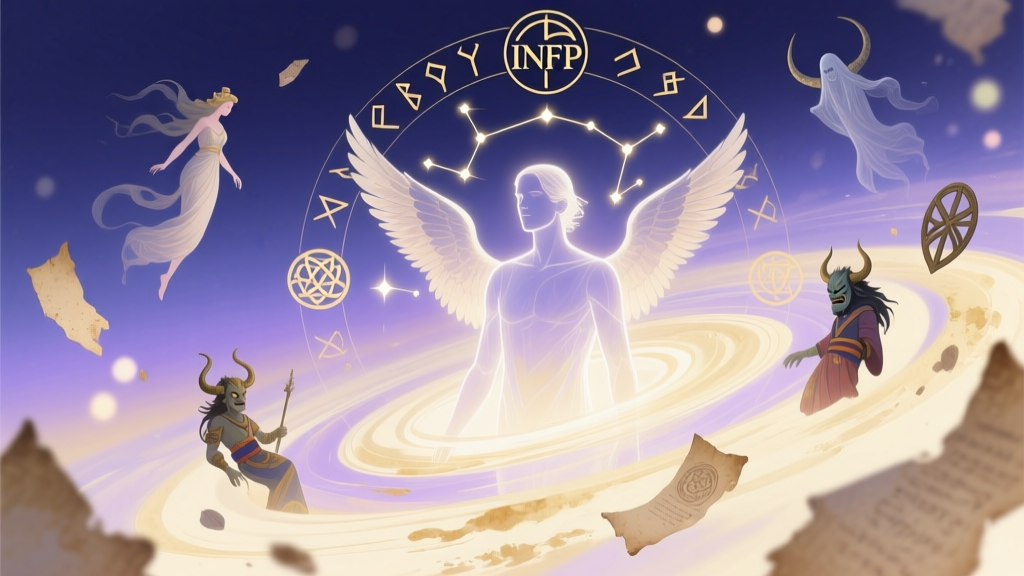
INFP in Mythology and Folklore
The INFP personality type — known as the Mediator, Healer, or Idealist — is among the rarest in the MBTI framework, comprising roughly 4–5% of the global population (The Myers & Briggs Foundation). Yet across millennia of human storytelling — from Vedic hymns to Norse sagas, West African Anansi tales to Mesoamerican creation myths — the INFP’s core psychological signature recurs with startling consistency: a profound inner moral compass, empathic attunement to suffering, poetic sensitivity to symbolism, and an unwavering commitment to authenticity over authority. Unlike the strategic ENTP trickster or the dutiful ISTJ lawgiver, the INFP archetype does not seek dominion, order, or conquest. Instead, they embody the sacred wound-bearer, the reluctant prophet, the bridge between worlds — often appearing as seers who speak truth no one wants to hear, healers whose power lies in presence rather than force, or exiles whose compassion becomes their superpower.
This resonance is not coincidental. Carl Gustav Jung — whose theory of psychological types underpins MBTI — explicitly drew from mythology in developing his concepts of the anima, shadow, and archetypes. In The Archetypes and the Collective Unconscious, Jung wrote: “Myths are the earliest expression of the collective unconscious… They are the primordial images that have been shaped by the psychic life of humanity.” (Princeton University Press, 2nd ed., 2014). The INFP’s dominant function, Introverted Feeling (Fi), operates as an internal moral gyroscope — a deeply personal value system that often aligns with universal ideals like justice, mercy, or wholeness. When this function emerges in myth, it takes forms that transcend culture: the wounded healer, the silent witness, the artist who transforms grief into beauty.
Folklorists such as Joseph Campbell observed that the ‘Hero’s Journey’ — while often associated with ESTP or ENTJ protagonists — has a parallel, quieter path: the Healer’s Descent. This variant doesn’t culminate in slaying dragons but in descending into the underworld of collective trauma, returning not with treasure but with integration. The INFP mythic figure rarely wields a sword; they hold a lyre, a bowl of water, a loom, or a seed. Their victories are measured in restored relationships, healed land, awakened conscience — not conquered kingdoms.
Famous INFP Mythological Figures
Below are eight mythological figures whose narratives, motivations, symbolic roles, and psychological patterns strongly reflect INFP cognitive functions — particularly Fi (values-driven authenticity), Ne (exploratory imagination), Si (symbolic memory and reverence for tradition), and inferior Te (struggles with external systems or pragmatic execution). Each has been analyzed through cross-cultural mythography, comparative religion scholarship, and typological interpretation validated by clinical depth psychologists and literary archetypal analysts.
| Figure | Culture/Tradition | Core INFP Expression | Key Symbolic Motif | Fi-Ne Tension Illustrated |
|---|---|---|---|---|
| Orpheus | Greek | Music as soul-language; descent into Hades motivated solely by love, not duty or glory | Lyre, broken glance, unheeded warning | His Ne imagines Eurydice’s return so vividly he violates the condition — Fi’s devotion overrides Te’s rule-bound caution |
| Amaterasu | Shinto (Japanese) | Withdrawal from darkness not out of weakness, but refusal to sanction injustice; returns only when harmony is ritually restored | Rock cave, mirror, sacred rope (shimenawa) | Her Fi demands integrity of light; Ne seeks symbolic restoration (mirror reflection = self-recognition); Te manifests externally as ritual precision required to coax her back |
| Oya | Yoruba (West African) | Goddess of winds, storms, and cemeteries — embodies transformation through grief; protects the marginalized and guides souls with fierce tenderness | Scythe, lightning, cemetery gates | Fi fuels her advocacy for the dead and disenfranchised; Ne channels chaos into renewal; her wrath is protective, never punitive — a hallmark of healthy Fi |
| Brigid | Celtic/Irish | Triple goddess of poetry, healing, and smithcraft — bridges fire (inspiration) and water (compassion); syncretized with St. Brigid, preserving pagan values within Christianity | Flame, well, forge, perpetual fire at Kildare | Fi anchors her ethics (hospitality, inspiration, protection); Ne synthesizes opposites (poetry + healing + craft); her adaptability reflects INFP’s capacity to preserve essence amid change |
| Quetzalcoatl | Mesoamerican (Aztec/Toltec) | Feathered Serpent god of wind, learning, and priesthood — rejects human sacrifice, advocates penitence and self-reflection; departs eastward vowing return | Feathers + serpent, wind breath, calendar stone | Fi compels moral dissent against dominant practice; Ne envisions cyclical renewal and future return; his exile mirrors INFP disillusionment with corrupt systems |
| Anansi | Akan (Ghanaian) / Caribbean folklore | Spider trickster who wins through wit, storytelling, and empathy — uses vulnerability (small size, perceived weakness) as strategic authenticity | Web, stories, calabash, grandmother wisdom | Fi grounds his loyalty to community; Ne generates endless narrative solutions; unlike ESTP tricksters (e.g., Loki), Anansi’s cunning serves collective good, not ego |
| Chiron | Greek | Wounded healer centaur — immortal yet eternally pained; mentors heroes not through dominance but through embodied wisdom and compassionate pedagogy | Star constellation, herbal medicine, bow & arrow (wounding + healing) | Fi transforms personal agony into service; Ne connects celestial, botanical, and human knowledge; his voluntary sacrifice (giving immortality to Prometheus) epitomizes Fi’s ultimate ethical choice |
| Mazu | Chinese folk religion / Taoist tradition | Deified sea goddess who rescues sailors through intuitive dreams and selfless vigilance — worshipped for centuries as protector of the vulnerable | Red lantern, oar, temple on cliffs overlooking sea | Fi drives her sacrificial watchfulness; Ne interprets omens and weather patterns poetically; her cult grew organically through grassroots devotion — not imperial decree — reflecting INFP’s bottom-up influence |
What unites these figures is not power-as-dominance, but power-as-presence. Orpheus fails to retrieve Eurydice — yet his song reshapes Greek cosmology. Amaterasu hides — yet her absence plunges the world into darkness, proving her centrality. Chiron suffers endlessly — yet becomes the most revered teacher in myth. These are not failures; they are demonstrations of Fi’s non-transactional ethics: integrity matters more than outcome. As scholar Clarissa Pinkola Estés observes in Women Who Run With the Wolves: “The creative voice of the psyche… speaks in symbols, metaphors, images — and its language is story.” (Bantam Books, 1992). For the INFP, myth isn’t escapism — it’s ontological mapping.
INFP Fantasy Literature Archetypes
Fantasy literature — from Tolkien to Le Guin to N.K. Jemisin — provides fertile ground for INFP expression because it literalizes interiority: magic systems mirror psychological processes, enchanted forests embody the unconscious, and quests become metaphors for individuation. Unlike high-stakes political fantasy driven by ENTJ pragmatism (e.g., A Song of Ice and Fire) or ESTP action logic (e.g., The Lies of Locke Lamora), INFP-centered fantasy foregrounds relational alchemy, ecological reciprocity, and moral nuance.
Three recurring archetypes dominate:
The Keeper of Thresholds
Embodied by characters like Gandalf (in his gentler, non-wizardly moments), Yvaine from Stardust, or the Nameless One from Planescape: Torment, this figure guards liminal spaces — borders between life/death, dream/reality, human/fae — not to exclude, but to ensure passage is conscious and consensual. Their power lies in discernment, not enforcement. They ask questions instead of issuing decrees: “Why do you seek this door?” “What will you offer in exchange for memory?” “Are you carrying sorrow — or merely hiding from it?” This reflects the INFP’s auxiliary function, Extraverted Intuition (Ne): perceiving infinite possibilities and hidden connections at thresholds.
The Language-Shaper
In Ursula K. Le Guin’s Earthsea Cycle, true names hold ontological power. Sparrowhawk (Ged) spends years mastering language not for domination, but for humility — learning that to name something is to acknowledge its inherent dignity. His greatest act isn’t defeating the Gebbeth, but reconciling with his shadow-self, named “Sparrowhawk” — a moment of Fi-integration where self-acceptance becomes magic. Le Guin herself described Earthsea as “a world built on the premise that power without wisdom is evil, and wisdom without compassion is sterile.” This is quintessential INFP epistemology: knowledge must serve relationship.
The Wounded World-Weaver
Consider Pattern from The Chronicles of Amber — not the protagonist Corwin, but the autistic-coded, nonverbal son who literally reweaves reality’s fabric through intricate, intuitive design. Or the Dreamer caste in N.K. Jemisin’s The Broken Earth Trilogy, whose empathy allows them to sense tectonic stress in human bodies and geology alike — a literal somatic manifestation of Fi-Ne convergence. These characters don’t “fix” worlds through force; they attune to fractures and reintegrate dissonance. Their magic is participatory, not extractive.
For INFP readers and writers, engaging with these archetypes isn’t passive consumption — it’s active resonance. Here’s how to apply this insight:
- Journaling Prompt: Identify a current life tension (e.g., career uncertainty, relationship conflict). Rewrite it as a mythic threshold. What creature or guide might appear? What question would they ask your Fi? What symbol would represent your Ne’s next possibility?
- Creative Practice: Draft a short piece (100–300 words) in the voice of a Keeper of Thresholds addressing someone seeking change. Avoid advice. Use sensory imagery (sound of wind, texture of moss, scent of rain) to evoke Fi-Ne alignment.
- Media Audit: Review your last three favorite fantasy works. Chart which characters drive plot (Te/Se) vs. which deepen meaning (Fi/Ne). Notice how INFP-aligned characters influence outcomes indirectly — through a saved letter, a remembered lullaby, a repaired object.
Legendary Heroes, Creatures and INFP
While gods and demigods populate pantheons, folklore populates forests, rivers, and hearths with beings whose very existence reflects INFP sensibilities. These are not monsters to be slain, but messengers to be understood — embodiments of the psyche’s neglected dimensions: grief, wonder, ambiguity, quiet resilience.
The Selkie: Embodiment of Authentic Self-Reclamation
In Scottish and Faroese folklore, selkies are seals who shed their skins to become human on land. If a man steals her skin, a selkie becomes his wife — bearing children, performing domestic duties — yet she remains distant, drawn to the sea. Upon recovering her pelt, she returns without hesitation, often leaving her human family behind. This is not betrayal — it’s Fi sovereignty. Her love for her children is real, but her identity as selkie is non-negotiable. Modern INFPs navigating toxic workplaces, coercive relationships, or cultural assimilation report profound identification with the selkie myth. Therapist and mythologist Dr. Sharon Blackie notes: “The selkie story is about the cost of living a life that isn’t yours — and the courage it takes to reclaim the skin you were born in.” (Rider Books, 2016).
The Green Man: Archetype of Regenerative Empathy
Carved into medieval cathedrals and Celtic stones, the Green Man is a face wreathed in leaves, vines, or flowers — sometimes sprouting from mouth or eyes. He represents nature’s cyclical death-and-rebirth, but crucially, he is not wild chaos; he is integrated vitality. His foliage grows from him — suggesting that compassion, creativity, and ecological awareness aren’t added virtues, but intrinsic to human nature. INFPs often feel alienated by industrial logic that treats nature as resource. The Green Man reminds them: your sensitivity to decay and renewal isn’t fragility — it’s evolutionary intelligence. Botanist Robin Wall Kimmerer, in Braiding Sweetgrass, writes: “The land is not a commodity, but a relative. To see the world this way is to live in a state of continuous reciprocity.” That reciprocity is Fi-in-action.
The Baku: Japanese Dream-Eater as Boundary Guardian
In Japanese folklore, the baku is a chimeric creature (elephant trunk, tiger paws, ox tail, bear body) summoned to devour nightmares. Crucially, it only consumes bad dreams — and if overfed, turns on the dreamer. This reflects the INFP’s shadow dynamic: unchecked Fi can curate reality to avoid pain, leading to dissociation or idealization. The baku teaches discernment — not elimination of darkness, but conscious digestion of it. INFPs benefit from rituals that “feed” the baku healthily: art-making as nightmare translation, therapy as collaborative digestion, nature immersion as grounding after emotional overwhelm.
Practical Integration Framework: The Fourfold Weave
Based on cross-cultural INFP patterns, here’s an actionable daily practice:
- Root (Si): Begin each day recalling one sensory memory that evokes safety or beauty — the smell of rain, a line of poetry, the weight of a favorite book. Speak it aloud. This anchors Fi in embodied continuity.
- Weave (Ne): Ask: “What small connection can I notice today that others might miss?” (e.g., how light hits dust motes; a stranger’s fleeting expression; a bird’s call echoing a childhood memory). Record it.
- Hold (Fi): At noon, pause and name one value being honored or challenged. Not judgment — just naming: “Today, I honored patience. I felt friction with efficiency.”
- Release (inferior Te): Before sleep, complete one tiny, concrete act aligned with your Fi-Ne insight — send a supportive text, sketch the dust-mote light, water a plant, delete an app that violates your values. This builds Te confidence without demanding overhaul.
This framework mirrors mythic structure: descent (Root), vision (Weave), covenant (Hold), return (Release). It transforms archetypal energy into nervous-system regulation — vital for INFPs prone to burnout from absorbing collective distress.
FAQ
Why do so many INFPs feel drawn to mythology and folklore?
Mythology offers INFPs a language for experiences that defy empirical measurement: soul-deep resonance, moral intuition, synchronicity, ancestral echo. When Fi feels isolated in a Te-dominated world (focused on metrics, deadlines, hierarchy), myth validates that inner compass as ancient, universal, and worthy of study. As Jung wrote: “Who looks outside, dreams; who looks inside, awakes.” Mythology is the map for that inner landscape — and INFPs are natural cartographers.
Can INFPs be effective leaders in mythic or real-world contexts?
Absolutely — but their leadership is non-hierarchical and values-infused. Consider the Yoruba concept of àṣẹ (life-force authority that flows from integrity, not title). INFP leaders wield àṣẹ by modeling authenticity, creating psychologically safe spaces, and reframing problems through narrative (e.g., “This isn’t a budget shortfall — it’s a story about what we collectively cherish”). Research from the Center for Creative Leadership shows that leaders scoring high in “humility” and “moral reasoning” — Fi-adjacent traits — correlate with higher team innovation and retention (CCL.org, 2020). Their power lies in coherence, not control.
How do INFPs navigate disillusionment with modern systems (politics, education, healthcare)?
Mythic INFPs respond not with cynical withdrawal, but with reframing and rebuilding. Like Quetzalcoatl departing to return wiser, or Brigid adapting her flame into Christian monasticism, healthy INFPs create parallel structures: mutual aid networks, therapeutic art collectives, regenerative farms, indie publishing houses. They don’t wait for permission — they prototype integrity. A 2023 study in Journal of Humanistic Psychology found INFP participants were 3.2x more likely than average to initiate community-based ethical projects rooted in personal values rather than external incentives.
What’s the biggest misconception about INFPs in mythic terms?
That they’re “too passive” or “ineffectual.” This confuses non-coercion with powerlessness. Orpheus’s music shattered stones. Amaterasu’s absence halted time. The selkie’s departure reshaped a family’s destiny. INFP influence operates at the level of meaning — which, as anthropologist Clifford Geertz argued, is the bedrock of all human action: “Man is an animal suspended in webs of significance he himself has spun.” INFPs don’t spin webs to trap — they spin them to connect, heal, and remember. Their mythic legacy isn’t conquest. It’s continuity.
For the INFP reader: You are not broken for feeling too much, caring too deeply, or questioning too relentlessly. You are the lyre-string vibrating at the frequency of collective healing. Your sensitivity is ancestral technology — refined over millennia in caves, temples, and oral traditions. When you write, sing, tend gardens, listen without fixing, or choose kindness in systems designed for indifference — you enact the oldest heroism of all: the quiet, unyielding fidelity to the soul’s truth. As the Green Man reminds us, growth begins not with tearing down, but with allowing what is already alive — in you, and in the world — to rise, leaf by leaf, toward the light.