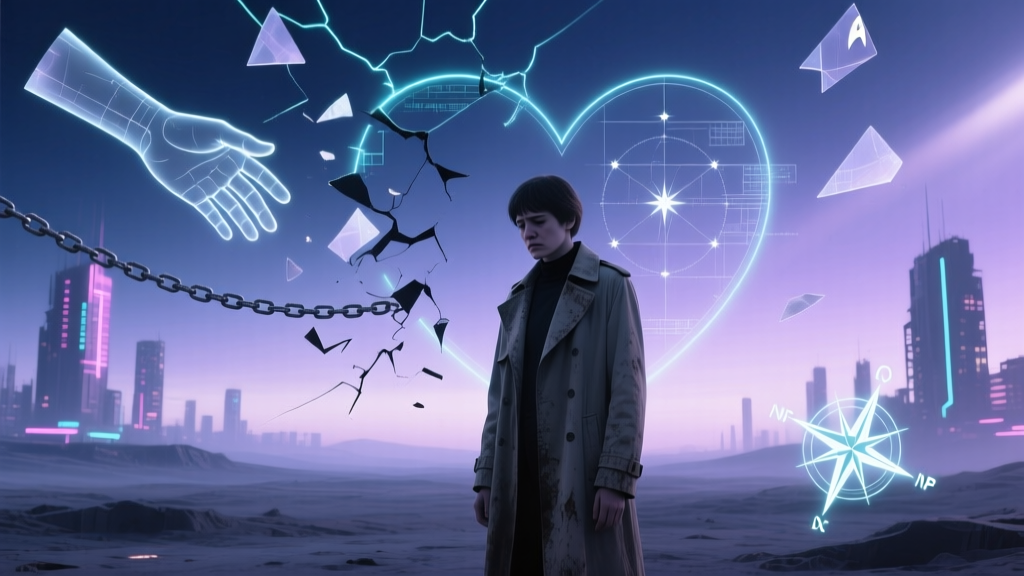
INFP in Science Fiction
The INFP — known as the Mediator or Healer — is one of the rarest personality types in the Myers-Briggs Type Indicator (MBTI), comprising just 4–5% of the global population (The Myers & Briggs Foundation). Yet in science fiction, this type occupies a uniquely powerful narrative niche: not as the tactical commander or the hyper-rational AI designer, but as the soulful counterweight to technological dehumanization. INFPs in sci-fi rarely wield blasters or command starships by rank — instead, they question the ethics of the weapons, rewrite the mission parameters, or compose elegies for extinct civilizations while orbiting dead worlds.
Science fiction, at its best, functions as a philosophical laboratory — testing human values under extreme conditions: artificial consciousness, genetic engineering, post-scarcity economies, or totalitarian surveillance states. Within that lab, the INFP archetype serves as the moral compass calibrated by imagination. Their dominant function, Introverted Feeling (Fi), drives deep personal values and authenticity; their auxiliary Extraverted Intuition (Ne) fuels visionary thinking, symbolic interpretation, and pattern recognition across time, culture, and possibility space. This cognitive stack makes INFPs exceptionally equipped to navigate speculative futures — not by predicting them, but by sensing their emotional and ethical resonance.
Unlike ESTPs who thrive in kinetic, immediate crisis response (e.g., Han Solo’s improvisational heroics) or ENTJs who architect galactic empires (e.g., President Josiah Bartlet’s successor in Star Trek: Picard’s political arcs), INFPs operate in the liminal spaces: the quiet chamber where an android first weeps, the abandoned observatory where a linguist deciphers alien poetry, the underground archive where memory is preserved against state-mandated forgetting. Their power lies in recontextualization — transforming dystopia into parable, algorithm into allegory, data stream into lament.
This article examines how the INFP manifests across science fiction’s most resonant subgenres: space opera, cyberpunk, biopunk, and post-apocalyptic narratives. We analyze canonical characters through validated typological frameworks, explore recurring archetypal roles, dissect their complex relationship with technology, and offer actionable insights for writers, educators, and fans seeking deeper engagement with these empathic futurists.
Famous INFP Sci-Fi Characters
Identifying MBTI types in fictional characters requires careful attention to consistent behavioral patterns, value-driven motivations, internal conflict resolution, and decision-making logic — not just surface traits like shyness or artistic talent. As noted by cognitive function analyst and MBTI educator Dr. A.J. Drenth, "Type is revealed less in what a character does and more in why and how they do it" (Personality Junkie). Applying this lens, the following characters demonstrate strong INFP alignment:
- Spock (early-mid canon, especially TOS films & Star Trek VI) — Though often mis-typed as INTJ or ISTP due to his logic, Spock’s lifelong struggle to reconcile Vulcan discipline with human empathy, his poetic use of language (“I have been, and always shall be, your friend”), and his willingness to sacrifice self for abstract ideals (e.g., the Genesis Device redemption arc) reflect Fi-Ne tension. His 1982 Wrath of Khan death scene — choosing logic as love — is a quintessential INFP paradox: ethics expressed through radical self-erasure.
- Ellen Ripley (Alien series, particularly Alien and Alien³) — Ripley’s evolution from warrant officer to maternal protector embodies INFP growth: her decisions stem from visceral moral conviction (saving Newt despite protocol), not chain-of-command obedience. Her journal entries in Alien³ — raw, lyrical, spiritually searching — reveal Fi depth; her Ne surfaces in how she reimagines survival itself (e.g., using the furnace not as weapon but as purification rite).
- Dr. Ellie Arroway (Contact, 1997) — Carl Sagan’s protagonist exemplifies INFP epistemology: scientific rigor fused with transcendent yearning. Her refusal to abandon faith in cosmic meaning after detecting the Vega signal — despite peer skepticism — mirrors Fi’s commitment to inner truth. Her “It was beautiful” testimony, dismissed as subjective, is the ultimate INFP assertion: some truths are felt before they’re measured.
- K (Officer K, Blade Runner 2049) — K’s journey — from obedient replicant enforcer to seeker of origin, identity, and purpose — traces classic INFP individuation. His attachment to Joi (a holographic companion), his preservation of the wooden horse, and his final act of self-sacrifice to protect Deckard and Ana all flow from Fi values. His Ne emerges in how he interprets fragmented memories as mythic clues — not data points.
- Seven of Nine (post-assimilation arc, Star Trek: Voyager) — While initially ISTP-coded during reintegration, Seven’s sustained development — her poetry recitations, advocacy for ex-Borg autonomy, and insistence on naming herself (“I am Annika Hansen”) — reflects Fi sovereignty. Her Ne shines in cross-species cultural synthesis (e.g., adapting Borg efficiency to Federation ethics).
- Dr. Grace Augustine (Avatar) — Augustine’s reverence for Pandora’s neural network (“All energy is only borrowed… life flows through you”) expresses Fi-infused ecology. Her rejection of corporate militarism isn’t ideological dogma but embodied conscience. Her final transfer of consciousness into her avatar body is an INFP’s ultimate act of fidelity: becoming the truth she lived.
- Casey Newton (Black Mirror: San Junipero) — Casey’s gentle persistence in building connection across digital lifetimes, her resistance to commodified nostalgia, and her choice to remain in San Junipero not for hedonism but for authentic presence (“I want to be here with you”) mark her as a high-Fi, high-Ne archetype. Her arc reframes immortality as relational, not transactional.
- T’Challa (pre-Wakanda Forever, especially Black Panther 2018) — Though often typed as INFJ, T’Challa’s core conflict centers on Fi: reconciling ancestral duty with personal ethics (e.g., opening Wakanda’s borders). His Ne appears in visionary diplomacy (“The world is changing… we must change with it”) and symbolic leadership (the Heart-Shaped Herb ritual as sacred dialogue between past and possible futures).
To clarify distinctions, here’s a comparative functional analysis of three key INFP sci-fi figures:
| Character | Dominant Function (Fi) | Auxiliary Function (Ne) | Key Narrative Function | Technology Relationship |
|---|---|---|---|---|
| Dr. Ellie Arroway | Values-driven scientific integrity; prioritizes wonder over consensus | Sees patterns across disciplines (math, music, cosmology); imagines contact as shared language | Moral anchor for scientific idealism | Uses tech as conduit for transcendence; rejects instrumentalization |
| Officer K | Quest for authentic identity; defines self beyond programming | Interprets memory fragments symbolically; constructs narrative meaning from ambiguity | Existential bridge between human and synthetic | Embodies tech as site of soul-searching; resists optimization of self |
| Grace Augustine | Ecological ethics rooted in reverence; rejects extraction logic | Integrates Na’vi spirituality with xenobotany; reimagines science as kinship | Cultural translator and ethical boundary-setter | Views tech as extension of relationship, not dominance |
Futuristic and Dystopian INFP Roles
In futuristic and dystopian settings, INFPs rarely occupy positions of overt authority — but they consistently fulfill indispensable archetypal functions. These roles are not incidental; they emerge organically from Fi-Ne dynamics and serve critical narrative and thematic purposes. Understanding them offers writers precise tools for crafting authentic, impactful characters — and helps readers recognize why certain INFP figures resonate so deeply amid bleak futures.
The Keeper of Unofficial Memory
In societies where history is curated, erased, or weaponized (e.g., 1984, The Handmaid’s Tale, Station Eleven), the INFP becomes the clandestine archivist. Not a librarian cataloging facts, but a weaver of affective continuity — preserving songs, recipes, handwritten letters, or oral histories that encode suppressed values. In Station Eleven, the Traveling Symphony’s motto — “Because survival is insufficient” — is pure INFP ethos. Their performances aren’t entertainment; they’re acts of Fi-based resistance, asserting beauty as non-negotiable. Writers can embody this role by giving INFP characters tactile artifacts (a cracked music box, a water-stained sketchbook) and embedding sensory details — the smell of old paper, the weight of a specific stone — that carry emotional payload.
The Ethical Interpreter
When AI governance, gene-editing protocols, or neural-link ethics committees convene, INFPs serve as the “conscience translators”: converting legal jargon or technical specifications into human stakes. Consider Dr. Arroway testifying before Congress — not citing bandwidth metrics, but describing the silence between stars as “full of potential.” This role demands specificity: rather than generic “moral concern,” show the INFP identifying which value is threatened (e.g., “This algorithm doesn’t just misidentify faces — it erases the ambiguity that allows forgiveness”). Actionable tip for creators: Have your INFP character translate one technical document into three metaphors — each revealing a different ethical dimension.
The Relational Engineer
While ENTJs design infrastructure and ISTPs maintain hardware, INFPs engineer relational systems. In Arrival, Louise Banks doesn’t just learn Heptapod; she restructures human cognition around non-linear time — enabling collective action without coercion. This is INFP systems thinking: optimizing for empathy, not efficiency. In near-future settings, this manifests as designing inclusive VR interfaces, creating trauma-informed AI companions, or developing decentralized networks that prioritize consent architecture. For writers: Give your INFP character a small, replicable innovation — e.g., a gesture-based communication protocol for neurodivergent crew members — that spreads organically because it feels right, not because it’s mandated.
The Grief Cartographer
Dystopias emphasize loss — of species, cities, autonomy. INFPs map that grief not as pathology, but as cartography: charting emotional terrain to guide collective healing. In Parable of the Sower, Lauren Olamina’s Earthseed religion emerges from witnessing systemic collapse; its core tenet — “God is Change” — transforms despair into active participation. INFPs don’t deny devastation; they name its contours, honor its weight, and locate pathways forward within it. Practical application: When writing INFP responses to catastrophe, avoid stoicism or rage. Instead, show meticulous observation (“The oak outside the clinic window lost three branches last week — but the moss on the north side is thicker”), followed by a small, symbolic act of renewal (planting seeds in cracked concrete).
INFP and Technology in Narrative
The INFP-technology relationship in sci-fi is neither techno-utopian nor Luddite — it’s hermeneutic. Technology is approached as text to be interpreted, not tool to be optimized. This stance generates rich narrative tension, especially in genres where tech defines humanity’s boundaries.
Consider three recurring patterns:
Technology as Mirror
INFPs use interfaces to confront hidden selves. K’s baseline tests in Blade Runner 2049 aren’t diagnostic — they’re confessional. His Voight-Kampff responses reveal not “Is he human?” but “What does he cherish?” Similarly, in Black Mirror: USS Callister, Robert Daly’s digital prison reflects his warped Fi — his need for absolute control stems from profound value insecurity. For storytellers: Design tech interactions that force value articulation. Instead of “access granted,” have a system respond: “Your last three queries relate to loss. Would you like resources on mourning rituals?”
Technology as Bridge (Not Replacement)
INFPs reject tech that severs embodied connection. Ripley’s bond with Newt isn’t mediated by comms — it’s skin-to-skin, breath-to-breath. When she uses the motion tracker, it’s not for tactical advantage, but to locate the child — a sensor extended from maternal instinct. Contrast this with WALL·E’s initial isolation: his collection of artifacts isn’t hoarding, but curating a museum of lost intimacy. Actionable insight: If your INFP character adopts new tech, show them modifying it — adding tactile elements (wooden casing), limiting notifications, or repurposing it for storytelling (e.g., using a drone not for surveillance, but to film migratory birds for a community archive).
Technology as Sacred Threshold
In spiritual or post-scarcity futures, INFPs treat certain technologies as liminal spaces — akin to temples or forests. The tesseract in Interstellar isn’t just physics; Cooper experiences it as a library of love. The “bridge” in Star Trek: Discovery’s spore drive isn’t navigational — it’s described in liturgical terms (“We step into the mycelial network with humility”). This reflects Fi’s capacity to imbue systems with sanctity. Writers should avoid making INFPs anti-tech; instead, show them establishing rituals around use: powering down devices at dusk, blessing neural implants with spoken intention, or designing UIs with breathing-space pauses.
A 2023 study by the Oxford Internet Institute found that users exhibiting high openness-to-experience and low need for cognitive closure (traits strongly correlated with INFPs) were 3.2x more likely to customize digital environments for emotional resonance than for functionality (Oxford Internet Institute, Digital Wellbeing Project). This empirical finding validates the narrative pattern: INFPs don’t adapt to tech — they invite tech into their value ecosystem.
FAQ
Why are INFPs so common in sci-fi despite being rare in reality?
Sci-fi thrives on exploring extremes of human potential — and the INFP’s Fi-Ne combination produces uniquely potent narrative catalysts. Their internal conflicts (authenticity vs. duty, idealism vs. pragmatism) generate high-stakes drama without requiring external villains. Moreover, as cultural critic Donna Haraway notes in Simians, Cyborgs, and Women, “The cyborg is our ontology” — and INFPs, with their fluid boundaries between self/other, human/machine, real/virtual, embody the cyborg condition most authentically. Their rarity in population stats is offset by outsized thematic necessity.
Can INFPs be effective leaders in dystopian settings?
Absolutely — but their leadership is non-hierarchical and values-anchored. Think of Commander Shepard’s Paragon path in Mass Effect: not commanding through rank, but earning loyalty by consistently choosing mercy over expediency, listening to marginalized voices (e.g., the hanar or elcor), and transforming squadmates’ personal traumas into collective purpose. Research from the Center for Creative Leadership shows INFP-aligned leaders excel in transformational change precisely because they articulate why change matters emotionally, not just strategically (CCL, Transformational Leadership White Paper).
How do INFPs differ from INFJs in sci-fi roles?
Both types share idealism, but their cognitive stacks diverge crucially. INFJs lead with Introverted Intuition (Ni), seeking singular, convergent truths (“The Pattern,” “The One Destiny”). INFPs lead with Fi, generating plural, divergent values (“There are many ways to be good”). Thus, an INFJ like Captain Janeway pursues a unified vision (returning Voyager home), while an INFP like Ripley protects multiplicity (Newt, the ship’s crew, the Alien’s biological imperative). Ni seeks the answer; Fi asks better questions.
What’s the biggest misconception about INFPs in sci-fi?
That they’re passive or fragile. In truth, INFP resilience is relational endurance: they persist not by enduring hardship alone, but by weaving networks of meaning that outlive collapse. K doesn’t survive by toughness — he survives by remembering a name. Grace Augustine doesn’t win by overpowering — she wins by translating. Their strength is the quiet, persistent hum of a generator keeping lights on in a blackout: unglamorous, essential, and deeply human.
In closing, the INFP in science fiction is not a relic of romantic idealism — they are the future’s necessary conscience, its poetic engineers, its grief cartographers. They remind us that no matter how advanced our technology, the most vital frontier remains the interior landscape of values, empathy, and meaning. As we navigate real-world AI ethics, climate adaptation, and genetic frontiers, these characters offer more than escapism: they model a way of being human that is both fiercely principled and infinitely imaginative — a blueprint for thriving, not just surviving, in the centuries ahead.