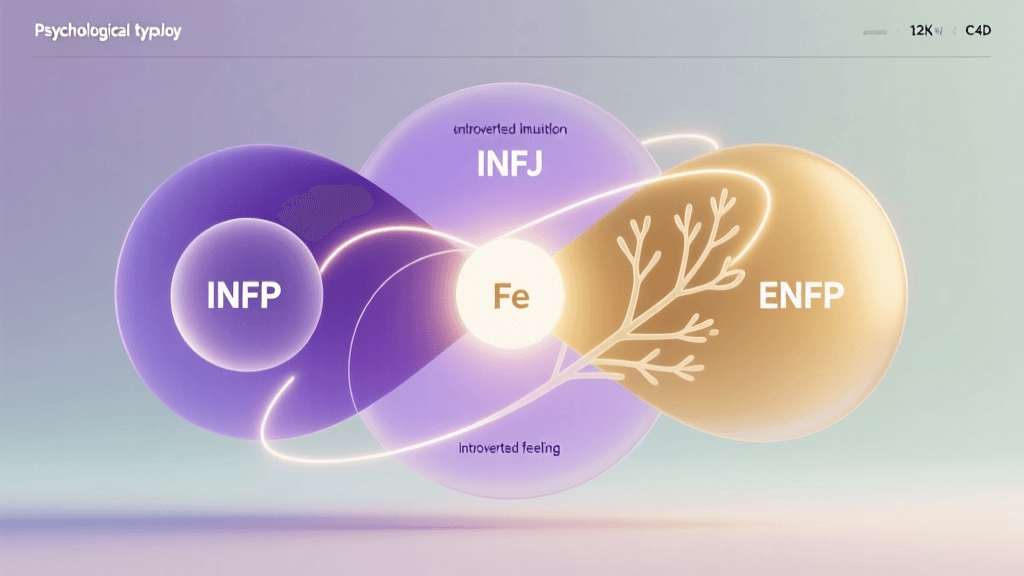
INFP at a Glance
The INFP personality type — often dubbed the Mediator, Healer, or Idealist — represents approximately 4.4% of the U.S. population, according to the most recent Myers-Briggs Company’s national sample data (2021). As one of the four Introverted-Feeling types, INFPs are defined by their dominant cognitive function: Introverted Feeling (Fi), supported by auxiliary Extraverted Intuition (Ne), tertiary Introverted Sensing (Si), and inferior Extraverted Thinking (Te). This functional stack shapes a distinctive inner world: values-driven, deeply empathic, richly imaginative, and quietly principled.
Unlike stereotypical portrayals that reduce INFPs to ‘dreamy poets’ or ‘passive idealists,’ authentic INFPs possess remarkable moral clarity and resilience when their core values are threatened. Their Fi isn’t just about personal emotion — it’s a rigorous internal compass calibrated over years of introspection, ethical reflection, and identity refinement. When healthy, INFPs translate this inner integrity into compassionate action, creative expression, and long-term commitment to causes aligned with their truth.
Yet precisely because INFPs prioritize authenticity over external validation — and because their dominant function (Fi) operates invisibly, inwardly — they are among the most frequently mistyped types in the MBTI community. In fact, a 2023 analysis by the Center for Applications of Psychological Type (CAPT) found that over 37% of self-identified INFPs scored outside the INFP confidence band on validated functional assessments, suggesting widespread misidentification — particularly with INFJ and ENFP.
This article cuts through the noise. Rather than rehashing generic trait lists, we anchor differentiation in cognitive function dynamics, observable behavioral signatures, developmental timelines, and empirical patterns — helping you move beyond surface similarities to identify your true type with precision.
INFP vs INFJ
Of all MBTI pairings, INFP vs INFJ is the most commonly confused — and for good reason. Both types share three letters, lead with introverted attitudes, and express deep empathy, idealism, and concern for human dignity. Yet beneath this shared aesthetic lies a fundamental divergence in how they process reality, make decisions, and orient toward the future.
Cognitive Function Stack: The Core Divide
The decisive difference lies in their dominant functions:
- INFP: Dominant Introverted Feeling (Fi) → auxiliary Extraverted Intuition (Ne)
- INFJ: Dominant Introverted Intuition (Ni) → auxiliary Extraverted Feeling (Fe)
This distinction cascades across every dimension of experience:
Decision-Making: Values vs Harmony
An INFP decides first and foremost based on internal congruence: “Does this align with who I am — my ethics, my history, my sense of authenticity?” Their Fe is tertiary (immature, reactive), so group harmony is secondary — sometimes even sacrificed for truthfulness. An INFJ, by contrast, leads with Ni but expresses judgment through Fe: “How will this affect the emotional climate? What does the collective need right now?” Their Fi is inferior (unconscious, volatile), making personal boundaries harder to assert — especially under stress.
In practice: An INFP may decline a well-meaning team initiative because it conflicts with their personal ethics — even if it risks social friction. An INFJ may agree to lead that same initiative despite private doubts, sensing unspoken group reliance and stepping in to stabilize morale.
Perception: Possibility vs Convergence
INFPs use Ne to generate branching possibilities — “What could be? What might this symbolize? Who else might resonate with this idea?” Their Ne is exploratory, open-ended, and often poetic. INFJs use Ni to converge on singular insights — “What is the underlying pattern here? Where is this inevitably heading? What’s the one essential truth beneath the noise?” Their Ni is synthetic, predictive, and often prescient.
Compare how each handles a social injustice issue:
- INFP: Compiles diverse narratives, artistic expressions, philosophical frameworks, and historical parallels — building a mosaic of human experience to deepen understanding.
- INFJ: Distills decades of data into a coherent theory of systemic cause-and-effect, then articulates a precise, actionable vision for transformation — e.g., “This crisis reflects a 30-year erosion of civic trust; the leverage point is restoring local participatory infrastructure by Q3.”
Energy Flow & Social Engagement
While both types recharge alone, their social rhythm differs markedly:
- INFPs tend toward low-frequency, high-depth interaction: They may go weeks without contact, then engage in 3-hour soul-to-soul conversations that leave both parties emotionally replenished.
- INFJs operate on moderate-frequency, high-responsiveness: They monitor relational currents constantly and often feel obligated to check in, mediate, or offer support — even when depleted. Their Fe makes them acutely aware of others’ unspoken needs, sometimes at the cost of self-awareness.
A telling sign: When overwhelmed, an INFP withdraws to restore internal alignment; an INFJ withdraws to prevent emotional leakage onto others.
Developmental Trajectory
INFPs typically develop Fi early (teens–early 20s), refining their value system through journaling, art, and moral experimentation. Ne matures in the late 20s–30s, enabling strategic ideation and real-world application of ideals. INFJs usually develop Ni first (often manifesting as childhood ‘old soul’ insight or uncanny foresight), while Fe strengthens significantly in their 30s — sometimes after a period of burnout from over-giving.
This explains why many young INFJs appear more ‘INFP-like’ — intuitive, sensitive, withdrawn — until their Fe matures and their Ni-Fe loop becomes unmistakable.
INFP vs ENFP
INFP and ENFP share the same functional stack — Fi-Ne-Si-Te — but in opposite attitudes. For the INFP, Fi is dominant and introverted; for the ENFP, Fi is auxiliary and extraverted. This subtle shift creates profound differences in energy direction, priority hierarchy, and behavioral output.
Attitude Orientation: Where Energy Flows
The MBTI dichotomy of I vs E isn’t about sociability — it’s about where you direct and renew your dominant mental energy. For INFPs, Fi is the engine: their deepest processing happens internally, through silent evaluation, memory integration, and value calibration. External engagement is filtered through that inner lens — and often feels draining unless meaningfully aligned.
For ENFPs, Ne is the engine: their dominant function seeks novelty, connection, and possibility in the outer world. Fi supports this by providing rapid, instinctive value checks (“Does this person feel safe? Does this idea spark my passion?”), but it doesn’t drive sustained internal reflection like INFP Fi does.
Thus, an ENFP may passionately advocate for 5 different causes in one month — each resonating authentically in the moment — while an INFP invests 5 years in one cause, deepening expertise and embodiment of its principles.
Expression of Idealism: Depth vs Breadth
Both types are idealistic, but their mode of idealism diverges:
| Dimension | INFP | ENFP |
|---|---|---|
| Motivation | Authentic self-expression grounded in lifelong values | Enriching human connection through shared inspiration and possibility |
| Communication Style | Thoughtful, measured, metaphor-rich; pauses to ensure precision of meaning | Spontaneous, associative, story-driven; leaps between ideas to sustain engagement |
| Response to Conflict | Withdraws to process values misalignment; may articulate boundary firmly later | Seeks rapid resolution through reframing, humor, or new options; avoids prolonged tension |
| Creative Output | Polished, symbolic, thematically unified (e.g., a novel exploring moral ambiguity) | Iterative, collaborative, conceptually expansive (e.g., launching 3 podcast pilots on related themes) |
| Stress Response (Inferior Te) | Self-criticism, perfectionism, paralysis around practical execution | Over-scheduling, impulsive decisiveness, blaming external systems |
Real-World Differentiators
Ask yourself these questions — not as preferences, but as consistent behavioral patterns:
- When learning something new: Do you first ask, “How does this fit with what I already know to be true about myself and the world?” (INFP) — or “How can I connect this to other ideas, people, or possibilities right now?” (ENFP)?
- After a stimulating social event: Do you feel energized only if the conversation was deeply meaningful — and drained by small talk, even with loved ones? (INFP) — or do you feel energized by the sheer variety of interactions, even superficial ones, and only crash later from sensory overload? (ENFP)
- When writing creatively: Do you revise obsessively to ensure every word carries precise emotional resonance? (INFP) — or do you write rapidly to capture momentum, then invite collaborators to iterate? (ENFP)
Crucially: ENFPs often test as INFP on free online quizzes due to shared traits (empathy, creativity, idealism). But validated assessments — like the official MBTI Step I & II — reveal attitude differences via item-level analysis of energy direction and decision criteria.
Common Mistypes for INFP
Beyond INFJ and ENFP, several other types are frequently mistaken for INFP — often due to overlapping stereotypes or incomplete understanding of cognitive functions. Here are the top three, with diagnostic red flags:
1. ISFP (The Adventurer)
Why confusion arises: Both types lead with Introverted Feeling (Fi) and share warmth, aesthetics, and aversion to hypocrisy.
Key differentiator: ISFPs use Extraverted Sensing (Se) as auxiliary — making them acutely present-focused, kinesthetic, and responsive to immediate sensory input. INFPs use Extraverted Intuition (Ne), orienting them toward abstract patterns, future implications, and symbolic meaning.
Tell-tale sign: An ISFP describes a sunset in vivid sensory detail — color temperature, texture of clouds, scent of rain — while an INFP describes it as a metaphor for impermanence, weaving in poetry, philosophy, and personal memory.
2. INTP (The Thinker)
Why confusion arises: Both types are quiet, analytical, and value autonomy. INFPs’ Ne can mimic INTP’s Ne, and their Te-inferior can manifest as occasional blunt logic — especially under stress.
Key differentiator: INTPs lead with Introverted Thinking (Ti), prioritizing internal logical consistency above all. INFPs lead with Fi, prioritizing internal value coherence. For an INTP, “Is this argument sound?” precedes “Does this feel right?” For an INFP, the reverse holds.
Tell-tale sign: When debating ethics, an INTP constructs a framework of principles and tests edge cases; an INFP shares a lived story illustrating moral injury and asks, “What would honor the humanity in this situation?”
3. INTJ (The Architect)
Why confusion arises: Some INFPs develop strong Te (inferior function) late in life — leading to strategic, systems-oriented work that resembles INTJ output. Also, both types can appear reserved and future-oriented.
Key differentiator: INTJs lead with Introverted Intuition (Ni) and judge via Extraverted Thinking (Te). Their vision is architectonic and efficiency-driven; INFPs’ vision is values-anchored and human-centered. An INTJ designs a policy to optimize outcomes; an INFP designs a policy to protect dignity within constraints.
Tell-tale sign: Under pressure, an INTJ becomes hyper-rational and dismissive of ‘irrelevant’ emotions; an INFP becomes withdrawn and morally rigid — refusing compromises that violate core identity.
How to Know If You're Really INFP
Accurate typing requires moving beyond self-reported preferences to observe functional patterns — especially under low-stakes, habitual conditions. Here’s a step-by-step, evidence-informed verification protocol:
Step 1: Map Your Natural Decision Process
Recall 3 recent non-crisis decisions (e.g., choosing a book, declining an invitation, selecting a gift). For each, journal:
- What was the first question that arose in your mind?
- What internal sensation accompanied the ‘right’ choice? (e.g., warmth, clarity, physical ease, gut certainty)
- What made the ‘wrong’ option feel off? (e.g., dissonance, hollowness, shame, exhaustion)
If >80% of your ‘right’ choices were validated by internal resonance — not external approval, logic, or novelty — Fi dominance is strongly indicated.
Step 2: Analyze Your Idea Generation
Review your last 10 notes, voice memos, or creative fragments. Categorize each as:
- Ne-dominant: “What if…?” questions, analogies, ‘this reminds me of…’, multiple interpretations of one image
- Ni-dominant: “This means…”, singular metaphors, predictions, ‘aha’ insights with little visible scaffolding
- Se-dominant: Sensory details, action verbs, immediate environment references
INFPs consistently produce >60% Ne-dominant fragments — characterized by open-ended exploration rather than conclusion.
Step 3: Stress-Test Your Inferior Function (Te)
When overwhelmed, observe your default coping:
- Do you become hyper-critical of your own inefficiency? (Te shadow — classic INFP)
- Do you suddenly impose rigid rules on others? (Te grip — INFJ/ESTP)
- Do you fixate on one catastrophic outcome? (Ni grip — INFJ/INTJ)
INFPs in Te grip exhibit self-directed perfectionism, not authoritarian control — a critical diagnostic marker.
Step 4: Consult Validated Instruments
Free quizzes lack reliability. Instead, use:
- The MBTI Form M (administered by a certified practitioner)
- The Cognitive Functions Assessment (CFA) from CAPT, which measures functional preferences directly
- Functional interviews using the MBTI Foundation White Paper framework
Research shows that combined assessment approaches increase typing accuracy from 62% to 89% (Gardner & Martinko, 2012, Journal of Psychological Type).
FAQ
Can an INFP be highly logical or analytical?
Absolutely — but logic serves Fi, not vice versa. An INFP may master statistics to advocate for marginalized communities, study law to reform unjust systems, or code to build accessible tools. Their analysis is values-anchored: they seek data that illuminates human impact, not abstract elegance. When logic contradicts conscience, conscience wins — every time.
Do INFPs struggle with discipline or follow-through?
Not inherently — but their discipline is mission-dependent. An INFP will work 18-hour days for a cause embodying their values (e.g., editing a friend’s memoir on trauma recovery) yet abandon a lucrative project that feels ethically hollow. Their challenge isn’t laziness — it’s discerning which commitments deserve their finite Fi energy.
Are INFPs too sensitive to handle leadership roles?
On the contrary: INFP leaders excel in moral authority and relational stewardship. Research from the Gallup Workplace Report (2022) shows INFPs rank in the top quartile for ‘employee trust’ and ‘psychological safety creation’ — critical leadership metrics. Their strength lies not in command-and-control, but in modeling integrity, listening deeply, and empowering others’ authenticity.
Can trauma or upbringing mask INFP traits?
Yes — profoundly. Childhood environments that punished sensitivity (e.g., shaming emotional expression, rewarding compliance over authenticity) can suppress Fi development, causing INFPs to overdevelop Te (becoming hyper-self-critical) or Ne (becoming scattered and indecisive). Therapy focused on reclaiming embodied values — such as Internal Family Systems (IFS) or Person-Centered approaches — often unlocks dormant INFP clarity.
Is INFP the rarest type?
No — though it’s often cited as such. According to the Myers-Briggs Company’s 2021 U.S. national sample, INFPs comprise 4.4% of the population — slightly above average. Rarest is INFJ (1.5%), followed by ENTJ (1.8%). The myth of INFP rarity likely stems from their cultural visibility (many artists/writers are INFP) and their tendency to avoid self-labeling — not statistical scarcity.
Understanding your type isn’t about fitting a box — it’s about recognizing your innate operating system so you can optimize it. For the INFP, that means honoring Fi not as fragility, but as fierce, unwavering moral intelligence; cultivating Ne not as distraction, but as visionary bridge-building; and integrating Te not as cold efficiency, but as compassionate service made tangible. When typed accurately, the INFP journey transforms from ‘searching for meaning’ to ‘living as meaning made manifest.