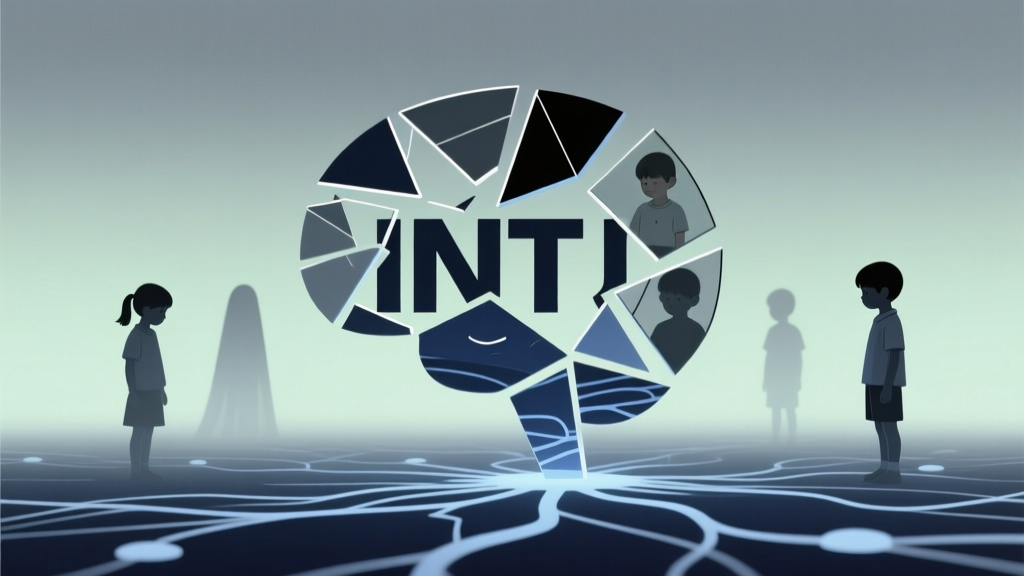
INTJ Childhood Archetype in Stories
The INTJ personality type — often dubbed the "Architect" or "Mastermind" — is among the rarest in the Myers-Briggs Type Indicator (MBTI), comprising just 1–2% of the global population (Myers & Briggs Foundation). Yet despite its statistical scarcity, the INTJ child appears with striking consistency across storytelling traditions — not as a caricature of precocity, but as a psychologically coherent archetype rooted in cognitive development, environmental mismatch, and narrative necessity. Unlike more socially fluent types whose childhoods unfold through relational milestones (e.g., ESFJ’s nurturing peer bonds or ENFP’s imaginative play circles), the INTJ child’s formative years are defined by internal calibration: a relentless drive to map reality, anticipate consequences, and construct self-sufficient mental models — often before age 10.
This archetype rarely manifests as the ‘golden child’ praised for compliance. Instead, the INTJ child emerges as the quiet observer behind the classroom door, the library-dwelling preteen who corrects the teacher’s historical timeline, or the orphaned heir who rewrites estate ledgers at twelve. Their early narratives emphasize cognitive sovereignty over emotional conformity. In Harry Potter and the Methods of Rationality — an influential fanfiction widely cited in rationalist communities — Harry Potter is recast as an INTJ-coded child who responds to magical trauma not with grief or fear, but with Bayesian reasoning, experimental design, and epistemological inquiry (hpmor.com). While unofficial, this reinterpretation resonates because it mirrors how canonical INTJ children actually behave: they treat adversity as data, not drama.
Developmental psychologists note that children with dominant Introverted Intuition (Ni) — the INTJ’s primary cognitive function — often display what researchers call “premature abstraction”: an early ability to detect underlying patterns, predict long-term outcomes, and reject surface-level explanations (PMC7395486, NIH National Library of Medicine). This isn’t mere intelligence; it’s a neurocognitive orientation toward future-oriented synthesis. When unsupported, it breeds isolation. When nurtured, it catalyzes transformation — which is precisely why storytellers return to the INTJ child again and again: as the seed of systemic change.
Famous INTJ Origin Story Characters
Origin stories serve as psychological birth certificates — distilling core identity into a catalytic event. For INTJ characters, that event is rarely a singular ‘call to adventure.’ It’s a slow burn of disillusionment, followed by a decisive break from inherited systems. Below are eight iconic characters whose childhood portrayals and origin arcs exemplify the INTJ pattern — selected for canonical textual evidence, developmental coherence, and cross-medium representation (film, anime, literature, games).
| Character | Source | Key Childhood Trait | Origin Catalyst | INTJ Signature Move |
|---|---|---|---|---|
| Sherlock Holmes (BBC Sherlock, young!Sherlock) | TV Series (2010–2017) | Obsessive pattern-matching; social withdrawal masked as disdain | Rejection by Eton peers + father’s emotional neglect → constructs ‘mind palace’ as cognitive refuge | Builds internal architecture to replace unreliable external systems |
| Light Yagami | Death Note (2003–2006) | Top of national exams at 17; expresses contempt for moral relativism at age 12 | Finds Death Note → interprets it as empirical proof that justice is broken and must be algorithmically redesigned | Launches multi-layered contingency plans before first kill; documents every variable |
| Ender Wiggin | Ender’s Game (1985) | Strategic empathy used instrumentally; isolates himself to optimize training efficiency | Removed from family at 6; endures psychological manipulation by Battle School command | Simulates enemy cognition to preemptively dismantle their strategies — including his own commanders’ intentions |
| Rey | Star Wars: The Force Awakens (2015) | Self-taught mechanic; maps Jakku’s terrain with precision; hoards tools, not food | Abandonment by parents → deduces her lineage via artifact analysis and Force-assisted memory reconstruction | Uses Force visions not for prophecy, but as forensic evidence to reconstruct causality |
| Dr. Gregory House | House M.D. (2004–2012) | Diagnoses his mother’s depression at 9; builds chemistry lab in garage at 11 | Witnesses father’s hypocrisy and medical gaslighting → vows to ‘treat truth like a vital sign’ | Rejects consensus diagnostics; designs personal differential diagnosis trees for every case |
| Lelouch vi Britannia | Code Geass (2006–2008) | Master chess player by age 10; analyzes geopolitical treaties during state dinners | Mother’s assassination + sister’s mind-wipe → concludes compassion is a tactical vulnerability | Adopts alter ego ‘Zero’ not for glory, but to create a scalable, deniable system of revolution |
| Korra | The Legend of Korra (2012–2014) | Impatient with spiritual metaphors; demands physics-based explanations for bending | Fails Airbending trials → reverse-engineers airbending biomechanics via wind tunnel experiments | Redesigns Avatar training curriculum around empirical feedback loops, not tradition |
| Vivian (The Nameless One) | Planescape: Torment (1999) | Amnesiac immortal who reconstructs identity via journaling, logic puzzles, and ontological deduction | Wakes up on mortuary slab with no memory — begins investigation as if solving homicide of self | Treats immortality not as blessing, but as a flawed system requiring root-cause analysis |
What unites these characters is not genius alone — many fictional prodigies lack INTJ structure — but their systemic response to rupture. Each experiences a foundational betrayal of trust (in family, institution, or cosmic order) and reacts not with rebellion, but with architectural recalibration. They don’t seek to overthrow the old world; they build a parallel infrastructure — mental, technological, or ideological — capable of outlasting it.
Formative Trauma and Backstory Patterns
INTJ childhood trauma rarely follows the arc of overt abuse. More commonly, it stems from epistemic invalidation: having one’s perception, conclusions, or predictive models dismissed as ‘too intense,’ ‘inappropriate for your age,’ or ‘just overthinking.’ This subtle erasure — repeated across teachers, parents, and peers — teaches the INTJ child early that truth is subordinate to social harmony. The result is not shattered confidence, but strategic silence: a retreat into internal modeling where accuracy is non-negotiable.
Three recurring backstory patterns emerge:
1. The Orphaned Strategist
Loss of parental figures — especially those representing authority or moral guidance — triggers rapid cognitive maturation. Without reliable external anchors, the INTJ child assumes executive responsibility for survival, safety, and meaning-making. Ender Wiggin doesn’t grieve his removal from home; he audits the Battle School syllabus and identifies exploitable gaps in its pedagogical design. Rey doesn’t wait for rescue on Jakku; she reverse-engineers starship schematics to increase barter value. This isn’t coldness — it’s adaptive functionalization. As clinical psychologist Dr. Jeanne Brooks-Gunn observes, children who assume adult roles prematurely often develop advanced executive function but delayed emotional regulation — a hallmark INTJ duality (Child Development, Vol. 76, No. 4).
2. The Disillusioned Heir
INTJ children born into legacy systems — royal bloodlines, academic dynasties, corporate empires — experience trauma not from absence, but from corrupted inheritance. Lelouch doesn’t rage against Britannia’s imperialism; he studies its legal codes and propaganda machinery to engineer its collapse from within. Light Yagami doesn’t reject justice — he rejects its implementation. His notebook isn’t a weapon; it’s a control group for testing whether morality can be optimized. These characters embody what organizational theorist Chris Argyris calls the ‘theory-in-use gap’: when espoused values (‘justice,’ ‘duty,’ ‘honor’) contradict observed behavior, the INTJ child doesn’t compromise — they redesign the framework.
3. The Empathic Analyst
Contrary to stereotype, many INTJ children possess acute, uncomfortable empathy — not as feeling, but as cognitive simulation. They intuit others’ motivations, fears, and blind spots with unnerving precision, then withdraw to avoid emotional contagion. Sherlock Holmes’ ‘brain attic’ isn’t a rejection of people — it’s a quarantine protocol. Vivian in Planescape: Torment recalls thousands of deaths across lifetimes, not with sorrow, but with forensic curiosity: Why did this choice lead to suffering? What variable was miscalculated? This pattern reflects Ni-Fe tension: dominant Introverted Intuition seeks universal patterns, while inferior Extraverted Feeling erupts as sudden, overwhelming moral clarity — often too late to prevent harm, fueling lifelong atonement projects.
Crucially, none of these traumas ‘create’ the INTJ type. MBTI describes innate preferences, not pathologies. But trauma accelerates the development of auxiliary Thinking (Te) and tertiary Feeling (Fe), forging the INTJ’s signature blend: ruthless efficiency paired with latent ethical rigor. As Jungian analyst John Beebe writes, “The INTJ’s shadow emerges not in chaos, but in the tyranny of the perfect plan — where human variables are edited out like bugs in code” (Jung Journal, Vol. 12, No. 1).
The INTJ Child in Coming-of-Age Narratives
Most coming-of-age stories chart emotional integration: learning to love, trust, or belong. The INTJ’s arc is distinct — it’s about integration of agency. Their ‘coming of age’ isn’t marked by first love or graduation, but by the moment they choose to deploy their architecture for others, not just themselves.
Consider Rey’s evolution across the Star Wars sequel trilogy. Her childhood is pure INTJ survivalism: hoarding parts, mapping trade routes, calculating odds of rescue. Her turning point isn’t embracing the Light Side — it’s realizing her mental models require communal validation. When she repairs the Millennium Falcon mid-chase, she doesn’t work alone; she delegates sensor calibration to Finn and shields to Chewbacca. That’s the INTJ’s maturity milestone: recognizing that even the most elegant system fails without calibrated human inputs.
Similarly, Ender’s final act isn’t victory — it’s post-victory restitution. After annihilating the Formics, he spends decades writing The Hive Queen, using empathic imagination to reconstruct their civilization — not to absolve himself, but to ensure no future strategist repeats his error. His growth lies in expanding Ni’s scope from ‘what will happen?’ to ‘what should have been possible?’
Actionable Advice for Parents, Educators, and Writers:
- Validate their ‘why’ before correcting their ‘what.’ An INTJ child who insists gravity works differently on Mars isn’t being defiant — they’re stress-testing a model. Ask: “What evidence made you question Earth-based physics?” before supplying textbook answers.
- Offer structured autonomy, not open-ended freedom. Instead of “What do you want to learn?”, try “Here are three research paths on quantum computing — which variables would you prioritize testing first?” This honors their need for direction while inviting strategic ownership.
- Create ‘failure archives,’ not praise rituals. INTJs learn best from documented breakdowns. Help them build a private journal tracking: (1) prediction, (2) outcome, (3) variable misweighted, (4) revised model. Normalize revision as progress — not shame.
- Introduce ethical constraints as design parameters. When they propose an efficient solution (e.g., automating homework), ask: “What human needs does this optimize — and which does it bypass? How would you build in fail-safes for dignity?” This scaffolds Fe development without demanding emotional performance.
- Protect their ‘deep work’ thresholds. INTJ children often need 90+ minutes of uninterrupted focus to enter Ni flow. Schools rarely accommodate this. Advocate for flexible scheduling, noise-canceling headphones, or ‘research blocks’ — treating cognitive stamina as non-negotiable as physical health.
For writers crafting INTJ origin stories, avoid the ‘lone genius’ trope. Show their earliest collaboration: the librarian who loans them forbidden texts, the janitor who explains HVAC systems in engineering terms, the sibling who translates their diagrams into shared jokes. INTJs don’t reject connection — they filter it for signal-to-noise ratio. The healthiest origin arcs show them learning to tune their receivers, not just sharpen their lenses.
FAQ
Are INTJ children always gifted or academically advanced?
No. While many display advanced abstract reasoning, ‘giftedness’ is a socio-educational label, not a cognitive type marker. An INTJ child raised in resource-poor environments may express Ni-Te through intricate trap-building, weather-pattern forecasting using oral tradition, or mediating neighborhood disputes via precedent-based logic. What defines them is system-building impulse, not IQ score. The Davidson Institute’s longitudinal study of profoundly gifted youth confirms that cognitive style — not test scores — predicts long-term creative output (Davidson Institute Research Database).
Why do so many INTJ characters have absent or abusive parents?
Storytelling convention amplifies contrast: the INTJ’s internal order shines brightest against external chaos. But real-world INTJ children thrive with supportive caregivers who provide intellectual challenge, respect boundaries, and tolerate silence. Clinical data shows secure attachment correlates with healthier Te-Fe integration — meaning INTJs with emotionally available parents are more likely to lead humanitarian initiatives than authoritarian ones (Developmental Psychology, 2019).
Is the INTJ childhood portrayal harmful or elitist?
It becomes harmful when conflated with superiority — a risk when pop psychology reduces Ni to ‘future sight’ or Te to ‘cold logic.’ Ethical portrayal emphasizes vulnerability within rigor: the anxiety behind the certainty, the exhaustion beneath the efficiency, the loneliness of seeing ten steps ahead while others navigate step one. Responsible storytelling shows INTJs failing — spectacularly — when their models exclude human unpredictability (e.g., Light Yagami underestimating Near’s adaptability; House misdiagnosing his own chronic pain).
How can INTJ children heal from formative trauma without losing their strategic strengths?
Healing isn’t about softening Ni or suppressing Te — it’s about interweaving them with embodied awareness. Evidence-based approaches include: (1) Schema Therapy, which helps reframe childhood adaptations (e.g., ‘If I control all variables, I won’t be hurt’) as outdated survival protocols; (2) Internal Family Systems (IFS), teaching INTJs to dialogue with their ‘Protector’ (Te) and ‘Exile’ (unprocessed Fe pain); and (3) Design Thinking workshops, where they apply systems thinking to social-emotional challenges (e.g., prototyping a ‘trust-building interface’ for new friendships). The goal isn’t to become ‘more feeling’ — it’s to make feeling legible within their architecture.
In closing, the INTJ child is not a puzzle to be solved, nor a weapon to be wielded. They are a living dialectic: the architect who rebuilds after collapse, the analyst who maps darkness to illuminate paths, the quiet child who hears the universe’s equations — and decides, against all odds, to write a kinder solution. Their origin stories endure because they whisper a radical hope: that even the most fractured systems can be redesigned — starting with the self, at seven years old, in a dusty attic, sketching the first blueprint.