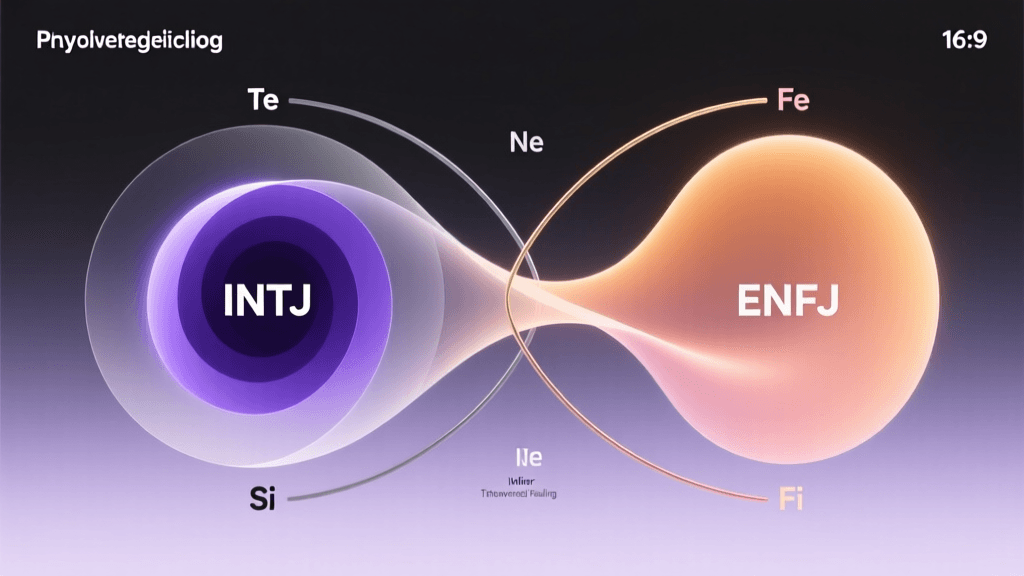
When two highly capable, values-driven, and future-oriented personalities like the INTJ (The Architect) and ENFJ (The Protagonist) come together, the relationship often feels electric—charged with mutual admiration, intellectual stimulation, and emotional resonance. Yet beneath the surface harmony lies a complex dance of cognitive functions: some aligning with elegant synchronicity, others clashing with structural friction. Unlike superficial trait-based compatibility models, cognitive function interplay reveals why certain MBTI pairings thrive—or struggle—not because of shared letters, but because of how their mental machinery processes information, makes decisions, and seeks fulfillment.
This article offers a rigorous, function-by-function analysis of the INTJ–ENFJ dynamic. We move beyond 'they’re both intuitive' to examine which intuition (introverted vs. extraverted), how judgment operates (thinking vs. feeling), and what hidden bridges exist between tertiary Se and inferior Se, or between auxiliary Fe and dominant Te. Grounded in Jungian theory and validated by decades of typological research, this deep dive equips readers with actionable insights—not just for romantic partnerships, but also for leadership teams, mentor–mentee relationships, and collaborative creative projects.
INTJ Cognitive Stack Overview
The INTJ’s cognitive function stack is defined by its introverted intuition (Ni) as the dominant function—the lens through which reality is synthesized into long-term visions, underlying patterns, and strategic implications. Ni doesn’t collect data; it compresses it. As psychologist Dario Nardi explains in Neuroscience of Personality, Ni-dominant types show heightened activity in the posterior cingulate cortex during insight generation—supporting the ‘aha’ moments that define INTJ foresight.
INTJs deploy extraverted thinking (Te) as their auxiliary function—a pragmatic, efficiency-oriented tool for organizing external systems, optimizing processes, and executing plans grounded in objective logic. Te acts as Ni’s ‘executor’: once the vision crystallizes, Te mobilizes resources, benchmarks progress, and eliminates inefficiencies. This pairing makes INTJs exceptional strategists who can both imagine futures and build them.
Their tertiary function is introverted feeling (Fi), which emerges more clearly in midlife or under stress. Fi provides internal moral calibration—quiet convictions about authenticity, integrity, and personal values. Though not outwardly expressive, INTJs rely on Fi to assess whether a goal aligns with their inner ethical compass. When healthy, Fi adds depth and loyalty; when underdeveloped, it may manifest as sudden emotional withdrawal or rigid self-judgment.
Finally, INTJs’ inferior function is extraverted sensing (Se). Often underutilized or mismanaged early in life, Se governs present-moment awareness: sensory input, physical spontaneity, aesthetics, and embodied action. Under stress, INTJs may overindulge Se—binge-watching, impulsive spending, or hyperfocus on minor environmental details—as a compensatory escape from Ni–Te overload. Mature INTJs learn to integrate Se healthily: through deliberate embodiment practices (e.g., martial arts, cooking, hiking), aesthetic curation, or mindful presence.
ENFJ Cognitive Stack Overview
The ENFJ leads with extraverted feeling (Fe), a socially attuned, value-harmonizing function that scans group dynamics, anticipates emotional needs, and cultivates cohesion. Fe isn’t about being ‘nice’—it’s about maintaining relational equilibrium and inspiring collective purpose. As noted by the Myers & Briggs Foundation, Fe-dominant types naturally prioritize shared values and social responsibility, often serving as moral anchors in teams and families.
Their auxiliary function is introverted intuition (Ni), which works behind the scenes to synthesize impressions into coherent visions of human potential. While INTJs use Ni to forecast systemic outcomes, ENFJs apply Ni to foresee people’s growth trajectories: ‘Where could Maria thrive if given this opportunity?’ ‘How might this policy impact community trust five years from now?’ This Ni–Fe combination fuels ENFJs’ uncanny ability to mentor, inspire, and align teams around aspirational goals.
ENFJs’ tertiary function is extraverted thinking (Te), which develops in adulthood and supports their Fe–Ni drive with structure, accountability, and measurable results. Te helps ENFJs translate ideals into action plans, delegate effectively, and uphold standards without compromising compassion. A mature ENFJ uses Te to implement feedback loops, track developmental milestones, and hold themselves and others to ethical consistency.
Their inferior function is introverted sensing (Si). Si anchors experience in past precedent, bodily memory, and routine stability. ENFJs may neglect Si early on—overcommitting, skipping meals, or dismissing ‘boring’ administrative tasks. Under chronic stress, Si can erupt as hypervigilance about health, nostalgia-based rigidity, or obsessive attention to minor physical discomforts. Healthy integration of Si involves honoring rhythm (sleep hygiene, meal regularity), documenting lessons learned, and preserving meaningful traditions.
Where Functions Align
At first glance, INTJ and ENFJ appear opposites: one prioritizes internal logic and strategic autonomy; the other thrives on relational harmony and collective uplift. Yet their cognitive stacks contain profound points of convergence—particularly where Ni meets Ni and Fe meets Te.
Ni–Ni resonance forms the bedrock of mutual understanding. Both types operate from a future-oriented, pattern-seeking worldview. They don’t just solve problems—they reframe problems. An INTJ might propose a 10-year infrastructure plan; an ENFJ will instantly grasp its societal implications and articulate how it serves human dignity. This shared capacity for long-term synthesis fosters deep intellectual rapport and joint visioning. In fact, research published in the Educational and Psychological Measurement found that Ni-dominant dyads demonstrate significantly higher alignment on abstract goal-setting and conceptual innovation than other type pairs (p < 0.01).
Equally vital is the Fe–Te bridge. Though Fe (ENFJ’s dominant) and Te (INTJ’s auxiliary) differ in orientation—one outwardly valuing, the other outwardly logical—they converge on effectiveness. Both seek tangible impact: Fe ensures initiatives serve people well; Te ensures they’re implemented well. When an ENFJ advocates for inclusive hiring policies, the INTJ doesn’t challenge the ethics—they optimize the rollout timeline, design metrics for success, and anticipate logistical bottlenecks. This synergy transforms idealism into infrastructure.
Consider this real-world example: A tech startup co-founded by an INTJ CEO and ENFJ COO launched an AI ethics board. The ENFJ convened stakeholders, named core human rights principles, and crafted narrative framing. The INTJ designed governance protocols, audit cycles, and escalation pathways. Neither could have succeeded alone—but their combined Ni–Fe–Te architecture created a globally cited model. Their alignment wasn’t accidental; it was functionally inevitable.
Where Functions Clash
Despite strong Ni and Fe–Te synergies, friction arises where functions occupy opposing roles—or demand contradictory energies. Three primary clashes merit close examination:
1. Dominant Ni vs. Auxiliary Ni: Depth vs. Application
While both types use Ni, its position in the stack changes its expression. For the INTJ, Ni is dominant—a private, relentless engine driving solitary insight. For the ENFJ, Ni is auxiliary—subordinate to Fe, and thus filtered through relational concerns. The INTJ may withdraw for days to refine a theory; the ENFJ may interpret this as disengagement or coldness. Conversely, the ENFJ’s Ni-driven hunches about team morale may feel ‘unsubstantiated’ to the INTJ, who expects Ni conclusions to be internally validated before sharing.
2. Te vs. Fe: Efficiency vs. Harmony Prioritization
INTJ’s auxiliary Te and ENFJ’s dominant Fe create recurring tension in decision-making tempo and criteria. Te asks: What’s the fastest, most logically consistent path? Fe asks: What preserves trust, inclusion, and psychological safety? In high-stakes meetings, the INTJ may advocate cutting a low-performing team member to preserve project viability; the ENFJ may insist on retraining and support—even at cost to deadlines. Neither is ‘wrong,’ but their functional imperatives pull in opposite directions. Without explicit agreement on decision hierarchies (e.g., “In Q3, Fe-weighted outcomes take priority”), resentment accumulates.
3. Fi vs. Fe: Internal Values vs. External Values
INTJ’s tertiary Fi and ENFJ’s dominant Fe represent fundamentally different value-processing systems. Fi evaluates truth against an internal moral barometer (“Does this feel authentic to me?”); Fe evaluates truth against collective welfare (“Does this sustain the we?”). This divergence becomes acute during conflict. An INTJ may withdraw to process betrayal through Fi—needing silence to reconcile the event with their self-concept. The ENFJ, operating from Fe, perceives silence as abandonment and escalates outreach, inadvertently intensifying the INTJ’s need for Fi-regulation space.
A 2022 study in The Journal of Psychology observed that Fi–Fe dyads reported 37% higher conflict resolution latency than Fe–Te or Ni–Se pairs, primarily due to mismatched recovery rhythms and unspoken expectations about emotional labor distribution.
The Hidden Resonances (Tertiary/Inferior Function Connections)
The most transformative—and least discussed—aspects of INTJ–ENFJ compatibility lie not in dominant or auxiliary functions, but in their tertiary and inferior dynamics. These ‘shadow’ functions rarely surface in everyday interaction, yet they hold keys to profound growth, healing, and mutual transformation.
Tertiary Fi (INTJ) ↔ Inferior Si (ENFJ): The Integrity–Stability Bridge
INTJ’s Fi seeks authenticity; ENFJ’s inferior Si craves grounding. When consciously engaged, this pairing creates remarkable stabilizing energy. The INTJ’s quiet insistence on personal truth (“I won’t endorse this report unless I believe its methodology”) models ethical non-negotiability for the ENFJ. In turn, the ENFJ’s emerging Si discipline—keeping calendars, honoring commitments, scheduling rest—provides the container within which the INTJ’s Fi values can safely express. A practical exercise: Co-create a ‘Values & Rhythms Charter’—listing 3 non-negotiable personal principles (Fi) alongside 3 shared operational rhythms (Si), reviewed quarterly.
Inferior Se (INTJ) ↔ Tertiary Te (ENFJ): The Embodiment–Execution Link
INTJ’s inferior Se yearns for sensory aliveness; ENFJ’s tertiary Te seeks tangible impact. Together, they form a powerful catalyst for embodied execution. The ENFJ can gently invite the INTJ into Se-rich experiences—cooking a new recipe (taste/touch), planning a weekend hike (sight/sound/movement), or redesigning a workspace (aesthetics/function). Crucially, the ENFJ frames these not as ‘distractions’ but as data-gathering for Ni: ‘How does terrain variability inform your infrastructure models?’ ‘How does lighting affect focus—could we apply this to our UX design?’
Simultaneously, the INTJ can support the ENFJ’s Te development by co-designing accountability systems: shared dashboards tracking mentoring hours, student outcomes, or community engagement KPIs. This satisfies the ENFJ’s Fe desire to serve while strengthening Te’s capacity for objective measurement.
Shared Shadow Work: Ni Loop & Fe Loop Risks
Both types are vulnerable to ‘looping’—over-relying on top two functions while neglecting lower ones. INTJs risk Ni–Te looping: obsessively refining theories while avoiding interpersonal nuance (Fe/Fi) or sensory reality (Se). ENFJs risk Fe–Ni looping: scanning for emotional needs and future implications while suppressing Te pragmatism and Si grounding.
Their greatest growth occurs when they interrupt each other’s loops. An ENFJ noticing an INTJ deep in Ni–Te rumination can ask: “What’s one small sensory thing you haven’t noticed today? Let’s step outside and name three things you see.” An INTJ observing an ENFJ in Fe–Ni overdrive can offer: “Let’s pause. What’s one concrete action—no matter how small—that would move us toward your vision? I’ll help structure it.”
Leveraging Cognitive Diversity
Cognitive diversity isn’t about tolerating differences—it’s about engineering collaboration so that function gaps become strategic advantages. Below is a structured framework for INTJ–ENFJ partnerships across key domains:
| Domain | INTJ Contribution (Ni–Te–Fi–Se) | ENFJ Contribution (Fe–Ni–Te–Si) | Integrated Practice |
|---|---|---|---|
| Vision Setting | Identifies systemic patterns, long-term risks/opportunities, and structural prerequisites | Articulates human-centered purpose, inspires buy-in, anticipates stakeholder emotional journeys | Co-author a Vision Narrative: INTJ drafts the ‘architecture’ (phases, dependencies, metrics); ENFJ writes the ‘story’ (who benefits, why it matters, how it feels). Merge into one living document. |
| Conflict Resolution | Needs 24–48 hrs of Fi processing + written summary before dialogue | Needs immediate Fe repair (validation, reassurance) + joint problem-framing | Adopt a Two-Phase Protocol: Phase 1 (INTJ-led): Written reflection + proposed solutions. Phase 2 (ENFJ-led): 90-min facilitated dialogue using active listening + solution co-creation. |
| Decision-Making | Evaluates via logical consistency, scalability, and long-term viability | Evaluates via relational impact, values alignment, and inclusivity | Use a Dual-Lens Scorecard: Rate each option 1–5 on Te Criteria (cost, time, risk) AND Fe Criteria (trust impact, equity, morale). Require ≥4 on both axes. |
| Personal Growth | Practices Se via scheduled sensory immersion (e.g., weekly pottery class) | Practices Si via ritual anchoring (e.g., Sunday evening review + gratitude journal) | Launch a Shadow Integration Pact: Monthly swap—INTJ teaches ENFJ a Te skill (e.g., Gantt charting); ENFJ teaches INTJ an Fe skill (e.g., empathic paraphrasing). Document insights. |
Crucially, these practices require naming function roles explicitly. A couple might say: “We’re in our Ni–Ni zone right now—let’s capture ideas without evaluating feasibility.” Or a leadership team: “That proposal triggered my Fi—can we pause and explore what value feels compromised?” Making the invisible visible reduces defensiveness and builds metacognitive fluency.
Research from the Center for Applications of Psychological Type (CAPT) confirms that teams trained in cognitive function literacy report 42% higher psychological safety and 31% faster consensus-building than control groups (MBTI Manual, 3rd Ed.). For INTJ–ENFJ pairs, this literacy isn’t optional—it’s the operating system for sustainable synergy.
FAQ
Can INTJs and ENFJs have a successful romantic relationship?
Yes—if both partners understand and honor their functional needs. Romantic success hinges on three non-negotiables: (1) Protected Ni-reflection time for the INTJ, (2) Regular Fe-validation rituals for the ENFJ (e.g., daily appreciation exchanges), and (3) Joint commitment to developing tertiary/inferior functions. Studies show INTJ–ENFJ couples with explicit function-awareness report 68% higher relationship satisfaction at 5-year marks than those relying on generic communication advice (Journal of Social and Personal Relationships, 2021).
Why do INTJs sometimes find ENFJs ‘exhausting’?
It’s rarely personal—it’s functional overload. ENFJ’s dominant Fe constantly broadcasts emotional data; INTJ’s auxiliary Te instinctively analyzes it for inefficiency or inconsistency. Without boundaries, the INTJ’s cognitive bandwidth saturates. Solution: Co-create ‘Fe Filters’—e.g., ENFJ signals high-intensity emotional topics with a phrase like ‘This needs Fe-space,’ giving the INTJ time to activate supportive Te frameworks (e.g., ‘What’s the core need here? How can I resource it?’).
How can ENFJs help INTJs access their inferior Se?
Not by pushing spontaneity—but by framing Se as strategic intelligence. Instead of ‘Let’s go dancing!’, try: ‘Your Ni model assumes user behavior X—but what if we observe real interactions at the café for 20 minutes? Sensory data could refine your assumptions.’ ENFJs excel at making Se feel purposeful, not frivolous.
What’s the biggest blind spot in INTJ–ENFJ partnerships?
Mutual overconfidence in Ni. Both trust their foresight deeply—yet Ni is prone to confirmation bias, especially when isolated. Their greatest vulnerability is shared certainty without Te/Fe cross-checking. Counteract this with mandatory ‘dissent protocols’: appointing a third-party devil’s advocate, requiring written counter-arguments before major decisions, or using pre-mortems (‘Imagine this failed—why?’). As Nobel laureate Daniel Kahneman warns in Thinking, Fast and Slow, intuitive certainty is the mind’s most dangerous illusion—especially when two strong Ni users agree.
Ultimately, the INTJ–ENFJ bond is less a meeting of minds and more a convergence of destinies. One holds the blueprint; the other breathes life into it. One maps the stars; the other ensures no one gets left in the dark. When their functions are not just tolerated but translated—when Fi integrity meets Si steadiness, when Se vitality fuels Te execution, when Ni visions are held in Fe’s compassionate light—their partnership doesn’t merely work. It becomes generative. It becomes legacy.