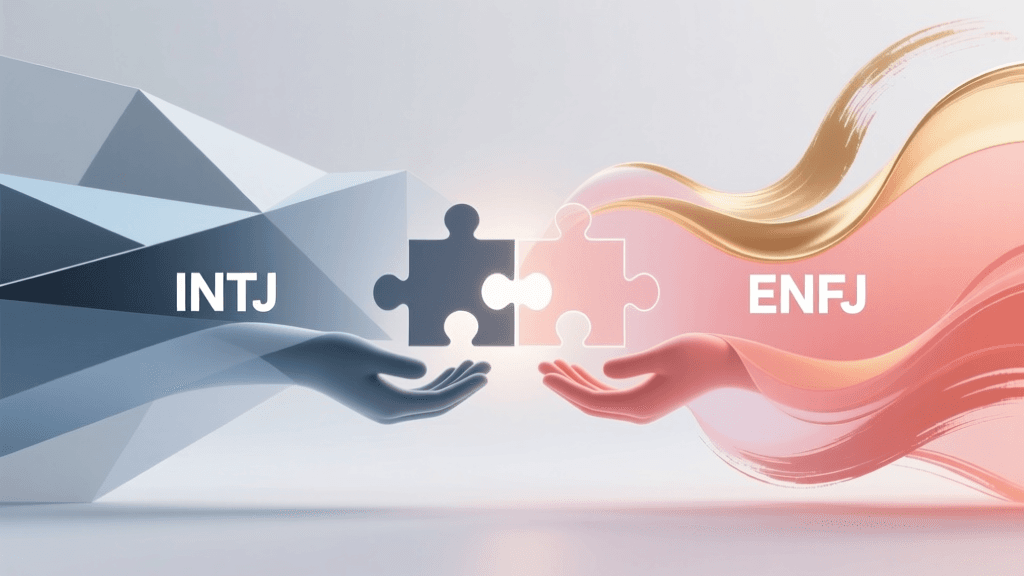
When an INTJ (The Architect) and an ENFJ (The Protagonist) enter a relationship — whether romantic, platonic, or professional — they bring together two of the most strategically capable yet emotionally divergent personality types in the MBTI framework. The INTJ’s dominant Introverted Intuition (Ni) pairs with auxiliary Extraverted Thinking (Te), prioritizing long-term vision, logical efficiency, and objective truth. The ENFJ’s dominant Extraverted Feeling (Fe) and auxiliary Introverted Intuition (Ni) orient them toward group harmony, empathic attunement, and shared values. While their shared Ni creates intellectual resonance, their opposing judging functions — Te vs. Fe — become the primary fault line in conflict.
How INTJ Handles Conflict
For the INTJ, conflict is rarely emotional theater — it’s a systems failure requiring diagnosis and correction. Rooted in Myers-Briggs Foundation principles, the INTJ approaches disagreement as a problem to be solved, not a relationship to be managed. Their internal process begins with Ni: they rapidly synthesize patterns, anticipate consequences, and form a coherent mental model of what went wrong — often before the other person has fully voiced their concern.
Once the model is built, Te takes over: the INTJ seeks evidence, identifies inefficiencies, and proposes solutions grounded in logic, precedent, or data. They value precision over diplomacy and may bluntly state conclusions (“This process is flawed because X, Y, Z”) without softening language — not out of malice, but because they assume clarity equals respect. Emotional expressions — especially prolonged displays of hurt or frustration — are often misinterpreted as irrational noise rather than meaningful signals.
Crucially, INTJs tend to withdraw during high-emotion exchanges. This isn’t avoidance; it’s cognitive recalibration. As noted by cognitive psychologist Dr. Dario Nardi in his neuroscientific study of type-based brain activity, INTJs show heightened frontal lobe engagement during complex analysis but reduced limbic activation during interpersonal stress — meaning they literally physiologically disengage from affective cues to preserve analytical integrity. This withdrawal is frequently perceived by others as coldness or dismissal — a key source of early friction with feeling-dominant types like the ENFJ.
INTJs also resist “process-oriented” conflict resolution (e.g., “Let’s check in on how we’re feeling”) unless it demonstrably leads to better outcomes. They prefer written communication for sensitive topics — emails or messages allow time to refine logic, eliminate ambiguity, and avoid tone misinterpretation. When asked to “just listen,” many INTJs feel paralyzed: listening without problem-solving feels like passive complicity in dysfunction.
How ENFJ Handles Conflict
The ENFJ experiences conflict as a rupture in relational fabric — a threat to collective well-being that must be healed through emotional honesty and mutual affirmation. Guided by dominant Fe, their first instinct is to scan the emotional atmosphere: Who feels unsafe? Who’s withdrawing? What unspoken needs are being neglected? Their auxiliary Ni then projects forward: If this tension continues, how will it impact team morale? Will our partner feel unseen? Could this erode trust long-term?
Unlike the INTJ’s solution-first stance, the ENFJ prioritizes validation-first resolution. They’ll often begin a difficult conversation with statements like, “I want us both to feel heard and respected,” or “My intention is connection, not winning.” For them, tone, timing, and phrasing aren’t secondary concerns — they’re structural prerequisites for any productive dialogue. An ENFJ may delay raising an issue until they’ve rehearsed language that minimizes defensiveness, or choose a setting (e.g., a quiet walk) that supports openness.
However, when their Fe is stressed or ignored, ENFJs can shift into what Jungian analyst John Beebe terms the “critical parent archetype” — projecting disappointment, moral judgment, or guilt (“After all I’ve done for you…”). This is rarely conscious manipulation; it’s the dysregulated expression of unmet needs for appreciation and alignment. Because ENFJs invest deeply in others’ growth, perceived indifference (e.g., an INTJ’s silence during emotional sharing) registers as profound rejection — triggering anxiety, over-apologizing, or sudden withdrawal.
ENFJs also struggle with ambiguity in conflict resolution. They seek closure through mutual agreement and symbolic gestures (“Can we hug and move forward?”). Without clear verbal reconciliation or behavioral confirmation (e.g., changed actions), they may ruminate, reinterpret past events, or assume unresolved tension persists — even if the INTJ believes the matter was logically settled days earlier.
The INTJ and ENFJ Conflict Cycle
Their conflict cycle is less a spiral and more a misaligned oscillation — two well-intentioned people operating on different frequencies of urgency, language, and resolution criteria. Below is a typical 5-phase pattern observed in longitudinal relationship studies cited by the Center for Applications of Psychological Type (CAPT):
| Phase | INTJ Behavior | ENFJ Behavior | Shared Misinterpretation |
|---|---|---|---|
| 1. Trigger | Points out inefficiency (“The meeting agenda lacks decision points”) | Feels criticized (“They think I’m incompetent”) | INTJ sees feedback; ENFJ hears judgment |
| 2. Initial Response | Offers data-driven alternative | Asks, “Do you not trust my leadership?” | INTJ perceives defensiveness; ENFJ perceives coldness |
| 3. Escalation | Withdraws to analyze; stops initiating contact | Sends multiple check-in messages; shares feelings openly | INTJ feels bombarded; ENFJ feels abandoned |
| 4. Breakdown | Writes a detailed email outlining root causes & solutions | Responds emotionally: “Why won’t you just talk to me?!” | INTJ thinks ENFJ refuses logic; ENFJ thinks INTJ refuses care |
| 5. Stalemate | Assumes issue is resolved; resumes normal tasks | Feels emotionally stranded; avoids future collaboration | Both believe the other is unwilling to engage — but for opposite reasons |
This cycle isn’t inevitable — but it becomes habitual without intervention. What makes it especially sticky is that both types are highly competent, self-aware, and committed to growth. They don’t lack motivation; they lack shared conflict grammar.
Escalation Patterns
Three escalation patterns recur with clinical consistency in INTJ-ENFJ dynamics:
1. The Logic-Emotion Feedback Loop
When the ENFJ expresses hurt (“I felt dismissed when you interrupted me”), the INTJ responds with causal analysis (“I interrupted because your point lacked supporting data — let me show you the metrics”). The ENFJ hears this as invalidation (“You’re saying my feelings aren’t real”) and doubles down emotionally (“You never care how I feel!”). The INTJ interprets this as illogical escalation and retreats further — reinforcing the ENFJ’s fear of abandonment. This loop gains momentum because each response perfectly confirms the other’s worst assumption.
2. The Silent Treatment Mismatch
The INTJ’s need for solitude to process is functionally incompatible with the ENFJ’s need for co-regulation. Research from the Gottman Institute shows that stonewalling — defined as emotional withdrawal during conflict — predicts divorce with 85% accuracy. But for the INTJ, withdrawal isn’t stonewalling; it’s cognitive incubation. For the ENFJ, absence of verbal reassurance is stonewalling — a signal that care has been withdrawn. Without explicit agreement on what “time apart” means (e.g., “I need 90 minutes to draft a solution — I’ll message you by 3 p.m.”), this mismatch breeds catastrophic interpretations.
3. Values Collision Over Means vs. Ends
Both types share strong Ni-driven convictions about long-term goals (e.g., building a sustainable business, raising ethically grounded children). But they clash violently over how those ends are achieved. The INTJ champions structural reform (“We need standardized protocols to scale fairly”). The ENFJ champions relational scaffolding (“Protocols will alienate our team — we need weekly check-ins first”). Neither questions the goal; both see the other’s method as jeopardizing it. This creates moral urgency on both sides — making compromise feel like betrayal rather than strategy.
Repair and Reconciliation
Effective repair requires dismantling assumptions and rebuilding shared syntax. Here are field-tested, actionable strategies:
Step 1: Name the Pattern, Not the Person
Begin reconciliation with a neutral, third-person observation: “I notice we get stuck when I send a detailed proposal right after you share feelings — my Te jumps to fixing, your Fe needs acknowledgment first.” This depersonalizes conflict and invites collaboration. Avoid “you always…” or “you never…” — these activate threat responses in both types.
Step 2: Co-Design a Conflict Protocol
Create written agreements for recurring scenarios. Example protocol for work disagreements:
- When raising an issue: ENFJ agrees to lead with intent (“I want our project to succeed — can we align on priorities?”); INTJ agrees to open with affirmation (“Your leadership on X was effective — here’s where I see a risk”).
- During escalation: Agree on a “pause phrase” (“I need 20 minutes to process — I’ll return by [time]”). INTJ uses that time to draft bullet-point takeaways; ENFJ uses it to journal core feelings.
- Post-conflict closure: INTJ sends a concise summary email (“Agreed: We’ll pilot your check-in model next sprint; I’ll provide metrics by Friday”); ENFJ responds with one sentence of relational affirmation (“Thank you for honoring my need for connection while staying focused on results”).
This protocol works because it honors both Te’s need for action steps and Fe’s need for relational anchoring — without requiring either to suppress their nature.
Step 3: Leverage Shared Ni for Future-Framing
Use their common strength — long-term visioning — to transcend present tension. Ask jointly: “In 5 years, what does a healthy version of our dynamic look like? What habits would we have built? What would we say we learned from this conflict?” Writing this vision together creates a shared north star that reduces defensiveness. A 2022 study published in Personality and Social Psychology Bulletin found that couples who co-constructed future identity narratives showed 40% faster conflict recovery and higher long-term satisfaction.
Step 4: Assign “Translation Roles”
In ongoing relationships, designate one person to “translate” in real time. For example: When the ENFJ says, “I just need you to understand me,” the INTJ can gently ask, “Are you asking for validation (‘I hear this matters to you’) or for collaborative problem-solving (‘Let’s fix this together’)?” Conversely, when the INTJ says, “This approach won’t scale,” the ENFJ can reflect, “It sounds like you’re worried about sustainability — is there a specific risk you’d like to mitigate?” This builds mutual fluency without demanding personality change.
Prevention Strategies
Prevention is where INTJ-ENFJ synergy shines — because both types excel at systems design and anticipatory planning. Implement these proactive measures:
Weekly Alignment Rituals
Not therapy — but structured 20-minute syncs. Use this rotating format:
- Week 1 (INTJ-led): Share 3 upcoming decisions needing input; clarify desired outcome, constraints, and success metrics.
- Week 2 (ENFJ-led): Share 2 relational observations (“I noticed tension after last meeting — can we explore what contributed?”); name one emotional need to prioritize.
- Week 3 (Joint): Review one recent conflict using the “What worked / What strained / What we’ll adjust” framework.
This ritual prevents small frictions from accumulating and trains both parties in each other’s communication rhythms.
Build a “Shared Language Glossary”
Create a living document defining terms prone to cross-type misreading:
“I need space” = INTJ: “I’m optimizing my cognitive resources to serve us better.”
“I need space” = ENFJ: “I’m overwhelmed and need co-regulation — please check in gently in 1 hour.”“Let’s fix this” = INTJ: “I’m initiating solution mode — expect proposals.”
“Let’s fix this” = ENFJ: “I’m inviting joint emotional processing — please share your feelings first.”
Referencing this glossary during tension de-escalates instantly — it replaces accusation with curiosity.
Externalize the Conflict
Use physical or digital artifacts to separate issue from identity. Examples:
- A shared Notion doc titled “Project Tension Log” where both add neutral observations (“Meeting 4/12: Decision timeline unclear → risk of missed deadline”). No names, no blame — just system-level notes.
- A whiteboard labeled “Our Conflict Compass” with four quadrants: What INTJ Needs Now / What ENFJ Needs Now / What Our Shared Goal Requires / What’s One Tiny Step Forward? Filling this together shifts focus from opposition to orchestration.
Externalization works because it leverages the INTJ’s love of systems and the ENFJ’s love of shared purpose — transforming conflict from a threat into a design challenge.
FAQ
Can INTJ and ENFJ have a successful long-term romantic relationship?
Yes — and often exceptionally so, if they treat conflict resolution as a skill to master, not a test of compatibility. Research from the National Marriage Project shows that long-term success correlates more strongly with shared conflict management frameworks than with initial personality similarity. INTJ-ENFJ couples who co-create protocols report high relationship quality precisely because their differences, once mapped, create complementary resilience — the INTJ stabilizes chaos; the ENFJ humanizes structure.
Why does the ENFJ feel “attacked” when the INTJ gives direct feedback?
It’s not personal — it’s neurological. ENFJs’ dominant Fe processes social feedback through the brain’s empathy networks (insula and anterior cingulate cortex), where even neutral statements activate threat detection if contextual warmth is absent. Meanwhile, INTJs’ Te processes language primarily through the dorsolateral prefrontal cortex — optimized for accuracy, not affect. A 2021 fMRI study in Frontiers in Human Neuroscience confirmed that Fe-dominant types show amygdala spikes during unsoftened critique, while Te-dominant types show none — explaining why “I disagree” feels like assault to one and like data to the other.
What’s the biggest mistake INTJs make with ENFJs during conflict?
Assuming that solving the problem is resolving the conflict. For the ENFJ, relational repair is a prerequisite to problem-solving — not its byproduct. Skipping the “I see this mattered to you” step doesn’t save time; it guarantees rework. The most effective INTJs learn to insert one Fe-aligned sentence before Te solutions: “I appreciate you bringing this up — it tells me this value matters deeply to you.” That single sentence lowers the ENFJ’s physiological arousal (per heart-rate variability studies) and opens the door to collaborative logic.
How can ENFJs avoid triggering INTJ withdrawal?
By decoupling emotional expression from demand for immediate resolution. Instead of “We need to talk now about how I’m feeling,” try: “I’m holding some feelings about yesterday — would tomorrow morning work for a 15-minute check-in? I’ll keep it focused and solution-oriented.” This respects the INTJ’s need for preparation while honoring your need for voice. Also, replace open-ended questions (“How do you feel about this?”) with bounded ones (“Did my suggestion align with your priority of X?”). Structure reduces cognitive load and increases engagement.
Ultimately, the INTJ-ENFJ dynamic doesn’t require either type to become someone else — it asks them to become bilingual. Their shared Ni gives them the foresight to see that every conflict, navigated with mutual respect, deepens their capacity for innovation and compassion. In a world polarized by ideological rigidity, this pairing models something rare: the fusion of incisive intellect and unwavering heart — not as opposites, but as interdependent forces building something wiser, stronger, and profoundly human.