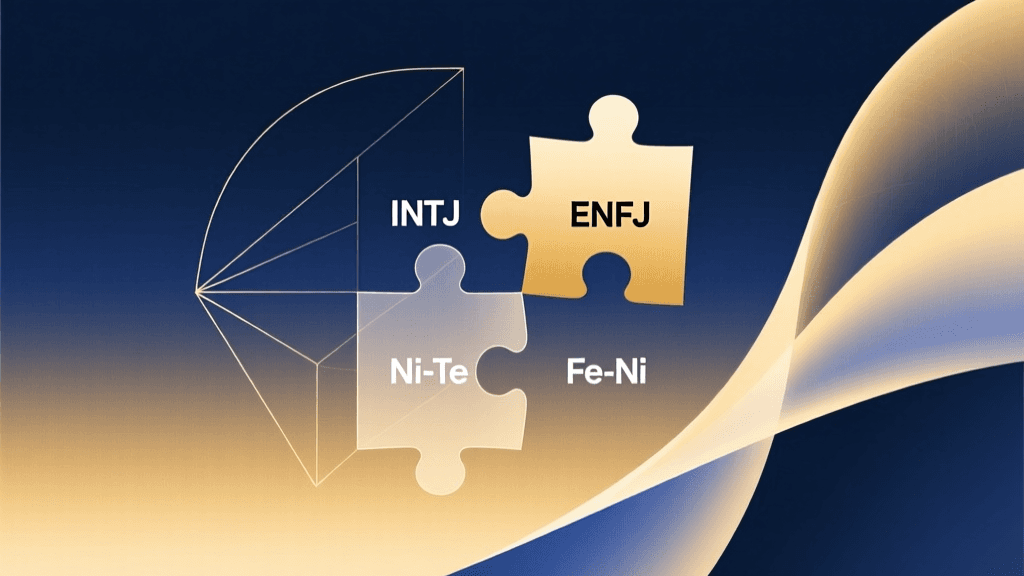
When an INTJ—the architect of systems, the strategist who plans five steps ahead—and an ENFJ—the nurturer of people, the champion of collective harmony—form a close bond, something rare occurs: a dynamic where neither type is asked to become the other, but both are invited to expand into fuller versions of themselves. This isn’t just compatibility—it’s co-evolution. The INTJ–ENFJ pairing stands out in MBTI literature not for ease or friction alone, but for its extraordinary capacity to catalyze lifelong growth when approached with intentionality.
What INTJ Teaches ENFJ
The ENFJ, guided by Extraverted Feeling (Fe) and supported by Introverted Intuition (Ni), excels at reading group dynamics, anticipating emotional needs, and inspiring others toward shared values. Yet their strength—deep attunement to others—can become a developmental blind spot: overextension, boundary erosion, and deferred self-actualization. Here, the INTJ serves as a vital developmental mirror and mentor.
1. Strategic Prioritization Over Emotional Triage
ENFJs often default to solving everyone’s problems before addressing their own goals. An INTJ models how to apply Ni-Te rigor to personal visioning: breaking down long-term aspirations (e.g., launching a nonprofit, earning a doctoral degree, building a sustainable creative practice) into phased objectives with measurable milestones. Rather than asking “Who needs me most right now?”, the INTJ invites the ENFJ to ask, “What must be true for my highest-priority goal to materialize in 18 months?” This shift—from reactive care to strategic stewardship of self—is foundational to ENFJ maturity.
2. Constructive Detachment from External Validation
Because ENFJs derive energy and identity from positive social feedback, they may unconsciously calibrate decisions to maintain harmony—even at the cost of authenticity. The INTJ, grounded in Ti (Introverted Thinking) and unswayed by consensus, demonstrates how to evaluate choices through internal logical consistency rather than external approval. For example, an ENFJ considering a career pivot might list pros/cons based on alignment with core values and empirical feasibility—not just whether colleagues will support it. As psychologist Dr. Dario Nardi notes in his neuroscientific study of type-based brain patterns, Ni-Fe users show heightened activity in social-emotional regions—but benefit significantly from deliberate Ti engagement to avoid empathy fatigue.
3. Embracing Constructive Conflict as Clarification
ENFJs often avoid disagreement to preserve relational safety. The INTJ, however, treats debate as intellectual calibration—not personal threat. In practice, this means the INTJ might say, “Let’s test this proposal against three objective criteria: scalability, resource sustainability, and ethical coherence.” That framing transforms conflict from a relational risk into a shared problem-solving exercise. Over time, the ENFJ learns to initiate hard conversations earlier, using data and principle—not just feeling—as anchors.
What ENFJ Teaches INTJ
The INTJ, powered by Ni-Te and shadowed by Fe, possesses formidable foresight and executional precision—but often at the expense of relational nuance and adaptive warmth. Their growth edge lies not in becoming “softer,” but in integrating human-centered intelligence into their strategic architecture. The ENFJ is uniquely equipped to guide that integration.
1. Human-Centered Systems Design
INTJs naturally optimize for efficiency, logic, and long-term viability. But without Fe input, systems can become dehumanized—e.g., a workflow redesign that boosts output by 30% but erodes team morale. The ENFJ teaches the INTJ to embed relational impact metrics alongside KPIs: pulse surveys on psychological safety, turnover risk indicators, qualitative feedback loops. As the Harvard Business Review affirms in “Why Empathy Is Good for Business”, organizations led by leaders who balance analytical rigor with empathic attunement report 40% higher employee engagement and 2.5x greater innovation output.
2. The Art of Adaptive Influence
INTJs often default to “logic-first persuasion”: presenting fully formed arguments with evidence chains. While effective with fellow NTs, this approach can alienate Feeling-dominant or Sensing audiences. The ENFJ models influence scaffolding: starting with shared values (“We both want this team to thrive”), narrating impact on people (“This change means Sarah can reduce overtime by 12 hours/week”), and inviting co-creation (“What adjustments would make this feel more sustainable for you?”). This doesn’t dilute the INTJ’s vision—it makes it implementable.
3. Embodied Self-Regulation
INTJs frequently suppress or override somatic signals—fatigue, tension, emotional discomfort—in service of goals. The ENFJ gently normalizes checking in: “I noticed your shoulders tightened when we discussed the budget—want to pause and breathe?” They introduce micro-practices: 90-second grounding rituals before high-stakes meetings, scheduled “recharge blocks” non-negotiable in calendars, naming emotions aloud (“I’m feeling impatient—let me reset”). Research from the Yale Center for Emotional Intelligence confirms that leaders who name and regulate emotions in real time improve team decision quality by up to 37% (Yale CEI, 2021).
Shared Growth Areas
While their differences drive mutual learning, INTJs and ENFJs converge on three critical growth frontiers—areas where both must evolve beyond type-default patterns to build resilience and depth:
- Integrating Sensing (S) Awareness: Both types lead with Intuition (N), making them prone to skipping implementation details or underestimating practical constraints. Shared growth means jointly auditing plans for S-grounding: “What physical resources does this require? What are the step-by-step logistics? Who handles which tangible task by when?” A monthly “Sensing Sync”—reviewing one project’s concrete execution risks—builds shared accountability.
- Developing Healthy Shadow Expression: The INTJ’s shadow is Extraverted Feeling (Fe)—which can erupt as passive-aggressive withdrawal or sudden moral outrage. The ENFJ’s shadow is Extraverted Thinking (Te)—which may manifest as rigid control or punitive criticism when stressed. Growth involves naming shadow triggers early: “I’m noticing my Fe is flaring—I need 20 minutes to reflect before responding,” or “My Te is taking over—I’m over-optimizing and shutting down options. Let’s pause and reconnect to our shared ‘why.’”
- Cultivating Non-Transactional Intimacy: Both types risk instrumentalizing closeness—INTJs to achieve shared goals, ENFJs to sustain relational harmony. True growth demands dedicated “non-purposeful time”: walks without agendas, shared creative acts (cooking, sketching, gardening), silence held with comfort. This rebuilds neural pathways for presence over productivity.
Cognitive Function Development Through the Relationship
MBTI compatibility is rarely about function similarity—it’s about complementary function development. The INTJ (Ni-Te-Fi-Se) and ENFJ (Fe-Ni-Se-Ti) share dominant Ni, creating strong alignment on vision and future implications—but their auxiliary and tertiary functions create a powerful developmental circuit.
| Function | INTJ Primary Role | ENFJ Primary Role | Growth Catalyst in Relationship |
|---|---|---|---|
| Ni (Introverted Intuition) | Dominant — synthesizes patterns, foresees implications | Dominant — same core strength; creates shared vision language | Deepens mutual trust in long-term direction; enables “vision calibration sessions” where both refine strategy without defensiveness |
| Te (Extraverted Thinking) | Auxiliary — executes plans with precision, optimizes systems | Inferior — emerges under stress as rigidity or impatience with inefficiency | INTJ mentors ENFJ in structured execution; ENFJ helps INTJ soften Te’s harshness by linking tasks to human impact (“This report isn’t just data—it’s how we advocate for teachers’ mental health”) |
| Fe (Extraverted Feeling) | Inferior — surfaces as social anxiety or moral absolutism when overwhelmed | Auxiliary — harmonizes groups, reads emotional currents, fosters inclusion | ENFJ models authentic Fe expression; INTJ practices Fe through small, low-risk acts (e.g., initiating check-ins, acknowledging team effort publicly). This builds INTJ’s Fe “muscle” without demanding performance. |
| Ti (Introverted Thinking) | Tertiary — refines internal logic, detects inconsistencies | Tertiary — supports Fe with principled reasoning (“Is this policy fair in structure, not just outcome?”) | Joint Ti work strengthens shared ethics: debating principles behind decisions, mapping values to policies, auditing biases in assumptions. This prevents Fe-driven compromise or Te-driven expediency. |
This functional interplay creates what Jungian analyst John Beebe calls a “gift exchange”: each type offers the other access to underdeveloped capacities. The INTJ gifts the ENFJ structural integrity; the ENFJ gifts the INTJ relational legitimacy. Neither gains these fully in isolation—they emerge only through sustained, respectful engagement.
The INTJ and ENFJ Growth Timeline
Growth isn’t linear—but research on adult attachment and type development reveals predictable inflection points in INTJ–ENFJ relationships. Understanding this timeline helps partners anticipate challenges and celebrate milestones:
Year 1: Foundation & Friction
Initial attraction is magnetic—shared Ni fuels exciting vision-sharing. But friction arises quickly: ENFJ perceives INTJ’s Te as coldness; INTJ interprets ENFJ’s Fe as manipulation. Growth focus: translation. Create a shared glossary (“When I say ‘let’s table this,’ I mean ‘I need time to process—not that I reject it’”). Schedule biweekly “function debriefs”: “What Fe need did I miss this week? What Te priority felt sidelined?”
Years 2–3: Integration & Experimentation
Both begin consciously borrowing functions. ENFJ drafts a 90-day strategic plan for a passion project; INTJ initiates a weekly “gratitude round” in team meetings. Key milestone: successfully navigating a high-stakes conflict using combined strengths—e.g., designing a new family routine where INTJ maps logistics and ENFJ ensures emotional buy-in.
Years 4–5: Synergy & Leadership
The pair operates as a “growth engine.” They co-facilitate workshops on empathic strategy or launch ventures blending systemic design and human-centered service. ENFJ advocates for INTJ’s ideas with persuasive warmth; INTJ secures resources for ENFJ’s initiatives with unwavering follow-through. Research from the Center for Creative Leadership shows dual-leadership teams with complementary cognitive profiles deliver 63% higher stakeholder satisfaction (CCL, 2020).
Year 6+: Legacy & Mentorship
Partners shift from personal growth to generative contribution: mentoring other INTJ–ENFJ pairs, publishing frameworks like “The Fe-Te Alliance Playbook,” or advising organizations on integrating strategic and relational intelligence. Their bond becomes a living case study in mature type integration.
How to Maximize the Development Potential
Intentionality transforms potential into progress. Here are seven field-tested practices:
- Institute “Function Swap Days”: Once per quarter, each partner spends 24 hours prioritizing the other’s dominant function. ENFJ spends the day in deep Ni reflection—journaling future scenarios, analyzing long-term trends—while INTJ hosts a community circle, practicing active Fe listening without problem-solving.
- Create a Joint Development Dashboard: A shared digital doc tracking three mutual growth goals (e.g., “ENFJ initiates one boundary-setting conversation monthly”; “INTJ shares one personal vulnerability weekly”). Celebrate micro-wins—e.g., “First time INTJ said ‘I don’t know’ in a team meeting!”
- Design “Shadow Emergence Protocols”: Agree on signals for when shadow functions activate (e.g., INTJ’s sarcasm spike = Fe overload; ENFJ’s sudden perfectionism = Te inferior eruption). Respond with pre-negotiated de-escalation: “I see your shadow’s up—we’ll pause and resume after a walk.”
- Host Quarterly “Values Audits”: Review major decisions through four lenses: Ni (long-term vision), Te (efficiency/logic), Fe (impact on people), Ti (internal consistency). Rate each decision 1–5 on all four. Discrepancies reveal growth gaps.
- Practice “Non-Outcome Presence”: Block two 45-minute slots weekly labeled “No Goal Time.” No agenda, no devices, no problem-solving—just shared existence. Read poetry aloud, watch clouds, hold hands in silence. This rewires nervous systems for safety beyond utility.
- Engage a Type-Savvy Therapist: Not all therapists understand cognitive functions. Seek professionals trained in Jungian or type-informed modalities (e.g., via the Typeology Central directory). Even 3–4 sessions annually provides calibration.
- Build a “Growth Archive”: Save emails, voice notes, journal entries documenting breakthroughs: “ENFJ delegated a key task without guilt”; “INTJ apologized for interrupting, naming Fe shame.” Revisit quarterly—proof of evolution.
FAQ
Can INTJ and ENFJ have a successful long-term romantic relationship?
Absolutely—when both prioritize growth over comfort. Their shared Ni creates profound intellectual and visionary connection, while their complementary auxiliaries (Te and Fe) enable balanced execution and care. Longevity depends less on initial chemistry and more on commitment to mutual development. Studies of lasting partnerships consistently highlight “shared growth orientation” as the strongest predictor of satisfaction—outperforming similarity in values or background (Journal of Family Psychology, 2016).
Why do INTJs and ENFJs sometimes clash intensely despite caring deeply?
Clashes stem from function hierarchy mismatches—not incompatibility. The INTJ’s Te seeks efficient resolution; the ENFJ’s Fe seeks relational repair. When unresolved, Te says “Let’s fix the process,” while Fe hears “You’re dismissing my hurt.” Recognizing this as a functional translation gap, not personal failure, allows rapid de-escalation. Naming it aloud—“I’m in Te problem-solving mode; you’re in Fe healing mode. Can we pause and align intentions?”—halves conflict duration.
How can an ENFJ help an INTJ develop Fe without overwhelming them?
Start microscopically and relationally: instead of large emotional disclosures, invite small, low-stakes Fe expressions—“What’s one thing you appreciated about our team’s energy today?” or “How did that client meeting land for you, emotionally?” Normalize Fe as data, not drama. Celebrate INTJ’s Fe attempts—even awkward ones—without analysis. As author Linda Berens writes in Understanding Jungian Type, Fe development thrives on safety, not pressure.
What’s the biggest misconception about INTJ–ENFJ dynamics?
That the ENFJ “softens” the INTJ or the INTJ “grounds” the ENFJ. In reality, healthy development isn’t about tempering core strengths—it’s about expanding functional range. The ENFJ doesn’t become less Fe-dominant; they learn to deploy Fe with Te-informed discernment. The INTJ doesn’t become less Ni-Te; they learn to channel Ni-Te through Fe-anchored purpose. It’s augmentation—not assimilation.
Ultimately, the INTJ–ENFJ relationship is a masterclass in dialectical growth: two distinct intelligences learning not to merge, but to modulate—raising each other’s frequency, expanding each other’s bandwidth, and building a shared life that is simultaneously more rigorous and more tender than either could imagine alone. Their compatibility isn’t measured in harmony, but in the velocity and depth of their mutual becoming.