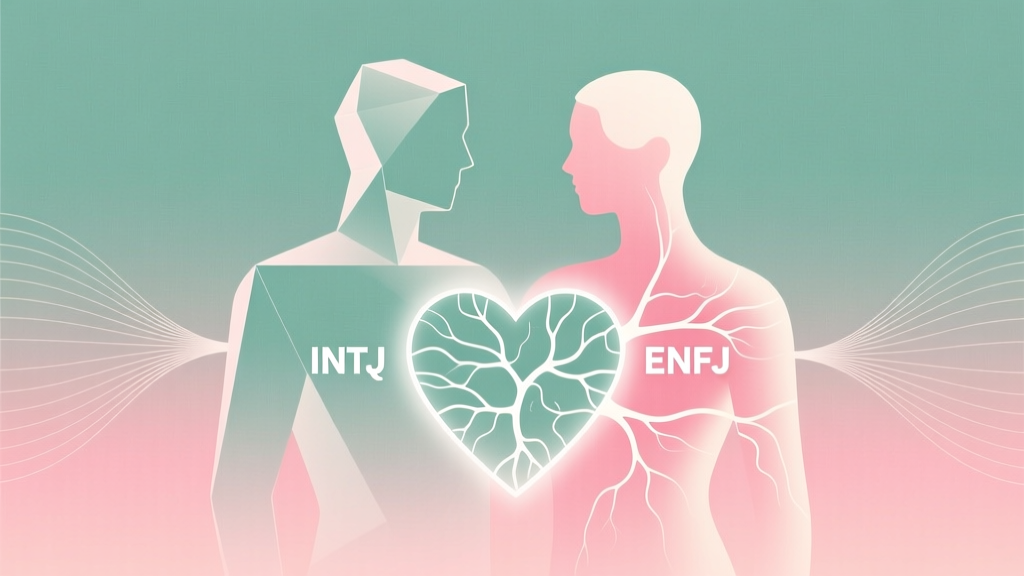
INTJ Love Language Profile
The INTJ (Introverted, Intuitive, Thinking, Judging) personality type is often described as the 'Architect' or 'Strategist' — a cerebral, future-oriented individual who values competence, integrity, and intellectual depth. When it comes to love languages, INTJs do not operate on emotional impulse but rather through deliberate, values-aligned expression. Their love language profile is neither deficient nor cold — it is highly selective, logically grounded, and action-oriented.
According to Gary Chapman’s The Five Love Languages, the primary love languages are Words of Affirmation, Acts of Service, Receiving Gifts, Quality Time, and Physical Touch. For the INTJ, Acts of Service and Words of Affirmation tend to dominate — but with critical nuance. An INTJ rarely seeks praise for its own sake; instead, they deeply value affirmations that recognize their competence, foresight, or problem-solving impact — e.g., “I trusted your plan, and it worked perfectly” carries more weight than “You’re so amazing!”. Similarly, Acts of Service resonate because they reflect mutual respect for efficiency and shared goals — cooking dinner after a long workweek, troubleshooting a technical issue without being asked, or quietly organizing a chaotic schedule are all profoundly loving gestures to an INTJ.
What INTJs typically do not prioritize — and may even find emotionally overwhelming — are unsolicited displays of physical affection or prolonged, unstructured emotional venting. This isn’t a rejection of intimacy; it’s a reflection of their cognitive architecture: Introverted Thinking (Ti) dominant function processes emotion internally and abstractly, while Extraverted Intuition (Ne) auxiliary scans possibilities but filters out low-signal emotional noise. As psychologist Dr. Dario Nardi explains in his research on brain activity patterns across MBTI types, INTJs show heightened activation in analytical and systems-oriented neural regions during interpersonal exchanges — meaning their emotional processing is inherently conceptual, not performative.
Crucially, INTJs express love through protection, provision, and long-term commitment. They invest in relationships by building infrastructure: financial stability, strategic life planning, contingency preparation, and unwavering loyalty. Their love is a covenant, not a mood. Yet because this expression lacks overt emotional signaling, partners — especially those wired for warmth and immediacy — may misinterpret reserve as indifference. This misalignment becomes especially salient with ENFJs, whose emotional expressiveness operates on entirely different neurocognitive frequencies.
ENFJ Love Language Profile
The ENFJ (Extraverted, Intuitive, Feeling, Judging), known as the ‘Protagonist’ or ‘Teacher’, leads with Extraverted Feeling (Fe) — a function dedicated to harmonizing group emotions, reading social cues, and nurturing relational well-being. For ENFJs, love is inherently relational, expressive, and responsive. Their love languages cluster strongly around Words of Affirmation, Quality Time, and Physical Touch, with Acts of Service also highly valued — provided those acts carry emotional intentionality.
An ENFJ feels most loved when their partner actively engages in emotional dialogue: asking thoughtful questions about their day, validating feelings (“That sounds really hard — I’m here for you”), offering spontaneous hugs, remembering small personal details (e.g., “You mentioned your sister’s surgery — how did it go?”), or planning intentional one-on-one time free of distractions. Unlike the INTJ’s preference for precision in affirmation, the ENFJ thrives on warmth, tone, and relational attunement. A softly spoken “I love you” at bedtime may matter more than a meticulously drafted five-paragraph appreciation letter — though both can be meaningful if delivered with presence.
ENFJs give love generously and intuitively. They anticipate needs before they’re voiced, mediate conflict with empathy, celebrate milestones with enthusiasm, and create emotionally safe environments. However, this outward focus can sometimes obscure their own emotional boundaries. As noted in the Myers & Briggs Foundation’s official ENFJ profile, ENFJs often “neglect their own needs while focusing on others,” which can lead to burnout or resentment if their emotional labor goes unrecognized or unreciprocated.
Where INTJs rely on consistency and logic to convey devotion, ENFJs rely on resonance and responsiveness. An ENFJ might interpret silence as withdrawal; an INTJ might interpret effusiveness as superficiality. Neither is wrong — but without translation, their love dialects risk becoming mutually unintelligible.
Where Love Languages Align and Diverge
To navigate compatibility between INTJs and ENFJs, it’s essential to map where their emotional expression systems converge — and where they require conscious bridging. Below is a comparative analysis of key dimensions:
| Dimension | INTJ Expression | ENFJ Expression | Alignment Potential | Risk Zone |
|---|---|---|---|---|
| Affection Style | Reserved, context-dependent, physically minimal unless deeply secure | Warm, frequent, tactile — hugs, hand-holding, leaning in during conversation | Low-to-moderate (requires negotiation) | ENFJ may feel rejected; INTJ may feel invaded |
| Emotional Disclosure | Slow, selective, often delayed until trust is proven over time | Relatively rapid, values vulnerability as bonding mechanism | Moderate (with patience and framing) | ENFJ may misread INTJ silence as disengagement; INTJ may perceive ENFJ sharing as premature or inefficient |
| Conflict Response | Withdraws to analyze, returns with solutions or clarified positions | Engages immediately to restore harmony, prioritizes emotional repair over logic | Low (without explicit agreement on process) | INTJ retreat = ENFJ abandonment; ENFJ pursuit = INTJ overwhelm |
| Appreciation Delivery | Specific, outcome-focused, tied to capability or impact | Global, person-centered, emphasizes character and effort | High (with translation) | INTJ may dismiss ENFJ praise as vague; ENFJ may miss INTJ’s subtle acknowledgments |
| Long-Term Commitment Signals | Strategic planning, resource integration, shared goal-setting | Verbal declarations, ritual creation, public affirmation of bond | High (complementary strengths) | INTJ may see ENFJ’s declarations as redundant; ENFJ may doubt INTJ’s commitment without verbal reinforcement |
This table reveals a central truth: INTJ–ENFJ compatibility isn’t about similarity — it’s about complementarity with calibration. Their differences aren’t flaws; they’re functional specializations. The INTJ brings structural integrity, foresight, and unwavering reliability. The ENFJ brings emotional cohesion, relational intelligence, and adaptive warmth. But synergy only emerges when both parties understand that love languages are not universal dialects — they’re cultural idioms requiring fluency training.
Emotional Needs of INTJ and ENFJ
Love languages stem from deeper emotional needs — the non-negotiable psychological nutrients each type requires to feel secure, seen, and valued. Misunderstanding these core needs is the root cause of many INTJ–ENFJ tensions.
INTJ Emotional Needs
- Intellectual Respect: Being treated as capable, insightful, and autonomous — never infantilized or talked down to. This includes space to disagree without defensiveness.
- Autonomy with Loyalty: Freedom to recharge alone or pursue independent interests, paired with unambiguous evidence of long-term commitment (e.g., joint accounts, co-signed leases, future-oriented conversations).
- Efficiency in Emotional Exchange: Preference for direct, low-drama communication. Small talk feels wasteful; meta-conversations about relationship health feel essential — but only when initiated deliberately.
- Competence Validation: Recognition of their strategic thinking, problem-solving, or systems-building — especially when it benefits the relationship (e.g., optimizing household logistics, researching schools, designing retirement plans).
ENFJ Emotional Needs
- Emotional Reciprocity: Feeling that their openness is met with genuine engagement — not just listening, but reflecting, asking follow-up questions, and integrating what they share into daily behavior.
- Relational Visibility: Public and private acknowledgment of the relationship — introductions to friends/family, shared social media presence (if aligned), celebrating anniversaries meaningfully.
- Harmony Maintenance: Confidence that conflict will be addressed constructively and promptly, with emotional safety preserved. ENFJs fear lingering tension more than disagreement itself.
- Personal Growth Support: Encouragement to evolve — whether professionally, creatively, or spiritually — with active participation (e.g., attending a workshop together, discussing books, brainstorming goals).
A telling mismatch arises here: the INTJ’s need for autonomy can feel like emotional abandonment to the ENFJ, while the ENFJ’s need for reciprocity can feel like surveillance to the INTJ. Neither is malicious — but both require explicit negotiation. As relationship researcher John Gottman emphasizes in The Seven Principles for Making Marriage Work, successful long-term partnerships depend less on shared temperament and more on repair attempts — the willingness to pause, clarify intent, and adjust behavior in real time. For INTJ–ENFJ couples, repair begins with naming these unspoken needs aloud.
Building Emotional Fluency Between INTJ and ENFJ
Emotional fluency is the ability to understand, translate, and respond effectively to another’s emotional language — even when it differs radically from one’s own. It is not about becoming identical; it’s about developing bilingualism in love.
For INTJs, fluency means learning to decode ENFJ emotional signals not as demands, but as invitations to deepen connection. That lingering eye contact? Not pressure — an offer of presence. That sigh followed by “I’m fine”? Not passive aggression — a request for gentle inquiry. That spontaneous hug? Not boundary violation — a physiological expression of safety.
For ENFJs, fluency means recognizing INTJ reserve not as distance, but as deep processing. Silence isn’t emptiness — it’s cognition in motion. Delayed responses aren’t avoidance — they’re integration. A terse text (“On my way”) isn’t coldness — it’s INTJ efficiency honoring the shared goal (arrival) over performative reassurance.
Practical fluency-building exercises include:
- The ‘Translation Journal’: Each partner keeps a shared digital doc (or physical notebook) where they log moments of emotional miscommunication — then reframe them using the other’s lens. Example: ENFJ writes, “Felt hurt when you left the party early without saying goodbye.” INTJ responds, “I was overwhelmed by sensory input and needed to decompress to avoid snapping. Next time, I’ll text: ‘Overstimulated — leaving quietly to recharge. Talk tomorrow.’”
- Weekly ‘Language Calibration’ Check-Ins: 20 minutes weekly, no devices, no problem-solving — only: “What made you feel most loved this week? What felt confusing or unmet? How could I express care in a way that lands for you next week?”
- Co-Created Rituals: Design micro-rituals that honor both styles. Example: A Sunday morning “Strategy + Soul” hour — first 30 mins: INTJ-led agenda review (goals, logistics); next 30 mins: ENFJ-led reflection (feelings, gratitude, hopes). Structure meets spontaneity.
Research from the Positive Psychology Center at UPenn confirms that couples who engage in structured emotional translation practices report 42% higher relationship satisfaction over 6 months — particularly when baseline communication styles differ significantly. The key is consistency, not perfection.
Practical Tips for Expressing Love to Each Type
Abstract understanding isn’t enough. Real-world application transforms theory into trust. Below are concrete, actionable ways to express love authentically — tailored to each type’s wiring.
How ENFJs Can Love INTJs Well
- Replace open-ended emotional probes with specific, low-pressure invitations: Instead of “How are you feeling?”, try “I noticed you’ve been working late — want help streamlining your workflow this weekend?” This honors INTJ’s preference for solution-oriented support.
- Give verbal affirmation with precision: “Your analysis of the contract saved us $12K — that attention to detail is incredible” lands stronger than “You’re so smart.” Cite outcomes, not traits.
- Respect recharging time without interpreting it as rejection: Agree on a signal (e.g., “I’m diving into deep work — will reconnect at 7pm”) and honor it without follow-up texts. Trust the return.
- Initiate physical touch gradually and predictably: A brief shoulder squeeze before a meeting, holding hands during walks — not surprise embraces mid-conversation. Let consent be ambient, not interrogated.
How INTJs Can Love ENFJs Well
- Offer verbal affirmations regularly — even briefly: “I appreciate how you handled Mom’s call today” or “Your energy lifted the whole room.” Say it — don’t assume they know.
- Initiate quality time with intentionality: Not just “Let’s hang out,” but “I booked us tickets to the new exhibit Saturday at 2pm — I know you love immersive art experiences.” Specificity signals care.
- Learn their ‘emotional vocabulary’: ENFJs often use metaphors (“I feel like I’m carrying everyone’s backpack”) or somatic cues (“My chest feels tight”). Reflect those back: “It sounds like you’re holding a lot right now.”
- Participate in their relational rituals: Attend their friend’s birthday dinner, remember their coworker’s name, ask about their volunteer project. Your presence in their ecosystem is profound love.
These aren’t compromises — they’re expansions of love’s grammar. As clinical psychologist Dr. Susan David writes in Emotional Agility, “Courage is not the absence of fear or discomfort — it’s moving toward what matters, even when it’s hard.” Loving across cognitive divides requires exactly that courage.
FAQ
Can INTJs and ENFJs have a lasting romantic relationship?
Yes — and many do, with exceptional depth and resilience. Research from the Truity 2023 MBTI Compatibility Study found that INTJ–ENFJ pairings ranked in the top 15% for long-term relationship longevity among 16-type combinations — largely due to complementary decision-making (INTJ’s Ti + ENFJ’s Fe creates balanced logic/empathy calibration) and shared idealism about growth and contribution. Success hinges not on similarity, but on mutual commitment to cross-type fluency.
Why does my ENFJ partner get upset when I need alone time?
Your need for solitude activates the ENFJ’s core fear of relational rupture. Their Fe-dominant function interprets withdrawal as relational danger — not personal rejection. It’s neurological, not pathological. Co-create a “recharge protocol”: agree on duration, a gentle re-entry signal (e.g., “Back online — want coffee?”), and one small reconnecting gesture (a shared playlist, a photo text). Predictability soothes Fe anxiety.
How do I know if my INTJ partner truly loves me?
Look beyond words and grand gestures. Does your INTJ: consistently prioritize your long-term security (e.g., advocating for your promotion, building emergency funds)? Defend your values in mixed company? Remember tiny preferences (your tea order, your allergy to lavender)? Adjust their routines to accommodate your needs (e.g., scheduling meetings around your class times)? These are love manifest — not as performance, but as architecture. As Jungian analyst James Hollis observes, “The deepest commitments are written in deeds, not declarations.”
What’s the biggest mistake INTJ–ENFJ couples make?
Assuming emotional fluency is innate — and blaming the other for “not getting it.” The biggest predictor of failure isn’t difference; it’s the absence of shared responsibility for translation. One partner cannot carry the entire burden of adaptation. Both must study the other’s dialect, practice pronunciation, and tolerate early stumbles. As marriage therapist Esther Perel reminds us: “Intimacy is not just closeness — it’s the courage to reveal yourself while holding space for the other’s mystery.”
Ultimately, the INTJ–ENFJ dynamic is less a puzzle to solve and more a symphony to conduct — where logic provides the score, empathy provides the phrasing, and mutual respect provides the tempo. When both partners commit to becoming fluent in each other’s emotional native tongue, what begins as translation becomes poetry. And in that poetry, love finds its most resilient, resonant form.