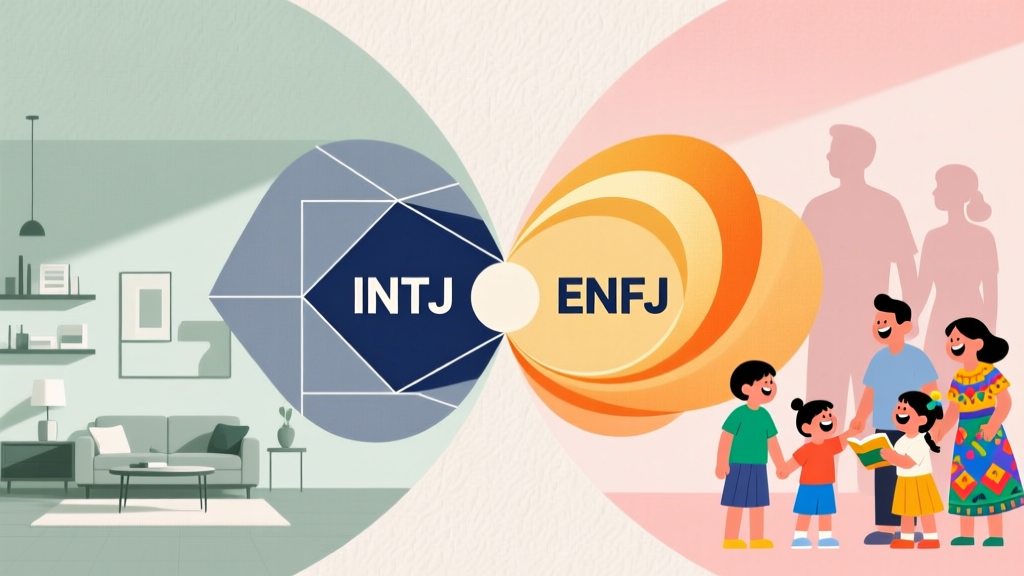
When an INTJ (The Architect) and an ENFJ (The Protagonist) form a parenting partnership, they bring together two of the most strategically capable and relationally attuned types in the MBTI framework. While their cognitive functions diverge significantly—INTJs lead with Introverted Intuition (Ni) and Extraverted Thinking (Te), whereas ENFJs lead with Extraverted Feeling (Fe) and Introverted Intuition (Ni)—their shared auxiliary Ni creates a powerful bridge for long-term vision, values alignment, and anticipatory planning. Yet, where they converge in foresight, they often diverge sharply in execution: one prioritizes efficiency, logic, and autonomy; the other emphasizes emotional resonance, harmony, and collective well-being. This duality is both the engine and the friction point of their family life.
INTJ as a Parent
The INTJ parent approaches child-rearing like a systems engineer designing a resilient, high-functioning ecosystem. Their parenting style is rooted in principled consistency, evidence-based decision-making, and long-term developmental scaffolding. An INTJ mother or father rarely improvises bedtime routines—or chooses a pediatrician based on a friend’s anecdote. Instead, they’ll research sleep science literature, compare vaccination schedules against WHO guidelines, and design a multi-year learning roadmap aligned with their child’s observed aptitudes (e.g., introducing chess at age 5 if pattern recognition emerges early, or enrolling in coding camps by age 10 if logical sequencing is strong).
INTJ parents value intellectual honesty above performative warmth. They may not offer frequent praise, but when they do, it’s specific, earned, and tied to effort or insight: “You revised your essay three times and tightened the thesis—that shows metacognitive discipline.” They model rigor, curiosity, and self-correction—not perfection. However, their low tolerance for inefficiency can manifest as impatience with repetitive questions (“Didn’t we cover fractions last week?”) or emotional theatrics (“Let’s identify the underlying need instead of escalating volume”). To an INTJ, tears are data points—not emergencies—requiring diagnosis before comfort.
Research confirms that high-Te (Extraverted Thinking) parents tend to emphasize structure and achievement orientation. A 2022 longitudinal study published in the Journal of Family Psychology found that children raised by Te-dominant caregivers demonstrated stronger executive function skills by adolescence—but also reported higher baseline anxiety when parental feedback was exclusively outcome-focused and lacked affective validation.
Practical strengths of the INTJ parent include:
- Anticipatory problem-solving: Preemptively addressing school transitions (e.g., touring middle school campuses six months in advance, scripting social scenarios for neurodivergent children).
- Resource optimization: Building home libraries with leveled reading series, curating STEM kits by developmental stage, negotiating bulk discounts for extracurriculars.
- Boundary clarity: Explicitly defining screen-time windows, homework non-negotiables, and consequences—with written charts updated quarterly.
Key growth areas involve softening affective responsiveness and tolerating ambiguity in emotional development. INTJs benefit from deliberate practice in naming emotions aloud (“It sounds like you’re feeling frustrated because your tower fell *right* after you balanced the blue block”), pausing before correcting (“Let me breathe for three seconds before responding”), and scheduling weekly ‘unstructured connection time’—no agenda, no teaching, just presence.
ENFJ as a Parent
The ENFJ parent operates as the family’s chief emotional architect—crafting relational safety, nurturing belonging, and cultivating moral imagination. Their Fe-dominance makes them exquisitely attuned to micro-shifts in mood, unspoken needs, and group dynamics. An ENFJ notices when a child’s laugh has lost its lilt, senses sibling tension before words surface, and intuitively adjusts dinner conversation to uplift a discouraged teen. They don’t just ask, “How was school?”—they ask, “Who made you feel seen today? What part of your day felt like *you*?”
ENFJs instinctively scaffold empathy. They teach conflict resolution through role-play (“Let’s try saying that again with your listening ears on”), normalize vulnerability (“Even grown-ups cry when things change—here’s my tissue and my hug”), and celebrate effort over outcome (“I loved watching you try that cartwheel—even when you wobbled!”). Their homes hum with ritual: Sunday gratitude circles, handwritten birthday letters archived in memory boxes, spontaneous dance parties to release stress. But this strength carries risk: ENFJs may over-identify with their children’s emotions, absorb their distress as personal failure, or prioritize relational harmony over necessary boundaries (“I’ll just skip my yoga class so I can drive Maya to her debate tournament—she needs me”.)
A landmark study by the Center for Applied Positive Psychology found that Fe-dominant parents consistently scored highest on measures of emotional availability and moral reasoning modeling, yet were also most likely to experience caregiver burnout when failing to differentiate their identity from their children’s successes or struggles.
Practical strengths of the ENFJ parent include:
- Emotional calibration: Adjusting tone, pace, and vocabulary to match each child’s receptivity (e.g., using metaphors for intuitive children, step-by-step visuals for sensing learners).
- Community weaving: Orchestrating playdates, parent-teacher coalitions, and neighborhood service projects that reinforce shared values.
- Motivational framing: Turning chores into stories (“We’re the Clean-Up Crew saving the Kingdom of Kitchen!”), linking math homework to real-world impact (“This budgeting sheet helps us plan our beach trip!”).
Key growth areas involve strengthening objective boundaries, trusting children’s capacity for discomfort, and resisting the urge to ‘fix’ every emotional state. ENFJs thrive when they adopt ‘Fe-with-Te’ practices: scheduling non-negotiable self-care blocks, using timers for emotional labor (e.g., “I will listen with full attention for 12 minutes, then we pause for water”), and writing down core family principles to reference when Fe impulses override fairness (e.g., “Equal isn’t always fair—Sam needs speech therapy; Leo needs soccer gear. Both serve growth.”)
Co-Parenting Dynamics for INTJ and ENFJ
INTJ–ENFJ co-parenting is a masterclass in complementary cognition—if consciously designed. Their shared Ni means they’ll align effortlessly on where the family is headed: “Our children will be globally literate, ethically grounded, and technically fluent by age 18.” But their divergent judging functions (Te vs. Fe) create recurring tension around how to get there. The INTJ drafts a color-coded 5-year academic plan; the ENFJ worries it leaves no room for joy or detours. The ENFJ organizes a neighborhood potluck to build community; the INTJ questions its ROI on family time and energy.
This isn’t dysfunction—it’s functional polarity. Neuroscience supports this: a 2023 fMRI study at the University of Cambridge (published in Nature Human Behaviour) demonstrated that mixed-cognition teams (e.g., Te/Fe pairings) outperformed homogenous ones in complex, long-term planning tasks—provided they established explicit communication protocols and shared success metrics.
Here’s how INTJ–ENFJ couples can operationalize that insight:
1. The Dual-Agenda Weekly Planning Session
Block 45 minutes every Sunday. Split the time:
- First 20 min (INTJ-led): Review logistics—school deadlines, medical appointments, resource allocation. Use shared digital dashboards (e.g., Notion or ClickUp) with filters for ‘Urgent,’ ‘Strategic,’ ‘Delegated.’
- Next 20 min (ENFJ-led): Review relational health—‘Who needs extra connection this week? What celebration or repair is needed? Which boundary felt stretched?’ Use a simple 1–5 scale for ‘family emotional temperature.’
- Last 5 min (Joint): Align on one shared action: e.g., “Agree to let Leo choose his own weekend activity (autonomy + joy), but require him to present a 3-point plan for managing time (structure + ownership).”
2. The ‘Function Swap’ Experiment
Once per month, each partner deliberately leads a domain outside their preference:
- INTJ handles ‘Feelings Night’: No solutions, no fixes—just reflective listening and validating phrases (“That sounds deeply unfair. Your anger makes sense.”)
- ENFJ handles ‘Systems Audit’: Reviewing insurance policies, optimizing grocery delivery routes, benchmarking after-school program costs—using spreadsheets, not sentiment.
This builds mutual respect and neural flexibility. Over time, the INTJ internalizes that emotional processing is productive work; the ENFJ sees that structural integrity enables compassion.
3. Conflict De-escalation Protocol
When disagreement flares:
- Pause phrase: “I need 90 seconds to reframe this through your lens.”
- INTJ asks: “What would make this feel safe and honoring for everyone involved?”
- ENFJ asks: “What evidence or principle would make this decision sustainable long-term?”
- Joint output: A single sentence combining both: “We’ll delay the summer camp deposit for two weeks (Te: preserves financial optionality) so Maya can process her anxiety with her counselor first (Fe: honors emotional readiness).”
Family Traditions and Values
INTJ–ENFJ families don’t just have traditions—they engineer them. Their shared Ni ensures traditions serve dual purposes: reinforcing core values and building future resilience. Unlike spontaneous or nostalgic rituals, theirs are iterative, evaluated, and upgraded.
Consider their holiday framework:
| Tradition | INTJ Design Logic | ENFJ Emotional Logic | Evolution Example |
|---|---|---|---|
| Annual Family Vision Board | Aligns goals with measurable outcomes (e.g., “Read 50 books” → tracked via Goodreads API) | Fosters collective hope and identity (“What kind of people do we want to become together?”) | Added ‘Gratitude Anchors’ section—3 past wins pinned beside future goals, preventing Ni-driven pessimism. |
| Monthly ‘Values Lab’ Dinner | Structured debate format (pro/con roles, time limits, evidence requirements) | Storytelling focus (“When did you feel most proud of living our value of courage?”) | Now rotates facilitators—including kids aged 10+—with rotating ‘Process Observer’ role to ensure psychological safety. |
| Quarterly Skill-Swap Weekend | Efficiency audit: “Which skill gaps cost us most in time/money? Let’s cross-train.” | Connection catalyst: “Learning something vulnerable together deepens trust.” | Added ‘Beginner’s Mind Pledge’—no expertise allowed; all participants must ask at least 3 ‘naïve questions.’ |
Notice how each tradition integrates Te’s precision and Fe’s warmth. The INTJ ensures traditions aren’t sentimental clutter; the ENFJ ensures they’re not sterile exercises. Their shared Ni prevents drift—their combined judgment prevents rigidity.
Core family values typically crystallize around:
- Intellectual Integrity: Questions are sacred; changing your mind = growth, not weakness.
- Relational Courage: Speaking hard truths with care—and receiving them without defensiveness.
- Future-Back Living: Every decision asked: “Does this serve who we aim to become in 5 years?”
This values architecture gives children a compass—not a map. They learn to weigh data and dignity, plan and pivot, lead and follow.
Raising Children with Different Personality Types
An INTJ–ENFJ household is uniquely equipped—and uniquely challenged—by having children across the MBTI spectrum. Their shared Ni helps them anticipate developmental inflection points; their divergent judging functions equip them to meet each child where they are.
For example, consider raising an ESTP child (The Entrepreneur) alongside an INFJ sibling (The Advocate):
- ESTP: Thrives on tactile problem-solving, immediate feedback, and freedom to experiment. The INTJ parent provides rigorous safety protocols (“Here’s the exact torque setting for your bike brakes”) and real-world challenges (“Design a lemonade stand ROI model”). The ENFJ parent supplies energetic encouragement, social coaching (“Let’s rehearse your pitch!”), and joyful celebration of results.
- INFJ: Needs deep meaning, quiet reflection, and ethical alignment. The ENFJ parent offers sanctuary (“Your room is your thinking temple—no interruptions until lunch”), validates idealism (“That injustice *should* break your heart—it breaks mine too”), and co-creates service projects. The INTJ parent grounds their visions (“Let’s research which NGO actually moves the needle on clean water access”) and teaches strategic advocacy (“Here’s how to write a policy brief that changes minds”).
Crucially, INTJ–ENFJ parents avoid type-based labeling. They don’t say, “You’re an ESTP, so you hate reading.” Instead, they observe: “You light up when building things with your hands and lose focus during silent sustained reading. Let’s find audiobooks with engineering themes and graphic novels about robotics.”
They leverage type-awareness as a diagnostic tool—not destiny. When their ISTJ child resists open-ended art projects, they don’t pathologize it; they co-design structured creative prompts (“Build a bridge from recycled materials that holds 500g—document your iterations”). When their ENFP teen rebels against chore charts, they co-create a ‘Contribution Menu’ with flexible options (cooking, pet care, tech support, elder visiting) and let them rotate weekly.
Research from the Child Mind Institute emphasizes that personality-informed parenting reduces power struggles by 40% when caregivers match task design to temperament—not force conformity. INTJ–ENFJ couples excel here because their natural polarity prevents one-size-fits-all solutions.
Navigating Extended Family as INTJ and ENFJ
Extended family gatherings are where INTJ–ENFJ dynamics either shine—or short-circuit. Grandparents may see the INTJ as ‘cold’ and the ENFJ as ‘overbearing.’ Cousins might perceive the INTJ’s silence as disinterest and the ENFJ’s enthusiasm as intrusive.
Proactive strategies include:
Pre-Gathering Alignment
Before any multigenerational event, the couple defines three non-negotiables:
- Energy Budget: “We’ll stay 3 hours max. INTJ takes first shift engaging elders; ENFJ takes second shift hosting cousins. We’ll text ‘recharge’ to signal swap.”
- Topic Boundaries: “Politics and unsolicited parenting advice are off-limits. If raised, INTJ cites data source; ENFJ redirects to shared memory (“Remember when Aunt Lena taught us to bake pies?”).
- Exit Protocol: “If a child melts down, ENFJ soothes while INTJ secures exit route (car keys, coats, backup ride). No explanations needed.”
Role Modeling Intentional Interaction
They demonstrate healthy boundaries without apology:
INTJ to overbearing relative: “We appreciate your concern about screen time. Our pediatrician’s guidance aligns with AAP recommendations—we’re happy to share the source.”
ENFJ to withdrawn relative: “I know quiet time is precious for you. Would you like to join us for the pie-cutting ceremony—or would you prefer we bring you a slice in the garden?”
Leveraging Complementary Strengths
During chaotic events, they deploy their functions like a relay team:
- INTJ scouts: Maps exits, identifies quiet zones, assesses food allergen risks, preps ‘emergency kits’ (noise-canceling headphones, fidget tools, hydration).
- ENFJ bridges: Greets newcomers, translates generational language (“Grandma means ‘help set the table’ when she says ‘make yourself useful’”), mediates sibling spats with humor.
This prevents the ENFJ from becoming the sole emotional buffer—and the INTJ from retreating entirely. It signals to extended family: We’re a unit with shared standards and distributed responsibility.
FAQ
How do INTJ and ENFJ parents handle discipline differently—and how can they unify their approach?
INTJs lean toward natural/logical consequences (“If you don’t charge your tablet, you won’t use it for tomorrow’s video call”) and rule-based frameworks (“Our screen-time contract is reviewed quarterly”). ENFJs favor restorative practices (“How can you repair the trust after breaking your promise?”) and relational accountability (“Let’s talk about how your actions affected your sister’s feelings”). Unification happens through the 3-Part Discipline Framework: (1) Clarity (INTJ drafts the rule with rationale), (2) Connection (ENFJ explains impact and invites input), (3) Course-Correction (jointly design the consequence—e.g., “You’ll help rebuild the Lego set you knocked over AND write a note apologizing”). This satisfies Te’s need for fairness and Fe’s need for healing.
What if our child tests as the same type as one parent—does that create bias or imbalance?
Yes—commonly. An INTJ parent may unconsciously privilege their ESTJ child’s organizational skills while overlooking their INFP child’s poetic sensitivity. An ENFJ parent may over-extend to their ESFJ child’s social needs while missing their ISTP child’s need for autonomous tinkering. Counter this with Type-Agnostic Observation Logs: For one week, document only behaviors—not interpretations (“Child spent 47 minutes drawing intricate cityscapes” vs. “Child is artistic”). Then analyze patterns across all children. This disrupts projection and reveals true developmental needs.
How can we prevent our ENFJ’s desire for family togetherness from overwhelming the INTJ’s need for solitude?
Build ‘Solitude Equity’ into family architecture. Examples: (1) Non-Negotiable Recharge Windows: Every adult gets 90 minutes daily—untouchable, no exceptions. (2) Choice Architecture: Replace “Let’s all go hiking!” with “Hiking trail, library study session, or backyard stargazing—vote by 7am.” (3) Shared Language: Agree that “I need my Ni space” is as valid as “I need Fe connection”—no justification required. Research in the American Psychological Association Monitor confirms that respecting introvert recharge needs improves relationship satisfaction by 32% in mixed-dynamic partnerships.
Our extended family insists on traditional gender roles—how do INTJ and ENFJ parents model progressive values without alienating relatives?
Use Stealth Values Integration: Instead of debating ideology, embed equity in action. Have the INTJ father teach daughters circuitry while sons learn meal prep—and document it casually (“Dad’s showing us how to fix the garage door opener!”). Have the ENFJ mother lead neighborhood cleanups while grandfathers mentor teens in woodworking—and frame it as “intergenerational skill-sharing.” Over time, behavior normalizes values more powerfully than arguments. As sociologist Dr. Lisa Wade notes in her book Gender: Ideas, Interactions, Institutions, “Cultural change occurs not through confrontation, but through repeated, visible, normalized alternatives.”
Ultimately, the INTJ–ENFJ parenting partnership is less about compromise and more about complementarity engineering. They don’t meet halfway—they build a third space where logic serves love, and love informs logic. Their children don’t just inherit stability or warmth; they inherit the rare ability to hold paradox: to plan with precision and pivot with grace, to think critically and feel deeply, to build systems that serve souls. In a world demanding both vision and velocity, that may be the most vital inheritance of all.