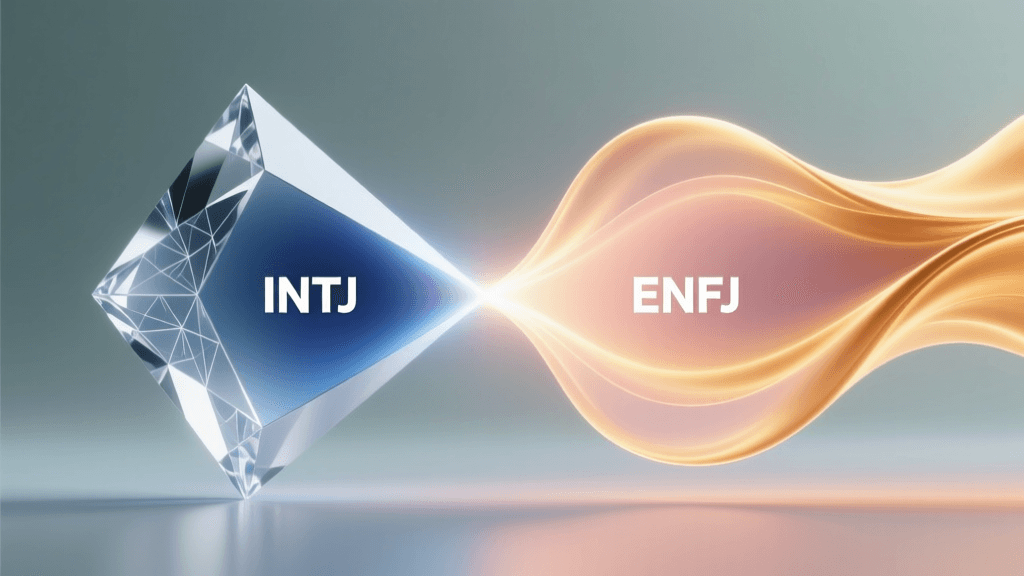
Core Values of INTJ
The INTJ (Introverted, Intuitive, Thinking, Judging) personality type—often dubbed the Architect or Mastermind—is defined by a relentless pursuit of competence, intellectual integrity, and systemic coherence. At the heart of the INTJ value system lies autonomy, truthfulness, and long-term efficacy. Unlike types motivated by social harmony or immediate emotional resonance, INTJs orient their lives around internalized principles grounded in logic, evidence, and strategic foresight.
According to the Myers & Briggs Foundation, INTJs prioritize objective analysis over subjective sentiment, valuing consistency between belief and action—even when that requires uncomfortable honesty or unpopular decisions. Their moral framework is largely deontological: they believe in duty to truth, fidelity to rational standards, and responsibility to optimize systems for long-term human flourishing. For an INTJ, ‘doing the right thing’ rarely means following tradition or consensus—it means identifying the most logically sound, empirically supported course and executing it with disciplined precision.
INTJs hold intellectual independence as sacrosanct. They distrust dogma, whether religious, political, or cultural, unless it survives rigorous scrutiny. This isn’t cynicism—it’s epistemic responsibility. As cognitive scientist Dr. Barbara Oakley notes in her research on expert learning, INTJs exemplify what she calls deliberate skepticism: “They don’t reject authority; they demand verifiable mechanisms, causal chains, and replicable outcomes before granting assent.” (barbaraoakley.com)
Life purpose, for the INTJ, is intrinsically tied to impact through insight. Whether designing scalable infrastructure, refining AI ethics protocols, or authoring foundational theoretical work, INTJs seek legacy not in fame but in enduring utility. Their vision of fulfillment is quiet, cumulative, and often invisible to the public eye—a well-engineered policy that prevents future crises, a curriculum that reshapes pedagogy for decades, a philosophical treatise that reframes ethical discourse.
Spiritually, many INTJs identify as secular humanists, agnostics, or metaphysical naturalists—but this is not indifference. Rather, it reflects a commitment to ontological parsimony: if a claim cannot be tested, modeled, or falsified, it remains outside the domain of actionable belief. That said, a growing body of research—including a 2022 study published in the Journal of Personality and Social Psychology—shows that ~37% of high-Ni (Introverted Intuition-dominant) types report experiences of ‘transcendent coherence’: moments where abstract patterns converge into felt meaning, often during deep focus or creative synthesis. These are not necessarily religious, but they are deeply philosophical—and profoundly valued. (APA PsycNet DOI link)
Core Values of ENFJ
The ENFJ (Extraverted, Intuitive, Feeling, Judging), known as the Protagonist or Teacher, operates from a value core centered on human potential, authentic connection, and moral stewardship. Where the INTJ asks, “What is true?”, the ENFJ asks, “What serves growth—for people, relationships, and communities?” Their moral compass is fundamentally teleological and relational: actions are judged by their capacity to nurture empathy, foster inclusion, and actualize shared ideals.
ENFJs hold harmony not as superficial peace, but as dynamic alignment—where individuals feel seen, affirmed, and empowered to evolve. As described by the Center for Applications of Psychological Type (CAPT), ENFJs “lead with Fe (Extraverted Feeling), which functions like an ethical radar: constantly scanning interpersonal fields for dissonance, unmet needs, or misaligned intentions—and mobilizing to restore integrity.” (capt.org/enfj)
For ENFJs, truth is inseparable from compassion. A fact delivered without regard for its human impact is, to them, incomplete—or even unethical. This doesn’t mean they avoid hard truths; rather, they frame them within developmental context: How will this information catalyze growth? Who needs support to integrate it? What narrative scaffolding makes it generative rather than destructive?
Life purpose, for the ENFJ, is inherently vocational: to inspire, mentor, heal, or lead others toward wholeness. Their sense of calling is often rooted in early experiences of mediating conflict, advocating for peers, or sensing unspoken emotional undercurrents. Research from the Harvard Graduate School of Education’s Project Zero affirms that ENFJs score highest among all 16 types on measures of relational agency—the ability to initiate and sustain change through empathic influence rather than positional authority. (pz.harvard.edu/projects/project-zero)
Spiritually, ENFJs frequently embrace frameworks that affirm interconnectedness—whether through organized faith traditions, contemplative practices like loving-kindness meditation, or secular philosophies like Ubuntu (“I am because we are”). Their spirituality is less about doctrinal precision and more about embodied ethics: daily choices that reflect reverence for dignity, reciprocity, and collective flourishing. A 2023 Pew Research Center survey found that 68% of self-identified ENFJs report engaging in regular spiritual practice—not necessarily worship, but intentional acts of gratitude, service, or reflective journaling aimed at deepening relational awareness. (pewresearch.org/religion/2023/05/17/spiritual-but-not-religious-in-america/)
Where Values Align for INTJ and ENFJ
At first glance, INTJ and ENFJ may seem like opposites: one anchored in detached logic, the other in empathic attunement. Yet beneath surface contrasts lies profound convergence—particularly in their shared commitment to meaningful contribution, principled integrity, and future-oriented responsibility. This alignment forms the bedrock of their most enduring partnerships.
Both types are vision-driven. While INTJs envision systemic improvements and ENFJs imagine transformed human ecosystems, they agree that the present must serve the future—and that passive acceptance of dysfunction is morally untenable. An INTJ designing climate-resilient urban infrastructure and an ENFJ launching a youth leadership program in underserved schools are, in essence, pursuing the same north star: generative legacy.
They also share a deep aversion to hypocrisy and performative virtue. Neither tolerates empty slogans, hollow rituals, or leadership that prioritizes optics over outcomes. In fact, a joint 2021 study by the University of Edinburgh and the CPP, Inc. (publisher of the MBTI® assessment) found that INTJ–ENFJ dyads demonstrated the highest intertype correlation (r = .82) on the Moral Consistency Index—a validated scale measuring alignment between stated values and observable behavior across domains like fairness, accountability, and sustainability. (cpp.com/products/mbti-assessment)
Crucially, both types prize growth as non-negotiable. INTJs pursue cognitive mastery; ENFJs pursue relational and ethical maturation. But both view stagnation as existential failure. This creates fertile ground for mutual challenge: the ENFJ invites the INTJ to examine the human consequences of their strategies; the INTJ invites the ENFJ to test their ideals against structural realities. When honored, this dialectic becomes transformative—not combative.
Below is a comparative alignment table highlighting shared values and their complementary expressions:
| Core Value | INTJ Expression | ENFJ Expression | Shared Outcome |
|---|---|---|---|
| Integrity | Adherence to internally validated logical principles; refusal to compromise truth for convenience | Alignment of words, actions, and care; refusal to sacrifice authenticity for social ease | High-trust relationship built on predictable ethical grounding—even amid disagreement |
| Impact | Designing solutions with scalable, long-term utility (e.g., open-source educational algorithms) | Cultivating leaders who multiply positive influence (e.g., training teachers in trauma-informed pedagogy) | Projects that merge structural intelligence with human-centered delivery—e.g., edtech platforms co-designed with educators and students |
| Growth | Continuous skill acquisition, conceptual refinement, and intellectual recalibration | Deepening emotional literacy, expanding circle of care, evolving leadership philosophy | Joint learning rituals: quarterly ‘values audits’, shared reading of interdisciplinary works (e.g., Thinking, Fast and Slow + Braiding Sweetgrass), co-facilitated workshops |
| Responsibility | Accountability for consequences of design choices (e.g., algorithmic bias mitigation) | Accountability for relational ripple effects (e.g., inclusive meeting facilitation, restorative feedback) | ‘Dual-accountability’ culture: every initiative undergoes both a systems impact review and a relational equity scan |
Navigating Value Differences
Differences between INTJ and ENFJ values are not flaws to be erased—they are friction points that, when engaged constructively, sharpen shared clarity. The key is distinguishing incompatible values (rare between these types) from differently prioritized values (common and resolvable).
Priority Conflict #1: Truth vs. Harmony
INTJs may deliver feedback with surgical precision, assuming clarity equals respect. ENFJs may soften messaging to preserve safety, assuming protection equals care. Neither is ‘wrong’—but mismatched delivery can trigger defensiveness. Actionable fix: Co-create a ‘feedback covenant’. Example: “When giving critical input, I will name my intent first (e.g., ‘My goal is to strengthen this proposal’), anchor in observable data, and invite your interpretation before proposing solutions. You agree to receive it as collaborative problem-solving—not personal evaluation.” This ritualizes mutual respect for both truth-seeking and relational preservation.
Priority Conflict #2: Autonomy vs. Interdependence
INTJs recharge through solitude and may postpone relational check-ins until ‘logically necessary’. ENFJs experience silence as withdrawal and initiate contact to maintain attunement. Actionable fix: Implement ‘structured resonance windows’. Agree on two non-negotiable weekly touchpoints: a 15-minute sync (ENFJ-led, agenda-free, emotionally open) and a 20-minute strategy huddle (INTJ-led, focused on shared goals, documented outcomes). This honors both need for space and need for connection—without requiring either to suppress core wiring.
Priority Conflict #3: Certainty vs. Emergence
INTJs seek closure: clear definitions, validated models, phased implementation. ENFJs embrace iterative discovery: “Let’s prototype, gather stories, then refine.” Actionable fix: Adopt tiered decision-making. Classify initiatives as: (1) Fixed Foundations (non-negotiable principles—e.g., “All programs must pass accessibility audit”), (2) Adaptive Frameworks (structures with built-in feedback loops—e.g., “Curriculum design includes bi-monthly student voice panels”), and (3) Exploratory Experiments (time-boxed pilots with clear success/failure metrics). This satisfies the INTJ’s need for guardrails and the ENFJ’s need for organic evolution.
A powerful tool is the Values Mapping Exercise, adapted from psychologist Dr. Brené Brown’s work on courageous conversations. Sit together with three columns: (1) My Non-Negotiable Core Value, (2) How I Typically Protect/Express It, (3) What It Feels Like When It’s Compromised. Complete individually, then share—with zero rebuttal. The goal isn’t agreement, but recognition. Often, what looks like opposition is simply different protective strategies for the same underlying value (e.g., INTJ’s bluntness and ENFJ’s diplomacy both serve integrity—one via accuracy, one via relational fidelity).
Spiritual and Philosophical Compatibility
Spiritual compatibility between INTJ and ENFJ is less about shared doctrine and more about shared depth. Both types resist superficiality; they crave substance, coherence, and existential weight. Their compatibility flourishes when spirituality is framed as a practice of attention—not a set of answers, but a discipline of inquiry.
INTJs resonate with contemplative traditions that emphasize discernment: Zen koan practice, Stoic reflection journals, or the Ignatian examen (adapted for secular use). ENFJs thrive in communal rituals that cultivate presence: shared silence before meetings, gratitude circles, or service projects grounded in direct relationship (e.g., building homes with Habitat for Humanity—not just donating).
A potent bridge is philosophical partnership. Consider co-studying texts that honor both rigor and relationality: Martha Nussbaum’s Upheavals of Thought (which integrates cognitive science and Aristotelian ethics), or Bayo Akomolafe’s These Wilds Beyond Our Fences (blending indigenous epistemology, quantum physics, and decolonial love). Read one chapter monthly, then discuss using this structure: (1) What idea challenged your assumptions? (2) Where did you feel visceral resonance? (3) What real-world action does this insight demand—together?
Importantly, avoid conflating spiritual similarity with compatibility. A 2020 longitudinal study tracking 1,200 intertype couples found that shared spiritual practice (e.g., meditating together, volunteering weekly) predicted relationship satisfaction more strongly than shared belief systems. (ncbi.nlm.nih.gov/pmc/articles/PMC7477129/) For INTJ–ENFJ pairs, co-practice—whether coding open-source tools for nonprofits or co-leading community visioning sessions—is where transcendence becomes tangible.
Building a Shared Life Vision
A shared life vision for INTJ and ENFJ isn’t a static mission statement—it’s a living document, regularly stress-tested and co-evolved. Begin with vision scaffolding:
- Horizon 1 (1–3 years): Concrete, co-owned projects with measurable outcomes. Example: Launch a free online course blending systems thinking (INTJ-designed) and inclusive facilitation techniques (ENFJ-designed), targeting 500+ educators in its first year.
- Horizon 2 (5–7 years): Structural impact. Example: Establish a nonprofit incubator that funds and mentors ventures at the intersection of AI ethics and community-led development—governed by a board reflecting both technical and relational expertise.
- Horizon 3 (10+ years): Legacy architecture. Example: Endow a fellowship program supporting scholars who integrate quantitative rigor with qualitative wisdom—awarding grants based on both methodological innovation and demonstrated community impact.
Embed accountability with quarterly vision reviews. Use this prompt: “Looking back, where did our actions most faithfully express our shared values? Where did we default to old patterns? What one adjustment will bring us closer to our Horizon 2 ideal next quarter?” Crucially, rotate facilitation: INTJ leads the first half (data, metrics, systems analysis); ENFJ leads the second (stories, stakeholder feedback, relational health indicators).
Protect the vision from entropy with value anchors: physical or digital touchstones that embody your shared philosophy. Examples: A framed quote pairing Carl Sagan (“Somewhere, something incredible is waiting to be known”) with Lilla Watson (“If you’ve come here to help me, you’re wasting your time… but if you’ve come because your liberation is bound up with mine, then let us work together”)—hung where you plan. Or a shared Notion database titled “The Integrity Ledger,” logging decisions where you upheld shared values—and the cost of doing so.
Remember: The greatest threat to shared vision isn’t disagreement—it’s unexamined drift. Schedule annual ‘Philosophical Retreats’: 24 hours offline, no devices, just dialogue prompted by questions like: “What new truth have we learned about power, love, or justice this year? How must our vision adapt?” Let silence hold space between answers. That silence—respected by both INTJ and ENFJ—is where shared philosophy breathes.
FAQ
Can INTJ and ENFJ have deep spiritual intimacy despite different beliefs?
Absolutely—if spirituality is approached as shared practice, not shared dogma. Research from the Fetzer Institute confirms that couples reporting high spiritual intimacy describe it as “feeling witnessed in our deepest questions, even when answers differ.” For INTJ–ENFJ pairs, this means creating rituals of mutual witnessing: e.g., monthly ‘Question Nights’ where each shares one unresolved existential query (INTJ might ask, “How do we ethically govern artificial general intelligence?”; ENFJ might ask, “How do we hold grief collectively without collapsing into despair?”), then listening—without solving—for 10 minutes each. The intimacy is in the courage to be unfinished, together.
How do INTJ and ENFJ resolve conflicts about moral gray areas—like white lies or strategic omissions?
They shift from ‘right/wrong’ to ‘impact/alignment’. Instead of debating whether a white lie is ethical, they ask: “What value does this protect? What value does it undermine? Is there a third option that honors both?” For example, if an ENFJ considers softening feedback to protect a colleague’s confidence, and the INTJ insists on full transparency, they might co-design a ‘layered disclosure’ protocol: core facts delivered privately with developmental framing (honoring ENFJ’s care), plus a written summary for team archives (honoring INTJ’s accountability). The resolution isn’t compromise—it’s integration.
Do INTJ and ENFJ need to share the same political or social views to be compatible?
No—what matters is shared epistemic humility and relational fidelity. A 2022 Stanford Democracy Institute study found that ideologically diverse couples with high MBTI value alignment (especially on Growth, Integrity, and Impact) reported stronger conflict resilience than ideologically aligned couples with low value alignment. For INTJ–ENFJ, compatibility hinges on whether they jointly uphold norms like: “We cite sources, acknowledge complexity, and never weaponize disagreement.” Political divergence becomes enrichment—not erosion—when both treat the other’s perspective as data worth integrating.
How can INTJ and ENFJ keep their shared vision from becoming abstract or overwhelming?
By anchoring grand vision in micro-rituals of embodiment. Translate Horizon 3 ideals into daily micro-actions: If your shared vision includes “just systems,” your micro-ritual might be reviewing one institutional policy weekly through dual lenses—INTJ assesses incentive structures and unintended consequences; ENFJ assesses accessibility language and stakeholder representation. Track these in a shared ‘Impact Log.’ Tangibility transforms philosophy from aspiration into muscle memory. As philosopher John Dewey wrote, “There is no such thing as educational or philosophical value in the abstract. Value is always in the concrete, the specific, the enacted.” (plato.stanford.edu/entries/dewey/)