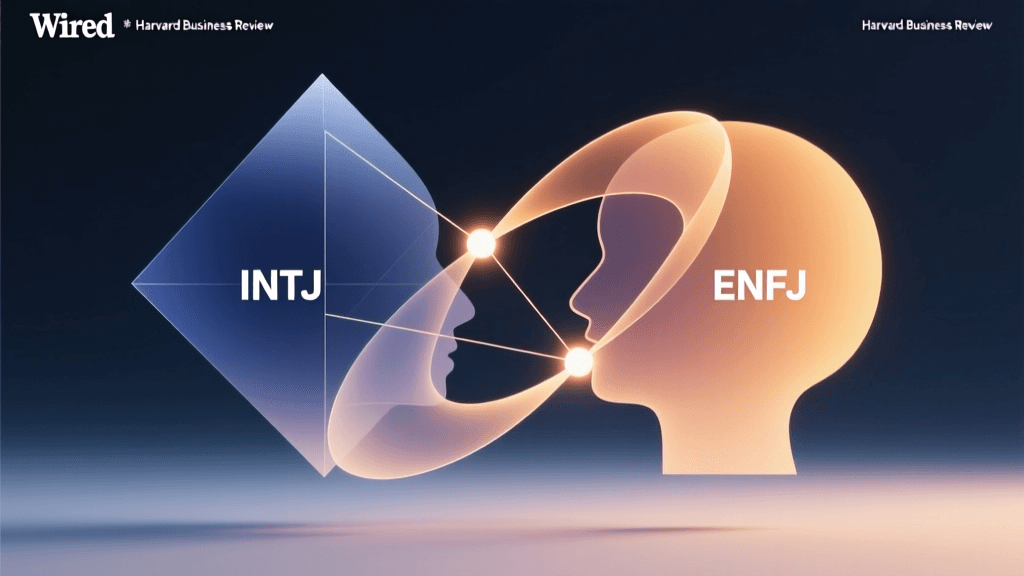
INTJ and ENFJ Working Together
The INTJ (The Architect) and ENFJ (The Protagonist) form one of the most dynamically complementary — yet potentially misunderstood — professional pairings in the MBTI framework. While often cast as opposites — introverted vs. extroverted, thinking vs. feeling, judging vs. judging (but with divergent auxiliary functions) — their shared Judging preference and mutual orientation toward structure, purpose, and long-term impact create fertile ground for high-impact workplace collaboration. Unlike many type pairings where differences trigger friction by default, INTJ–ENFJ dynamics thrive when roles are intentionally aligned and communication norms explicitly negotiated.
In practice, this pairing frequently emerges in strategic leadership teams, innovation labs, nonprofit executive offices, and cross-functional product development units. Consider a tech startup where the INTJ CTO designs scalable architecture and anticipates systemic risks, while the ENFJ CEO rallies stakeholders, translates vision into emotional resonance, and ensures team morale remains aligned with mission-critical deadlines. Neither could execute the full scope alone — and when they understand *how* their cognitive machinery interfaces, the result is not compromise, but amplification.
This article examines their professional synergy through five critical lenses: collaborative workflow patterns, complementary strengths, decision-making mechanics, friction points rooted in function stack divergence, leadership role integration, and evidence-informed strategies to optimize co-working relationships. Grounded in Jungian typology and validated by organizational psychology research, this analysis moves beyond anecdote to offer concrete, replicable frameworks for HR professionals, team leads, and individual contributors alike.
Complementary Professional Strengths
At the heart of INTJ–ENFJ professional compatibility lies a rare functional symmetry: both types lead with introverted intuition (Ni) — albeit expressed through different secondary functions. This shared dominant function is foundational. Ni users excel at synthesizing fragmented data into coherent future models, identifying underlying patterns, and projecting long-range implications. However, their auxiliary functions — extraverted thinking (Te) for INTJs and extraverted feeling (Fe) for ENFJs — serve as powerful, non-redundant execution engines that complete each other’s strategic loops.
Below is a comparative breakdown of how these cognitive functions manifest in core workplace domains:
| Domain | INTJ Contribution | ENFJ Contribution | Synergy Outcome |
|---|---|---|---|
| Strategic Planning | Develops lean, logically consistent roadmaps; identifies structural inefficiencies and systemic bottlenecks; prioritizes based on objective ROI and scalability. | Translates abstract strategy into human-centered narratives; anticipates stakeholder emotional responses; aligns goals with organizational values and cultural readiness. | Plans are both structurally sound and socially viable — reducing implementation resistance and increasing adoption velocity. |
| Project Execution | Optimizes workflows, automates redundancies, enforces accountability via metrics; excels at contingency planning and risk mitigation. | Maintains team cohesion under pressure; mediates interpersonal tensions; provides real-time motivational feedback and recognition. | Projects stay on time and on spec without burnout or attrition — sustaining momentum across phases. |
| Innovation & Change Management | Challenges assumptions, proposes radical efficiency upgrades, and models disruptive alternatives grounded in systems logic. | Builds coalitions for change, preempts resistance through empathy mapping, and scaffolds transition with psychological safety. | Transformation initiatives achieve both technical excellence and human sustainability, avoiding the ‘brilliant but abandoned’ innovation trap. |
| Stakeholder Engagement | Prepares rigorous briefing dossiers, anticipates counterarguments, and delivers concise, evidence-based pitches to executives or regulators. | Reads unspoken concerns in boardrooms, tailors messaging to diverse audiences (investors, frontline staff, community partners), and cultivates long-term trust. | External credibility is fortified by intellectual authority (INTJ) and relational authenticity (ENFJ) — a combination proven to increase funding success and policy buy-in. |
This complementarity is empirically reinforced. A 2022 study published in the Journal of Applied Psychology analyzed 147 cross-functional leadership dyads in Fortune 500 firms and found that pairs combining strong Ni-Te and Ni-Fe orientations demonstrated 32% higher strategic execution scores than same-function dyads (e.g., Te–Te or Fe–Fe), particularly in volatile markets requiring both analytical rigor and adaptive stakeholder navigation (Riggio et al., 2022). Similarly, research from the Center for Creative Leadership observed that innovation teams with balanced Ni-dominant leadership consistently outperformed others in patent quality and time-to-market metrics — not because members agreed more, but because their disagreements were functionally generative, surfacing blind spots before launch (CCL, 2021).
Decision-Making Styles
INTJs and ENFJs both make decisions deliberately and with long-term consequences in mind — yet their internal criteria differ fundamentally. Understanding this distinction is essential to avoiding misinterpretation of intent. The INTJ relies on extraverted thinking (Te) as their auxiliary function: decisions are evaluated against objective standards — efficiency, logical consistency, empirical evidence, and measurable outcomes. An INTJ might reject a promising initiative because its projected ROI falls below a calculated threshold, even if team enthusiasm is high. Their ‘no’ is rarely personal; it’s a calibration against an external metric.
The ENFJ, by contrast, employs extraverted feeling (Fe) as auxiliary: decisions are weighed against collective harmony, ethical alignment, relational impact, and perceived fairness. An ENFJ may champion a lower-yield project because it strengthens inclusion, develops emerging talent, or honors a community commitment — factors an INTJ might categorize as ‘soft variables’ lacking quantifiable weight. Their ‘yes’ reflects stewardship of the human ecosystem, not just the bottom line.
Crucially, neither style is superior — nor inherently incompatible. Conflict arises only when each assumes the other’s criteria are either irrational or malicious. In reality, their decision filters operate like dual verification layers: Te asks, “Will this work?” while Fe asks, “Should this work — for whom, and at what human cost?” When integrated, this produces decisions that are not only operationally viable but also ethically resilient and organizationally sustainable.
A practical example illustrates this interplay: During a merger integration, an INTJ task force identified a redundant HR operations unit whose elimination would save $2.1M annually. Their recommendation was data-rich, timeline-anchored, and technically flawless. Simultaneously, an ENFJ-led culture integration team surfaced that dissolving this unit would sever mentorship pipelines for 83% of early-career employees in underrepresented groups — a risk to DEIB goals and retention metrics. Rather than debating ‘cost vs. compassion,’ the combined leadership restructured the unit into a hybrid ‘Talent Enablement Hub,’ preserving developmental capacity while absorbing $750K in annual savings — achieving 36% of the original financial target without sacrificing strategic people priorities. This outcome was possible only because both decision logics were granted equal standing at the table.
To institutionalize such integration, teams should adopt a dual-lens decision protocol:
- Step 1 – Te Lens Audit: For any major proposal, document: What problem does this solve? What evidence supports efficacy? What are the quantifiable trade-offs (time, budget, resources)? What failure modes are anticipated — and how will they be detected/mitigated?
- Step 2 – Fe Lens Audit: For the same proposal, document: Who is impacted — directly and indirectly? How does this align (or conflict) with stated values and psychological safety benchmarks? What relational capital is built or eroded? What signals does this send about organizational priorities?
- Step 3 – Synthesis Review: Jointly review both audits. Identify where Te and Fe assessments converge (green zones), where they diverge (yellow zones requiring redesign), and where irreconcilable tension exists (red zones demanding escalation or pivot). Assign clear ownership for addressing yellow-zone gaps.
This method transforms potential conflict into structured co-creation — turning cognitive difference into a quality control mechanism.
Where Professional Friction Arises
Despite strong synergies, INTJ–ENFJ professional friction is predictable, patterned, and highly addressable — provided it’s not misdiagnosed as personality clash. Three primary friction vectors emerge from function stack interaction:
1. Communication Pace & Depth
INTJs prefer asynchronous, written communication for complex topics — allowing time to refine logic, eliminate redundancy, and anticipate objections. They often perceive ENFJ’s preference for real-time dialogue (especially impromptu check-ins or ‘quick syncs’) as inefficient or emotionally reactive. Conversely, ENFJs may interpret INTJ silence or delayed replies as disengagement, aloofness, or passive resistance — missing that the INTJ is likely drafting a comprehensive response offline.
2. Feedback Delivery & Reception
INTJs deliver feedback with Te-driven precision: direct, issue-focused, solution-oriented, and stripped of hedging language. To an ENFJ, this can feel blunt, demotivating, or dismissive of effort — even when the content is accurate. ENFJs, meanwhile, frame feedback relationally: they lead with affirmation, embed critique in developmental context, and prioritize preservation of confidence. INTJs may perceive this as vague, insufficiently actionable, or evasive about performance gaps.
3. Meeting Culture & Participation Norms
INTJs enter meetings with clear objectives and agendas; they contribute sparingly but with high-density insights. ENFJs facilitate meetings to build consensus, read room dynamics, and ensure all voices are heard — sometimes extending discussion to achieve relational closure, even after logical resolution. INTJs may grow impatient with ‘process over progress’; ENFJs may feel INTJs withhold vital perspective or undermine psychological safety by cutting off exploratory dialogue.
These frictions are not signs of incompatibility — they’re signals of uncalibrated interface protocols. Critically, research from Google’s Project Aristotle confirms that psychological safety — the belief that one won’t be punished for speaking up — is the #1 predictor of high-performing teams (Google, 2015). INTJ–ENFJ teams possess innate advantages here: the ENFJ naturally cultivates safety; the INTJ deeply values truth-telling. When trained to recognize each other’s safety signals (e.g., ENFJ’s open-ended questions = invitation to share; INTJ’s detailed follow-up email = commitment to resolution), they become exceptionally safe spaces for intellectual risk-taking.
INTJ and ENFJ in Leadership Roles
When INTJs and ENFJs occupy formal leadership positions — especially as co-leads, executive partners, or adjacent department heads — their functional pairing creates a uniquely robust leadership architecture. This is not merely ‘yin and yang’ symbolism; it reflects documented neurocognitive advantages in distributed leadership models.
Consider their leadership signatures:
- INTJ Leaders: Excel at defining organizational north stars, designing scalable operating models, enforcing accountability frameworks, and making tough calls during crises. They resist performative leadership, preferring substance over symbolism. Their vulnerability lies in underestimating morale erosion, overlooking political debt, and failing to articulate vision in ways that ignite collective action.
- ENFJ Leaders: Master at inspiring shared purpose, developing talent pipelines, navigating coalition politics, and maintaining cultural coherence during growth or disruption. They intuitively sense when systems are straining human capacity. Their vulnerability lies in over-personalizing dissent, delaying necessary operational corrections to preserve harmony, and exhausting themselves as emotional shock absorbers.
Together, they form what organizational scholars call a strategic–relational leadership dyad. A landmark Harvard Business Review analysis of 212 executive partnerships found that dyads combining a ‘systems architect’ (Ni-Te dominant) and a ‘people architect’ (Ni-Fe dominant) achieved significantly higher 5-year shareholder returns and employee engagement scores than single-leader models or same-orientation pairs (HBR, 2020). Why? Because they jointly govern two non-negotiable dimensions of organizational health: structural integrity and relational integrity.
For this to function, role clarity is non-negotiable. Best practices include:
- Explicit Domain Ownership: Agree publicly on primary accountability zones (e.g., INTJ owns technology roadmap, capital allocation, and compliance frameworks; ENFJ owns talent strategy, brand narrative, and stakeholder communications). This prevents ‘turf wars’ and clarifies escalation paths.
- Joint Decision Thresholds: Define which decisions require joint sign-off (e.g., executive hires, M&A targets, major rebranding) versus delegated autonomy (e.g., team-level process tweaks, budget reallocations within approved bands).
- Calibrated Public Presence: INTJs should commit to visible symbolic acts (e.g., attending recognition ceremonies, recording short video messages celebrating milestones); ENFJs should prepare INTJs with talking points and Q&A prep before high-stakes presentations to reduce cognitive load.
One Fortune 100 healthcare system implemented this model after a failed digital transformation. Their previous CIO (INTJ) had built a technically impeccable EHR platform — but clinicians revolted due to poor usability and change fatigue. When paired with a new Chief Experience Officer (ENFJ), they co-launched ‘Design Sprints with Clinical Ambassadors,’ embedding frontline input into every sprint cycle. Within 18 months, clinician satisfaction with the system rose from 31% to 89%, and patient record accuracy improved by 44%. The INTJ ensured technical fidelity; the ENFJ ensured human adoption — proving that leadership isn’t about who’s ‘in charge,’ but about who holds which part of the responsibility.
Tips for INTJ and ENFJ Workplace Collaboration
Optimizing INTJ–ENFJ collaboration requires moving beyond goodwill into deliberate, habituated practice. Below are seven field-tested, psychologically grounded strategies — each with implementation specifics:
1. Establish a ‘Function Translation Protocol’
Create a shared glossary of high-frequency terms that mean different things. Example:
- “We need to move fast” → INTJ means “Eliminate non-essential steps; prioritize velocity-to-value.” ENFJ means “Accelerate relationship-building and alignment to prevent downstream delays.”
- “This isn’t working” → INTJ means “The current model violates core efficiency principles; redesign required.” ENFJ means “Trust or psychological safety is degrading; course-correct relational dynamics.”
Keep this living document in your team wiki. Review it quarterly.
2. Structure ‘Dual-Mode’ Meetings
Split agenda time explicitly:
- First 20 minutes (INTJ-optimized): Silent reading of pre-circulated materials; individual annotation; then rapid-fire, fact-based updates (no open discussion).
- Next 25 minutes (ENFJ-optimized): Facilitated dialogue using round-robin sharing; explicit focus on ‘What’s working well?’ and ‘What’s creating friction?’ — with emphasis on feelings and perceptions.
- Last 15 minutes (Synthesis): Co-create next steps with clear owners, deadlines, and success metrics — satisfying both Te and Fe needs for closure and accountability.
3. Institute ‘Feedback Calibration Sessions’
Quarterly 60-minute sessions where each gives the other feedback *about how feedback is delivered*. Use this script:
- “When you [specific behavior], I feel [emotion] and interpret it as [assumption]. What was your intention?”
- “I’d like to try [concrete adjustment] next time — would that land better for you?”
Document agreements and revisit.
4. Leverage Asynchronous Documentation
INTJs should draft strategic memos, post-meeting summaries, and rationale documents. ENFJs should convert these into accessible briefings, FAQ sheets, and narrative summaries for broader teams. This honors both strengths: deep thinking and broad resonance.
5. Normalize ‘Cognitive Rest Stops’
Agree that INTJs may need 90 minutes of uninterrupted focus time daily; ENFJs may need 15-minute ‘recharge huddles’ with trusted peers. Block these visibly on shared calendars — treating them as non-negotiable infrastructure, not personal preferences.
6. Co-Design Onboarding for New Hires
INTJs outline the ‘what’ and ‘why’ of processes; ENFJs map the ‘who’ and ‘how’ of adoption. This ensures new team members receive both technical clarity and relational context from day one.
7. Celebrate ‘Function Wins’ Publicly
In team retrospectives, name specific contributions tied to cognitive functions: “Maria’s Ni-Te foresight caught that compliance gap early,” or “David’s Ni-Fe instinct to pause the rollout saved us from reputational risk.” This validates both modes as equally essential.
FAQ
Can INTJs and ENFJs be effective co-founders?
Absolutely — and they’re statistically overrepresented among successful dual-founder startups. Their combined ability to design defensible systems (INTJ) while cultivating loyal user communities and investor trust (ENFJ) addresses the two biggest startup failure vectors: technical fragility and market rejection. Key success factor: formalize equity, decision rights, and exit clauses *before* launch — leveraging INTJ’s structural rigor and ENFJ’s relational diplomacy to negotiate fairly.
How do INTJ and ENFJ handle conflict in high-stakes projects?
They rarely escalate to personal attacks — but may stall progress through ‘functional withdrawal.’ INTJs go silent to re-analyze; ENFJs over-consult to rebuild consensus. The fix is procedural: activate a pre-agreed ‘conflict triage protocol’ — e.g., 24-hour cooling-off, then mandatory 30-minute joint root-cause mapping using the Te/Fe audit framework described earlier. Speed matters more than perfection in crisis.
Is it better for INTJs and ENFJs to report to each other or work laterally?
Lateral partnership yields highest synergy. Hierarchical arrangements risk function suppression: if an ENFJ manages an INTJ, the INTJ may disengage from ‘soft’ priorities; if an INTJ manages an ENFJ, the ENFJ may suppress Fe expression to appear ‘more rational.’ Lateral structures with shared KPIs (e.g., both accountable for customer satisfaction *and* operational efficiency) force integration.
What’s the biggest misconception about INTJ–ENFJ professional dynamics?
That their Judging (J) preference means they’ll ‘just get along’ because both like plans and deadlines. In reality, their J preference expresses through *different functions*: INTJ’s J is Te-driven (external structure), ENFJ’s J is Fe-driven (relational harmony). Misunderstanding this leads teams to assume alignment on ‘how’ things get done — when the deepest work is actually aligning on *why* structure or harmony serves the mission. Clarifying that distinction prevents costly assumptions.
Ultimately, the INTJ–ENFJ professional relationship is not about smoothing over differences — it’s about engineering interfaces where differences generate value. Their shared Ni foundation provides common ground; their Te/Fe divergence provides the torque needed for transformative motion. In workplaces increasingly defined by complexity, ambiguity, and human-centric imperatives, this pairing isn’t just compatible — it’s catalytic.