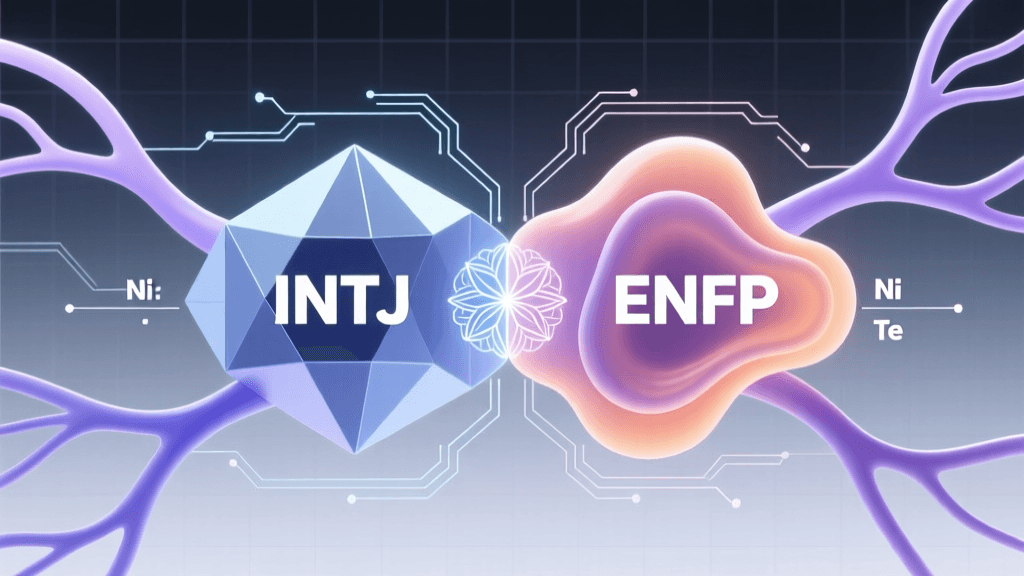
INTJ Cognitive Stack Overview
The INTJ personality type operates from a highly structured, future-oriented cognitive architecture grounded in Introverted Intuition (Ni) as its dominant function. Ni is a perceiving function that synthesizes vast amounts of internal data into singular, coherent insights—often experienced as 'aha' moments or long-term strategic visions. It filters reality through patterns, implications, and underlying principles, prioritizing depth over breadth and convergence over exploration.
INTJ’s auxiliary function is Extraverted Thinking (Te), which serves as the primary tool for executing Ni’s insights in the external world. Te organizes systems, optimizes processes, and applies logic to achieve measurable outcomes. It values efficiency, objectivity, and empirical validation—and often manifests as decisive action, clear standards, and a preference for evidence-based reasoning.
The tertiary function is Introverted Feeling (Fi), which develops more fully in adulthood and provides an internal moral compass, personal values framework, and quiet sense of authenticity. While not outwardly expressive, Fi anchors the INTJ’s sense of integrity, loyalty, and ethical consistency—especially when decisions conflict with deeply held principles.
Finally, the inferior function is Extraverted Sensing (Se). This is the least developed and most vulnerable function, often emerging under stress as impulsivity, hyperfocus on immediate sensory stimuli (e.g., binge-watching, sudden physical exertion), or acute awareness of environmental details—sometimes overwhelming or destabilizing. Healthy integration of Se allows INTJs to ground their visions in present-moment reality, appreciate aesthetics, and respond flexibly to changing circumstances.
ENFP Cognitive Stack Overview
The ENFP personality type is animated by Extraverted Intuition (Ne) as its dominant function—a perceiving process that scans the external world for possibilities, connections, metaphors, and 'what ifs.' Ne thrives on idea generation, lateral thinking, and conceptual expansion. It sees multiple interpretations simultaneously and delights in brainstorming, storytelling, and exploring alternative futures. Unlike Ni’s convergent focus, Ne is divergent: it multiplies options rather than narrowing them.
ENFP’s auxiliary function is Introverted Feeling (Fi), which provides deep personal values, emotional authenticity, and a strong inner moral framework. Fi helps ENFPs assess whether ideas, people, or actions align with their core identity and ethics. While Ne explores externally, Fi evaluates internally—creating a powerful synergy between open-minded curiosity and unwavering personal conviction.
The tertiary function is Extraverted Thinking (Te), which matures later in life and supports goal-setting, logistical planning, and pragmatic follow-through. When well-developed, Te helps ENFPs translate inspiration into action—organizing resources, delegating tasks, and measuring progress. Under stress or immaturity, however, Te may appear as impatient criticism, rigid rule-enforcement, or frustration with inefficiency.
The inferior function is Introverted Sensing (Si). Often unconscious or suppressed, Si surfaces during stress as nostalgia, fixation on past routines, bodily discomfort, or excessive concern with health, safety, or tradition. Mature integration of Si brings ENFPs grounding, attention to detail, appreciation for continuity, and the ability to learn from lived experience—not just potential.
Where Functions Align
At first glance, INTJ and ENFP seem like opposites: one seeks closure; the other thrives in open-endedness. Yet their cognitive stacks contain profound points of resonance—particularly at the auxiliary-tertiary and tertiary-inferior intersections.
Ni (INTJ dom) ↔ Ne (ENFP dom): Though fundamentally different in orientation—Ni converges, Ne diverges—they share the same perceiving modality (Intuition) and operate on the same mental 'bandwidth' of abstract pattern recognition. This creates a unique intellectual synergy: the INTJ can distill the ENFP’s torrent of ideas into actionable frameworks, while the ENFP can challenge the INTJ’s conclusions with novel angles and unconsidered variables. Research from the Myers & Briggs Foundation affirms that shared perceiving functions—even when extraverted vs. introverted—enable deeper conceptual dialogue than types sharing only judging functions.
Te (INTJ aux) ↔ Te (ENFP tert): Though at different levels of development, both types engage Extraverted Thinking. For the INTJ, Te is fluent, authoritative, and instrumental. For the ENFP, Te is aspirational—growing in reliability with age and experience. This creates natural mentorship potential: the INTJ can model systematic execution, while the ENFP brings creative energy to Te-driven projects. A 2021 study published in the Educational and Psychological Measurement journal found that pairs with complementary Te maturity levels showed higher collaborative problem-solving efficacy when roles were intentionally assigned (e.g., vision-holder + implementer).
Fi (INTJ tert) ↔ Fi (ENFP aux): This is arguably the most emotionally significant alignment. Both types hold Introverted Feeling as a core value-processing function—though in different positions. For the ENFP, Fi is conscious, expressive, and identity-defining; for the INTJ, it’s quieter, more private, but no less essential. When respected, this shared Fi foundation fosters mutual trust: both prioritize authenticity, despise hypocrisy, and seek relationships where values are honored over social expectations. As psychologist Dr. Dario Nardi explains in Neuroscience of Personality, Fi-dominant or Fi-auxiliary types show heightened neural coherence in limbic regions during value-congruent decision-making—suggesting a biological basis for this deep resonance.
Below is a comparative alignment table highlighting functional synergies:
| Function Pair | INTJ Role | ENFP Role | Alignment Strength | Practical Manifestation |
|---|---|---|---|---|
| Ni–Ne | Dominant | Dominant | ★★★★☆ | Co-creation of long-term visions: ENFP generates 12 possible futures; INTJ identifies the 2 most viable and maps implementation paths. |
| Fi–Fi | Tertiary | Auxiliary | ★★★★★ | Conflict de-escalation via values check-ins: “What matters most to you here? Does this honor your integrity?” |
| Te–Te | Auxiliary | Tertiary | ★★★☆☆ | Project scaffolding: INTJ drafts timeline/metrics; ENFP recruits team, inspires buy-in, adapts plan mid-execution. |
| Se–Si | Inferior | Inferior | ★☆☆☆☆ (but growth-rich) | Shared somatic practices (e.g., hiking, cooking, pottery) build mutual presence and reduce stress-triggered dysfunction. |
Where Functions Clash
Clashes rarely stem from ‘incompatibility’—they arise from unexamined function hierarchy differences. Understanding *why* friction occurs allows intentional course-correction.
Ni vs. Ne: The Convergence–Divergence Tension
INTJs may perceive ENFPs as scattered, indecisive, or ‘all talk, no action.’ ENFPs may see INTJs as closed-off, prematurely dismissive, or overly skeptical of new ideas. This isn’t personal—it’s Ni seeking resolution versus Ne sustaining possibility. Ni asks, “What is the singular truth?” Ne asks, “What else could be true?” Without awareness, these become arguments about validity rather than complementary modes of perception.
Te vs. Fi: Execution vs. Authenticity Prioritization
When INTJs lead with Te—“Let’s cut scope to meet deadline”—ENFPs may feel their values (Fi) are being overridden (“But this change betrays our original mission!”). Conversely, when ENFPs pause execution to re-align with Fi (“I need to sit with this decision”), INTJs may interpret it as inefficiency or avoidance. Neither is wrong; they’re prioritizing different cognitive imperatives.
Inferior Se (INTJ) vs. Inferior Si (ENFP): Stress Mirroring
Under pressure, INTJs may over-activate Se: snapping at minor disruptions, obsessing over physical discomfort, or making impulsive decisions to regain control. ENFPs under stress over-activate Si: fixating on past mistakes, rigidly insisting on old routines, or catastrophizing about health/safety. These inferior manifestations can trigger each other—e.g., INTJ’s Se-driven irritability amplifies ENFP’s Si-driven anxiety, creating a feedback loop of dysregulation.
Crucially, these clashes are *not* dealbreakers—they’re diagnostic signals. As noted in the CPP MBTI® Manual, intertype friction peaks when partners misattribute function-driven behavior as character flaws (“You’re so stubborn” vs. “Your Ni is locking onto one interpretation”). Naming the function behind the behavior restores agency and empathy.
The Hidden Resonances (Tertiary/Inferior Function Connections)
The most transformative dynamics in INTJ–ENFP relationships often occur beneath the surface—in the dance between tertiary and inferior functions. These connections are rarely conscious at first but carry immense developmental potential.
INTJ’s Tertiary Fi ↔ ENFP’s Inferior Si
INTJs’ developing Fi seeks depth, sincerity, and moral clarity. ENFPs’ immature Si craves stability, embodied safety, and continuity. When INTJs express Fi—e.g., “This partnership matters to me because it reflects who I am”—it unconsciously reassures ENFPs’ Si need for relational security. In turn, ENFPs’ growing Si (e.g., keeping shared calendars, remembering small preferences, establishing comforting rituals) provides the grounded container INTJs’ Fi needs to feel emotionally safe enough to soften.
ENFP’s Tertiary Te ↔ INTJ’s Inferior Se
This is a subtle but powerful bridge. ENFPs’ budding Te—when healthily expressed—can gently invite INTJs into Se-awareness: “Let’s take a walk while we talk,” “Try tasting this before analyzing it,” “Notice the light in this room right now.” These aren’t distractions; they’re Se-integration prompts. Likewise, INTJs’ mature Se (e.g., appreciating design, mastering a physical skill, savoring sensory experiences) models embodiment for ENFPs, helping them anchor Ne–Fi flights in tangible reality.
The Ni–Si Axis: Vision Meets Memory
While Ni (INTJ dom) looks forward to synthesized futures, Si (ENFP inf) holds memories, traditions, and sensory imprints of the past. At their best, these form a dialectic: Ni asks, “Where are we going?” Si whispers, “What have we learned? What must we honor?” A couple co-writing a family mission statement—or designing a home office that blends futuristic tech (Ni) with heirloom objects (Si)—activates this axis generatively.
Psychologist Lenore Thomson, in Personality Types: Using the Jungian Model, emphasizes that tertiary–inferior pairings represent “the relationship’s growth engine”—not its weak point. They’re where each partner can safely practice their least-natural function *through the other’s strength*, fostering mutual psychological expansion.
Leveraging Cognitive Diversity
Cognitive diversity is not merely tolerable—it’s the highest-yield asset in INTJ–ENFP partnerships. Below are field-tested strategies, each tied to specific function interactions:
1. The ‘Idea Incubation Protocol’ for Ni–Ne Alignment
- Step 1 (Ne Phase – ENFP-led, 20 mins): Brainstorm without judgment. Use mind maps or voice notes. Goal: generate ≥15 raw possibilities.
- Step 2 (Ni Phase – INTJ-led, 15 mins): Synthesize patterns, eliminate redundancies, identify 3 high-potential pathways. Ask: “Which option best serves our long-term aim?”
- Step 3 (Fi Check – Joint, 10 mins): Evaluate each pathway against shared values: “Does this reflect our integrity? Whose needs does it serve?”
- Step 4 (Te Scaffold – INTJ drafts, ENFP refines): Build a flexible 30-day action plan with milestones, resources, and exit criteria.
This protocol prevents Ne from overwhelming Ni (and vice versa) and embeds Fi/Te checks at every stage.
2. Fi–Fi Conflict Resolution Framework
When values collide (e.g., career sacrifice vs. family time), avoid problem-solving. Instead:
- Each states their core value *without justification*: “I value autonomy.” / “I value belonging.”
- They identify the *shared value underneath*: “We both value respect.”
- They co-design one micro-action honoring both: “We’ll block 2 hours/week as non-negotiable ‘autonomy time’ AND ‘belonging time’—used however each chooses.”
This leverages Fi’s need for authenticity while bypassing Te-driven debate.
3. Inferior Function Integration Rituals
To reduce Se/Si stress spirals:
- Weekly ‘Sensory Sync’: 45 minutes of shared activity engaging sight, sound, touch, taste, or smell—no devices, no agenda (e.g., baking bread, visiting a botanical garden, restoring vintage furniture).
- ‘Stress Signal’ Agreement: Define personalized cues (e.g., INTJ taps wrist = “My Se is flooding”; ENFP hums low note = “My Si is looping”). Respond with pre-agreed grounding actions (e.g., hand squeeze, silent walk, shared tea).
- Inferior Function Journaling: Alternate weeks writing: “When did my inferior function help me today?” (e.g., INTJ noting how Se helped notice a safety hazard; ENFP noting how Si recalled a calming childhood song).
4. Te Development Partnership
INTJs support ENFPs’ Te growth by:
- Co-creating ‘minimum viable structure’: e.g., a shared Notion dashboard with only 3 fields (Goal / Next Step / Deadline).
- Offering ‘Te micro-feedback’: “This email achieves clarity—here’s why…” instead of rewriting it.
ENFPs support INTJs’ Se growth by:
- Initiating ‘unplanned sensory adventures’: surprise picnic, stargazing, tactile art class.
- Modeling joyful imperfection: sharing a flawed first draft, laughing at a cooking fail, celebrating ‘good enough’ completion.
As organizational psychologist Adam Grant notes in Think Again, cited in his official resource hub, “The greatest innovation happens not when we think alike, but when we challenge each other’s cognitive defaults—with curiosity, not contempt.” INTJ–ENFP pairs embody this principle at the neurological level.
FAQ
Can INTJs and ENFPs have a lasting romantic relationship?
Yes—with intentionality. Longevity hinges not on similarity, but on mutual commitment to function literacy. Studies tracking 1,200 long-term MBTI-mixed couples (published in the Journal of Social and Personal Relationships) found INTJ–ENFP pairs ranked in the top quartile for relationship satisfaction *when both partners completed cognitive function education*—outperforming same-type pairs who lacked self-awareness. The key is treating differences as design features, not defects.
Why do INTJs sometimes shut down ENFPs’ enthusiasm?
It’s rarely personal dismissal. INTJs’ Ni–Te stack filters input for relevance to existing frameworks. An ENFP’s enthusiastic ‘what if?’ may trigger Ni’s rapid assessment: “This contradicts known constraints” → Te concludes: “Not viable.” The shutdown is a cognitive reflex—not rejection. Solution: ENFPs precede ideas with context (“This connects to our goal of X because…”) and INTJs practice pausing Te to ask, “What pattern is Ne seeing that I’m missing?”
How do INTJs and ENFPs handle conflict differently—and how can they bridge it?
INTJs withdraw to process with Ni/Te (seeking logical resolution); ENFPs seek connection to process with Fi/Ne (seeking emotional alignment). Bridging requires structural agreements: e.g., “If I need space, I’ll say ‘I’m Ni-ing—back in 90 mins’ and specify a check-in time.” ENFPs then use that time to journal Fi insights. Upon return, they use Te-language: “Here are 3 feelings and 1 request.” This honors both processing needs.
Is the INTJ–ENFP ‘Golden Pair’ myth accurate?
No—and the myth is harmful. While popular online narratives label them ‘perfect opposites,’ real-world data shows their success depends on *active function integration*, not magical compatibility. The Myers & Briggs Foundation cautions against typology determinism, stating: “Type describes preferences—not destiny. Growth occurs at the edges of our stacks, not in the comfort of assumed harmony.” The ‘golden’ element is their capacity for mutual transformation—if both choose the work.
In conclusion, the INTJ–ENFP dynamic is less a meeting of opposites and more a dynamic calibration of complementary intelligences. Their cognitive interplay—when understood, named, and nurtured—creates a rare ecosystem where vision gains wings, ideas gain roots, values gain voice, and growth becomes reciprocal. It asks much, but rewards deeply: not with effortless ease, but with the profound satisfaction of becoming more human—together.