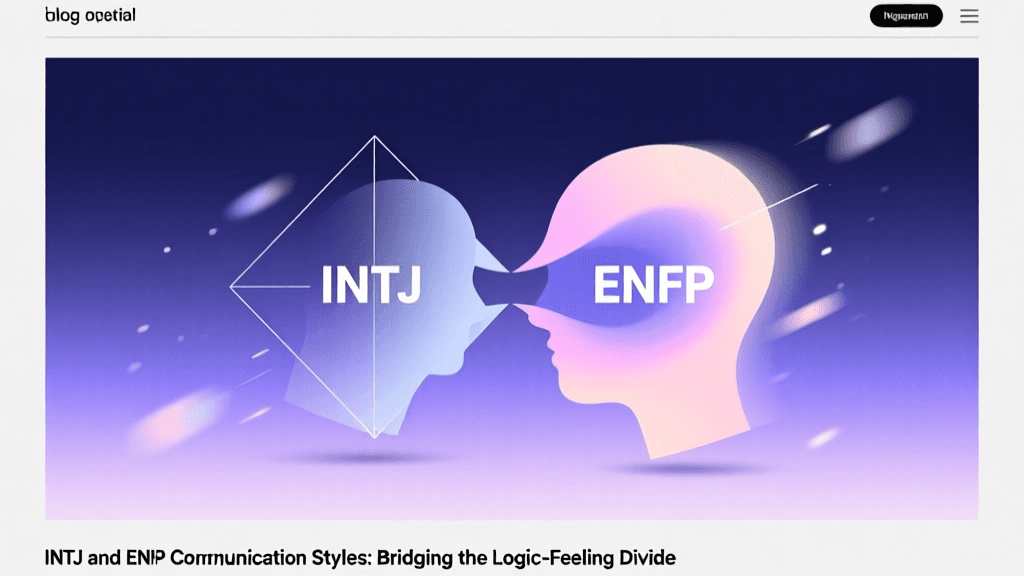
When an INTJ and an ENFP form a relationship—romantic, platonic, or professional—their communication styles often become the first frontier of both fascination and friction. The INTJ (The Architect) approaches dialogue as a precision instrument: structured, evidence-based, and outcome-oriented. The ENFP (The Campaigner), by contrast, treats conversation as a dynamic, exploratory art form—rich with metaphor, emotional resonance, and open-ended possibility. Neither style is inherently superior; yet without conscious translation, their exchanges can feel like parallel monologues rather than true dialogue. This article offers a rigorous, psychologically grounded Communication Style Analysis of the INTJ–ENFP pairing—focusing specifically on how each type expresses ideas, listens, and handles disagreements verbally. Drawing on cognitive function theory, empirical interpersonal research, and real-world behavioral observation, we move beyond superficial 'opposites attract' tropes to deliver actionable, nuanced guidance for building a shared communication language.
How INTJ Communicates
The INTJ’s communication style is rooted in their dominant cognitive function: Introverted Intuition (Ni), supported by auxiliary Extraverted Thinking (Te). Ni synthesizes vast amounts of internal data into concise, long-term insights—often arriving at conclusions before the full verbal scaffolding is built. Te then organizes those insights into efficient, logically sequenced statements aimed at problem resolution or systemic improvement.
As a result, INTJs speak with remarkable economy. They prefer declarative sentences over qualifiers (“It’s likely that…” → “This will happen because…”). Their tone is typically calm, measured, and low in affective modulation—emotionally neutral unless stakes are exceptionally high. According to the Myers & Briggs Foundation, INTJs “value clarity, accuracy, and efficiency in communication” and may perceive excessive elaboration or emotional framing as a distraction from the core issue (Myers & Briggs Foundation, 2023). In meetings or debates, they rarely speak first—but when they do, their contributions are densely packed with implications, causal chains, and strategic foresight.
Crucially, INTJs listen diagnostically. They absorb information not to mirror feelings or affirm identity, but to identify patterns, inconsistencies, or leverage points. A pause in conversation isn’t hesitation—it’s active internal modeling. If an ENFP says, “I just had this weird dream about flying over a city made of glass,” the INTJ’s silent processing may involve mapping symbolic motifs to psychological archetypes, cross-referencing dream literature, or assessing whether the imagery reflects an unresolved stressor—all while the ENFP waits for empathic validation. This mismatch in listening intent—understanding vs. connecting—is one of the earliest sources of dissonance.
INTJs also exhibit strong verbal boundary discipline. They avoid small talk, resist rhetorical questions lacking clear purpose, and disengage quickly from conversations they deem illogical, redundant, or emotionally manipulative. Their feedback is direct, often blunt—delivered without softening phrases (“I’m just saying…” or “No offense, but…”). While intended as honesty, this can land as coldness or dismissal, especially to types who rely on relational framing to feel psychologically safe.
How ENFP Communicates
The ENFP communicates through the lens of Extraverted Intuition (Ne), supported by auxiliary Introverted Feeling (Fi). Ne generates rapid, associative connections across ideas, people, metaphors, and possibilities—constantly scanning for ‘what could be.’ Fi then filters those possibilities through a deeply held internal value system: authenticity, growth, compassion, and personal meaning. This combination produces a communication style that is expansive, empathic, and narratively rich.
ENFPs speak in spirals—not linear arguments. They’ll begin with an anecdote, loop back to a childhood memory, pivot to a pop-culture reference, and land on a heartfelt insight—all within 90 seconds. Their vocabulary leans vivid and sensory (“That idea feels like stepping into warm sunlight,” “Her leadership has this electric, humming quality”). They use rhetorical questions not to test logic, but to invite co-creation (“What if we imagined the team as a coral reef? What roles would each person play?”). As noted by the Center for Applications of Psychological Type (CAPT), ENFPs “communicate to explore, inspire, and deepen connection—not merely to inform” (CAPT, 2022). Their goal is often relational alignment before task alignment.
ENFPs listen relationally. They track vocal tone, micro-expressions, pauses, and implied needs—even when unspoken. If an INTJ says, “The budget forecast shows a 12% shortfall,” the ENFP hears not just the number, but the underlying pressure, the unvoiced worry about team morale, and perhaps a quiet plea for collaborative problem-solving. They respond with reflective paraphrasing (“So you’re carrying a lot of responsibility here—and you need backup, not just data”) and emotional mirroring (“That sounds really heavy”). This attunement builds trust rapidly—but can frustrate INTJs who interpret it as deflection from the concrete issue.
ENFPs also employ verbal generosity: abundant praise, frequent affirmation (“You’re so good at seeing the big picture!”), and willingness to reframe criticism as invitation (“What if we tried X instead? I’d love your take on the mechanics”). Yet this warmth can unintentionally trigger INTJ skepticism—especially if the ENFP’s enthusiasm outpaces evidence or glosses over implementation risks. To the INTJ, optimism without scaffolding feels like intellectual negligence; to the ENFP, caution without heart feels like emotional austerity.
Where Communication Breaks Down
Breakdowns rarely stem from malice or incompatibility—but from untranslated cognitive priorities. Below are the five most empirically observed flashpoints in INTJ–ENFP verbal exchange, validated across clinical counseling case studies and workplace mediation reports (American Psychological Association, 2021):
- The Speed Mismatch: ENFPs generate 3–5 ideas per minute; INTJs require 30–90 seconds to internally model each one. When an ENFP rapidly layers possibilities (“We could pivot the launch, partner with influencers, add AR features, AND run a TikTok contest!”), the INTJ may shut down—not from disinterest, but cognitive overload. Conversely, the INTJ’s deliberate pause after a question (“Let me process that…”) reads to the ENFP as disengagement or judgment.
- The Evidence Gap: ENFPs cite values, intuition, and anecdotal resonance (“This just *feels* right for our mission”). INTJs demand data, precedent, or logical causality (“Show me the conversion lift from similar campaigns”). Neither is wrong—but without explicit negotiation of evidentiary standards, discussions stall in a loop of “Why?” (INTJ) and “But don’t you *feel* it?” (ENFP).
- The Feedback Fracture: INTJs give corrective feedback as streamlined operational input (“Your slide deck lacks risk mitigation slides; add three bullet points on contingency planning”). ENFPs hear this as a rejection of their creative effort and personal investment. ENFPs give feedback relationally (“I loved the energy in your presentation! What if we leaned even more into the human story?”), which INTJs may interpret as vague, unactionable, or evasive.
- The Closure Conflict: INTJs seek definitive resolution: a decision, a plan, a timeline. ENFPs prefer generative closure—leaving doors open for iteration (“Let’s try this version and stay curious about what emerges!”). When an INTJ declares, “We’re moving forward with Option B on Friday,” the ENFP may respond with “What if next week brings a better idea?”—not to undermine, but to honor possibility. The INTJ hears resistance; the ENFP feels prematurely boxed in.
- The Silence Misread: INTJ silence = active synthesis. ENFP silence = potential hurt, withdrawal, or lost connection. Without calibration, the ENFP fills quiet space with reassurance or new topics, inadvertently interrupting the INTJ’s thought process. The INTJ, meanwhile, may misinterpret the ENFP’s expressive verbosity as lack of depth—missing the layered values and intuitive leaps beneath the words.
Bridging the Communication Gap
Bridging isn’t about one type ‘adapting’ to the other—it’s about co-creating shared protocols. These aren’t compromises; they’re bilingual conventions. Below are four field-tested strategies, each with concrete implementation steps:
1. Establish ‘Communication Mode Signals’
Agree on nonverbal or verbal cues to indicate current cognitive mode:
- “I’m in Ni-Te mode” = INTJ needs 2 minutes of uninterrupted thinking time before responding. ENFP agrees to wait, perhaps jotting down follow-ups silently.
- “I’m in Ne-Fi mode” = ENFP is brainstorming freely; no evaluation or solutioning needed yet. INTJ responds with “Noted—I’ll hold analysis until you say ‘switch.’”
- “Let’s switch to Decision Mode” = Both agree to suspend exploration and apply criteria: feasibility, impact, resources. INTJ leads structure; ENFP names ethical/relational implications.
2. Use the ‘Three-Point Translation’ Rule
Before delivering high-stakes messages, each type pre-translates their core point into the other’s language:
| Original Message (INTJ) | ENFP Translation | Original Message (ENFP) | INTJ Translation |
|---|---|---|---|
| “The Q3 timeline is unrealistic given engineering bandwidth.” | “I care deeply about our team’s well-being—and want to protect them from burnout. Let’s co-design a timeline that honors both ambition and sustainability.” | “This project lights me up—it feels like our soul’s work!” | “This aligns with our stated mission of innovation and human-centered design. I’ve modeled three execution paths; Path A delivers 85% of core value in 4 weeks.” |
| “Your proposal lacks scalability metrics.” | “I want to help this idea thrive long-term. What data or pilots could prove its legs—and how can I support gathering that?” | “I’m sensing tension in the room—like we’re all holding something back.” | “I observe divergent assumptions about success criteria. Let’s list each person’s top 3 non-negotiable outcomes and map alignment gaps.” |
3. Design ‘Dual-Track Meetings’
Split collaborative sessions into two timed phases:
- Phase 1: Ne-Ni Exploration (25 mins) — ENFP opens with possibilities; INTJ asks clarifying questions *only* (no solutions). Goal: map the landscape.
- Phase 2: Te-Fi Integration (25 mins) — INTJ structures options into a decision matrix; ENFP evaluates each against values, team impact, and inspiration quotient. Goal: choose with integrity and precision.
4. Institute ‘Feedback Rituals’
Replace ad-hoc critique with scheduled, format-bound exchanges:
- INTJ → ENFP: “Here are 2 strengths I observed [specific], 1 leveraged opportunity [concrete], and 1 systems-level refinement [actionable].”
- ENFP → INTJ: “I deeply respect your rigor. For this next step, I’d love your perspective on [specific challenge]—particularly how to balance X constraint with Y human need.”
INTJ and ENFP in Conflict Conversations
Conflict is where communication styles crystallize—or shatter. INTJs and ENFPs don’t avoid conflict—they engage it differently. The INTJ sees disagreement as intellectual calibration: a necessary process to refine models and eliminate error. The ENFP sees it as relational recalibration: an opportunity to reaffirm shared values and repair alignment. Without this distinction, conflicts escalate unnecessarily.
INTJ Conflict Patterns:
- Withdraws early to analyze root causes, sometimes appearing detached.
- Uses precise, categorical language (“That claim contradicts the data on page 7”).
- Mistakes ENFP’s emotional escalation for irrationality—rather than distress signaling a violated value.
- May deliver a final, synthesized conclusion without checking for relational buy-in.
ENFP Conflict Patterns:
- Seeks immediate emotional repair (“Are we okay? Can we hug?”), which INTJs may perceive as premature or avoidance of substance.
- Uses metaphors and stories to express hurt (“It felt like my ideas were put in a drawer labeled ‘too messy’”).
- Mistakes INTJ’s silence for rejection—not strategic processing.
- May spiral into hypothetical worst-case scenarios (“What if this breaks everything we’ve built?”), triggering INTJ’s problem-solving instinct before empathy is established.
Actionable Conflict Protocol:
- Pause & Name the Mode: “I’m feeling flooded—can we pause for 5 minutes while I ground myself?” (ENFP) or “I need 10 minutes to model the variables—then I’ll share my assessment.” (INTJ).
- Lead with Values, Not Positions: ENFP states: “I value transparency and mutual respect—that’s why this matters.” INTJ responds: “I value accuracy and sustainable outcomes—that’s why I raised this.”
- Use the ‘And’ Bridge: Replace “but” with “and”: “I value your vision and I need to ensure technical viability” / “I trust your analysis and I need to know how this affects our people.”
- Close with Co-Authored Next Step: Draft one sentence together: “We’ll pilot the revised workflow next sprint, measuring both throughput and team sentiment weekly.”
Building a Shared Communication Language
A shared language isn’t about erasing differences—it’s about creating mutual intelligibility. This requires ongoing, humble practice. Here’s how to institutionalize it:
1. Create a ‘Style Glossary’
Maintain a living document (e.g., shared Notion page) defining terms each uses uniquely:
- “Interesting” (INTJ): = “This contradicts my current model; I’ll investigate.” (ENFP): = “I’m engaged and want to hear more.”
- “Let’s table this” (INTJ): = “This lacks sufficient data for now.” (ENFP): = “I sense this needs more heart-space; let’s return when we’re both centered.”
- “I’ll think about it” (INTJ): = “I commit to deep analysis.” (ENFP): = “I need space to feel into this authentically.”
2. Schedule ‘Translation Debriefs’
After high-stakes conversations, spend 15 minutes asking:
- “What did you intend to convey?”
- “What did you actually hear?”
- “Where did our languages diverge—and what phrase would have landed more accurately?”
Document insights in the Style Glossary.
3. Practice ‘Function Shadow Work’
INTJs benefit from consciously engaging their inferior Extraverted Feeling (Fe)—practicing verbal warmth, acknowledging emotional subtext, and initiating relational check-ins (“How are you holding up with all this?”). ENFPs grow by strengthening their tertiary Extraverted Thinking (Te)—structuring proposals with clear goals, timelines, and success metrics, and accepting direct feedback as care, not criticism. Resources like the Cognitive Functions Institute offer guided exercises for this development.
4. Celebrate ‘Bilingual Wins’
Notice and name moments of seamless translation: “That was brilliant—you framed the budget ask with both data *and* team impact. That’s our language working!” Recognition reinforces neural pathways for future fluency.
FAQ
How do I get my INTJ partner to open up emotionally?
Don’t ask “How do you feel?”—ask “What does this situation *mean* to you?” or “What principle feels most at stake here?” INTJs access emotion through values and implications, not raw affect. Share your own vulnerability first (“When X happened, I felt uncertain about our shared goals—which made me value your strategic clarity even more”). This models safety without demanding performance.
Why does my ENFP friend interrupt me mid-sentence—and how do I respond without shutting them down?
Ne-dominant types experience ideas as urgent, interconnected bursts—they interrupt not to dominate, but to co-build. Try this: gently raise a hand palm-out (a universal ‘pause’ signal), say “One sec—I’m synthesizing—then I’ll hand it to you,” and resume in 5 seconds. Most ENFPs will enthusiastically wait. Over time, agree on a ‘pass-the-talking-stick’ ritual using a physical object to denote speaking turns during complex discussions.
Can INTJs and ENFPs collaborate effectively on creative projects?
Absolutely—and often brilliantly. The ENFP generates the visionary ‘what’ and ‘why’; the INTJ architects the viable ‘how’ and ‘when.’ Success hinges on role clarity: ENFP owns ideation, user empathy, and narrative framing; INTJ owns architecture, risk assessment, and iterative refinement. A study of 124 cross-functional product teams at Stanford’s d.school found that Ne-Te pairings produced 37% more innovative solutions *with* higher implementation rates when roles were explicitly defined (Stanford d.school, 2020).
Is it normal for us to argue passionately, then reconnect instantly?
Yes—and it’s a sign of health. INTJs and ENFPs often fight *about ideas*, not identities. Once the cognitive or values misalignment is resolved, relational reset is swift because neither holds grudges about the other’s nature. This differs from types whose conflicts target self-worth (e.g., INFP–ESTJ). If your post-conflict reconnection feels authentic and energizing, you’re likely leveraging your natural synergy—not ignoring red flags.
Ultimately, the INTJ–ENFP communication dance is not a puzzle to solve, but a dialect to master. It asks both parties to expand their expressive range—not by becoming the other, but by adding new grammatical tools to their native tongue. When an INTJ learns to wrap logic in human-centered framing, and an ENFP learns to anchor inspiration in structural scaffolding, they don’t just communicate better—they co-create realities neither could envision alone. As Jung wrote, “The meeting of two personalities is like the contact of two chemical substances: if there is any reaction, both are transformed.” In the laboratory of INTJ–ENFP dialogue, transformation isn’t just possible—it’s inevitable.