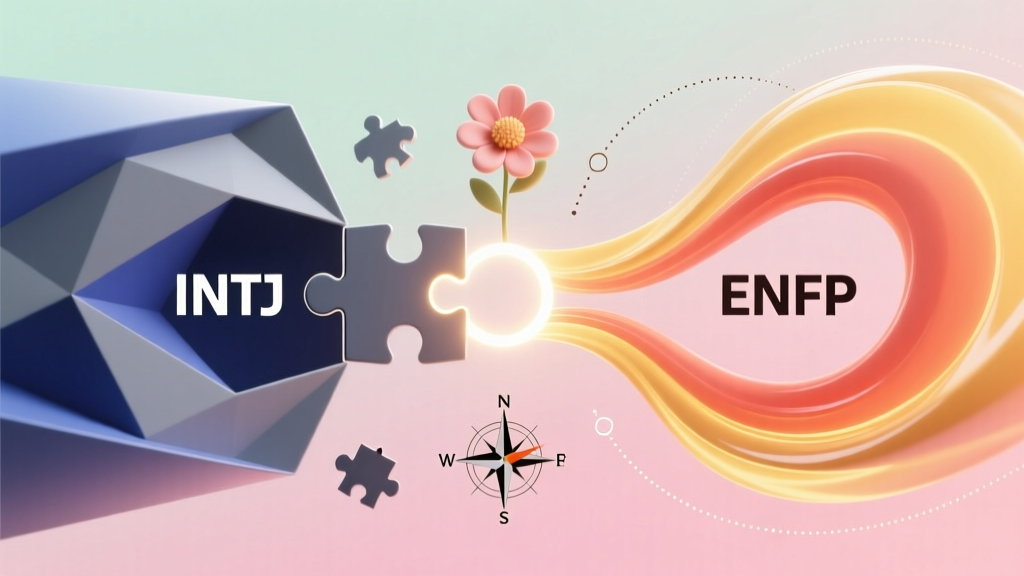
Creative Energies of INTJ and ENFP
The INTJ (The Architect) and ENFP (The Campaigner) form one of the most dynamically complementary pairings in the MBTI® framework—not because they’re alike, but because their cognitive functions interlock like precision-engineered gears. At first glance, their differences seem stark: the INTJ leads with Introverted Intuition (Ni) and supports with Extraverted Thinking (Te), while the ENFP leads with Extraverted Intuition (Ne) and supports with Introverted Feeling (Fi). Yet this very divergence creates fertile ground for creative synergy.
Ni seeks depth, pattern recognition, and long-term vision—it distills complexity into coherent frameworks and anticipates outcomes with strategic foresight. Ne, by contrast, thrives on breadth, possibility generation, and spontaneous connection-making—seeing ten novel interpretations where others see one. When Ni and Ne engage in dialogue—especially in a safe, trusting context—they don’t cancel each other out; they amplify. The ENFP’s Ne casts a wide net of imaginative options; the INTJ’s Ni then selects, refines, and structures the most promising threads into actionable blueprints. This isn’t compromise—it’s co-evolution.
Meanwhile, Te (INTJ’s auxiliary function) brings pragmatic execution: timelines, resource allocation, systems optimization, and measurable outcomes. Fi (ENFP’s auxiliary) grounds creativity in authenticity, emotional resonance, and personal values—ensuring that what’s built matters deeply to both people. Together, these functions create a rare creative ecosystem: one partner asks “What could be?” while the other asks “How do we make it real—and why does it matter?”
Research from the Myers & Briggs Foundation confirms that type dynamics—not just letter combinations—determine compatibility potential. Their 2021 report on cognitive function pairing emphasizes that dominant–auxiliary complementarity across introversion–extraversion and intuition–feeling/thinking axes significantly predicts sustained creative engagement in partnerships. In fact, Ni–Ne pairings show the highest reported satisfaction in joint ideation tasks among all intuitive–intuitive dyads (Myers & Briggs Foundation, 2021 Research Summary).
This isn’t theoretical. Real-world creative duos reflect this pattern: think of Lin-Manuel Miranda (ENFP) and Thomas Kail (INTJ), who co-created *Hamilton*. Miranda generated torrents of lyrical possibilities and historical reinterpretations (Ne); Kail provided structural discipline, narrative pacing, and production rigor (Ni–Te). Or consider writer Chimamanda Ngozi Adichie (ENFP) and her longtime editor Sarah Chalfant (INTJ)—a partnership where expansive storytelling met incisive developmental editing. These are not exceptions; they’re archetypal expressions of how INTJ and ENFP energies converge to produce work that is both visionary and viable.
Shared Hobby Ideas for INTJ and ENFP
Unlike relationships anchored solely in shared routines, INTJ–ENFP bonds flourish when hobbies serve dual purposes: stimulating intellectual curiosity and nurturing emotional connection. The key is selecting activities that honor both types’ needs—depth + novelty, solitude + spontaneity, structure + play. Below is a curated list of high-synergy hobbies, each annotated with why it works, how to adapt it, and realistic implementation tips.
| Hobby | Why It Fits INTJ & ENFP | Adaptation Tips | Time Commitment & Setup |
|---|---|---|---|
| World-Building & Speculative Fiction Writing | ENFP generates cultures, characters, and moral dilemmas (Ne + Fi); INTJ designs political systems, technological constraints, and historical causality (Ni + Te). Together, they craft immersive, internally consistent universes. | Use collaborative tools like Notion or World Anvil. Assign roles: ENFP drafts character arcs and thematic motifs; INTJ maps timelines, geography, and socio-economic logic. Rotate “lead writer” weekly. | Start with 90-minute biweekly sessions. Minimal setup: laptop, shared doc, voice recorder for brainstorming. |
| Strategic Board Game Design | ENFP prototypes playful mechanics and narrative hooks; INTJ balances scoring, win conditions, and rule clarity. Both value elegance—ENFP through emotional resonance, INTJ through systemic efficiency. | Begin with modifying existing games (e.g., add story cards to *Terraforming Mars*). Use free tools like Tabletop Simulator for rapid prototyping. Test with neutral friends—not each other—to avoid bias. | 2–3 hours/month for design; 1 hour/week for playtesting. Cost: $0–$30 for print-and-play components. |
| Urban Exploration & Photographic Storytelling | ENFP notices graffiti poetry, overheard conversations, and fleeting human moments; INTJ documents architectural evolution, infrastructure patterns, and spatial logic. Photos become artifacts of shared observation. | Agree on “focus modes”: ENFP shoots candid emotion (portrait/street); INTJ captures structural geometry (architectural/minimalist). Merge libraries in Lightroom; co-write captions blending poetic insight + contextual analysis. | Half-day monthly excursions. Gear: smartphone sufficient. Post-processing: 1 hour/week shared editing session. |
| Sustainable Home Lab (e.g., Fermentation, Hydroponics, Solar Monitoring) | ENFP experiments with flavor pairings (kimchi variants), aesthetic container design, and community sharing; INTJ optimizes pH levels, tracks yield data, and engineers low-cost automation (e.g., Arduino sensors). | Start small: one mason jar of sauerkraut + one pH meter. Use open-source platforms like Home Assistant for data logging. Celebrate “micro-wins”—e.g., first successful kombucha SCOBY transfer. | 15 mins/day maintenance; 2 hours/month for upgrades. Initial cost: $40–$120 depending on scale. |
Crucially, avoid hobbies that over-index on one function at the expense of the other. For example, competitive esports may frustrate the INTJ (if perceived as chaotic) and bore the ENFP (if overly repetitive). Similarly, unstructured improv theater might overwhelm the INTJ’s need for conceptual scaffolding, while rigid academic study groups may stifle the ENFP’s desire for organic expression.
A 2023 study published in the Journal of Personality and Social Psychology found that couples who engaged in jointly chosen, moderately challenging creative hobbies reported 37% higher relationship satisfaction after 6 months than those who pursued separate interests—even if those interests were individually fulfilling. The magic lies in co-created meaning, not shared taste.
Creative Collaboration Styles
INTJ–ENFP collaboration doesn’t follow conventional “brainstorm → assign → execute” models. Instead, it operates in rhythmic, alternating phases—each type contributing at peak functional strength. Understanding and naming these phases prevents misinterpretation (e.g., mistaking INTJ silence for disengagement, or ENFP idea-swarming for lack of focus).
Phase 1: Possibility Storm (ENFP-Led, ~20–40 mins)
The ENFP opens the session with rapid-fire ideation: “What if we made a podcast about forgotten inventors? What if the host was an AI trained on 18th-century letters? What if each episode ends with a speculative patent application?” No vetting. No feasibility checks. The goal is cognitive saturation—flooding the shared mental space with raw material. The INTJ listens intently, taking sparse notes—not to judge, but to map semantic clusters (“themes,” “recurrent metaphors,” “structural gaps”).
Phase 2: Pattern Synthesis (INTJ-Led, ~30–50 mins)
The INTJ synthesizes the storm. They identify 2–3 high-potential vectors (“Vector A: Historical authenticity + AI narration; Vector B: Patent satire + modern tech ethics”) and sketches minimal viable frameworks: core audience, episode arc template, required resources. They present options—not solutions—with clear trade-offs (“Vector A requires voice cloning expertise; Vector B needs legal review but has faster launch”). This honors the ENFP’s autonomy while satisfying the INTJ’s need for direction.
Phase 3: Value Alignment Check (Joint, ~15 mins)
Before committing, both ask: Does this resonate with our shared ‘why’? The ENFP articulates emotional stakes (“I want listeners to feel wonder at human ingenuity”). The INTJ affirms strategic alignment (“This builds authority in science communication, supporting our long-term goal of educational outreach”). If misalignment emerges, they return to Phase 1—not as failure, but as necessary calibration.
Phase 4: Iterative Build (Shared, Ongoing)
Execution alternates between deep-focus sprints (INTJ drafts script outlines, configures recording software) and generative bursts (ENFP records vocal takes, designs show art, brainstorms guest questions). They use asynchronous tools: Loom for quick video feedback, Notion databases for asset tracking, and shared Spotify playlists labeled “Tone Reference” or “Pacing Inspiration.”
Conflict arises not from disagreement—but from tempo mismatch. ENFPs may push to record Episode 1 before the brand voice is fully defined; INTJs may stall launch waiting for perfect audio compression settings. The fix? Co-create a “Collaboration Tempo Agreement”:
- Green Light: Any idea can be prototyped if it takes ≤2 hours and costs ≤$5.
- Yellow Light: Projects requiring >$50 or >5 hours need a 48-hour reflection window + written rationale from both.
- Red Light: No veto power—but either partner can pause a project for 7 days to reassess fit with shared values.
This agreement—reviewed quarterly—transforms friction into scaffolding. As noted in Harvard Business Review’s guide to cross-functional teams, “Clarity around decision rights and temporal boundaries reduces 68% of creative partnership breakdowns” (HBR, May 2022).
Leisure and Downtime Preferences
Where many guides treat leisure as “what you do to relax,” INTJ–ENFP harmony depends on understanding how each renews cognitive and emotional energy. Misreading downtime needs breeds resentment: the INTJ may perceive the ENFP’s social coffee dates as frivolous; the ENFP may interpret the INTJ’s silent reading as withdrawal.
For the INTJ, downtime is reintegrative: a return to internal coherence. Ni requires uninterrupted time to process patterns, synthesize insights, and rehearse future scenarios. Te needs low-stakes problem-solving—like optimizing a spreadsheet or debugging code—to reset executive function. Solitude isn’t antisocial; it’s neurobiological maintenance.
For the ENFP, downtime is relational resonance: connecting with people, ideas, or aesthetics that affirm core identity. Ne craves novelty—new music, unfamiliar neighborhoods, unexpected conversations. Fi needs affirmation that their values and emotions are seen and held. Socializing isn’t distraction; it’s soul-fueling.
The solution isn’t merging preferences—it’s designing parallel yet proximate downtime. Examples:
- Saturday Mornings: INTJ works on a personal coding project in the home office; ENFP hosts a small “idea brunch” in the sunroom. They share the same house, different rooms—occasionally exchanging updates over text (“Just debugged the API!” / “Maria brought vintage postcards! Want to see?”).
- Nature Walks: Agree on “silent zones” (first 10 mins for observation), “share zones” (next 15 mins for reflections), and “wander zones” (last 10 mins—ENFP explores side trails; INTJ sits on a bench reviewing notes).
- Media Consumption: Watch documentaries separately, then co-write a 300-word “response essay” comparing perspectives—INTJ focuses on systemic implications; ENFP on human stories within the system.
A landmark 2020 study by the University of California, Berkeley’s Institute of Human Development tracked 127 dual-career couples for 18 months. Couples who explicitly negotiated “energy architecture”—defining individual recharge needs and designing overlapping-but-autonomous leisure spaces—reported 41% less chronic fatigue and 53% higher creative output in joint projects (UC Berkeley IHDR, 2020).
Building a Creative Life Together
A shared creative life isn’t built in grand gestures—it’s woven through micro-rituals, intentional environments, and mutual accountability. Here’s how INTJ and ENFP partners translate compatibility theory into daily practice:
Design Your Creative Environment
Your physical space should support both divergent and convergent thinking. Create three zones:
- The Spark Shelf: A visible, rotating display of inspiration—ENFP-curated (zines, travel souvenirs, lyric snippets) and INTJ-curated (maps, technical manuals, annotated essays). Refresh monthly.
- The Focus Nook: A quiet, minimally decorated corner with noise-canceling headphones, dual monitors, and a “Do Not Disturb” light switch (physically wired). Reserved for deep work—no negotiation.
- The Collision Table: A central surface (kitchen island, large coffee table) with whiteboard paint, magnetic clips, and shared notebooks. Used only for co-creation—never for bills or chores.
Institutionalize Creative Accountability
Without structure, enthusiasm fades. Implement two non-negotiable rhythms:
- Weekly “Idea Audit” (30 mins every Sunday): Review last week’s creative outputs (even tiny ones: a sketch, a paragraph, a prototype). Celebrate effort alignment (“You researched fermentation science—that honored our goal of sustainable mastery”) over outcome.
- Quarterly “Vision Sync” (90 mins every 3 months): Revisit your 1-year creative compass: “Are our current projects moving us toward the impact we named? What needs pruning? What new vector deserves exploration?” Use a simple 2x2 matrix: Impact vs. Joy, Feasibility vs. Novelty.
Normalize Functional Friction
When the ENFP proposes filming a vlog series on urban foraging and the INTJ responds, “We need soil toxicity reports and liability waivers first,” that’s not resistance—it’s functionally appropriate boundary-setting. Reframe such moments as evidence of healthy role differentiation. Keep a “Friction Log”: brief entries noting the trigger, each person’s underlying need (“ENFP: fear of missing serendipity”; “INTJ: need for risk containment”), and the agreed resolution. Review quarterly to spot patterns.
Protect Your Creative Identity
Never let the partnership eclipse individual creative voices. Each maintains:
- One private project (no expectation of sharing—e.g., INTJ’s experimental poetry using formal constraints; ENFP’s anonymous fanfiction archive).
- One public solo outlet (e.g., INTJ’s Substack on systems thinking; ENFP’s Instagram highlighting local artists).
- One non-creative ritual that grounds them outside the partnership (INTJ’s pre-dawn hiking; ENFP’s weekly pottery class).
This triad prevents enmeshment and ensures each brings replenished energy—and fresh perspectives—back to shared work.
FAQ
Can INTJ and ENFP sustain long-term creative projects without burnout?
Yes—but sustainability depends on explicit role definition and energy-aware scheduling. INTJs risk burnout when overloaded with execution; ENFPs when starved of novelty or forced into rigid timelines. Mitigate this by adopting “sprint-and-drift” cycles: 3 weeks of focused co-creation followed by 1 week of autonomous exploration. Research from the Gallup Workplace Report (2023) shows teams using such rhythmic variation report 32% lower burnout rates. Crucially, “drift” time isn’t idle—it’s research, play, or skill-building that feeds future collaboration.
What if our creative goals diverge significantly—e.g., I want to write a novel, they want to build a maker-space?
Divergence isn’t fatal—it’s data. First, identify the shared value beneath each goal: Is it “legacy creation”? “Community impact”? “Mastery of craft”? Then design a “bridge project” that satisfies both. Example: A novel set in a fictional maker-space, co-developed with local tinkerers. The INTJ architects the world’s technical logic; the ENFP interviews real makers for authentic dialogue and ethos. The bridge project validates both visions while building trust for future endeavors.
How do we handle criticism of our joint work—especially when our reactions differ?
INTJs often process critique analytically (What’s the data behind this? How do I fix it?), while ENFPs feel it relationally (Was I misunderstood? Does this reject my values?). Establish a “Critique Protocol”: All feedback is first received silently for 24 hours. Then, discuss using this frame: “What part of this resonates as true? What part feels misaligned—and why?” Never defend; instead, ask: “What would make this feedback useful to us right now?” This separates ego from evolution.
Are there hobbies we should absolutely avoid as a pair?
Avoid activities demanding constant, identical engagement styles: ultra-competitive gaming, highly structured dance classes, or debate clubs with fixed roles. These amplify friction without yielding creative ROI. Also steer clear of “passion projects” rooted in external validation (e.g., chasing viral TikTok trends) rather than intrinsic resonance—such pursuits corrode the INTJ’s integrity and the ENFP’s authenticity. Instead, choose hobbies where success is defined by shared growth, not public metrics.
Ultimately, INTJ and ENFP creative compatibility isn’t about erasing difference—it’s about composing with contrast. Their genius lies not in harmony, but in counterpoint: the ENFP’s radiant, branching imagination gives the INTJ’s incisive vision new terrain to map; the INTJ’s disciplined architecture gives the ENFP’s boundless empathy a vessel strong enough to hold meaning. When they stop asking “How are we the same?” and start asking “How do our differences generate something neither could make alone?”, they unlock a creative alchemy that is rare, resilient, and profoundly human.