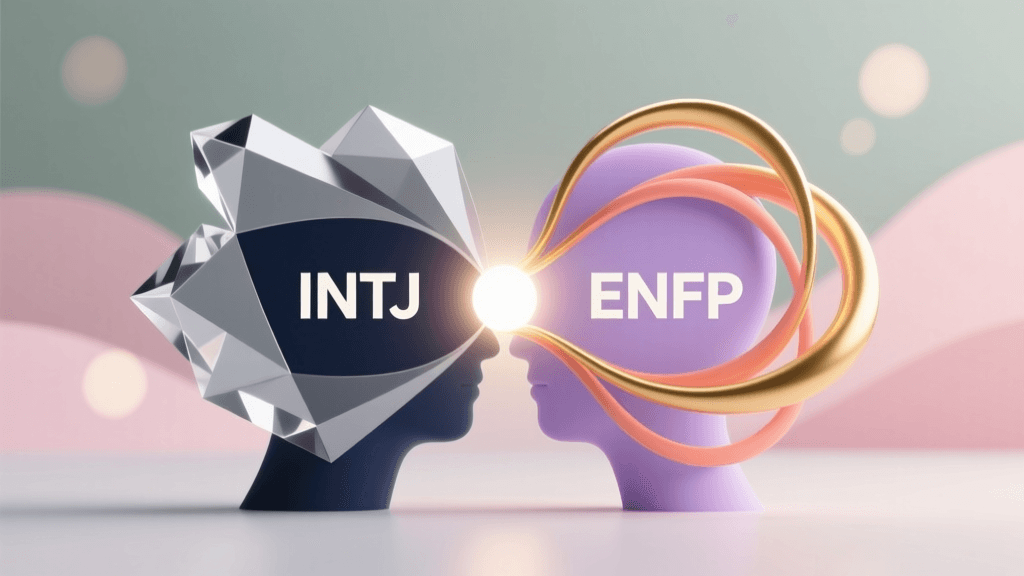
INTJ as a Parent
The INTJ (Introverted, Intuitive, Thinking, Judging) parent approaches parenting with strategic foresight, intellectual rigor, and quiet consistency. Often described as the 'Architect' or 'Mastermind,' the INTJ parent doesn’t rely on instinct alone—they design their parenting philosophy like a long-term project plan. Their strength lies in anticipating developmental milestones, researching evidence-based child-rearing practices, and establishing systems that foster independence, critical thinking, and self-discipline.
INTJs typically value competence over compliance. Rather than enforcing arbitrary rules, they explain the 'why' behind expectations—e.g., “We limit screen time because research shows excessive use correlates with reduced attention span and poorer sleep quality in children aged 6–12” American Academy of Pediatrics. This rationale-oriented approach resonates deeply with older children and teens who appreciate logic and autonomy—but can feel overwhelming or emotionally distant to younger kids needing warmth and spontaneity.
INTJ parents often create structured routines: consistent bedtimes, designated homework hours, weekly skill-building goals (e.g., learning basic coding concepts by age 10), and clearly defined household responsibilities. They may maintain digital dashboards tracking academic progress, extracurricular commitments, and emotional check-ins—tools not for control, but for optimizing growth. However, their preference for efficiency can unintentionally sideline unstructured play, emotional validation, or the ‘messy’ creativity that fuels early childhood development.
A key vulnerability is emotional attunement. While INTJs deeply love their children, they may struggle to recognize or respond to subtle nonverbal cues—tears masked by stoicism, anxiety disguised as defiance, or excitement expressed through physical exuberance rather than verbal articulation. They may misinterpret a child’s need for comfort as a request for problem-solving (“What’s wrong?” → “Let’s fix it”) rather than presence (“I’m here with you”). Research from the University of Nebraska–Lincoln’s Extension Program emphasizes that emotion-coaching—validating feelings before addressing behavior—is linked to higher emotional regulation and resilience in children. For the INTJ parent, this requires deliberate practice: pausing before advising, naming emotions aloud (“It sounds like you’re frustrated”), and offering physical comfort (a hand on the shoulder, shared silence) without rushing to resolve.
ENFP as a Parent
The ENFP (Extraverted, Intuitive, Feeling, Perceiving) parent embodies warmth, imagination, and infectious enthusiasm—a living embodiment of the phrase “raising humans, not resumes.” Known as the 'Champion' or 'Inspirer,' the ENFP parent sees every child as a unique universe of potential waiting to be discovered and celebrated. Their parenting style is relational, adaptive, and deeply values-driven: connection, authenticity, curiosity, and joy are non-negotiable pillars.
ENFPs excel at reading emotional atmospheres and intuitively adjusting their energy to meet their child’s needs—switching from playful storyteller at bedtime to empathetic confidant during teenage heartbreaks. They thrive in spontaneous moments: turning a rainy afternoon into an impromptu science experiment, transforming grocery shopping into a rhyming scavenger hunt, or launching a family podcast about neighborhood history. Their homes often buzz with art supplies, half-finished craft projects, open books, and evolving vision boards pinned to the fridge.
However, their perceiving (P) preference means structure is often organic rather than imposed. Routines may flex constantly—bedtimes shift with mood or inspiration, homework deadlines blur when a more ‘meaningful’ project emerges—and household systems (like chore charts or meal planning) may exist more in spirit than in execution. While this nurtures creativity and adaptability, it can create anxiety for children who crave predictability—or for co-parents who rely on consistency. A 2023 longitudinal study published in Frontiers in Psychology found that children with high sensory processing sensitivity (common among INFP, INFJ, and ISFJ types) showed significantly better emotional outcomes when paired with at least one highly structured caregiver—even if the other parent was more flexible—highlighting the importance of complementary scaffolding.
ENFPs also face challenges around boundaries. Their desire to affirm and uplift can lead to over-accommodation—rescuing children from natural consequences, avoiding necessary discipline for fear of dampening spirit, or over-scheduling to fulfill every perceived interest. Learning to say “no” with love—and distinguishing between nurturing and enabling—is a vital growth edge. As clinical psychologist Dr. Becky Kennedy notes in her work on authoritative parenting, “Boundaries aren’t walls; they’re the architecture of safety. Children don’t feel freer without limits—they feel safer *within* them.”
Co-Parenting Dynamics for INTJ and ENFP
INTJ and ENFP co-parenting is one of the MBTI’s most dynamically complementary pairings—rich with synergy yet demanding conscious calibration. At first glance, their differences appear oppositional: system vs. spontaneity, analysis vs. intuition, reserve vs. expressiveness. Yet precisely these contrasts, when harnessed intentionally, create a remarkably resilient and holistic parenting ecosystem.
Consider the daily rhythm: The INTJ designs the foundational framework—the school-year calendar color-coded by subject and deadline, the morning routine checklist laminated and hung by the door, the quarterly review of academic and social-emotional goals. The ENFP breathes life into that structure: adding themed breakfasts for ‘Motivation Mondays,’ turning math drills into treasure hunts, or initiating heartfelt ‘gratitude circles’ at dinner that deepen family bonds beyond task completion. Neither style alone suffices; together, they provide both stability and soul.
Conflict arises not from disagreement on values—both prioritize integrity, growth, and compassion—but from divergent pathways to those ends. An INTJ may initiate a ‘family optimization meeting’ to revise screen-time policy using data from the AAP guidelines; the ENFP may counter with, “But what if we tried a ‘Tech-Free Tuesday’ where we all paint murals instead? Let’s see how it feels first!” Neither is wrong. The resolution lies in integrating both: pilot the mural experiment *while* tracking its impact on sleep and focus for two weeks, then jointly review findings before deciding long-term policy.
Effective co-parenting hinges on three non-negotiable practices:
- Ritualized Debriefs: Schedule 20-minute weekly ‘co-pilot syncs’—not to solve problems, but to share observations. INTJ shares patterns (“Liam has missed three violin practices; his frustration tolerance seems lower during transitions”). ENFP shares emotional insights (“He cried softly while packing his cello case yesterday—I think he’s afraid he’s disappointing us”). Together, they co-create hypotheses and small experiments.
- Role Clarity with Fluid Boundaries: Assign primary responsibility domains based on natural strengths—not rigidly, but with mutual accountability. INTJ owns academic scaffolding and health logistics (appointments, nutrition planning); ENFP leads emotional check-ins, creative enrichment, and social coordination (playdates, holiday planning). Crucially, each commits to stepping into the other’s domain monthly—e.g., INTJ facilitates a ‘Feelings Journal’ session; ENFP drafts a 90-day learning roadmap for a child’s passion project.
- Shared Language for Conflict: Agree on a neutral phrase to pause escalation: “Let’s table this for our sync.” When disagreements flare (e.g., about summer camp choice), avoid debating merits in the moment. Instead, each writes a one-paragraph rationale—INTJ citing research on skill-transfer rates in immersive STEM programs, ENFP describing observed signs of burnout and longing for nature connection—then exchanges and discusses with curiosity, not persuasion.
Their greatest shared strength? Future-orientation married with present-moment aliveness. While INTJs envision their children thriving as innovative leaders in 2040, ENFPs ensure those children know, right now, that they are seen, cherished, and free to be gloriously imperfect. That dual vision is rare—and transformative.
Family Traditions and Values
INTJ and ENFP couples don’t just inherit or replicate traditions—they co-author them. Their shared values—authenticity, lifelong learning, ethical responsibility, and joyful curiosity—form the bedrock. But how those values manifest in ritual reveals beautiful dialectic tension.
For example, their annual ‘Year-in-Review & Horizon Scan’ tradition blends INTJ’s love of metrics with ENFP’s love of narrative:
- INTJ Contribution: A beautifully formatted PDF with graphs showing each child’s reading level growth, new skills mastered (e.g., bike riding, baking sourdough), community service hours, and even sentiment analysis of journal entries (using simple word-cloud tools).
- ENFP Contribution: A handmade ‘Story Scroll’—a 10-foot-long paper chain where each link holds a handwritten memory (“The time Maya convinced the neighbor’s cat to wear sunglasses,” “When Leo gave his entire allowance to the food bank after learning about hunger”).
- Joint Ritual: On New Year’s Eve, they unroll both artifacts side-by-side, reflect aloud on patterns and surprises, then collaboratively draft three ‘Horizon Goals’—one intellectual (e.g., “Learn conversational Spanish”), one relational (e.g., “Have one device-free family walk per week”), and one imaginative (e.g., “Build a backyard fairy village”).
Other signature traditions include:
- ‘Question of the Month’: Posted on the fridge. INTJ selects a philosophically rich prompt (“What does fairness mean when resources are limited?”); ENFP crafts playful, multi-sensory ways to explore it (debate club, fairness-themed board game night, interviewing grandparents about justice in their youth).
- ‘Silent Saturday Mornings’: Honoring INTJ’s need for restoration and ENFP’s capacity for deep presence. No screens, no agenda—just shared quiet (reading, sketching, gardening) with optional gentle conversation. Proven to reduce parental stress and model healthy boundaries Psychology Today.
- ‘Values Auction’: Quarterly family activity where each member gets ‘values dollars’ to bid on core principles (e.g., Adventure, Honesty, Creativity, Rest, Service). Bidding reveals implicit priorities—and sparks rich dialogue about why ‘Rest’ outbid ‘Adventure’ this quarter (hint: post-school transition fatigue).
Crucially, they audit traditions annually: “Does this still serve our values? Does it energize or deplete us? What would make it more inclusive for [child’s name], whose ISTP tendencies mean they engage best through building, not talking?” This intentional evolution prevents tradition from becoming dogma.
Raising Children with Different Personality Types
No two children—nor any child across development—express personality identically. An INTJ/ENFP couple raising an ESTJ toddler, an INFP teen, and an ESFP preschooler faces layered complexity. Their superpower? Recognizing that personality isn’t destiny—it’s a lens for understanding motivation, communication, and stress response.
They apply type-aware strategies with precision:
| Child's Type | Key Motivators | Stress Triggers | INTJ-ENFP Co-Parenting Response |
|---|---|---|---|
| ESTJ (e.g., 8-year-old) | Clarity, fairness, tangible results, contributing to order | Unclear rules, inconsistency, perceived injustice, chaotic environments | INTJ drafts a visual ‘Household Constitution’ with rights/responsibilities; ENFP hosts ‘Justice Council’ meetings where ESTJ helps revise clauses. Weekly ‘Contribution Spotlight’ celebrates concrete acts of helpfulness. |
| INFP (e.g., 14-year-old) | Authenticity, meaning, creative expression, deep connection | Feeling misunderstood, pressure to conform, criticism of values, rushed decisions | ENFP initiates ‘Soul Mapping’ sessions (journaling + music + nature walks); INTJ creates private ‘Values Archive’—a secure digital folder where INFP stores poems, ethical reflections, and idealistic visions, reviewed quarterly with zero judgment. |
| ESFP (e.g., 4-year-old) | Fun, sensory engagement, immediate rewards, social play | Boredom, excessive waiting, abstract instructions, isolation | ENFP designs ‘Sensory Stations’ (texture bins, music corners, taste-test labs); INTJ engineers ‘Play Schedules’—color-coded timers for activities, ensuring novelty within predictable flow. Joint ‘Joy Patrol’ checks in hourly: “What made you giggle today?” |
This approach avoids type-based labeling (“You’re just an INFP, so you’ll always hate math”) and instead focuses on functional support. They understand that an ISTJ child might need written step-by-step instructions for chores, while an ENTP teen thrives on debating pros/cons of family decisions. Critically, they resist projecting their own type preferences: the INTJ parent doesn’t assume their ENFP child shares their love of solitude, nor does the ENFP parent assume their INTJ child craves constant affirmation. Instead, they ask: “How do *you* feel most capable? Most seen? Most at peace?”
Research from the Child Trends Institute confirms that when caregivers accurately perceive and accommodate a child’s temperament—especially in areas like sensitivity, activity level, and adaptability—children show measurably lower cortisol levels and higher executive function scores. For the INTJ/ENFP duo, this means leveraging their combined observational power: INTJ notices behavioral patterns; ENFP decodes emotional subtext. Together, they become unparalleled advocates for each child’s neurodiverse brilliance.
Navigating Extended Family as INTJ and ENFP
Extended family gatherings are where INTJ/ENFP dynamics shine—and strain. INTJs may dread unstructured, emotionally charged events; ENFPs may feel drained by overly formal or rigid relatives. Their joint strategy transforms potential landmines into opportunities for boundary-setting and cultural translation.
Pre-Gathering Alignment:
- INTJ Prepares: A ‘Family Context Brief’—concise notes on each relative’s known sensitivities (e.g., “Aunt Clara dislikes unsolicited advice about her health”), communication styles (“Uncle Mark responds best to direct questions, not small talk”), and logistical needs (“Grandpa needs elevator access; confirm with venue”).
- ENFP Prepares: A ‘Connection Map’—identifying potential affinity points (“Cousin Lena loves vintage fashion—bring photos of your 1920s sewing project”; “Nephew Kai is obsessed with volcanoes—download eruption videos to share”).
During Events:
- Tag-Team Hosting: ENFP circulates, greets, tells stories, and draws people out. INTJ manages flow—refilling drinks, troubleshooting tech for virtual attendees, quietly redirecting heated political debates using pre-agreed neutral pivots (“That’s fascinating—has anyone read the recent Brookings report on that?”).
- Exit Strategy: They agree on a subtle signal (e.g., INTJ adjusts glasses; ENFP touches necklace) to initiate graceful departure. INTJ handles logistics (“I’ve called the car; it arrives in 3 minutes”); ENFP delivers warm, appreciative farewells that leave no room for guilt.
Post-Event Processing:
Within 24 hours, they hold a ‘Debrief & Decompress’—INTJ shares factual observations (“Three relatives asked about college plans; two commented on Lily’s shyness”); ENFP shares emotional resonance (“I felt protective when Grandma compared Leo to his cousin—he slumped in his chair”). They then co-create one actionable insight: “Next time, we’ll prep Leo with a ‘conversation toolkit’ (3 fun facts about himself, 2 questions to ask others) and designate him ‘Photo Archivist’ to give him purposeful role.”
This structured-yet-compassionate approach models healthy family systems for their children—showing that love and boundaries aren’t opposites, but interdependent forces.
FAQ
How do INTJ and ENFP parents handle discipline differently—and how can they align?
INTJs favor logical, consistent consequences tied to clear principles (“Breaking trust means temporarily losing phone privileges until you propose a repair plan”). ENFPs lean toward restorative, relationship-focused approaches (“Let’s talk about how your actions affected your sister—and what makes things feel fair again”). Alignment happens by merging frameworks: agree on 3–5 non-negotiable family values (e.g., Respect, Safety, Integrity), then co-create consequence menus for each—e.g., for disrespect: INTJ’s option = written reflection on impact + apology letter; ENFP’s option = collaborative ‘Repair Project’ (baking cookies for the hurt person, creating a comic about kindness). Children choose, fostering agency within structure.
What if our child tests as a type that clashes with one parent—like an ESTP child with an INTJ parent?
Clash is inevitable—but it’s data, not destiny. ESTPs thrive on action, realism, and immediate feedback; INTJs operate in abstraction and long-term strategy. The solution isn’t changing the child or parent, but bridging the gap: INTJ learns to deliver feedback in bite-sized, observable terms (“Your science presentation had strong eye contact and clear examples—great job!”) instead of abstract critique. ESTP child gains appreciation for INTJ’s depth by co-designing a ‘Real-World Application’ project—e.g., using physics principles to optimize their skateboard ramp. Resources like the Myers & Briggs Foundation offer type-specific communication guides validated by decades of practitioner use.
How can we maintain our own relationship amid parenting demands?
INTJs recharge through focused solitude; ENFPs through meaningful connection. Their secret? ‘Dual-Dimension Dates.’ Monthly, they schedule two parallel commitments: (1) A 90-minute ‘Deep Dive’—INTJ reads a leadership article aloud while ENFP sketches ideas inspired by it, then discuss implications for family growth; (2) A 60-minute ‘Unstructured Spark’—no agenda, no devices, just walking while sharing one ‘small wonder’ each noticed that day. This honors both needs simultaneously—structure for meaning, freedom for joy.
Are there specific resources you recommend for INTJ/ENFP co-parenting?
Absolutely. Start with The Whole-Brain Child by Daniel J. Siegel and Tina Payne Bryson—its neuroscience-backed strategies help INTJs translate emotion into biology and ENFPs ground intuition in brain science. For practical tools, the Gottman Institute’s Four Horsemen guide offers concrete scripts to replace criticism with ‘I-statements’ during parenting disagreements. Finally, the National Association for the Education of Young Children (NAEYC) provides age-specific, research-grounded benchmarks—giving INTJs data and ENFPs developmental context to co-create responsive, stage-appropriate expectations.