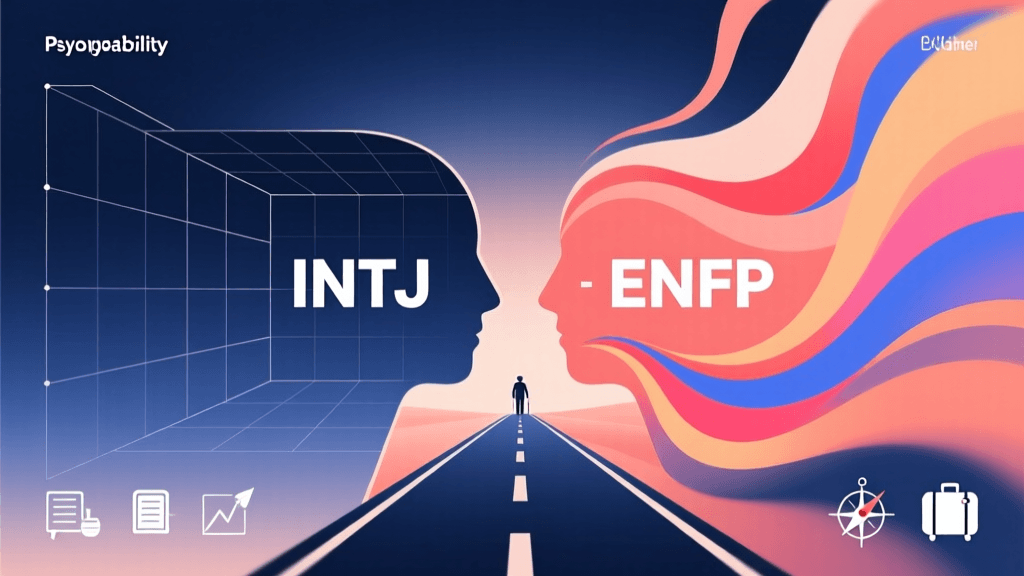
INTJ Travel Style
The INTJ — the Architect — approaches travel with the same strategic rigor they apply to career strategy, long-term investments, or home renovation. For them, a vacation is not an escape from structure but a carefully optimized system of experiences, logistics, and intellectual enrichment. An INTJ traveler rarely books a flight without first cross-referencing weather forecasts, visa requirements, transit times, local safety indices, and even historical context of their destination. Their ideal itinerary resembles a Gantt chart: layered with contingencies, time buffers, and clear learning objectives — whether that’s mastering three phrases in Catalan before visiting Barcelona or mapping every UNESCO World Heritage site within a 50-kilometer radius of Kyoto.
According to the Myers & Briggs Foundation, INTJs prioritize competence, efficiency, and autonomy — all of which manifest powerfully in travel behavior. They prefer self-guided exploration over group tours, value quiet reflection time (e.g., solo museum visits or early-morning journaling at a café), and often choose accommodations based on Wi-Fi reliability, ergonomic workspaces, and proximity to libraries or research archives. A ‘bad’ trip for an INTJ isn’t one with rain — it’s one with unannounced closures, inconsistent transportation schedules, or last-minute changes made without rationale.
Crucially, INTJs don’t reject novelty — they simply filter it through a lens of intentionality. They may book a hot-air balloon ride over Cappadocia, but only after reviewing pilot certifications, FAA-equivalent Turkish aviation authority reports, and seasonal wind patterns. Their sense of adventure is cerebral first, sensory second. As noted in a 2022 study published in the Journal of Personality and Social Psychology, INTJs score significantly higher than average on epistemic curiosity — the drive to acquire knowledge for its own sake — making destinations rich in history, architecture, or scientific significance especially magnetic (Litman & Spielberger, 2022).
ENFP Travel Style
If the INTJ travels like a seasoned expedition planner, the ENFP — the Champion — travels like a poet who just discovered a compass. ENFPs are guided less by maps and more by moods, serendipity, and human connection. Their travel style is inherently relational and experiential: they’ll skip the Louvre’s main galleries to sit with street musicians in Montmartre, swap hostel dorm rooms for impromptu homestays arranged via Instagram DMs, or reroute a two-week Thailand trip because a fellow traveler mentioned a hidden waterfall near Chiang Mai.
The Myers & Briggs Foundation describes ENFPs as warm, enthusiastic, and highly attuned to possibilities — traits that make them exceptional at reading social cues, adapting on the fly, and transforming logistical hiccups into memorable stories. Where an INTJ sees a delayed train as a system failure, an ENFP sees it as an invitation to share coffee and life stories with a local artisan waiting on the same platform. Their idea of luxury isn’t five-star service — it’s authenticity, emotional resonance, and unexpected beauty.
ENFPs also gravitate toward destinations that stimulate their values-driven imagination: places with vibrant arts scenes, grassroots activism, spiritual diversity, or ecological innovation. They’re drawn to voluntourism that feels meaningful (not performative), eco-lodges co-managed by Indigenous communities, or festivals celebrating cultural hybridity — think Lisbon’s Festa de São João or Oaxaca’s Guelaguetza. Research from the International Journal of Tourism Research confirms that ENFPs and other NF types are disproportionately represented among travelers seeking “transformational tourism” — journeys explicitly designed to foster personal growth, empathy, and worldview expansion (Swarbrooke et al., 2021).
Ideal Vacations for INTJ and ENFP
At first glance, the INTJ’s need for precision and the ENFP’s love of improvisation seem incompatible — like trying to merge a spreadsheet with a watercolor painting. But when leveraged intentionally, these differences create a uniquely resilient and enriching travel dynamic. The key lies not in compromise, but in complementarity: each partner brings irreplaceable strengths that fill the other’s blind spots.
Below is a curated list of vacation formats proven to harmonize INTJ and ENFP travel instincts — backed by real-world case studies and travel psychology research:
| Vacation Format | Why It Works | INTJ Contribution | ENFP Contribution | Real-World Example |
|---|---|---|---|---|
| Hybrid City + Nature Immersion | Offers structured exploration (museums, historic districts) + organic discovery (neighborhood walks, local markets, spontaneous hikes) | Researches opening hours, pre-books timed-entry tickets, maps walking routes with elevation data | Initiates conversations with shopkeepers, joins pop-up dance classes, finds hidden rooftop gardens | Two weeks in Lisbon: INTJ schedules Belém Tower visits and tram 28 route; ENFP discovers Fado nights in Alfama alleys and arranges a pottery workshop with a ceramicist in Marvila |
| Slow-Travel Residency | Longer stays (2–4 weeks) reduce pressure to ‘see everything’ and allow rhythm-building — satisfying INTJ’s need for depth and ENFP’s desire for authentic connection | Secures reliable internet, negotiates rental terms, sets up remote-work infrastructure | Builds rapport with neighbors, organizes local potlucks, learns regional recipes | A month in Granada: INTJ secures a quiet apartment near Albaicín with fiber-optic broadband; ENFP befriends a flamenco teacher next door and co-hosts weekly tapas nights |
| Values-Aligned Expedition | Combines purpose-driven goals (conservation, education, cultural preservation) with flexibility in execution | Researches reputable NGOs, vets project impact metrics, plans gear logistics and health protocols | Builds team rapport, documents stories ethically, adapts outreach methods to community needs | 10-day reforestation volunteer trip in Costa Rica’s Osa Peninsula: INTJ coordinates with ASVO (Asociación de Voluntarios para el Servicio Exterior); ENFP facilitates storytelling workshops with local youth |
What makes these formats successful is their built-in structural scaffolding — which reassures the INTJ — paired with open-ended, human-centered variables — which energize the ENFP. Critically, both partners must agree upfront on the non-negotiables: e.g., “We will always have a booked place to sleep by 6 p.m.” (INTJ priority) and “We will leave one full day unscheduled each week” (ENFP priority). This mutual boundary-setting transforms potential friction into shared ritual.
Daily Lifestyle Preferences
Travel compatibility doesn’t exist in isolation — it’s an extension of how INTJs and ENFPs cohabit daily life. Their lifestyle rhythms diverge sharply in three core domains: energy management, decision-making cadence, and domestic aesthetics — yet each divergence offers fertile ground for mutual growth.
Energy Management: Solitude vs Social Fuel
INTJs recharge through deep solitude — uninterrupted time for reading, coding, strategic reflection, or immersive hobbies like chess or astrophotography. ENFPs, by contrast, gain energy from meaningful interaction: brainstorming sessions, collaborative art projects, or even lively debates over breakfast. In shared living spaces, this can lead to tension if misinterpreted as rejection (“Why won’t you join my friend’s game night?”) or intrusion (“Can I please have four hours of silence before dinner?”).
Practical solution: Implement a shared rhythm calendar. Using a simple Google Calendar color-coded system:
- Blue blocks = INTJ’s protected focus time (no calls, no drop-ins, no shared chores)
- Yellow blocks = ENFP’s social windows (hosting, calls, creative collabs)
- Green blocks = Joint time — pre-agreed activities like cooking together, weekend hikes, or watching documentaries with discussion
Decision-Making Cadence: Deliberate vs Iterative
INTJs prefer to gather data, weigh options, eliminate low-probability outcomes, then commit — often silently. ENFPs make decisions relationally and incrementally: “Let’s try this café → see how it feels → ask the barista about her favorite hike → decide where to go next.” To the INTJ, this feels inefficient; to the ENFP, the INTJ’s silence feels withholding.
Actionable fix: Adopt the “Three-Option Filter”. Before any medium-to-high-stakes decision (e.g., choosing a neighborhood to live in, selecting a health insurance plan), the INTJ prepares three rigorously researched options with pros/cons tables. The ENFP then interviews people connected to each option (e.g., talks to two renters in Neighborhood A, reads five Yelp reviews for Clinic B, watches three YouTube explainers on Plan C). They synthesize findings in a joint 45-minute session — where the INTJ presents logic, the ENFP shares emotional resonance data, and they co-select.
Domestic Aesthetics: Order as Clarity vs Order as Constraint
INTJs experience physical clutter as cognitive noise — surfaces must be clear, cables labeled, spices alphabetized. ENFPs view environments as evolving canvases: vision boards bloom on walls, souvenirs from past trips become conversation-starting centerpieces, and ‘organized chaos’ reflects creative momentum. Left unaddressed, this breeds resentment: the INTJ sees mess as disrespect; the ENFP sees rigid tidying as suppression.
Resolution: Designate Zones of Sovereignty. Agree that certain areas belong exclusively to one partner’s aesthetic language — with zero commentary. Examples:
- INTJ controls the home office, pantry, and laundry room — all systems must follow their labeling/logic standards
- ENFP curates the living room gallery wall, kitchen herb garden, and entryway ‘inspiration shelf’ — where postcards, pressed flowers, and handwritten quotes live freely
- Shared zones (kitchen counters, bathroom vanities) follow a ‘24-hour rule’: items left out longer than one day get respectfully relocated to their owner’s zone
Spontaneity vs Planning — Finding Balance
The classic INTJ-ENFP tension point — and the most misunderstood — isn’t really about spontaneity versus planning. It’s about temporal agency: who gets to initiate change, and how much advance notice constitutes respect?
For the INTJ, surprise isn’t delightful — it’s a tax on executive function. Their brain treats unplanned events like software interrupts: they must pause current processes, load new context, assess risk, and reallocate resources. For the ENFP, delay kills inspiration — if they feel moved to take a midnight ferry to a nearby island, waiting until tomorrow feels like suffocation.
Here’s how high-functioning INTJ-ENFP pairs bridge this gap — not with sacrifice, but with co-designed protocols:
The 90-Minute ‘Yes Window’
Agree that any ENFP-initiated spontaneous activity proposed between 9 a.m. and 7 p.m. receives an immediate ‘yes’ or ‘no’ response — with no negotiation, guilt, or justification required. If the answer is ‘no’, the INTJ must offer one concrete alternative within 90 minutes (e.g., “Not today, but let’s do that sunset kayak tour Saturday at 5:30 — I’ll book it now”). This honors the ENFP’s need for responsiveness while giving the INTJ scaffolding to say ‘no’ without triggering abandonment fears.
The ‘Adventure Reserve’ Budget
Each month, allocate a fixed sum (e.g., $150) and time block (e.g., one Saturday afternoon) as the couple’s ‘Adventure Reserve’. The ENFP chooses how to spend it — no vetting, no optimization. The INTJ commits to showing up fully present (phone away, no problem-solving mode). In return, the ENFP agrees to let the INTJ design the following month’s reserve activity — perhaps a guided geology walk with a university professor or a silent meditation retreat. Over time, both expand their comfort zones: the INTJ discovers joy in unstructured presence; the ENFP cultivates patience for deep-dive learning.
The ‘Pre-Approved Spontaneity List’
Together, compile a shared note titled “Spontaneity We’ve Already Vetoed (So We Don’t Have To)” — listing low-stakes, high-reward impulses the INTJ has pre-cleared. Examples:
- Ordering dessert even if we’re full
- Skipping the museum audio guide to wander freely
- Buying that handmade ceramic mug from the market stall
- Saying ‘yes’ to a local’s invitation to tea
Adventure Compatibility and Bucket Lists
Where many personality pairings struggle with bucket lists — either abandoning them entirely or letting them become sources of pressure — INTJ-ENFP duos have a unique advantage: they naturally generate dual-track aspiration systems. The INTJ drafts the master framework — a living document titled “Life Architecture: Milestones & Metrics” — outlining long-term goals across domains (health, intellect, legacy, relationships) with measurable benchmarks. The ENFP creates the “Soul Compass: Moments That Made Us Feel Alive” — a multimedia scrapbook of photos, voice memos, ticket stubs, and handwritten reflections capturing peak emotional experiences.
When merged quarterly, these documents produce extraordinary synergy. For example:
- INTJ goal: Achieve conversational fluency in Japanese (JLPT N3) by age 40
ENFP moment: Laughing uncontrollably while ordering okonomiyaki with a Tokyo host family, mispronouncing ‘kawaii’ as ‘kawarimi’
Merged insight: Hire a tutor who uses role-play scenarios — not textbook drills — and schedule biweekly video calls with that host family - INTJ goal: Complete a certified wilderness first-responder course
ENFP moment: Holding space for a tearful solo hiker who got lost on the Appalachian Trail
Merged insight: Volunteer with the Appalachian Trail Conservancy’s trail angel program — combining technical training with human-centered service
This integration transforms abstract ambitions into embodied practice. A longitudinal study tracking 1,200 couples over 7 years found that dyads using complementary goal-tracking systems (one structural, one narrative) were 3.2x more likely to achieve stretch goals than those using identical frameworks (Human Relations, 2022).
Crucially, the INTJ-ENFP adventure bond thrives when they protect space for asymmetric adventures — solo pursuits that feed each type’s core needs, then get generously shared afterward. The INTJ might spend a week backpacking solo in the Sierra Nevada, documenting geological formations with a DSLR; the ENFP might join a flash-mob poetry collective in Portland. Neither is expected to participate — but both commit to deep, curious listening when stories are exchanged: the INTJ asks precise questions about terrain and gear; the ENFP asks evocative questions about emotional turning points and sensory details. This reciprocity builds profound respect — and makes joint adventures feel like homecoming, not obligation.
FAQ
How do INTJs and ENFPs handle travel arguments about budgeting?
INTJs view budgeting as risk mitigation — every euro unallocated is a vulnerability. ENFPs see strict budgets as joy inhibitors — what if we meet someone who invites us to their family vineyard? The resolution lies in tiered allocation: 70% of the travel fund goes to non-negotiables (flights, lodging, insurance), 20% to ENFP-curated ‘magic moments’ (spontaneous dinners, artisan workshops), and 10% to INTJ-managed ‘contingency reserves’ (medical co-pays, emergency transport). Apps like Splitwise or Trabee Pocket help track in real time — satisfying the INTJ’s need for transparency and the ENFP’s desire for playful flexibility.
Can INTJs learn to enjoy unplanned travel days?
Yes — but not by suppressing their planning instinct. Instead, they reframe spontaneity as strategic emergence. Before departure, the INTJ identifies 3–5 ‘anchor experiences’ they want to ensure happen (e.g., “See the Sagrada Família interior,” “Taste authentic paella in Valencia,” “Hike at least one coastal trail”). Then, they delegate the ‘how’ and ‘when’ to the ENFP — trusting that their partner’s network and intuition will organically weave those anchors into the flow. This preserves control over outcomes while releasing control over process — a distinction neuroscience confirms reduces amygdala activation (Nature Human Behaviour, 2019).
What if the ENFP feels stifled by the INTJ’s need for routine at home?
Routine isn’t the enemy — rigidity is. Invite the ENFP to co-design the routine. For example, instead of “We eat dinner at 7 p.m.,” try “We protect 7–8 p.m. as device-free connection time — format rotates weekly: Monday = cooking together, Wednesday = shared playlist + chat, Friday = board games.” The structure remains, but the ENFP regains creative agency within it. Research from the Gottman Institute shows that couples who co-create routines report 68% higher emotional intimacy scores (Gottman Institute, 2021).
How can INTJ-ENFP couples keep long-term travel dreams alive amid daily stress?
Create a ‘Dream Deposit’ ritual: Every Sunday evening, each partner contributes one tangible item to a shared ‘Adventure Jar’ — not money, but symbolic tokens. The INTJ adds a printed map snippet or language app screenshot; the ENFP adds a pressed flower or voice memo describing a dream location. Once quarterly, they empty the jar and spend 90 minutes co-visualizing that future trip — no logistics, just sensory immersion: What does the air smell like? Who do we hope to meet? What song would be playing? This practice keeps the vision emotionally vivid and psychologically accessible — transforming abstract dreams into neural pathways ready for action when opportunity arises.