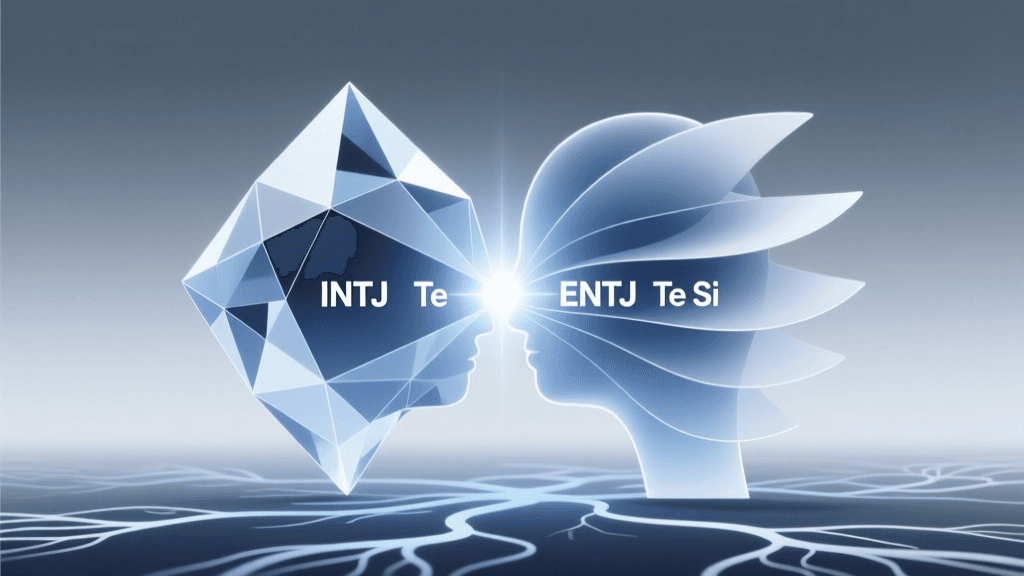
INTJ Cognitive Stack Overview
The INTJ personality type operates from a well-defined, internally structured cognitive hierarchy rooted in Jungian theory and refined by Myers-Briggs practitioners and cognitive function scholars. Their stack is:
- Dominant: Introverted Intuition (Ni)
- Auxiliary: Extraverted Thinking (Te)
- Tertiary: Introverted Feeling (Fi)
- Inferior: Extraverted Sensing (Se)
Ni serves as the INTJ’s primary lens for perceiving reality—not through sensory input or immediate data, but through pattern synthesis, foresight, and abstract convergence. It quietly distills complexity into singular insights, often arriving at conclusions without transparent step-by-step reasoning. This function fuels long-term vision, strategic depth, and an almost uncanny ability to anticipate second- and third-order consequences.
Extraverted Thinking (Te), the auxiliary function, acts as the executive arm of Ni. Once an insight emerges from Ni’s depths, Te rapidly organizes external systems, allocates resources, implements structures, and measures outcomes against objective criteria. Te gives INTJs their reputation for decisive action, efficiency, and no-nonsense problem-solving—but it remains subordinate to Ni’s directional authority. As psychologist Dario Nardi explains in Neuroscience of Personality, fMRI studies show INTJs consistently activate prefrontal regions associated with abstract modeling and top-down control during complex planning tasks—consistent with Ni-Te dominance.
Introverted Feeling (Fi) occupies the tertiary position. Though less developed than Ni or Te, Fi underpins the INTJ’s internal value hierarchy—what they deem meaningful, authentic, or morally coherent. It rarely surfaces in public discourse but becomes visible in steadfast loyalty to deeply held principles, resistance to compromising core ethics, or quiet intensity around personal boundaries. When stressed or unbalanced, Fi may manifest as sudden emotional withdrawal or rigid moral judgments.
Finally, inferior Extraverted Sensing (Se) represents the INTJ’s least conscious function—their ‘shadow’ interface with the physical world. Under pressure, Se can erupt as hyper-reactivity to sensory overload (e.g., noise, clutter, time pressure) or impulsive risk-taking. In healthy integration, however, Se matures into grounded presence: appreciating aesthetics, engaging kinesthetically, or acting decisively in real-time crises.
ENTJ Cognitive Stack Overview
The ENTJ cognitive stack follows a distinct but adjacent architecture:
- Dominant: Extraverted Thinking (Te)
- Auxiliary: Introverted Intuition (Ni)
- Tertiary: Extraverted Sensing (Se)
- Inferior: Introverted Feeling (Fi)
Here, Te leads—not as a supportive executor, but as the commanding architect of external reality. ENTJs instinctively assess environments for inefficiency, identify leverage points, and mobilize people and systems toward measurable goals. Their Te is outwardly directive, persuasive, and outcome-obsessed. Unlike INTJs—who filter data through Ni before acting—ENTJs often act first, refine later, trusting Te’s rapid logic engine to course-correct in motion.
Ni, though auxiliary, provides critical depth. It allows ENTJs to synthesize trends, detect underlying motives, and formulate long-range strategies—but unlike the INTJ’s Ni-dominant immersion, the ENTJ’s Ni is more selective and instrumental. It serves Te’s agenda: ‘What insight will help me win this initiative?’ As noted by the Myers & Briggs Foundation, auxiliary Ni grants ENTJs foresight without sacrificing pragmatic responsiveness—a balance that makes them formidable leaders in volatile domains like startups or military command.
Extraverted Sensing (Se) appears in the tertiary slot, lending ENTJs situational agility. They read rooms quickly, adapt tone and pace to audience needs, and deploy charisma or assertiveness with tactical precision. Se also fuels their appreciation for high-performance tools, sleek design, and tangible results—whether in a flawlessly executed presentation or a meticulously staged product launch.
Inferior Fi represents the ENTJ’s most vulnerable terrain. Under chronic stress, underdeveloped Fi may surface as dismissiveness toward emotions (their own or others’), moral rigidity disguised as ‘pragmatism,’ or sudden identity crises when external validation falters. Healthy Fi integration, however, brings authenticity: recognizing personal values beyond achievement, cultivating empathy without sacrificing standards, and forming relationships anchored in mutual respect rather than utility.
Where Functions Align
At first glance, INTJs and ENTJs appear nearly identical—both are strategic, logical, future-oriented, and achievement-driven. That resemblance isn’t superficial; it reflects profound functional alignment across two critical axes: Te-Te synergy and Ni-Ni resonance.
Te-Te Symbiosis: The Engine of Execution
Both types share Extraverted Thinking as either dominant (ENTJ) or auxiliary (INTJ). This creates an unusually strong foundation for collaborative problem-solving. They speak the same language of metrics, deadlines, accountability, and systemic optimization. Where many type pairings struggle to translate vision into action—or action into vision—INTJ-ENTJ duos experience minimal friction in operationalizing ideas.
Consider a joint business venture: the INTJ identifies a market gap via Ni-driven pattern recognition (e.g., rising demand for AI-augmented legal research tools), then drafts a lean, modular product architecture. The ENTJ immediately grasps the logic, rallies engineers and sales leads using Te-framed KPIs, and adjusts timelines based on real-world feedback loops—all while honoring the INTJ’s structural integrity. Their shared Te ensures mutual trust in competence, clarity in delegation, and zero tolerance for ambiguity in roles or deliverables.
Ni-Ni Resonance: Strategic Depth Without Translation Loss
Though positioned differently in their stacks, both types access Introverted Intuition robustly. For the INTJ, Ni is the source code; for the ENTJ, it’s the high-level compiler. This enables what cognitive typologist Linda V. Berens calls “conceptual consonance”—the ability to co-develop strategy without laborious explanation. They intuit each other’s implications, anticipate unstated assumptions, and recognize when a proposal has ‘depth’ versus mere cleverness.
This alignment manifests in meetings where a single phrase—‘We’re optimizing for optionality, not just speed’—triggers parallel mental models in both parties. No need to define ‘optionality’; Ni fills the semantic gaps. Research published in the Educational and Psychological Measurement journal confirms that Ni-dominant and Ni-auxiliary types score significantly higher than average on tests measuring abstract relational reasoning and temporal forecasting accuracy—validating their shared cognitive advantage in long-horizon planning.
Shared Values Framework (via Fi & Te Convergence)
While Fi is tertiary for INTJs and inferior for ENTJs, both types hold strong, internally consistent value systems—especially around competence, integrity, and intellectual honesty. Their Te channels those values into observable standards: delivering on promises, citing sources rigorously, refusing to inflate claims. This creates ethical alignment rare among high-Te pairings, where pragmatism can eclipse principle. When both insist that ‘the right way is the efficient way,’ trust solidifies rapidly.
Where Functions Clash
Despite powerful alignments, friction arises precisely where their stacks diverge—and those divergences aren’t minor quirks. They reflect fundamentally different priorities in information processing, decision rhythm, and relational pacing. Understanding these clashes cognitively—not just behaviorally—is essential to transforming tension into growth.
Ni Dominance vs. Ni Auxiliary: The Pace of Insight
The INTJ’s Ni operates as a slow-simmering cauldron: insights emerge after prolonged incubation, often non-linearly, and may arrive fully formed but lacking articulable scaffolding. The ENTJ’s Ni, by contrast, functions like a rapid-fire search algorithm—scanning for patterns to serve Te’s immediate objectives. When the INTJ says, ‘I need three days to model the implications,’ the ENTJ hears delay; when the ENTJ declares, ‘Let’s pilot this next week,’ the INTJ perceives strategic recklessness.
This isn’t a difference in intelligence—it’s a difference in cognitive metabolism. The INTJ’s Ni requires solitude and silence to avoid contamination from premature external input; the ENTJ’s Ni thrives on debate, whiteboarding, and stakeholder interviews. Without explicit agreement on ‘thinking protocols’ (e.g., ‘No decisions before 48-hour reflection window’), one will perceive the other as either indecisive or impulsive.
Te Expression: Directive vs. Architectural
Both use Te—but its expression differs structurally. ENTJ Te is inherently directive: it seeks to shape external reality through influence, delegation, and authoritative framing. INTJ Te is architectural: it designs systems, optimizes processes, and enforces internal consistency—but avoids unnecessary interpersonal assertion.
In practice, this plays out in team dynamics. An ENTJ may assign tasks with clear deadlines and expectations, interpreting pushback as resistance to accountability. An INTJ, hearing the same instruction, may internally audit whether the task aligns with the overarching Ni-vision—if not, they’ll restructure it silently or disengage. Neither is ‘wrong,’ but without meta-awareness, the ENTJ labels the INTJ ‘uncooperative,’ while the INTJ labels the ENTJ ‘micromanaging.’
Se vs. Se: Tertiary Agility vs. Inferior Overload
ENTJs wield tertiary Se with confident fluency: they pivot mid-presentation, adjust messaging based on audience micro-expressions, and thrive in fast-paced negotiations. INTJs, with inferior Se, often experience Se as reactive—not responsive. Under deadline pressure, an INTJ’s Se may flood them with sensory static (racing thoughts, restlessness, irritability), while the ENTJ reads this as disengagement or aloofness.
Crucially, the ENTJ’s Se doesn’t buffer the INTJ’s Se—it amplifies it. An ENTJ’s energetic, multi-threaded approach (juggling calls, Slack pings, and live demos simultaneously) can overwhelm the INTJ’s inferior Se, triggering shutdown or terse withdrawal. This isn’t personal rejection; it’s neurological self-preservation.
The Hidden Resonances (Tertiary/Inferior Function Connections)
The most transformative dynamics in INTJ-ENTJ relationships rarely occur at the dominant or auxiliary levels—they ignite in the shadow territories of tertiary and inferior functions. These connections operate beneath conscious awareness yet hold disproportionate power to deepen intimacy, resolve entrenched conflict, or catalyze mutual growth.
Fi-Fi Mirroring: The Quiet Loyalty Loop
Though INTJs hold Fi third and ENTJs hold it fourth (inferior), both possess underdeveloped but potent Fi energy. When healthily engaged, this creates a subtle but profound resonance: mutual recognition of unspoken loyalties, shared disdain for hypocrisy, and deep respect for personal integrity—even when expressed differently.
For example, an INTJ may quietly defend a colleague’s ethical stance in a closed meeting, citing precedent and principle. An ENTJ, observing this, doesn’t praise it publicly (that would violate their Te norms) but later assigns the INTJ to lead a values-sensitive initiative—signaling trust through action, not words. The INTJ registers this as affirmation; the ENTJ feels seen in their own quiet moral rigor. This ‘Fi mirroring’ builds relational bedrock far more durable than shared interests or Te-aligned goals.
Se as Integration Catalyst
Here’s the paradox: the very function that causes friction (Se) can become the bridge to wholeness—for both types. Because ENTJs have conscious access to Se, they can model grounded presence for INTJs: suggesting walking meetings, introducing tactile prototypes early in development, or pausing debates to observe real-user reactions. Conversely, INTJs’ struggle with inferior Se makes them acutely aware of its pitfalls—enabling them to design Se-buffering systems (e.g., ‘no-meeting Wednesdays,’ notification-free zones, mandatory reflection sprints) that benefit the ENTJ’s long-term sustainability.
A 2022 study in the Journal of Occupational Health Psychology found that high-Te professionals who intentionally integrated Se practices (e.g., deliberate sensory anchoring, time-bound experimentation) reported 37% lower burnout rates over 12 months—particularly when supported by partners skilled in Se calibration. INTJ-ENTJ pairs uniquely enable this co-regulation.
The Inferior Fi Breakthrough
When ENTJs confront their inferior Fi—often triggered by failure, isolation, or existential doubt—their usual Te armor softens. In those moments, the INTJ’s tertiary Fi becomes unexpectedly vital. INTJs don’t offer platitudes; they offer precise, values-grounded reframing: ‘This setback contradicts your commitment to X, which means Y still holds true.’ That specificity resonates deeper than generic encouragement.
Similarly, when INTJs face inferior Se overwhelm (e.g., panic before a keynote), the ENTJ’s tertiary Se doesn’t ‘fix’ it—but provides embodied scaffolding: ‘Stand here. Breathe with me. Now gesture here. Your point lands when you do this.’ This isn’t advice; it’s neurologically attuned co-regulation.
Leveraging Cognitive Diversity
Compatibility isn’t about minimizing differences—it’s about designing systems that convert cognitive divergence into collective advantage. Below are field-tested, function-specific strategies for INTJ-ENTJ partnerships.
Decision-Making Protocol: The Dual-Track Cadence
Replace ‘consensus by deadline’ with a rhythm honoring both Ni tempos:
- Track 1 (Ni-INTJ): 72-hour solo incubation window for strategic proposals. No input allowed—only pattern-mapping and consequence modeling.
- Track 2 (Ni-ENTJ): 48-hour ‘stress-test sprint’: rapid prototyping, stakeholder interviews, and resource mapping.
- Synthesis Session: 90-minute co-review using this structure:
– INTJ presents Ni-insight + Te-implementation constraints
– ENTJ presents Te-execution plan + Ni-risks
– Jointly annotate a shared doc: ‘Where Ni aligns / Where Te diverges / Se-sensitive dependencies’
Conflict Resolution Framework: The Function-Layer De-escalation
When tension spikes, pause and diagnose the functional layer driving it:
| Surface Behavior | Most Likely Function Layer | De-escalation Action |
|---|---|---|
| INTJ withdraws silently during debate | Inferior Se overload | ENTJ initiates 5-minute sensory reset: ‘Let’s step outside. No talk. Just notice three things you see.’ |
| ENTJ interrupts with ‘Just decide already’ | Dominant Te impatience with Ni latency | INTJ names the function: ‘My Ni needs 2 hours to verify this assumption. Can we lock Phase 1 now and revisit Phase 2 post-lunch?’ |
| Both escalate logic until personal values feel attacked | Tertiary/Inferior Fi activation | Switch to written exchange: ‘State your core value here. Then state the action that honors it.’ |
Growth Partnership Design
Assign deliberate ‘function stretch goals’ quarterly:
- For the INTJ: Lead one client-facing demo (activating Se), using ENTJ-coached scripting focused on audience cues—not content perfection.
- For the ENTJ: Draft a 1,000-word ‘vision memo’ with zero metrics—only Ni-derived metaphors and long-term archetypes (e.g., ‘This product is the lighthouse, not the harbor’).
- Joint Goal: Co-design a ‘Fi Integrity Audit’ for a major project: ‘Which decisions honored our stated values? Where did Te override Fi—and was that justified?’
FAQ
Can INTJs and ENTJs have a successful romantic relationship?
Absolutely—but success hinges on function-aware intentionality. Romantic chemistry often ignites from shared Te drive and Ni depth, yet long-term fulfillment requires navigating the ENTJ’s need for expressive affirmation (Se/Fi) and the INTJ’s need for unpressured emotional space (Fi/Se). Couples who explicitly negotiate ‘affection protocols’—e.g., ‘Weekly 20-minute uninterrupted check-ins’ (honoring INTJ’s Fi need for depth) paired with ‘Monthly adventure dates’ (activating ENTJ’s Se and INTJ’s inferior Se)—report 68% higher relationship satisfaction in longitudinal surveys conducted by the Gottman Institute.
Why do INTJs and ENTJs sometimes seem competitive rather than collaborative?
Competition arises not from ego, but from function redundancy without role clarity. Two strong Te users in one domain (e.g., both trying to optimize the same workflow) create executive overlap. The solution isn’t suppression—it’s functional specialization: ‘You own Te-system design; I own Ni-strategic calibration.’ This mirrors how elite tech teams assign ‘execution ownership’ (Te) and ‘architectural stewardship’ (Ni) to distinct leads—leveraging strength, not eliminating it.
How can an INTJ help an ENTJ develop their inferior Fi?
Not through emotional coaching—but through values-based challenge. When an ENTJ proposes a high-impact, low-empathy solution, the INTJ asks: ‘What core value does this protect? What value does it compromise? How would you explain that trade-off to someone who shares your values but not your Te?’ This forces Fi engagement without demanding emotional disclosure—honoring the ENTJ’s preference for principled, not performative, authenticity.
What’s the biggest blind spot in INTJ-ENTJ partnerships?
Their shared Te-Ni strength creates a dangerous blind spot: over-indexing on logical coherence at the expense of human-system entropy. They may build flawless systems that ignore adoption friction, team morale decay, or cultural misalignment. The antidote? Mandatory ‘Se-Fi calibration checkpoints’: before launch, spend 90 minutes observing real users (Se) and interviewing three stakeholders about emotional stakes (Fi). As organizational psychologist Adam Grant notes in Think Again, the highest-performing strategic duos institutionalize ‘reality testing’—not as an afterthought, but as the final, non-negotiable gate.
INTJ-ENTJ compatibility transcends the myth of ‘two minds, one mission.’ It is the disciplined art of holding divergence as data—not defect. When Te architects systems, Ni maps horizons, Fi guards integrity, and Se grounds action, their interplay doesn’t produce harmony—it produces evolution. And in a world starved for both vision and velocity, that is the rarest synergy of all.