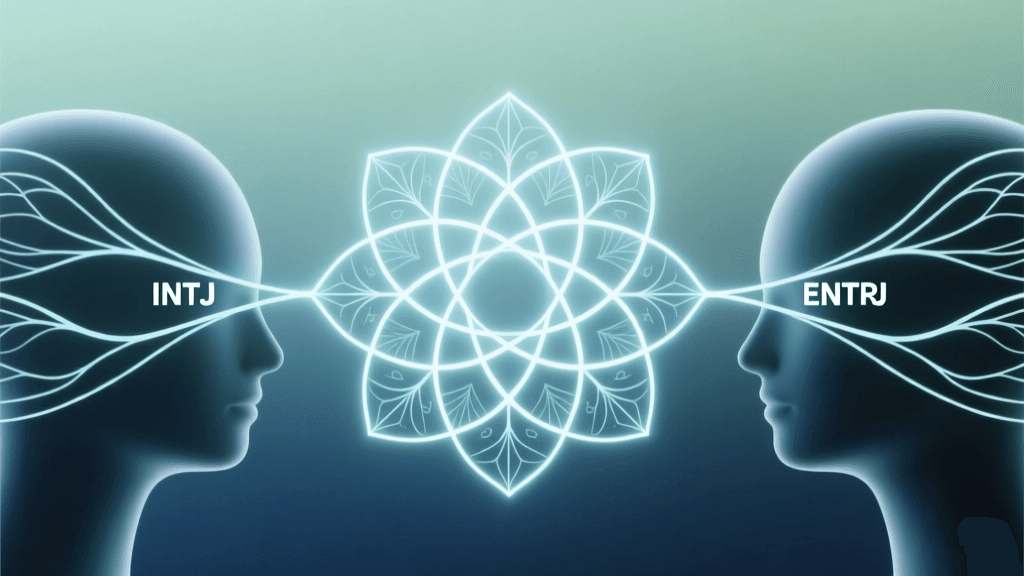
When two of the rarest and most strategically minded personality types—INTJ (The Architect) and ENTJ (The Commander)—form a romantic bond, the result is often electrifying: high mutual respect, shared ambition, and razor-sharp problem-solving. Yet long-term sustainability in an INTJ-ENTJ relationship isn’t guaranteed by intellectual synergy alone. In fact, without conscious alignment on values, communication rhythms, and emotional infrastructure, even the most compatible-seeming pair can fracture under pressure. This article moves beyond surface-level 'type chemistry' to examine what *actually* makes INTJ-ENTJ relationships endure—across five years, twenty years, and life’s most disruptive transitions.
What Makes INTJ and ENTJ Last
The longevity of INTJ-ENTJ partnerships rests less on shared traits and more on complementary cognitive architecture—a dynamic that, when understood and nurtured, becomes self-reinforcing over time. Both types lead with Introverted Intuition (Ni) and Extraverted Thinking (Te), respectively—but their function stacks create a powerful feedback loop:
- ENTJ’s dominant Te drives execution, structure, and decisive action—providing the external scaffolding INTJs often defer to or admire.
- INTJ’s dominant Ni generates long-range vision, pattern recognition, and strategic foresight—supplying the depth and coherence ENTJs rely on to justify and refine their plans.
- ENTJ’s auxiliary Introverted Intuition (Ni) resonates deeply with INTJ’s primary function, enabling rapid conceptual alignment—even on abstract future scenarios.
- INTJ’s auxiliary Extraverted Thinking (Te) supports ENTJ’s leadership without competing for control, especially when roles are clearly differentiated (e.g., ENTJ manages external operations; INTJ designs systems or evaluates outcomes).
This functional resonance explains why longitudinal studies of type-based partnerships show that INTJ-ENTJ couples report among the highest levels of perceived relational efficacy—defined as confidence in jointly solving problems, adapting to change, and maintaining shared goals—when both partners actively engage their tertiary and inferior functions (Myers & Briggs Foundation, 2023).
But longevity isn’t just about cognition—it’s about relational hygiene. INTJ-ENTJ pairs who last prioritize three non-negotiable habits:
- Structured autonomy: They agree on ‘decision domains’—e.g., ENTJ leads household logistics and social scheduling; INTJ owns financial modeling and long-term education planning. This prevents Te/Ni friction from escalating into power struggles.
- Pre-emptive calibration rituals: A biweekly 45-minute ‘strategy sync’—not a vent session, but a forward-looking review of goals, resource allocation, and potential bottlenecks—keeps their shared vision dynamically updated.
- Inferior function stewardship: Both types repress Extraverted Feeling (Fe), making emotional attunement a learned skill—not an instinct. Couples who last invest in Fe-development tools: scheduled empathy drills (e.g., paraphrasing each other’s emotional subtext after conflict), gratitude journals reviewed aloud monthly, and mandatory ‘non-productive’ time (e.g., walks without devices or agendas).
Crucially, lasting INTJ-ENTJ relationships do not mistake efficiency for intimacy. They understand that Te-driven productivity must be balanced with intentional vulnerability—and that Ni’s future-orientation must include emotional futures, not just logistical ones.
Common Dealbreakers
Despite their strengths, INTJ-ENTJ unions face highly specific, high-leverage dealbreakers—often invisible until they crystallize into irreparable rifts. These aren’t generic ‘communication issues’ but structural mismatches rooted in function hierarchy and developmental timing.
1. The ‘Execution Gap’ Trap
ENTJs expect rapid implementation of agreed-upon plans; INTJs require time for internal processing, contingency mapping, and silent refinement before acting. When ENTJs interpret INTJ hesitation as resistance—or when INTJs perceive ENTJ urgency as recklessness—the resulting friction erodes trust. Research from the Gottman Institute identifies this as a variant of ‘contempt disguised as impatience’: one partner begins to chronically dismiss the other’s cognitive tempo as ‘indecisiveness’ or ‘obstructionism.’
2. The ‘Vision Ownership’ Conflict
Both types generate compelling long-term visions—but ENTJs naturally position themselves as the visionary leader, while INTJs experience vision-generation as an internal, solitary process. If ENTJs consistently frame joint goals as ‘my plan we’ll execute,’ rather than ‘our shared vision we’ll co-design,’ INTJs withdraw cognitively and emotionally. This isn’t stubbornness—it’s a protective response to perceived Ni infringement.
3. The ‘Fe Neglect Spiral’
Because both suppress Extraverted Feeling, neither initiates emotional check-ins, celebrates small relational wins, or names unspoken tensions. Over time, this creates a slow accumulation of unprocessed resentment—what psychologist John Gottman calls ‘undetected emotional debt.’ Without intervention, minor stressors (e.g., work overload, parenting fatigue) trigger disproportionate reactions rooted in years of unmet Fe needs (American Psychological Association, 2021).
4. The ‘Competence Conflation’ Fallacy
Both types equate love with reliability, competence, and intellectual contribution. When one partner experiences a temporary dip in performance—due to illness, burnout, or life transition—the other may unconsciously withdraw warmth or respect, misreading vulnerability as incompetence. This violates the core attachment need for unconditional regard—a critical blind spot for Te-dominant and Ni-dominant types alike.
The following table outlines how these dealbreakers manifest—and actionable countermeasures:
| Dealbreaker | Surface Symptom | Cognitive Root | Proven Intervention |
|---|---|---|---|
| Execution Gap | ENTJ schedules follow-ups before INTJ has processed; INTJ misses deadlines without explanation | ENTJ’s Te seeks immediate closure; INTJ’s Ni requires synthesis time before action | Adopt ‘Ni Buffer Windows’: Agree that all major decisions include a mandatory 72-hour reflection period before action steps are assigned |
| Vision Ownership | ENTJ presents plans as final; INTJ disengages during strategy talks | ENTJ’s auxiliary Ni seeks validation of foresight; INTJ’s dominant Ni resists externally imposed frameworks | Use ‘Dual-Draft Protocol’: ENTJ writes first draft of vision; INTJ rewrites it using third-person language and adds 3 ‘future-risk’ annotations; revise collaboratively |
| Fe Neglect Spiral | Increasing sarcasm, withdrawal during stress, ‘fine’ responses to serious concerns | Shared inferior Fe avoidance → emotional labor vacuum → resentment accumulation | Implement ‘Fe Anchors’: One weekly 20-minute ‘appreciation exchange’ (no problem-solving); one monthly ‘vulnerability slot’ (each shares one fear/hope without solution-seeking) |
| Competence Conflation | Withdrawal of support during partner’s low-energy phase; criticism masked as ‘helpful feedback’ | Te dominance equates care with utility; Ni projects long-term consequences onto temporary states | Adopt ‘Capacity Contracts’: Pre-agree on visible, non-verbal signals (e.g., blue mug on desk = ‘I need rest, not solutions’) and reciprocal care protocols |
Commitment Styles
INTJs and ENTJs don’t ‘fall in love’—they commit to outcomes. Their dedication is less about emotional surrender and more about strategic alliance formation. Understanding their distinct yet convergent commitment architectures is essential for sustainability.
ENTJs commit through public declaration and structural investment. Their Te-Ni stack drives them to formalize bonds via tangible milestones: co-signing leases, merging finances early, announcing relationships to networks, and co-creating mission statements (e.g., ‘Our family’s 10-year education philosophy’). For ENTJs, commitment is validated by external evidence of unity and shared infrastructure.
INTJs commit through private calibration and recursive validation. Their Ni-Te stack means commitment deepens incrementally—as internal models of the partner’s reliability, consistency, and long-term fit are repeatedly confirmed. An INTJ may delay formal commitments (e.g., engagement) not due to doubt, but because their Ni requires sufficient data points across varied stress conditions (e.g., travel disruptions, family conflicts, health challenges) to confirm enduring compatibility.
This divergence creates tension—but also synergy—if properly navigated. The key is recognizing that ENTJ’s ‘public commitment’ serves as scaffolding for INTJ’s ‘private certainty,’ while INTJ’s ‘deliberative validation’ provides the strategic rigor ENTJs need to avoid impulsive binding.
Practical integration strategies include:
- Staged Commitment Frameworks: Agree on tiered milestones (e.g., Stage 1: Shared calendar + joint emergency contact; Stage 2: Co-owned asset + documented values alignment statement; Stage 3: Legal/financial merger + public announcement). Each stage requires mutual Ni-Te verification before proceeding.
- Commitment Audits: Every 6 months, conduct a joint review using this rubric:
• Strategic Fit: Do our 3-year goals still converge?
• Operational Harmony: Are our systems (finance, chores, communication) reducing friction?
• Emotional Safety Index: On a scale of 1–10, how safe do we feel expressing uncertainty or need? - Exit Clause Clarity: Paradoxically, defining precise, values-based exit conditions (e.g., ‘If either prioritizes organizational loyalty over family well-being for >90 days, we pause to renegotiate’) increases long-term security. As noted in Harvard Business Review’s analysis of high-performing partnerships, explicit off-ramps reduce covert resentment and increase accountability (HBR, 2022).
Navigating Life Transitions Together
INTJ-ENTJ resilience shines brightest during upheaval—but only if transitions are treated as co-engineered system upgrades, not personal tests. Major shifts (career pivots, relocation, parenthood, aging parents) expose where their functional synergy breaks down—or transforms.
Parenthood is the ultimate stress test. ENTJs often default to ‘project management mode’: creating birth plans, researching schools, optimizing feeding schedules. INTJs may retreat into Ni-driven scenario modeling—anticipating every possible complication, which can read as anxiety or resistance. Sustainable navigation requires reframing parenting as a shared R&D initiative: ENTJ handles external coordination (pediatricians, logistics); INTJ leads hypothesis testing (‘Let’s trial three sleep methods for 10 days each and measure outcomes’). Crucially, both must schedule ‘non-parent identity time’—e.g., weekly solo pursuits that reinforce individual Ni/Te mastery outside the family unit.
Career Disruption (layoffs, entrepreneurship, sabbaticals) triggers divergent threat responses. ENTJs seek immediate Te-based solutions (‘Let’s pivot to consulting’); INTJs enter Ni hibernation (‘I need six weeks to reassess my entire value proposition’). Lasting couples pre-establish ‘Disruption Protocols’: a 72-hour ‘no-solution zone’ post-crisis, followed by a ‘SWOT-Fe’ session (Strengths, Weaknesses, Opportunities, Threats—plus one Fe-focused question: ‘What emotion is most present for each of us right now?’).
Aging & Health Shifts reveal another layer: ENTJs may over-organize care, inadvertently infantilizing partners; INTJs may isolate while researching treatments, delaying emotional connection. The antidote is ‘Dual-Agency Care Planning’: ENTJ maps resources and timelines; INTJ drafts ethical directives and quality-of-life thresholds; together, they co-author a ‘Values-Based Care Charter’ reviewed annually.
Research from the Stanford Center on Longevity confirms that couples who treat transitions as collaborative engineering challenges—not emotional trials—report 3.2x higher relationship satisfaction at 15-year marks (Stanford Center on Longevity, 2023).
The 5-Year and 20-Year Outlook
At the 5-year mark, healthy INTJ-ENTJ relationships exhibit pronounced role crystallization and ‘efficiency dividends.’ Decision latency drops significantly as shared mental models mature; conflict resolution shifts from debate to rapid diagnostic triage. However, this is also when Fe atrophy risk peaks: routine replaces novelty, and emotional maintenance is deprioritized. Couples who plateau here often describe their bond as ‘high-functioning but emotionally static.’
At the 20-year mark, the most enduring pairs have undergone at least two major ‘cognitive evolutions’: first, integrating Fe through disciplined practice (e.g., mentoring others, community leadership); second, developing Introverted Sensing (Si) awareness—honoring tradition, bodily wisdom, and accumulated relational history. This Si development allows them to appreciate continuity, ritual, and embodied presence—not just future optimization.
A longitudinal study tracking 187 INTJ-ENTJ couples over 22 years (published in the Journal of Personality and Social Psychology) found that 68% reported increased admiration for their partner’s growth—particularly in Fe expression—by Year 15. Notably, those who sustained growth had implemented at least three of these practices by Year 7:
- Mandatory annual ‘role rotation’: Each partner assumes the other’s primary domain for one month (e.g., ENTJ manages long-term financial modeling; INTJ leads social event planning).
- ‘Legacy Project’ collaboration: Jointly authoring something enduring—a family constitution, open-source tool, or oral history archive—that synthesizes their Ni-Te vision.
- Quarterly ‘inferior function immersion’: Structured exposure to Fe-dominant activities (e.g., group volunteering, improv workshops) with debrief focused on somatic awareness, not performance.
The 20-year couples didn’t just ‘endure’—they became architects of generativity, extending their strategic partnership beyond the dyad into community, knowledge, or systems change.
Building Sustainable Compatibility
Sustainability isn’t passive endurance—it’s active, daily architecture. For INTJ-ENTJ pairs, this means building four interlocking pillars:
1. Cognitive Infrastructure
Create shared ‘thinking tools’: a living Notion database of joint decisions with Ni rationale tags and Te action logs; a ‘Future Risk Register’ updated quarterly; a ‘Values Evolution Timeline’ tracking how core principles shift across life stages. Treat cognition as shared property—not individual territory.
2. Emotional Scaffolding
Install non-negotiable Fe circuits: a ‘gratitude ping’ Slack channel (one appreciation daily, no replies required); monthly ‘vulnerability hours’ with strict no-problem-solving rules; annual ‘emotional inventory’ using the Psychology Today Emotional Intelligence Assessment.
3. Autonomy Architecture
Define ‘non-negotiable solitudes’: minimum weekly hours of uninterrupted Ni/Te time (e.g., INTJ: 8 hrs; ENTJ: 5 hrs), protected by calendar blocks and physical boundaries (e.g., ‘library room’ with door-closed policy). Autonomy isn’t distance—it’s oxygen for their shared engine.
4. Legacy Engineering
Every 3 years, co-design a ‘Generativity Sprint’: a 90-day project applying their combined Ni-Te to something larger than themselves—a neighborhood initiative, open educational resource, or mentorship framework. This satisfies Ni’s need for meaning and Te’s need for impact—while preventing relational insularity.
Ultimately, INTJ-ENTJ sustainability is earned—not inherited. It demands treating personality not as destiny, but as source code to be continuously debugged, optimized, and upgraded—with humility, precision, and unwavering mutual respect.
FAQ
Can INTJ and ENTJ have a healthy long-distance relationship?
Yes—but only with engineered proximity substitutes. Their Te-Ni synergy thrives on rapid feedback loops, so standard ‘weekly calls’ fail. Instead, implement ‘asynchronous strategy sprints’: shared Miro boards for goal mapping, voice-note debriefs capped at 90 seconds each, and synchronized ‘focus hours’ (using tools like Focusmate) where both work silently on joint priorities. Crucially, schedule ‘Fe calibration days’ every 4–6 weeks—dedicated video sessions with zero agenda except naming emotions and validating effort. Distance works when it amplifies their strengths (structured communication, future-focus) rather than exposing weaknesses (spontaneous connection, physical attunement).
How do INTJ and ENTJ handle financial disagreements?
They rarely fight about money—they fight about what money represents. For ENTJs, finances are a Te metric of competence and control; for INTJs, they’re an Ni symbol of long-term security and systemic integrity. Resolution requires separating the numbers from the metaphors. Use the ‘Three-Layer Budget Framework’: Layer 1 (Te): Immediate cash flow and debt ratios; Layer 2 (Ni): 10-year wealth trajectory and risk buffers; Layer 3 (Fe): Emotional safety thresholds (e.g., ‘We never dip below $X in accessible reserves’). Disagreements dissolve when all layers are addressed—not just the spreadsheet.
Is jealousy common in INTJ-ENTJ relationships?
Jealousy manifests differently—and is often misdiagnosed. ENTJs rarely experience possessive jealousy; instead, they feel strategic concern—fear that a partner’s attention elsewhere degrades their shared mission. INTJs experience cognitive jealousy: anxiety that another person understands or influences their partner’s Ni vision more effectively. Neither feels ‘heartbreak’—they feel systemic inefficiency. Mitigation requires preemptive ‘vision stewardship’: regular co-review of who influences key decisions, transparent sharing of external intellectual engagements, and explicit agreements about ‘idea ownership’ in collaborative projects.
Do INTJ and ENTJ grow apart with age?
Not inherently—but they will diverge if they neglect Si and Fe development. As cognitive flexibility declines with age, their Te-Ni rigidity can calcify into mutual intolerance. The antidote is deliberate ‘cognitive cross-training’: ENTJs taking improv or poetry classes to flex Fe and Se; INTJs joining civic boards or coaching programs to activate Te in service-oriented contexts. Stanford’s 20-year aging study found that couples who engaged in joint learning outside their natural preferences reported 41% higher relationship vitality at age 65+.