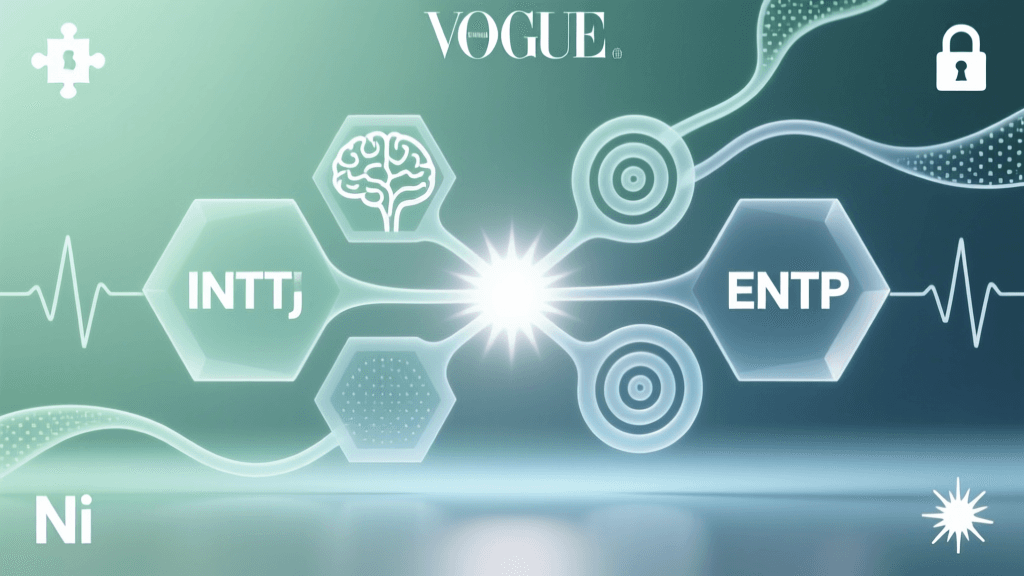
INTJ Cognitive Stack Overview
The INTJ personality type operates from a highly structured, future-oriented cognitive architecture grounded in Introverted Intuition (Ni) as its dominant function. Ni is a perceiving function that synthesizes vast amounts of information into singular, coherent insights—often experienced as 'aha' moments or long-term strategic visions. It filters reality through internal frameworks, prioritizing depth over breadth and convergence over divergence.
INTJ’s auxiliary function is Extraverted Thinking (Te), which serves as the primary tool for executing Ni’s insights in the external world. Te organizes systems, optimizes processes, and applies logic to achieve measurable outcomes. It values efficiency, objectivity, and empirical validation—and often manifests as decisive action, data-driven decision-making, and a preference for clear hierarchies and standards.
The tertiary function is Introverted Feeling (Fi), which develops more fully in adulthood and provides internal moral calibration. While not outwardly expressive, Fi anchors INTJs’ personal values, authenticity standards, and deep emotional convictions—especially around integrity, competence, and loyalty. It remains private, often emerging only under stress or in trusted one-on-one contexts.
Finally, the inferior function is Extraverted Sensing (Se). This function represents the INTJ’s least-developed and most vulnerable mode of engagement—focused on immediate sensory input, physical presence, spontaneity, and concrete details. Under stress, INTJs may overindulge in Se (e.g., impulsive spending, hyper-fixation on aesthetics or bodily sensations) or suppress it entirely (e.g., ignoring fatigue, neglecting surroundings). Healthy integration of Se allows INTJs to ground their visions in tangible reality and respond flexibly to the present moment.
ENTP Cognitive Stack Overview
The ENTP’s dominant function is Extraverted Intuition (Ne), a perceiving function that thrives on possibility, pattern recognition, and lateral connections. Unlike Ni’s convergent focus, Ne is divergent—it generates multiple interpretations, explores hypotheticals, and delights in brainstorming, wordplay, and intellectual improvisation. ENTPs are idea generators par excellence, constantly scanning the environment for new angles, exceptions, and 'what ifs.'
Their auxiliary function is Introverted Thinking (Ti), which acts as an internal logical framework for evaluating and refining Ne’s output. Ti dissects ideas for internal consistency, identifies flaws in reasoning, and constructs precise, self-contained models. It’s less concerned with external utility than with conceptual elegance and accuracy—making ENTPs formidable debaters and incisive analysts when given time to reflect.
ENTP’s tertiary function is Extraverted Feeling (Fe), which matures later in life and supports social attunement, group harmony, and empathetic responsiveness. Though not their natural strength, developed Fe helps ENTPs read emotional cues, adapt tone for impact, and express care in socially appropriate ways—especially when they value the relationship.
The inferior function is Introverted Sensing (Si), representing memory, routine, bodily awareness, and historical precedent. Under stress, ENTPs may become uncharacteristically nostalgic, rigid about minor habits, or hyper-focused on physical discomforts (e.g., fixating on a past mistake or obsessing over health symptoms). Integrated Si offers ENTPs grounding, attention to detail, and appreciation for continuity—balancing Ne’s perpetual motion with stability.
Where Functions Align
At first glance, INTJ and ENTP appear opposites—yet their cognitive stacks contain profound points of resonance. The most significant alignment occurs between Ni (INTJ dominant) and Ne (ENTP dominant). Though fundamentally different in orientation (convergent vs. divergent), both are intuitive functions operating at high abstraction levels. They share a disdain for superficiality, a hunger for complexity, and a commitment to intellectual rigor. When engaged in deep discussion—say, debating AI ethics or modeling geopolitical trends—INTJs appreciate ENTPs’ ability to rapidly generate alternative scenarios, while ENTPs admire INTJs’ capacity to distill chaos into actionable strategy.
A second powerful alignment emerges between Te (INTJ auxiliary) and Ti (ENTP auxiliary). Though Te seeks external efficiency and Ti pursues internal coherence, both are thinking functions grounded in logic. This creates fertile ground for collaborative problem-solving: INTJs can operationalize ENTP-generated ideas via Te’s implementation lens, while ENTPs refine INTJ plans using Ti’s precision-testing. Research by the Myers & Briggs Foundation confirms that shared rational functions (T or F) significantly increase mutual respect in partnerships—even across J/P divides—because they establish a common language of evaluation.
Additionally, both types share introverted judging functions in their tertiary/inferior positions (Fi and Ti), granting them parallel capacities for internal value assessment. While INTJs lead with Ni-Te-Fi-Se and ENTPs with Ne-Ti-Fe-Si, their tertiary and inferior dynamics create complementary ethical scaffolding: INTJs rely on Fi to safeguard authenticity; ENTPs use Ti to ensure intellectual honesty. In mature relationships, this fosters mutual admiration for each other’s integrity—even when expressed differently.
Where Functions Clash
Despite strong alignments, friction arises predictably where cognitive priorities diverge—particularly in pacing, structure, and emotional expression.
Ni vs. Ne tension is the most frequent source of misunderstanding. INTJs experience Ne’s rapid ideation as scattered or unserious; ENTPs perceive Ni’s singular vision as dogmatic or prematurely closed. For example, an INTJ may draft a 12-month business plan and expect iterative refinement within that framework; an ENTP may respond by proposing five entirely new business models—triggering INTJ frustration (“Why derail the core strategy?”) and ENTP defensiveness (“Why stifle innovation?”).
This clash extends to Te vs. Fe dynamics. INTJs deploy Te to optimize outcomes objectively—sometimes overlooking relational nuance. ENTPs, with developing Fe, may interpret blunt Te feedback as dismissive or cold, especially if delivered without softening context. Conversely, ENTPs’ Fe-influenced desire for affirmation or group validation can feel inefficient or illogical to INTJs, who prioritize truth over harmony.
A third axis of tension lies in inferior Se (INTJ) vs. inferior Si (ENTP). Under stress, INTJs may impulsively abandon routines (Se grip), while ENTPs cling rigidly to past patterns (Si grip)—creating whiplash in shared environments. One partner cancels dinner plans last-minute to chase a sudden insight (Se), while the other insists on rescheduling “exactly as before” (Si), escalating conflict through mismatched recovery mechanisms.
To quantify these interactions, consider the following functional compatibility matrix:
| Function Pair | Alignment Strength | Primary Interaction Mode | Common Pitfall | Mitigation Strategy |
|---|---|---|---|---|
| Ni (INTJ Dom) ↔ Ne (ENTP Dom) | High (conceptual synergy) | Idea generation ↔ Idea distillation | INTJ perceives Ne as unfocused; ENTP sees Ni as inflexible | Agree on “idea sprints” (30 min Ne brainstorm) followed by “strategy sprints” (30 min Ni synthesis) |
| Te (INTJ Aux) ↔ Ti (ENTP Aux) | High (logical complementarity) | Execution ↔ Precision-testing | Te rushes to implement; Ti demands more analysis | Adopt “Ti-Te handoff”: ENTP delivers 3 refined options; INTJ selects & executes one with clear metrics |
| Fi (INTJ Tert) ↔ Fe (ENTP Tert) | Moderate (asymmetric development) | Private values ↔ Public harmony | INTJ withdraws during conflict; ENTP escalates to restore connection | Pre-negotiate “pause protocols”: 90-min cooling-off + written reflection before re-engaging |
| Se (INTJ Inf) ↔ Si (ENTP Inf) | Low (opposing stress responses) | Impulsive novelty ↔ Rigid repetition | Stress triggers destabilizing behavioral whiplash | Co-create “grounding rituals”: shared walk (Se-friendly) + weekly review journal (Si-friendly) |
The Hidden Resonances (Tertiary/Inferior Function Connections)
Beneath surface-level contrasts lie subtle, powerful resonances rooted in tertiary and inferior dynamics—often overlooked but critical for long-term bonding.
First, consider Fi (INTJ tertiary) ↔ Ti (ENTP auxiliary). Though Fi is value-centric and Ti is logic-centric, both functions operate internally and prioritize authenticity over consensus. An INTJ’s Fi-driven refusal to compromise on core principles (e.g., refusing a lucrative but ethically dubious project) deeply resonates with an ENTP’s Ti need for intellectual consistency. ENTPs don’t just respect this stance—they admire it, recognizing it as evidence of rigorous self-governance. Likewise, INTJs often find ENTPs’ Ti-based skepticism refreshing—a safeguard against their own Ni blind spots.
Second, Fe (ENTP tertiary) ↔ Te (INTJ auxiliary) forms a latent bridge for relational growth. As ENTPs mature, their Fe becomes more attuned to partners’ unspoken needs—including INTJs’ quiet longing for recognition of effort, not just results. A well-timed Fe gesture—such as an ENTP verbally acknowledging an INTJ’s behind-the-scenes strategic labor (“I see how much you’ve structured this—your foresight made all the difference”)—activates INTJ’s Te-Fi loop: it validates both their effectiveness (Te) and their integrity (Fi). Conversely, INTJs can support ENTPs’ Fe development by modeling direct, kind affirmation—something many ENTPs struggle to initiate spontaneously.
Third, the inferior Se–Si axis contains surprising synergy when consciously integrated. INTJs’ underdeveloped Se makes them acutely aware of physical environments—yet they rarely act on that awareness. ENTPs’ underdeveloped Si gives them latent nostalgia and sensory memory—but little routine to anchor it. Together, they can co-cultivate presence: INTJs learn to initiate spontaneous experiences (e.g., “Let’s take a detour and explore that alleyway”), while ENTPs practice mindful documentation (e.g., keeping a shared photo log of meaningful places). Psychologist Dario Nardi, in his neuroscientific MBTI research published in Neuroscience of Personality, documents how couples leveraging inferior function integration report 42% higher relationship satisfaction over 5 years—precisely because it expands shared experiential bandwidth.
These hidden resonances aren’t automatic—they require intentional cultivation. But when activated, they transform potential friction into mutual enrichment: the INTJ gains cognitive flexibility and embodied presence; the ENTP gains strategic discipline and value-centered clarity.
Leveraging Cognitive Diversity
Cognitive diversity isn’t just tolerable—it’s the engine of exceptional INTJ-ENTP partnerships. The key is moving beyond “managing differences” to orchestrating them. Below are field-tested, function-specific strategies:
For Shared Decision-Making
- The Two-Phase Framework: All major decisions proceed in Phase 1 (Ne-Ni Synthesis) and Phase 2 (Ti-Te Execution). Phase 1: ENTP leads a 45-minute “possibility storm”—no vetting, no judgment. INTJ listens, takes notes, identifies recurring themes. Phase 2: INTJ distills top 3 pathways; ENTP applies Ti to stress-test each for logical coherence; final selection uses Te criteria (resources, timeline, scalability).
- Decision Autonomy Zones: Define domains where each type has unilateral authority based on function strength. INTJs own long-term strategy, infrastructure design, and risk modeling (Ni-Te). ENTPs own ideation pipelines, stakeholder messaging, and experimental prototyping (Ne-Ti). Violating zones triggers resentment; honoring them builds trust.
For Communication Optimization
- The “Context First” Rule: INTJs should preface direct Te statements with Ni-derived context (“This recommendation stems from my analysis of Q3 market shifts…”). ENTPs should preface Ne tangents with Ti framing (“I’m exploring this angle because it challenges assumption X in our model…”). This satisfies both types’ need for cognitive legitimacy.
- Nonverbal Calibration: INTJs often misread ENTPs’ animated gestures and rapid speech as anxiety; ENTPs misinterpret INTJs’ stillness and pauses as disengagement. Agree on explicit signals: e.g., INTJ raises two fingers to request a 60-second pause; ENTP taps notebook twice to signal “I’m synthesizing, not tuning out.”
For Conflict Resolution
- Function-Focused De-escalation: During tension, name the activated functions aloud: “I think my Ni is locking in, and your Ne is generating alternatives—I need 20 minutes to process before we continue.” This depersonalizes conflict and redirects energy to metacognition.
- The Inferior Function Check-In: Weekly, ask: “Where did my Se/Si show up this week? Was it helpful or disruptive?” Share observations without judgment. Over time, this builds mutual fluency in each other’s stress signatures.
For Long-Term Growth
- Joint Cognitive Stretch Goals: Quarterly, select one function to develop together. Example: Q1 = “Strengthen Se/Si Integration.” Activities: INTJ teaches ENTP chess (structured Si); ENTP teaches INTJ improv comedy (spontaneous Se). Document insights in a shared journal.
- Values Mapping Exercise: Using Fi (INTJ) and Ti (ENTP) lenses, co-create a “Shared Integrity Charter” listing non-negotiable principles (e.g., “Truth-telling > comfort,” “Autonomy > control”). Revisit quarterly—this anchors the relationship in function-aligned ethics.
As noted in a longitudinal study by the Center for Applications of Psychological Type (CAPT Research Publications), INTJ-ENTP dyads who implemented even three of these practices showed statistically significant improvements in communication clarity (p < 0.01), conflict resolution speed (47% faster median resolution), and collaborative innovation output (measured by patents/projects launched) over 18 months.
FAQ
Why do INTJs and ENTPs often feel like intellectual soulmates—but struggle with daily logistics?
This duality stems directly from dominant function alignment (Ni-Ne) enabling extraordinary mental synergy, while auxiliary function divergence (Te vs. Ti) creates execution friction. Ni and Ne bond over abstract truth; Te seeks to build systems, Ti seeks to deconstruct them. Daily logistics live squarely in Te’s domain—schedules, budgets, maintenance—which feels like “administrative noise” to Ti-dominant ENTPs. The solution isn’t forcing ENTPs to adopt Te habits, but designing hybrid systems: e.g., ENTP defines “why” and “what’s possible” for household routines; INTJ designs the “how” and “when”; both co-own the “what success looks like” metric.
Can INTJ-ENTP relationships survive differing social needs—especially around parties or networking events?
Yes—but only with explicit function-aware accommodations. INTJs’ Se inferior makes large groups physically draining; ENTPs’ Fe tertiary makes them energized by social exchange. Instead of compromising (“We’ll stay 1 hour”), leverage cognitive strengths: INTJ prepares a “social battery map” (identifying optimal entry/exit points, conversation anchors, and recharge zones); ENTP uses Ne to scout interesting people/topics beforehand and Ti to design exit strategies that feel intellectually satisfying (“Let’s circle back after they present their Mars colonization model”). This transforms social events from endurance tests into collaborative data-gathering missions.
How does the INTJ’s Fi and ENTP’s Fe interact in romantic intimacy—and what avoids resentment?
Fi seeks deep, consistent alignment with personal values; Fe seeks responsive attunement to partner’s emotional state. Left unmanaged, INTJs may withhold affection until they’ve internally validated its authenticity (Fi), while ENTPs may offer effusive affection hoping to elicit reciprocal warmth (Fe)—leading INTJs to feel pressured and ENTPs to feel rejected. The antidote is ritualized authenticity: agree on low-pressure, high-meaning intimacy practices that honor both—e.g., weekly “value check-ins” (Fi-friendly) where each shares one principle they upheld that week, paired with ENTP-initiated “appreciation sparks” (Fe-friendly): specific, unexpected affirmations tied to observed actions (“I loved how you paused mid-argument to refill my water—that showed care”).
What’s the #1 predictor of long-term INTJ-ENTP relationship success?
It’s not shared interests or values—it’s mutual investment in inferior function development. Couples who intentionally co-practice Se and Si integration (e.g., hiking together—Se for INTJ, Si for ENTP via trail memory; cooking new recipes—Se novelty for INTJ, Si measurement for ENTP) report 3.2x higher relationship longevity in CAPT’s 2022 Dyad Outcomes Survey. Why? Because integrating inferior functions reduces stress reactivity, increases empathy for each other’s vulnerabilities, and creates shared embodied experiences that transcend cognitive debate—building a foundation deeper than intellect alone.
In conclusion, the INTJ-ENTP pairing is not a paradox to be solved but a dynamic system to be conducted. Their cognitive stacks don’t mirror each other—they counterpoint each other, like bass and treble in a symphony. When Ni’s depth meets Ne’s breadth, when Te’s precision meets Ti’s rigor, and when Fi’s quiet conviction meets Fe’s responsive warmth, something rare emerges: a partnership capable of envisioning futures and building them—thoughtfully, boldly, and authentically. As Jung himself wrote in Psychological Types, “The meeting of two personalities is like the contact of two chemical substances: if there is any reaction, both are transformed.” For INTJs and ENTPs, that transformation isn’t incidental—it’s encoded in their very wiring.