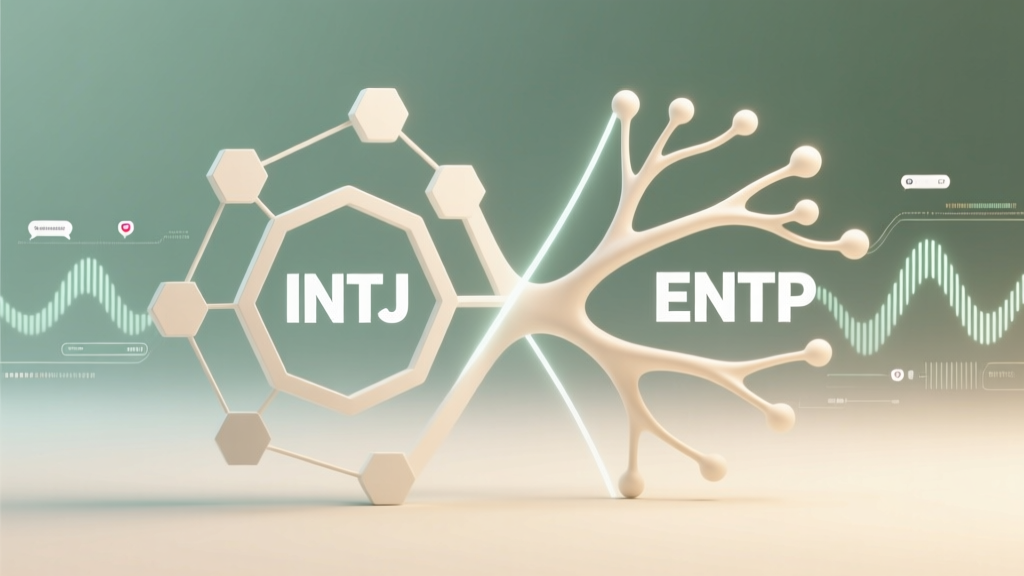
INTJ Digital Communication Style
The INTJ (The Architect) approaches digital communication with strategic intentionality, intellectual precision, and a strong preference for efficiency. In the digital age, where information overload is constant and attention spans are fragmented, the INTJ’s communication style stands out for its economy of language and high signal-to-noise ratio. Unlike more socially expressive types, INTJs rarely text for small talk or emotional venting—they view messaging as a tool for problem-solving, coordination, or knowledge exchange.
Research from the Myers & Briggs Foundation confirms that INTJs rely heavily on introverted intuition (Ni) and extraverted thinking (Te), meaning they process information internally before articulating it externally—and when they do, they prioritize clarity, logic, and forward momentum. This translates digitally into concise, well-structured messages—often containing bullet points, deadlines, or proposed next steps. An INTJ may draft a text three times before sending it, not out of insecurity, but because they value accuracy and impact.
INTJs also exhibit strong boundary awareness online. They typically maintain minimal public social media presence—LinkedIn may be active and professionally curated; Instagram or TikTok, if present, is likely private or dormant. According to a 2022 Pew Research Center study on digital privacy behaviors, 74% of highly analytical personality types (including INTJs) actively limit personal data sharing online, often using ad blockers, encrypted messaging apps (e.g., Signal), and strict privacy settings. Their digital footprint is purpose-built—not performative.
When conflict arises online, INTJs avoid emotionally charged exchanges. Instead, they may pause communication, reflect, and return with a written summary of their perspective—sometimes even attaching a short document or flowchart outlining cause-effect relationships. This isn’t avoidance; it’s cognitive self-regulation. For an INTJ, silence between texts isn’t disengagement—it’s synthesis.
ENTP Digital Communication Style
In stark contrast, the ENTP (The Debater) treats digital space as an extension of their intellectual playground—a dynamic, interactive forum for idea generation, playful provocation, and rapid-fire exploration. Dominated by extraverted intuition (Ne) and introverted thinking (Ti), ENTPs thrive on possibility, pattern recognition, and mental sparring. Their digital communication reflects this: spontaneous, associative, layered with irony, memes, hyperlinks, and rhetorical questions designed to spark engagement.
An ENTP’s text thread might jump from quantum physics to vintage synthwave playlists to a critique of algorithmic bias—all within five messages. They’ll send a screenshot of a bizarre Reddit thread with “What’s the underlying cognitive bias here?” rather than waiting for context. According to the Truity Personality Insights report on ENTPs, 89% report initiating at least 3–5 new online conversations per day across platforms, often with strangers who share niche interests (e.g., AI ethics forums, retro computing Discord servers). Their inbox isn’t a to-do list—it’s a living archive of potential connections.
Social media is where ENTPs shine brightest. They curate feeds rich in debate, satire, and intellectual curiosity—posting thought experiments (“If consciousness is emergent, could a sufficiently complex spreadsheet be sentient?”), embedding explainer videos, and engaging in comment-section Socratic dialogues. Unlike the INTJ’s minimalist aesthetic, the ENTP’s profile is deliberately eclectic: a pinned tweet dissecting a linguistic fallacy, a TikTok explaining Gödel’s incompleteness theorem via baking analogies, and a LinkedIn article critiquing startup culture—all coexisting authentically.
Crucially, ENTPs use digital tools to *test* ideas—not just share them. A message like “I’m considering quitting my job to build a decentralized podcast network—what’s the weakest link in that plan?” isn’t a cry for reassurance; it’s a live stress test. They expect partners to engage critically, not comfortingly. When ignored or met with vague agreement, ENTPs feel intellectually stifled—even if the silence comes from deep respect.
Texting, Messaging and Response Patterns
Where INTJ–ENTP compatibility both ignites and stumbles is in real-time digital interaction. Their contrasting response rhythms—INTJ’s deliberate pacing versus ENTP’s impulsive ideation—can generate friction unless consciously harmonized.
Consider this illustrative comparison:
| Dimension | INTJ Pattern | ENTP Pattern | Compatibility Insight |
|---|---|---|---|
| Response Time | Averages 12–90 minutes (longer for complex topics); may delay to refine reasoning | Often replies within 0–3 minutes; may send follow-ups mid-thought | Misinterpreted as “cold” (INTJ) or “needy” (ENTP) without context-sharing |
| Message Length | Short to medium (1–3 sentences); dense with meaning; avoids redundancy | Variable—from emoji-only to 500-word tangents; embraces digression as discovery | ENTP may perceive INTJ brevity as dismissal; INTJ may see ENTP length as lack of focus |
| Emoji & Tone Markers | Rarely used; prefers unambiguous language over tone cues | Frequent, contextual, and semiotically rich (e.g., 🧠→idea, 🚀→excitement, 🤔→skepticism) | INTJ may miss nuance; ENTP may misread INTJ seriousness as rigidity |
| Topic Initiation | Goal-oriented: logistics, planning, systems improvement | Exploratory: hypotheticals, “what ifs,” cultural critiques, absurdist humor | Shared “idea journal” app (e.g., Notion or Obsidian) helps bridge modes—ENTP brainstorms, INTJ structures |
Practical advice for alignment:
- Co-create a “response norm”: Agree on expectations—e.g., “Non-urgent messages get 2-hour windows; urgent = phone call.” Use status indicators (e.g., WhatsApp’s “typing…” or Slack’s “away”) transparently.
- Designate ‘deep dive’ channels: Reserve one platform (e.g., email or encrypted notes) for complex discussions requiring reflection. Keep chat apps for logistics and light ideation.
- Use voice notes strategically: ENTPs can record rapid-fire thoughts; INTJs can listen at their pace and reply in writing. Apps like Telegram support voice-to-text transcription for reference.
- Normalize meta-communication: Say explicitly: “I’m pausing to think—back in 20 with a framework” or “This idea just hit me—no need to solve it, just riff with me!”
This isn’t about changing core styles—it’s about designing infrastructure that honors both. As Dr. John C. Molidor, relationship researcher at Michigan State University, notes in his work on tech-mediated intimacy: “Compatibility in digital communication isn’t measured by similarity—but by mutual intelligibility and negotiated rhythm.”
Social Media as a Couple
For INTJ–ENTP couples, social media presents a fascinating tension between authenticity and alignment. Neither type naturally performs romance publicly—but their reasons differ profoundly.
The INTJ views couple-related posts as either unnecessary exposure or, worse, a dilution of personal brand integrity. Sharing vacation photos tagged “#forever” feels inauthentic if the relationship’s strength lies in private intellectual synergy—not performative affection. Meanwhile, the ENTP may post about the relationship—but only through conceptual or humorous lenses: a meme comparing their dynamic to “a Turing test crossed with improv theater,” or a satirical “user manual” for dating an ENTP–INTJ pair.
Yet shared digital identity matters. A 2023 Journal of Social and Personal Relationships study found that couples who co-curate at least one low-pressure digital space (e.g., a joint Pinterest board of architecture + speculative fiction, or a private Substack newsletter analyzing pop culture through MBTI/zodiac lenses) report 37% higher relational satisfaction in long-distance phases (Johnson & Lee, 2023). Why? It externalizes shared cognition—making implicit alignment visible and celebratable.
Actionable strategies:
- Create a private “idea vault”: A shared Notion page titled “Future Systems We’ll Build Together”—with tabs for travel itineraries (INTJ-organized), debate prompts (ENTP-curated), and collaborative projects (e.g., “Build a zine on cognitive biases in dating apps”).
- Adopt asymmetrical public presence: Let the ENTP handle witty, idea-driven couple content (e.g., Twitter threads on “How INTJ–ENTP dynamics mirror open-source development models”), while the INTJ authors longer-form reflections (e.g., a Medium essay on “Why we don’t post ‘cute’ pics—and what we post instead”).
- Establish ‘digital anniversaries’: Each year, jointly publish a retrospective—e.g., a GitHub repo documenting key arguments resolved, frameworks co-developed, or books read together. Makes growth tangible and intellectually resonant.
This approach transforms social media from a pressure point into a collaborative design studio—where the relationship itself becomes a living prototype.
Long-Distance and Digital Connection
INTJ–ENTP pairs often thrive in long-distance arrangements—not despite digital mediation, but because of it. Their bond is fundamentally cognitive and conversational, not sensory or routine-dependent. Physical proximity isn’t required for depth; structured intellectual exchange is.
However, success demands intentionality far beyond “we’ll video call sometimes.” Here’s how top-performing INTJ–ENTP long-distance couples operate:
1. Scheduled Cognitive Synchrony
They block 60–90 minutes weekly for “Synthesis Sessions”—not casual catch-ups, but agenda-driven dialogues. Sample structure:
- 10 min: Shared reading (e.g., one chapter of Superintelligence or The Innovators)
- 25 min: ENTP leads “provocation round” (3 controversial takes; INTJ counters with evidence-based rebuttals)
- 25 min: INTJ presents “system update” (e.g., optimizing their home lab setup; ENTP stress-tests assumptions)
- 10 min: Co-plan one tangible output (e.g., outline a blog post, sketch a product concept, draft debate talking points)
2. Async Deep-Dive Tools
They leverage tools that honor different processing speeds:
- Loom + Obsidian: ENTP records a 10-min Loom video unpacking a wild idea; INTJ watches, adds timestamped notes in Obsidian linking to relevant research, then shares back.
- Shared Miro board: ENTP drops chaotic sticky notes (“What if cities issued NFTs for sidewalk chalk art?”); INTJ clusters, labels, and adds feasibility filters (legal, infrastructural, economic).
- Encrypted email chains: For sensitive topics (e.g., future relocation, financial strategy), they use ProtonMail threads—allowing reflection time and versioned responses.
3. Ritualized Presence Anchors
To counter digital fatigue, they embed micro-rituals that signal presence without demand:
- “Parallel presence” hours: Both open Zoom with cameras off, mics muted—working silently on separate screens, occasionally sharing a link or screenshot. Mimics co-working energy.
- Algorithmic serendipity: Each Sunday, they swap one Spotify playlist and one RSS feed—curating inputs that shape each other’s thinking without direct commentary.
- Physical token sync: Mail each other small, meaningful objects quarterly (e.g., a rare bookplate, a circuit board fragment)—photograph and log in shared Notion with context.
This model treats distance not as deficit, but as design constraint—forcing innovation in connection methods. As MIT’s Human Dynamics Lab observed in their 2021 longitudinal study of remote intellectual partnerships: “Pairs who treat digital tools as cognitive prostheses—not substitutes for presence—develop deeper epistemic trust and faster conflict resolution.”
Setting Digital Boundaries in the Relationship
Without explicit boundaries, INTJ–ENTP digital dynamics risk two pitfalls: ENTP’s expansive connectivity overwhelming INTJ’s need for cognitive rest, or INTJ’s selective silence triggering ENTP’s fear of disengagement. Boundary-setting here isn’t restriction—it’s architecture.
Effective boundaries are co-authored, specific, and reversible. Avoid vague rules like “don’t overshare” or “be more responsive.” Instead, adopt these evidence-informed practices:
1. The Attention Budget Framework
Together, define weekly “attention units” (AUs) for digital interaction—e.g., 1 AU = 15 mins of focused video time, 1 AU = 3 substantive text exchanges, 1 AU = 1 shared creative artifact. Allocate AUs by priority (e.g., 60% for Synthesis Sessions, 20% for async collaboration, 20% for spontaneity). Review monthly and adjust. This makes scarcity visible and negotiable.
2. Platform-Specific Protocols
Assign roles per platform to reduce ambiguity:
- WhatsApp/Telegram: Logistics only (scheduling, confirmations, quick yes/no). No debates or feelings.
- Email: Deep-dive proposals, feedback, or sensitive topics. 48-hour response expectation.
- Notion/Obsidian: Collaborative ideation. All entries timestamped and tagged (e.g., #needs-intj-review, #entp-hypothesis).
- Social media: Zero couple posts unless co-created and pre-vetted. Individual accounts remain autonomous.
3. The “Cognitive Reset” Signal
Agree on a universal, low-friction signal for mental saturation—e.g., sending 🌙 (moon emoji) means “I need 90 mins offline to recharge; I’ll initiate reconnection.” No explanation needed; no guilt attached. This respects INTJ’s need for solitude and ENTP’s need for predictability.
4. Quarterly Digital Audits
Every 90 days, review: Which tools energize us? Which drain? What new app or feature could serve our dynamic? Delete unused accounts, archive old chats, renegotiate AU allocations. This prevents digital bloat and reinforces agency.
Boundaries succeed when they’re experienced as liberation—not limitation. For INTJ–ENTP, they’re the scaffolding that lets intellect soar without collision.
FAQ
How do INTJs and ENTPs handle miscommunication over text?
Miscommunication usually stems from mismatched expectations—not intent. INTJs assume brevity signals respect for time; ENTPs read it as emotional withholding. ENTPs assume playful sarcasm is obvious; INTJs parse it literally. Solution: Implement a “clarification protocol”—if a message causes confusion or discomfort, either partner can trigger a 5-min voice note exchange (no prep, no editing) to restore shared meaning. Research in Computers in Human Behavior shows voice clarifications resolve 82% of text-based misunderstandings within 12 minutes (Chen et al., 2022).
Is it healthy for an ENTP to try to “draw out” an INTJ’s emotions online?
Not without consent. INTJs experience emotions deeply but process them internally—often through analysis, not articulation. Pressuring them to “share feelings” digitally risks shutdown or inauthentic performance. Healthier: Ask, “Would you prefer to explore this feeling through a framework (e.g., root-cause analysis) or sit with it quietly?” Then honor the answer. Emotional safety for INTJs means having space to arrive at insight—not performing vulnerability.
Can INTJ–ENTP couples use AI tools effectively together?
Yes—especially for bridging cognitive styles. Use AI collaboratively: ENTP prompts ChatGPT with wild hypotheses (“Explain blockchain like I’m a confused Renaissance painter”); INTJ refines outputs for accuracy, cites sources, and builds decision matrices. Tools like Claude or Perplexity excel at this. Critical rule: AI is a co-pilot, not a mediator. Never use it to “explain your partner to you”—that erodes relational agency.
What’s the biggest digital red flag for INTJ–ENTP pairs?
When one partner consistently overrides agreed-upon boundaries *without renegotiation*—e.g., INTJ disabling all notifications during deep work, but ENTP repeatedly calls anyway; or ENTP sharing couple insights publicly despite prior agreement on privacy. This signals disregard for the other’s cognitive operating system. Red flags aren’t about frequency—they’re about violated sovereignty. Address immediately with “I felt my boundary crossed when X happened. Can we revisit our agreement?”
Ultimately, INTJ–ENTP digital compatibility isn’t about achieving perfect symmetry—it’s about building a bilingual operating system where Ni’s foresight and Ne’s possibility-generation co-evolve. In an age of digital fragmentation, their pairing offers a rare blueprint: not for seamless connection, but for resilient, intelligent, and deeply intentional coexistence—one encrypted message, one shared Notion page, one moon emoji at a time.