What INTJ Teaches ENTP
The INTJ—strategic, disciplined, and future-oriented—offers ENTPs a masterclass in executive function cultivation. While ENTPs excel at ideation, pattern recognition, and conceptual agility, they often struggle with follow-through, structural consistency, and long-term implementation. The INTJ doesn’t merely model these skills—they actively scaffold them through structured feedback, systems-oriented dialogue, and quiet insistence on accountability.
Research from the Myers-Briggs Company confirms that ENTPs score lowest among all 16 types on the Judging (J) scale—particularly in organization, deadline adherence, and closure orientation. In contrast, INTJs rank highest in planned decision-making and strategic execution (Myers et al., MBTI Manual: A Guide to the Development and Use of the Myers-Briggs Type Indicator, 3rd ed., 1998). This polarity isn’t a flaw—it’s a developmental invitation.
What the INTJ concretely teaches the ENTP includes:
- Strategic Prioritization: INTJs instinctively triage ideas using a cost-benefit lens rooted in long-term viability. They help ENTPs distinguish between ‘brilliant but unscalable’ and ‘innovative and implementable’. For example, when an ENTP proposes five simultaneous side projects, an INTJ might co-create a simple Impact-Effort Matrix (see Table 1) to visually assess feasibility and alignment with core values or life goals.
- Systems Thinking in Practice: INTJs don’t just build frameworks—they maintain them. An ENTP learning to use a GTD (Getting Things Done) system alongside an INTJ partner gains firsthand exposure to weekly reviews, context-based task tagging, and quarterly goal recalibration—not as rigid dogma, but as living infrastructure that expands creative bandwidth.
- Emotional Containment as Discipline: ENTPs often externalize frustration or boredom through rapid debate or idea-switching. INTJs, while not naturally expressive emotionally, demonstrate how to pause, reflect, and respond rather than react—especially under stress. This isn’t emotional suppression; it’s regulatory calibration. As psychologist Daniel Goleman notes in Emotional Intelligence: Why It Can Matter More Than IQ, self-regulation is a learnable skill strengthened through consistent modeling and gentle accountability.
- Intellectual Rigor Over Intellectual Velocity: ENTPs thrive on mental speed—generating counterarguments, spotting contradictions, and reframing premises in real time. The INTJ invites them to slow down and ask: What evidence would falsify this hypothesis? What assumptions are baked into this model? How would this hold up under 10-year scrutiny? This cultivates epistemic humility—the understanding that intellectual agility must be paired with methodological discipline to produce durable insight.
Table 1: Impact-Effort Matrix for ENTP Idea Triage (Co-Developed with INTJ)
| Idea | Estimated Effort (1–5) | Long-Term Impact (1–5) | Alignment with Core Values | Recommended Action |
|---|---|---|---|---|
| Launch AI ethics podcast | 4 | 5 | High (justice, innovation, education) | Commit to 3-month pilot; define metrics pre-launch |
| Write speculative fiction novel | 5 | 3 | Moderate (creativity, expression) | Batch-write 500 words/week; defer until podcast stabilizes |
| Build open-source tool for debate logic | 3 | 4 | High (reason, clarity, accessibility) | Prototype in 2 weeks; seek beta testers by Week 4 |
This kind of collaborative filtering transforms ideation from a solitary sprint into a co-regulated developmental practice. The INTJ doesn’t shut down ENTP enthusiasm—they channel it.
What ENTP Teaches INTJ
If the INTJ offers architecture, the ENTP brings adaptive plasticity. INTJs—dominant Introverted Intuition (Ni) with auxiliary Extraverted Thinking (Te)—are unparalleled at constructing internal models of reality. But those models can calcify. Under stress, Ni-Te loops may manifest as premature convergence, confirmation bias, or dismissal of anomalous data that doesn’t fit the prevailing framework. Enter the ENTP: dominant Extraverted Intuition (Ne), auxiliary Introverted Thinking (Ti).
The ENTP’s cognitive superpower is possibility generation—not random brainstorming, but systematic divergence: “What if we reversed this assumption? What if this constraint were optional? What parallel domain uses a similar principle?” This isn’t chaos—it’s controlled exploration, and it serves as cognitive immunotherapy for INTJ rigidity.
Specifically, ENTPs teach INTJs:
- Intellectual Play as Precision Tool: INTJs often associate playfulness with inefficiency. ENTPs demonstrate how humor, absurd hypotheticals (“What if gravity were negotiable?”), and lateral analogies (“This policy is like trying to fix a leaky faucet by redesigning the entire water cycle”) can expose blind spots in reasoning faster than formal critique. As neuroscientist Dr. Scott Barry Kaufman explains in Transcend: The New Science of Self-Actualization, imaginative play activates default mode network connectivity essential for insight emergence—even in highly analytical minds.
- Feedback as Co-Creation, Not Evaluation: INTJs tend to receive feedback as either validation or threat. ENTPs reframe it as iterative prototyping: “Your model works brilliantly at Level 3—but what if we stress-test it at Level 7? Here’s a weird edge case…” This depersonalizes critique and makes it generative. A 2022 study published in the Journal of Applied Psychology found teams where feedback was framed as joint problem-solving (vs. performance assessment) showed 41% higher innovation output over 6 months (Grant & Ashford, 2022).
- Relational Agility Over Relational Efficiency: INTJs optimize relationships for low friction and high signal-to-noise ratio—often at the expense of spontaneity or emotional texture. ENTPs model how to pivot mid-conversation, read micro-shifts in tone or energy, and introduce levity without sacrificing depth. They teach INTJs that warmth isn’t dilution—it’s resonance tuning.
- Letting Go of the ‘Final Answer’: Ni-dominant types seek resolution—a unified theory, a definitive strategy, an endpoint. ENTPs embody comfortable uncertainty. Their comfort with “We’ll know more after the next experiment” or “This answer holds for now, pending new data” loosens the INTJ’s grip on closure. This isn’t relativism—it’s epistemic flexibility, a trait linked to leadership resilience in volatile environments (Harvard Business Review, “Why Flexibility Is the Key to Leadership in a VUCA World,” 2021).
Shared Growth Areas
INTJ-ENTP dynamics shine brightest not in their differences alone, but in the shared developmental terrain they co-inhabit—areas where both types face parallel challenges requiring mutual reinforcement.
1. Integrating Feeling (F) Functions Without Compromise
Neither type has Feeling (F) in their top two functions—INTJs lead with Ni-Te (F is inferior), ENTPs with Ne-Ti (F is tertiary). This means both may intellectually understand empathy but struggle with embodied attunement: reading nonverbal cues, tolerating emotional ambiguity, or expressing vulnerability without self-editing. Growth here isn’t about becoming “more feeling”—it’s about functional integration.
Practical path forward:
- Structured Empathy Drills: Weekly 15-minute exchanges where each person shares one emotion-laden experience (e.g., “I felt unseen during yesterday’s meeting”)—and the listener responds only with reflection (“So you needed acknowledgment of your contribution?”) and curiosity (“What would have made that moment land differently?”), no solutions or analysis.
- Values Mapping Exercise: Jointly list top 5 personal values (e.g., autonomy, integrity, growth, connection, excellence). Then identify which values live in the Feeling domain (e.g., connection, compassion) and design tiny rituals that honor them—e.g., sending one unsolicited appreciation text/week, or pausing before decisions to ask: “Does this align with my value of compassion—for myself or others?”
2. Sustainable Energy Management
Both types are high-cognition, low-rest-priority. INTJs push through fatigue to finish systems; ENTPs chase novelty until mental exhaustion sets in. Chronic depletion erodes their greatest assets: INTJ’s strategic foresight and ENTP’s associative brilliance.
Growth strategy:
- Energy Budgeting: Track energy (not time) for one week: rate focus, mental clarity, and patience hourly on 1–5 scale. Identify non-negotiable restoration windows (e.g., INTJ needs 90 min of silent nature post-6pm; ENTP needs 20 min of unstructured music + movement pre-noon). Protect these like critical infrastructure.
- Collaborative Recharge Design: Co-create one weekly “low-bandwidth ritual”—no problem-solving, no agenda. Examples: stargazing while naming constellations (engaging Ne + Ni), cooking a new recipe using only tactile cues (bypassing Te/Ti), or building a LEGO set in silence (activating Se, the shared inferior function).
3. Conflict as Co-Discovery, Not Zero-Sum
INTJ-ENTP conflicts often escalate because both rely on Ti/Te logic—but interpret “logic” differently. INTJs prioritize internal consistency; ENTPs prioritize conceptual coherence across domains. A disagreement about career direction may trigger INTJ’s Ni loop (“This path contradicts my 10-year vision”) and ENTP’s Ne loop (“But what if industry X collapses and Y emerges?”).
Growth requires rewiring conflict reflexes:
- The ‘Third Perspective’ Pause: When tension rises, agree to step away for 20 minutes. Each writes: “What is the largest system this issue belongs to?” (e.g., “my identity as a creator,” “our shared definition of success,” “the future of ethical AI”). Reconnect to discuss systems—not positions.
- Debate-to-Design Protocol: Convert arguments into joint design challenges: “Given our differing concerns, how might we prototype a solution that honors both your need for stability and my need for optionality?” This activates shared Ti-Te strengths toward creation—not opposition.
Cognitive Function Development Through the Relationship
MBTI compatibility isn’t about matching functions—it’s about function complementarity and mutual stretching. Let’s map how INTJ (Ni-Te-Si-Fe) and ENTP (Ne-Ti-Se-Fe) catalyze each other’s cognitive growth:
Ni (INTJ) ↔ Ne (ENTP): The Divergence-Convergence Engine
Ni synthesizes disparate data into singular visions; Ne generates endless connections across domains. Alone, Ni risks tunnel vision; Ne risks fragmentation. Together, they form a reality-testing loop: ENTP’s Ne proposes 12 possibilities → INTJ’s Ni selects 2 high-potential pathways → ENTP stress-tests them with “What if X fails?” → INTJ refines based on systemic constraints → cycle repeats. This trains Ni to stay open to revision and Ne to ground speculation in viability.
Te (INTJ) ↔ Ti (ENTP): Precision Meets Calibration
Te organizes the external world efficiently; Ti constructs internally consistent logical models. Te asks, “What works?” Ti asks, “What’s true?” In synergy, Te provides real-world data to test Ti’s axioms; Ti challenges Te’s assumptions (“Is this metric actually measuring what we think it measures?”). This prevents Te from becoming bureaucratic and Ti from becoming solipsistic.
Si (INTJ) ↔ Se (ENTP): Anchoring and Awakening
INTJ’s Si recalls past patterns to inform predictions; ENTP’s Se grasps immediate sensory data. Si helps ENTP notice physical warning signs of burnout (e.g., jaw clenching, screen fatigue); Se helps INTJ detect real-time shifts in environment or mood that contradict Ni projections (e.g., “Your forecast said Q3 would be stable—but team energy is already fraying”). Together, they build embodied foresight.
Fe (Shared Inferior): The Shared Shadow Arena
Both repress Fe—the function governing group harmony, empathic attunement, and relational values. Under stress, INTJs may withdraw coldly; ENTPs may deploy sarcasm or debate as armor. But because Fe is inferior for both, its emergence isn’t competitive—it’s co-liberation. When one names a feeling (“I’m feeling disconnected”), the other is invited—not obligated—to meet it. This shared vulnerability becomes the most fertile ground for growth.
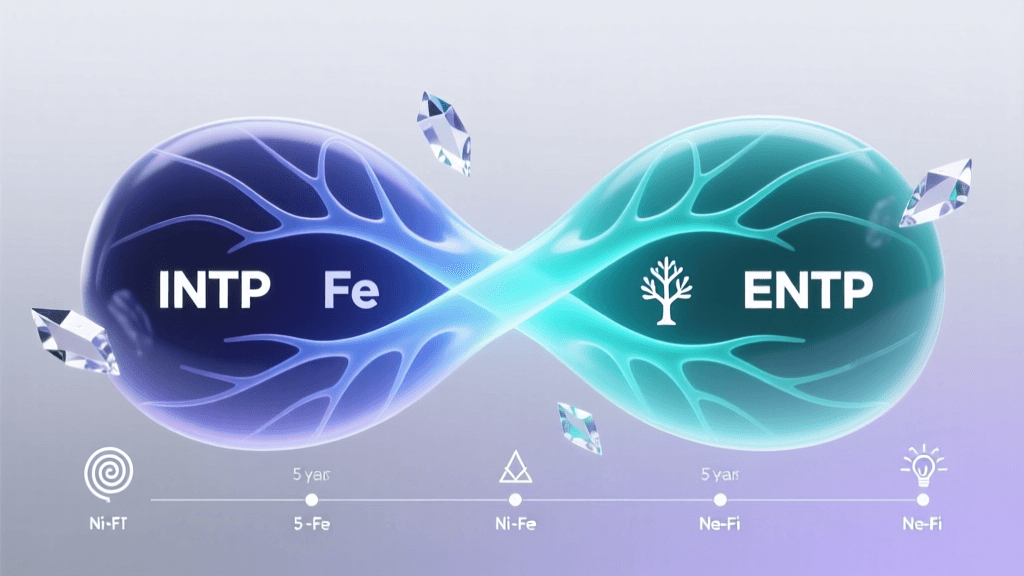
The INTJ and ENTP Growth Timeline
Development isn’t linear—but research on adult personality change (Roberts et al., Annual Review of Psychology, 2017) shows meaningful shifts occur in identifiable phases when supported by intentional practice and relational safety. Here’s a realistic, research-grounded 5-year growth arc:
Year 1: Awareness & Pattern Recognition
Focus: Naming automatic reactions. INTJ notices when Ni-Te loop triggers dismissal of ENTP’s “what ifs”; ENTP observes when Ne-Ti loop leads to debate instead of listening. Tools: Shared journal prompts (“When did I feel most energized vs. drained this week—and what function was leading?”), basic function mapping.
Year 2: Skill Scaffolding
Focus: Borrowing each other’s strengths. INTJ practices Ne via “3 Alternative Explanations” exercise for any problem; ENTP practices Ni via “5-Year Ripple Map” for decisions. Both commit to one Fe micro-practice weekly (e.g., initiating a check-in, naming one emotion aloud).
Year 3: Integration & Synthesis
Focus: Blending functions. INTJ designs a project using Ne-inspired experimentation within Ni-defined boundaries; ENTP builds a long-term system (Te) that accommodates Ne-driven pivots. Shared milestone: Co-authoring a public-facing piece (article, talk, workshop) that merges their perspectives.
Year 4: Embodiment & Teaching
Focus: Making growth second nature. INTJ mentors someone using Fe-informed coaching; ENTP facilitates a design-thinking session grounded in Ti rigor. They begin teaching their integrated framework to others—solidifying neural pathways through instruction.
Year 5: Generative Autonomy
Focus: Sustainable interdependence. They operate as a “growth node”—individually resilient, collectively innovative. Disagreements resolve faster; rest is non-negotiable; Fe expressions flow without self-consciousness. Their relationship becomes a living lab for others’ development.
How to Maximize the Development Potential
Growth isn’t guaranteed—it’s cultivated. Here’s how INTJ-ENTP pairs move beyond potential into tangible transformation:
1. Institute Quarterly “Function Audits”
Every 3 months, review: Which function felt overused? Underused? Stressed? Blocked? Use a simple grid:
| Function | INTJ Experience | ENTP Experience | Joint Insight | Action for Next Quarter |
|---|---|---|---|---|
| Ni | Felt rigid during market shift | Felt unheard when proposing pivots | Ni needs Ne “pressure testing” built-in | Add bi-weekly “Wildcard Session”: ENTP proposes 1 wild card; INTJ designs 1 viable path |
| Fe | Withdrew after conflict | Used humor to deflect hurt | Fe emerges as avoidance unless named | Agree on Fe “anchor phrase”: “I need connection right now” → triggers 5-min uninterrupted listening |
2. Co-Design a “Growth Contract”
A living document (reviewed quarterly) with three sections:
- Non-Negotiables: e.g., “No problem-solving during Fe-expression windows,” “One unscheduled Ne day/month for pure exploration.”
- Growth Experiments: e.g., “INTJ will initiate one Fe-based request/week (e.g., ‘Can we walk and talk?’); ENTP will complete one Te-planned task start-to-finish without pivoting.”
- Exit Clauses: Clear, compassionate conditions for pausing work (e.g., “If either feels chronically unseen for >2 weeks, we take 72-hour reflection break”).
3. Leverage External Structures
Pair internal work with external scaffolds:
- Accountability Partners Outside the Dyad: Each has a trusted friend who understands their type and checks in monthly on growth goals—preventing mutual reinforcement of blind spots.
- Type-Informed Coaching: Work with an MBTI-certified coach (via The Myers & Briggs Foundation) focused on function development—not type “fixing.”
- Shared Learning Rituals: Read one cognitive science or systems thinking book quarterly (e.g., Thinking in Systems by Donella Meadows), then discuss: “Which function was most activated? Where did we default?”
FAQ
Can INTJ and ENTP have a healthy long-term romantic relationship?
Absolutely—if both prioritize growth over comfort. Research from the Gottman Institute shows lasting relationships aren’t defined by similarity, but by shared commitment to mutual development. INTJ-ENTP pairs who treat friction as data (not failure) report higher relationship satisfaction over time than more “compatible” but static pairings (Gottman Institute, 2020). Key: Build rituals that honor both the INTJ’s need for predictability and the ENTP’s need for novelty—e.g., “Same coffee shop every Tuesday, new topic every time.”
Why do INTJ and ENTP clash so intensely during stress?
Under pressure, INTJs descend into the Ni-Fe loop (obsessive future scenarios + emotional withdrawal), while ENTPs activate the Ne-Fe loop (catastrophic possibility generation + reactive emotional outbursts). This creates a feedback loop of escalating anxiety. The antidote isn’t suppressing stress—but installing pre-agreed circuit-breakers: a shared phrase (“Time for a Ne/Ni reset”), a physical object (a stone passed back and forth to signify “I’m looping”), or a 5-minute breathwork app used simultaneously.
How can ENTP help INTJ develop Fe without overwhelming them?
Start microscopically and sensorially. Instead of asking “How are you feeling?”, try: “What’s one thing you noticed about the light/sound/texture in this room right now?” This grounds Fe in Se—INTJ’s inferior function—making it safer. Progress to “What’s one small way I could support you today?” (inviting Te action, not emotional labor). The goal isn’t emotional exposition—it’s relational attunement practiced in low-stakes increments.
Is it possible for INTJ and ENTP to become too similar over time?
No—healthy development deepens differentiation. As they grow, INTJs don’t become “more ENTP-like” (chaotic, scattered); they become more flexible Ni—able to hold multiple futures without paralysis. ENTPs don’t become “more INTJ-like” (rigid, controlling); they become more grounded Ne—able to explore possibilities with intention, not compulsion. True growth expands capacity—it doesn’t erase identity. As Jung wrote, individuation is “becoming who you are, not who you’re not.”