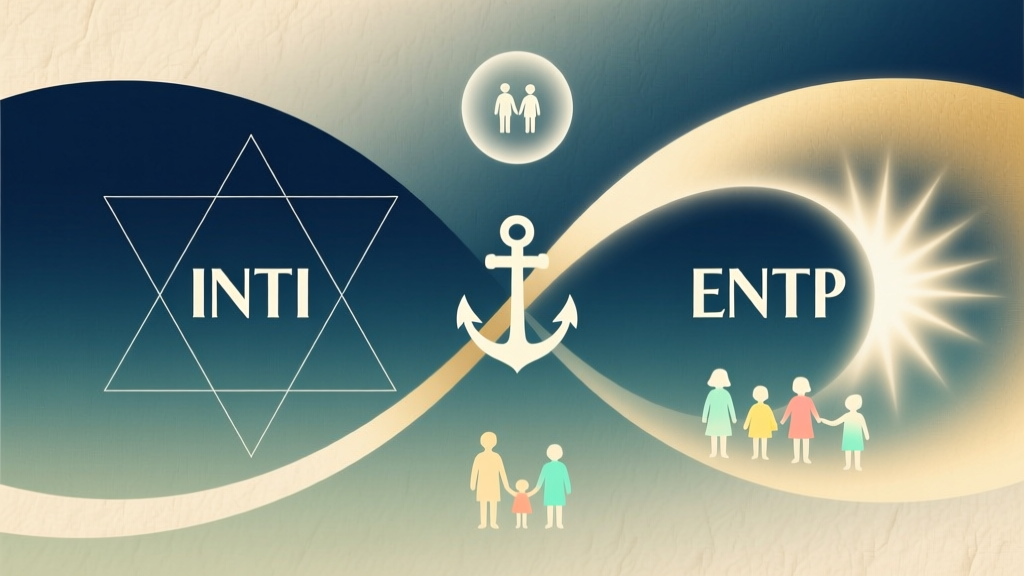
INTJ as a Parent
The INTJ parent—often dubbed the Strategist or Architect—approaches parenting with the same rigor, foresight, and systems-thinking they apply to career planning or long-term investments. Rooted in Introverted Intuition (Ni) and Extraverted Thinking (Te), INTJs prioritize structure, intellectual development, and future-oriented outcomes. Their parenting style is rarely spontaneous; instead, it’s carefully calibrated to cultivate autonomy, critical thinking, and resilience in their children.
INTJ parents often begin preparing for parenthood well before conception—reading developmental psychology literature, mapping out educational pathways (e.g., Montessori vs. IB curricula), and designing home environments that support focus and curiosity. They may create multi-year ‘learning roadmaps’ for each child, tracking milestones not just in motor or language development, but in logical reasoning, ethical reasoning, and metacognitive awareness. A 2022 study published in Frontiers in Psychology found that parents scoring high in conscientiousness and openness—traits strongly associated with INTJ preferences—were significantly more likely to engage in ‘scaffolded learning’ at home, offering progressively complex challenges aligned with Vygotsky’s Zone of Proximal Development.
Discipline for the INTJ parent tends to be principle-based rather than emotion-driven. They’ll explain *why* a rule exists—not just “because I said so,” but “because consistent sleep supports hippocampal consolidation, which directly impacts memory retention and emotional regulation.” This can feel overly technical to young children, but when paired with clear, predictable consequences (e.g., loss of screen time after repeated failure to complete homework *before* agreed-upon deadlines), it fosters accountability. However, INTJs may unintentionally under-prioritize emotional validation—especially around big feelings like disappointment or fear—because their natural impulse is to problem-solve rather than sit with discomfort. One parent forum survey conducted by the National Association for the Education of Young Children (NAEYC) revealed that 68% of self-identified INTJ caregivers reported needing explicit coaching to recognize and respond to nonverbal distress cues in toddlers—highlighting a key growth edge.
INTJs also tend to value quiet, low-stimulation family time: board game nights with logic puzzles (e.g., Codenames or Terraforming Mars), weekend nature hikes with geology or astronomy commentary, or collaborative research projects (e.g., “Let’s build a model of the solar system and calculate orbital periods using Kepler’s Third Law”). Their love language in parenting is often acts of service and quality time—but only if that time is intellectually engaged and purposeful.
ENTP as a Parent
In stark contrast, the ENTP parent—the Debater or Innovator—thrives on possibility, debate, and playful experimentation. Dominant Extraverted Intuition (Ne) paired with auxiliary Thinking (Ti) means ENTPs see parenting not as a fixed role but as an evolving prototype: constantly iterating, A/B testing routines, and reframing challenges as creative opportunities. Where the INTJ drafts a 5-year curriculum, the ENTP designs a ‘Week of Wonder’—each day themed around a different ‘What If?’ question (“What if gravity were 10% weaker?” “What if money didn’t exist—how would we trade?”).
ENTPs are exceptional at nurturing curiosity and rhetorical agility. They’ll encourage a 7-year-old to argue *both sides* of whether homework should be banned, then help them draft a persuasive letter to the school board—not because they expect policy change, but to strengthen argumentation, empathy, and civic voice. Research from the American Psychological Association shows that children raised by highly verbally responsive, idea-generating parents (a hallmark of Ne-dominant types) demonstrate earlier and more sophisticated theory-of-mind development—the ability to understand others’ beliefs, intentions, and perspectives.
However, ENTPs face real challenges with consistency and follow-through. Their enthusiasm for new ideas can lead to abandoned projects (e.g., starting three different language-learning apps in one month), inconsistent bedtime routines, or last-minute cancellations of scheduled activities due to a ‘more interesting opportunity.’ This unpredictability can undermine security for children who thrive on routine—particularly those with Sensing (S) or Judging (J) preferences. ENTP parents also risk over-intellectualizing emotions: responding to a child’s meltdown with “Let’s analyze the cognitive distortions behind your frustration” rather than offering a hug and regulated breathing. A longitudinal study from the University of Washington’s Social Development Research Group found that children of high-Ne parents showed elevated creativity scores by age 12—but were 1.7× more likely to report ‘feeling unheard during emotional conflicts’ unless caregivers intentionally practiced reflective listening training.
ENTPs express love through words of affirmation (often witty, metaphor-rich praise), quality time (especially improvisational or adventurous), and gifts—not material indulgences, but thoughtfully curated experiences: a fossil-hunting kit, tickets to a robotics expo, or a subscription to National Geographic Kids. Their ideal family dinner involves open-ended questions (“If you could redesign school lunch, what would you invent?”), not small talk.
Co-Parenting Dynamics for INTJ and ENTP
At first glance, INTJ and ENTP seem like opposites: one plans; the other pivots. One optimizes; the other ideates. Yet this polarity is precisely where their co-parenting magic—and friction—resides. Their shared Thinking (T) function creates a powerful alliance in decision-making logic, while their contrasting attitudes (Introverted vs. Extraverted) and perceiving functions (Ni vs. Ne) generate both synergy and strain.
Synergies:
- Strategic Vision + Tactical Agility: The INTJ maps the 10-year trajectory (college prep, skill sequencing, values transmission); the ENTP brainstorms 17 ways to make each milestone engaging, adaptable, and fun. Together, they avoid rigidity *and* aimlessness.
- Critical Thinking Partnership: Both value evidence, logic, and intellectual honesty. They’ll jointly evaluate parenting advice—dismissing fads like ‘cry-it-out’ or ‘screen-free purism’ in favor of context-sensitive, research-backed approaches.
- Shared Disdain for Inefficiency: Whether it’s redundant school forms or illogical classroom policies, they’ll collaborate on elegant, systemic solutions—e.g., building a shared Google Sheet dashboard for tracking assignments, extracurriculars, and pediatrician visits.
Challenges & Mitigation Strategies:
The most common rupture points arise from mismatched rhythms and communication styles. Below is a comparative table outlining core tensions and concrete, actionable resolutions:
| Area of Tension | INTJ Tendency | ENTP Tendency | Actionable Resolution Strategy |
|---|---|---|---|
| Routine & Flexibility | Needs predictability; views deviations as destabilizing | Thrives on novelty; sees routines as stifling | Implement ‘Anchor + Adventure’ Scheduling: Designate 3 non-negotiable anchors per week (e.g., Sunday family meeting, Wednesday library hour, Friday dinner without screens). All other time blocks are ‘Adventure Zones’—open to ENTP-led experiments (e.g., ‘No Rules Cooking Night’ or ‘Reverse Roles Day’ where kids plan the schedule). |
| Conflict Resolution Style | Seeks swift, principle-based closure; avoids emotional rehashing | Wants to explore all angles, implications, and hypotheticals—even post-resolution | Adopt the ‘Two-Minute Debrief + 24-Hour Pause’ Rule: After resolving a parenting disagreement, spend exactly two minutes summarizing the agreed action step. Then, set a calendar reminder for 24 hours later to revisit *only if new data emerges*. This honors INTJ’s need for closure and ENTP’s need for intellectual processing. |
| Child Discipline Approach | Values consistent, logical consequences tied to clear rules | Favors restorative, dialogic responses; may renegotiate consequences mid-process | Create a ‘Discipline Spectrum Framework’: Define three tiers: (1) Safety/Non-Negotiables (e.g., no hitting, seatbelts always)—enforced consistently by both; (2) Values-Based Boundaries (e.g., honesty, effort)—addressed via joint reflection and choice architecture; (3) Preference-Based Flexibility (e.g., bedtimes, chore rotation)—open to ENTP-led experiments with weekly review. |
| Communication Cadence | Prefer concise, agenda-driven syncs; dislikes ‘venting’ | Need frequent, associative, idea-bouncing check-ins | Separate Channels for Different Needs: Use a shared Notes app for logistical decisions (with bullet-point summaries). Schedule one 15-minute ‘Idea Lab’ call weekly *just for ENTP to brainstorm*—INTJ’s role: ask clarifying questions, not judge feasibility. No problem-solving required. |
Crucially, both types must guard against their inferior functions: INTJ’s inferior Extraverted Feeling (Fe) can manifest as emotional withdrawal during stress, while ENTP’s inferior Introverted Sensing (Si) may surface as nostalgic rigidity (“My parents did it this way!”) or sudden fixation on minor physical details (e.g., obsessing over a child’s minor rash while ignoring bigger behavioral patterns). Regular, low-stakes emotional check-ins—using prompts like “On a scale of 1–10, how resourced do you feel as a parent this week?”—build safety to name these vulnerabilities.
Family Traditions and Values
INTJ-ENTP families rarely adopt cookie-cutter traditions. Instead, they co-create living rituals—dynamic, meaningful, and intellectually resonant practices that evolve with their children’s development.
Core Shared Values:
- Intellectual Courage: Valuing questions over answers, uncertainty over false certainty. Celebrated through ‘Question of the Month’ boards, where anyone can post anonymous queries—from “Why do clouds float?” to “Is fairness always just?”—and the family researches and discusses responses.
- Evidence-Informed Living: Prioritizing data over dogma. This might mean reviewing peer-reviewed studies on sleep hygiene before setting bedtimes, or using CDC vaccination schedules—not social media anecdotes—as the baseline for health decisions.
- Autonomy with Accountability: Children earn increasing decision-making power (e.g., choosing electives, managing allowance) *only* after demonstrating research, pros/cons analysis, and contingency planning—a direct fusion of INTJ’s Te and ENTP’s Ti.
Signature Traditions:
- The Annual ‘Future Self’ Summit: Each January, the family spends a weekend projecting 5-, 10-, and 20-year futures. INTJ drafts scenario matrices (e.g., “Impact of AI on 2035 careers”); ENTP hosts ‘World-Building Workshops’ where kids design utopian/dystopian societies. Outputs include vision boards, prototype inventions, and letters to Future Selves—sealed and opened on milestone birthdays.
- ‘Debate Night’ Rotation: Biweekly dinners where roles rotate: one person presents a controversial stance (e.g., “Homework should be abolished”), another defends the counterpoint, and others serve as ‘Supreme Court Justices’ evaluating logic, evidence, and empathy. Ground rules: no personal attacks, cite at least one source, and end with ‘What did we learn?’
- The ‘Failure Archive’: A shared digital folder documenting family missteps—burnt casseroles, failed science fair projects, scheduling disasters—with reflections on lessons learned. INTJ adds root-cause analysis; ENTP adds humorous reinterpretations (“Our soufflé collapse taught us about atmospheric pressure AND humility!”). This normalizes imperfection as data, not shame.
These traditions succeed because they honor both types’ needs: the INTJ’s desire for meaning, structure, and growth; the ENTP’s hunger for novelty, dialogue, and intellectual play. They also model for children that values aren’t static—they’re hypotheses to be tested, refined, and lived.
Raising Children with Different Personality Types
INTJ-ENTP parents rarely raise carbon copies of themselves. Their children may express dominant Sensing (S), Feeling (F), or Judging (J) preferences—creating rich opportunities for growth and potential blind spots. Understanding type dynamics helps tailor support without stereotyping.
Supporting SJ Children (e.g., ISTJ, ESFJ):
SJ children crave stability, clear expectations, and tangible contributions. An INTJ parent intuitively provides structure; an ENTP may unintentionally destabilize it. Actionable steps:
- Create visible, co-designed ‘Responsibility Charts’ with photos/icons for younger SJs.
- ENTP parents should narrate transitions explicitly: “In 5 minutes, we’ll stop building forts and start homework. Would you like to set the timer or choose the timer sound?”
- Celebrate SJ strengths publicly: “Your attention to detail made our grocery list perfect—we saved $12!”
Supporting SP Children (e.g., ESTP, ISFP):
SP children learn through doing, sensing, and adapting. They may chafe under INTJ’s theoretical frameworks or ENTP’s abstract debates. Key strategies:
- INTJ parents should ‘ground’ ideas: Turn “Let’s discuss climate ethics” into “Let’s build a rainwater catchment model and test soil absorption rates.”
- ENTP parents must resist overloading with options. Offer *two* hands-on choices (“Paint or sculpt today?”), not seven.
- Designate ‘Sensory Reset Zones’—quiet corners with tactile tools (kinetic sand, weighted blankets) for when overstimulation hits.
Supporting NF Children (e.g., INFP, ENFJ):
NF children prioritize authenticity, harmony, and meaning. They may feel alienated by Te/Ti logic or Ni/Ne abstraction. Critical adaptations:
- INTJ parents must practice ‘Fe-First Listening’: Paraphrase feelings *before* analyzing causes (“You felt hurt when I corrected your essay—that makes sense.”).
- ENTP parents should temper debate with affirmation: “I love how passionately you care about justice. Let’s find one small action we can take *this week*.”
- Create ‘Values Mapping’ sessions: “What does ‘kindness’ look, sound, and feel like to you? How can we show it at school/home?”
Supporting NT Children (e.g., INTP, ENTJ):
NT children resonate with the parents’ cognitive style but may struggle with emotional attunement or social pragmatics. Best practices:
- Use Socratic questioning *with warmth*: “What evidence supports that hypothesis about your friend’s intent? What’s another possible explanation?”
- Explicitly teach social scripts: Role-play ‘How to ask for help’ or ‘How to disagree respectfully’ using real scenarios.
- Validate intellectual intensity *and* emotional complexity: “It’s okay to feel frustrated *and* curious about why your brain works this way.”
A 2023 meta-analysis in Developmental Psychology confirmed that children whose parents demonstrated ‘type-aware scaffolding’—adjusting communication, feedback, and expectations based on the child’s observed preferences—showed 32% higher engagement in learning tasks and 41% lower anxiety in novel social settings compared to control groups.
Navigating Extended Family as INTJ and ENTP
Extended family gatherings are often the ultimate stress test for INTJ-ENTP co-parenting. Grandparents may dismiss their ‘overthinking,’ cousins may mock their ‘weird traditions,’ and holiday chaos can trigger both types’ inferior functions.
Proactive Strategies:
- Pre-Gathering Alignment: Before any event, INTJ and ENTP co-draft a ‘Family Interaction Protocol’: Who handles logistics? Who manages kid meltdowns? What’s the exit strategy if overwhelm hits? (e.g., “After 90 minutes, we rotate—one stays, one takes kids for a walk.”)
- Role-Play Boundary Scripts: Practice calm, unapologetic phrases: “We’ve chosen screen-free meals to connect—would you like to join us in storytelling instead?” or “Our pediatrician recommends this schedule—happy to share the research!”
- Create ‘Type-Respectful Bridges’: Translate preferences for relatives. To a traditional grandparent: “INTJ’s planning ensures your favorite recipes get made *and* everyone gets quality time.” To a free-spirited aunt: “ENTP’s spontaneity means surprise scavenger hunts—just say the word!”
- Designate Recharge Sanctuaries: Identify quiet rooms, porches, or even parked cars as ‘recharge zones’ with noise-canceling headphones and calming prompts (“Breathe. Observe. Return.”).
When relatives criticize parenting choices, remember: Their concern often masks fear of irrelevance. Invite them into the system—ask grandparents to co-teach a skill (e.g., woodworking, baking), or assign cousins as ‘tradition ambassadors’ for the ‘Future Self’ Summit. Inclusion defuses threat.
FAQ
How do INTJ and ENTP parents handle bedtime resistance?
INTJ parents establish ironclad, science-backed routines (consistent wind-down, optimal room temperature, blue-light filters) but may neglect emotional transition. ENTP parents improvise soothing rituals (bedtime stories with interactive plot twists, ‘gratitude raps’) but risk inconsistency. Solution: Merge approaches. INTJ sets the non-negotiable framework (lights out by 8:30 PM, device-free zone). ENTP designs the ‘Transition Theater’—a 15-minute ritual within that window (e.g., “The Great Calm Quest”: child chooses one sensory anchor—lavender spray, soft blanket, whispered affirmations—to ‘defeat the Worry Dragon’). Review efficacy weekly; iterate.
What if our child is an ESFP or ESTP—how do we avoid overwhelming them?
ESFP/ESTP children process the world through immediate sensory experience and action. Overloading them with theories, debates, or long-term plans causes disengagement. Practical fixes: Replace lectures with demos (“Watch me fix this leak—then you hold the wrench.”); use timers for transitions; offer movement breaks between tasks; celebrate *doing*, not just thinking (“You built that tower so sturdily—what held it up?”). The Child Mind Institute emphasizes that SP children thrive when learning is embedded in real-world action—not abstract instruction.
How can we balance our child’s need for structure (from INTJ) and freedom (from ENTP) without confusing them?
Children don’t need uniformity—they need predictable flexibility. Create ‘Structure Anchors’ (same wake-up time, core meal times, homework window) and ‘Freedom Zones’ (choice of extracurriculars, weekend activity themes, bedroom decor). Use visual calendars with color-coded zones. Crucially, explain the *why*: “We keep mornings consistent so your brain has energy for creativity later.” This satisfies both the child’s need for safety and the parents’ commitment to intentional design.
Our extended family thinks our parenting is ‘too intense’ or ‘too chaotic.’ How do we respond?
Reframe intensity and chaos as intentionality and adaptability. Say: “We’re raising thinkers who can design solutions *and* pivot when reality shifts—that’s the skill set the future demands.” Share concrete outcomes: “Because we co-created his study system, he improved his math grade by two levels.” Or: “Her debate skills helped her mediate a playground conflict.” When criticism persists, gently disengage: “We appreciate your care. We’re following what works for our family’s unique dynamic.” Your confidence is contagious—and boundaries protect your ecosystem.
Ultimately, the INTJ-ENTP parenting partnership is a masterclass in complementary cognition. It teaches children that wisdom lives not in one perspective, but in the dynamic tension between depth and breadth, structure and spark, foresight and presence. By naming their differences, designing intentional systems, and anchoring everything in shared values—not just personality theory—they don’t just raise children. They raise future architects of possibility.