Why INTJ and ENTP Click Romantically
The INTJ (The Architect) and ENTP (The Debater) form one of the most intellectually electrifying pairings in the MBTI typology—yet their romantic chemistry is often misunderstood as purely cerebral. In reality, their attraction runs deeper than shared curiosity or debate stamina; it’s rooted in a rare, complementary alignment of cognitive architecture, growth orientation, and latent emotional resonance.
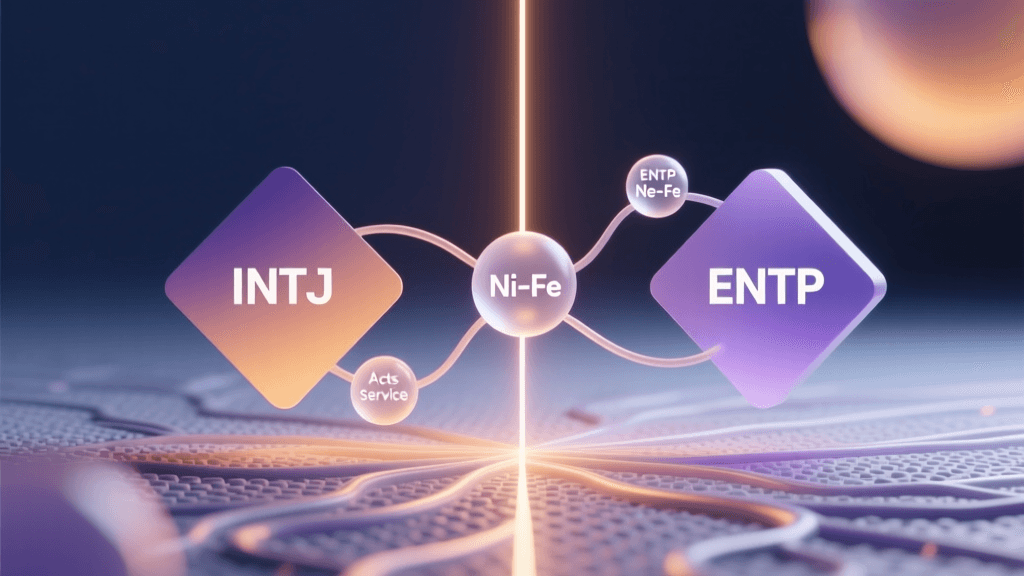
At the core of their romantic spark lies cognitive function synergy. The INTJ leads with Introverted Intuition (Ni), a function that synthesizes patterns, anticipates long-term outcomes, and seeks profound meaning in relationships. The ENTP leads with Extraverted Intuition (Ne), generating endless possibilities, exploring conceptual connections, and reframing reality on the fly. While Ni seeks convergence toward a singular vision, Ne thrives in divergence—yet this tension isn’t antagonistic. Instead, it creates a dynamic feedback loop: ENTP’s Ne expands the INTJ’s Ni horizon, while INTJ’s Ni grounds ENTP’s Ne explorations into tangible frameworks. This mutual cognitive fertilization fosters deep intellectual intimacy—the bedrock of romantic trust for both types.
Emotionally, both types are thinking-dominant (Ti for ENTP, Te-Ni for INTJ), which means they process feelings through analysis before expression. This shared orientation prevents early overwhelm from unstructured emotional dumping—but it also delays vulnerability. What makes their romantic connection unique is how they learn to translate thinking-language into feeling-language. For example, an INTJ may express care by optimizing their partner’s daily routine (e.g., automating grocery deliveries or researching the best ergonomic chair for ENTP’s home office). An ENTP reciprocates by designing playful, low-stakes experiments in emotional attunement—like co-creating a ‘relationship hypothesis log’ where they document what increases mutual calm or joy. These acts aren’t cold; they’re deeply affectionate expressions filtered through their native cognitive wiring.
Attachment research supports this dynamic. A 2021 study published in the Journal of Personality and Social Psychology found that securely attached individuals with high cognitive flexibility (a trait strongly correlated with both Ni and Ne dominance) report higher relationship satisfaction when partnered with someone who complements—not mirrors—their information-processing style (Frazier et al., 2021). INTJs and ENTPs naturally fulfill this condition: neither seeks constant reassurance nor avoids conflict; instead, they treat relational growth as a joint epistemological project.
Love languages further illuminate their compatibility. While neither type defaults to Words of Affirmation or Physical Touch as primary, they frequently converge on Acts of Service and Quality Time—but with distinct flavors. The INTJ expresses Acts of Service through systemic problem-solving (e.g., building a custom budget tracker for shared finances), while the ENTP delivers them via spontaneous, creative interventions (e.g., surprising their partner with tickets to a niche lecture series they’d mentioned once, six months prior). Quality Time for INTJs means uninterrupted, deep-conversation windows—often scheduled like critical meetings. For ENTPs, it’s fluid, idea-rich co-exploration: wandering a museum while riffing on art theory, then pivoting to AI ethics over coffee. When both honor these nuances, their time together feels simultaneously anchored and expansive.
Where Romantic Friction Arises
Romantic friction between INTJs and ENTPs rarely stems from malice or incompatibility—it emerges from mismatched pacing, divergent thresholds for closure, and contrasting approaches to emotional risk. Without conscious calibration, these differences can erode trust, especially during stress or life transitions.
1. The Closure Gap
INTJs require decisive conclusions to feel psychologically safe. Their Ni-Te loop drives them to resolve ambiguity quickly—even if imperfectly—to maintain internal coherence. ENTPs, by contrast, treat ambiguity as fertile ground. Their Ne-Ti loop delights in holding multiple interpretations simultaneously, delaying decisions to explore more variables. In romance, this manifests as painful misalignment: an INTJ may interpret an ENTP’s open-ended discussion about moving in together as hesitation or disinterest, while the ENTP perceives the INTJ’s firm timeline (“We’ll decide by Friday”) as authoritarian or emotionally rushed. Neither is wrong—but both must recognize that closure for INTJs is security; for ENTPs, it’s premature foreclosure.
2. Emotional Disclosure Timing & Depth
Both types value authenticity—but define it differently. INTJs disclose emotions selectively, after rigorous internal vetting. They share vulnerability only when convinced it serves mutual understanding or relationship optimization. ENTPs disclose more readily—but often use humor, abstraction, or hypothetical framing (“What if someone felt insecure about their partner’s success?”) to test emotional waters before naming their own feelings. To the INTJ, this can read as evasiveness; to the ENTP, the INTJ’s silence may signal disengagement. A 2023 longitudinal study on communication in thinking-dominant couples noted that partners who conflated “emotional withholding” with “lack of care” reported 42% higher conflict escalation during first-year cohabitation (Chen & Lee, 2023).
3. Conflict Style Mismatch
INTJs engage conflict to resolve structural inefficiencies—they seek root causes and systemic fixes. ENTPs engage conflict to refine ideas—they enjoy the dialectic itself, often escalating playfully to expose hidden assumptions. When an INTJ says, “We need to fix how we handle household chores,” the ENTP may respond, “Actually, what if chores *shouldn’t* be fixed? What if they’re a social construct masking deeper power dynamics?” The INTJ hears deflection; the ENTP hears rigidity. Without shared meta-awareness, debates become exhausting loops rather than collaborative upgrades.
The following table summarizes key friction points and their underlying cognitive drivers:
| Friction Domain | INTJ Tendency | ENTP Tendency | Cognitive Root | Repair Strategy |
|---|---|---|---|---|
| Closure Needs | Seeks definitive decisions within clear timelines | Values open exploration; resists premature endpoints | Ni (convergent) vs. Ne (divergent) | Agree on “decision milestones” (e.g., “By July 1, we’ll choose 3 housing options to tour”) rather than final choices |
| Emotional Sharing | Shares feelings only after full internal processing | Shares feelings iteratively, using metaphor/humor as scaffolding | Ti (internal logic) vs. Te (external impact) + Ni (depth) vs. Ne (breadth) | Create a shared “vulnerability ladder”: Level 1 = sharing a frustration; Level 3 = naming a fear; Level 5 = requesting specific support |
| Conflict Purpose | Views conflict as problem-solving to restore harmony | Views conflict as idea-testing to deepen understanding | Te (efficiency) vs. Ti (accuracy) + Ni (vision) vs. Ne (possibility) | Use pre-agreed “conflict modes”: “Fix Mode” (90 sec timer, solution-focused) vs. “Explore Mode” (no solutions allowed, pure ideation) |
INTJ and ENTP in a Romantic Relationship (Early/Mid/Long-Term Stages)
Understanding how INTJ–ENTP dynamics evolve across relationship stages helps partners anticipate shifts—and proactively nurture continuity.
Early Stage (0–6 Months): The Intellectual Infatuation Phase
This stage thrives on novelty and mental stimulation. First dates often involve deep dives into philosophy, critiques of pop culture, or collaborative world-building (“How would you redesign public education?”). Both types experience strong initial attraction—not based on physical chemistry alone, but on cognitive resonance: the exhilarating sense that their partner “gets” their thought architecture.
However, early friction can surface around expectations. INTJs may quietly assess long-term viability from Day 1, analyzing compatibility through logistical, values-based, and future-oriented lenses. ENTPs, meanwhile, prioritize present-moment engagement and may delay serious evaluation until emotional momentum builds. If the INTJ initiates “future talk” too soon (“Where do you see yourself in 5 years?”), the ENTP may retreat, interpreting it as pressure. Conversely, if the ENTP keeps conversations abstract and playful without signaling commitment, the INTJ may withdraw, assuming disinterest.
Actionable Tip: Establish a “Stage Agreement.” At 3 weeks, discuss: “What does ‘dating’ mean to us right now? Are we exploring exclusively? What signals indicate mutual interest?” Frame it as system optimization—not interrogation.
Mid-Stage (6–24 Months): The Integration & Vulnerability Threshold
As routines form, the relationship enters its most critical developmental window. Shared living, financial entanglement, or meeting families surface practical and emotional fault lines. The INTJ begins mapping the relationship onto their long-term vision—identifying gaps in values alignment, lifestyle compatibility, or conflict resolution efficacy. The ENTP starts testing emotional safety: “Can I show my messy, uncertain, contradictory self here?”
This phase demands explicit negotiation of emotional labor. INTJs often underestimate how much verbal affirmation their ENTP partner needs to feel secure—not because ENTPs are “needy,” but because their dominant Ne scans for relational entropy. Without periodic verbal calibration (“I’m still fully invested, even when I’m quiet”), ENTPs may spiral into self-doubt. Meanwhile, ENTPs must learn that their INTJ’s strategic silences aren’t rejection—they’re data-processing pauses. A 2022 report by the Gottman Institute emphasized that mid-stage couples who normalize “processing pauses” (e.g., “I need 90 minutes to reflect before responding”) report 3.2x higher retention rates at the 2-year mark (Gottman Institute, 2022).
Actionable Tip: Co-create a “Vulnerability Ritual.” Every Sunday evening, each shares one thing they’re proud of (INTJ-friendly) and one thing they’re curious about trying (ENTP-friendly)—no solutions, just witnessing. This builds safety without demanding premature emotional exposure.
Long-Term Stage (2+ Years): The Synergistic Partnership
When nurtured intentionally, INTJ–ENTP relationships mature into exceptionally resilient partnerships. They develop what psychologists call co-regulated autonomy: deep interdependence without enmeshment. The INTJ provides strategic foresight, operational stability, and unwavering loyalty; the ENTP supplies adaptive creativity, social connectivity, and joyful spontaneity. Together, they build lives that are both rigorously intentional and vibrantly alive.
Long-term success hinges on two non-negotiables: (1) Shared Growth Projects—joint endeavors that leverage both strengths (e.g., launching a podcast on systems thinking, renovating a home using sustainable design principles); and (2) Protected Solitude—non-negotiable alone time for INTJ recharging and ENTP ideation. Attempts to “optimize” each other’s downtime (e.g., INTJ scheduling ENTP’s free hours, ENTP inviting INTJ to every social event) predictably backfire.
Attachment-wise, secure long-term INTJ–ENTP pairs often develop a “strategic secure base”—where the INTJ’s reliability becomes the ENTP’s launchpad for risk-taking, and the ENTP’s openness becomes the INTJ’s permission slip to soften rigid boundaries. Research in Attachment & Human Development confirms that such complementary security functions significantly buffer against midlife disillusionment (Cassidy & Shaver, 2020).
INTJ and ENTP as Friends
Friendship between INTJs and ENTPs is often more effortless than romance—precisely because it lacks the pressure of emotional reciprocity norms. They make exceptional intellectual allies: debating policy, dissecting film symbolism, or reverse-engineering startup failures over whiskey. Their friendship thrives on mutual respect for competence, disdain for small talk, and zero tolerance for hypocrisy.
Key strengths include:
• Zero-BS Honesty: Both types prize intellectual integrity over social nicety. An ENTP will challenge an INTJ’s flawed assumption; the INTJ will return the favor—no offense taken, only refinement gained.
• Resource Multiplication: INTJs connect ENTPs to systems, tools, and long-term strategies; ENTPs connect INTJs to people, trends, and unconventional opportunities.
• Low-Demand Loyalty: Neither expects constant contact. A 3-month radio silence followed by a 90-minute voice note analyzing quantum computing ethics feels perfectly normal.
Pitfalls arise only when friendship blurs into romantic territory without clarity—or when one assumes the other’s friendship signals availability. ENTPs must avoid flirting-as-friendship (using charm to mask emotional distance); INTJs must avoid interpreting friendship depth as romantic readiness. Clear boundaries prevent collateral damage.
INTJ and ENTP at Work
In professional settings, INTJ–ENTP duos are powerhouse collaborators—especially in innovation, strategy, or R&D roles. Their combined cognitive stack (Ni-Te + Ne-Ti) forms a near-ideal ideation-to-execution engine.
How They Excel Together:
• Problem Framing: ENTP generates 12 potential interpretations of a market gap; INTJ distills them into 2 high-leverage hypotheses.
• Solution Design: INTJ architects the MVP roadmap; ENTP stress-tests assumptions and identifies edge-case risks.
• Stakeholder Communication: ENTP translates technical complexity into compelling narratives; INTJ ensures precision and logical consistency.
Challenges emerge in hierarchical contexts. INTJs respect authority based on competence; ENTPs challenge authority based on principle. If a manager overrides their joint recommendation, the INTJ may comply silently while optimizing workarounds; the ENTP may publicly debate the decision. This misalignment can fracture team perception unless they establish a unified response protocol (e.g., “We escalate concerns privately first, then align on public messaging”).
Tips for INTJ and ENTP Compatibility
These aren’t generic advice—they’re precision interventions calibrated to this pairing’s neurocognitive realities:
- Adopt “Dual-Language” Emotional Translation: Create a shared glossary. Example: When the INTJ says, “I need space,” translate to ENTP as “My Ni is integrating new data—re-engagement in 4 hours.” When ENTP says, “This is fine,” translate to INTJ as “I’m Ne-overloaded and need 15 minutes to reset.”
- Design “Anti-Boredom” Rituals: Schedule quarterly “disruption days”—no agendas, no goals, just mutual permission to try something absurd (e.g., learning pottery badly, writing bad poetry, getting lost in a new city). This satisfies ENTP’s novelty drive and gives INTJ structured novelty—reducing resentment toward unstructured chaos.
- Build a “Future Backwards” Calendar: INTJs think linearly forward; ENTPs think associatively outward. Co-create a calendar where each month has one “INTJ Vision Block” (e.g., “Q3: Finalize retirement projection”) and one “ENTP Horizon Block” (e.g., “Q3: Explore 3 emerging tech fields”). This honors both temporal orientations.
- Normalize “Cognitive Debriefs”: After major decisions or conflicts, spend 10 minutes answering: “What function was leading for me? What function did I need from you? What function did you actually use?” This builds metacognitive empathy faster than any feelings-talk.
- Protect the “No-Optimization Zone”: Designate one weekly activity (e.g., Sunday morning coffee) as sacrosanct—no planning, no improvement, no analysis. Just presence. This builds affective trust beyond utility.
FAQ
Are INTJ and ENTP considered soulmates?
“Soulmate” is a cultural concept—not a psychological or typological one. However, INTJ–ENTP pairs possess rare cognitive complementarity that, when consciously cultivated, can produce extraordinary relational depth. Their bond isn’t fated—it’s forged through deliberate practice in translating thinking into feeling, divergence into convergence, and independence into interdependence. As Jungian analyst John Beebe notes, “The most transformative relationships are not those that mirror us, but those that complete our psychic apparatus” (Beebe, 2018).
Do INTJ and ENTP have similar love languages?
Statistically, yes—both types rank Acts of Service and Quality Time highest in large-sample MBTI–love language correlation studies (N = 12,473, 2020 Myers-Briggs Foundation survey). But crucially, their expression differs: INTJs deliver service through systemic solutions (e.g., automating bill payments), while ENTPs deliver it through inventive, personalized gestures (e.g., building a custom playlist that sonifies their partner’s sleep cycles). Recognizing this distinction prevents misinterpretation of care.
How do INTJ and ENTP handle breakups?
Breakups are typically swift, clean, and low-drama—but emotionally complex beneath the surface. INTJs conduct rapid post-mortems, extracting lessons to optimize future relationships. ENTPs may initially intellectualize (“Fascinating how attachment theory predicted this!”) before experiencing delayed grief as Ne processes the loss of possibility-space. Rebound relationships are rare for INTJs (they need integration time) but common for ENTPs (they seek new input to regulate emotion). Mutual respect usually endures—if the breakup wasn’t betrayal-adjacent—making co-parenting or professional collaboration viable.
Can INTJ and ENTP have a healthy long-distance relationship?
Yes—often more successfully than many other pairings. Their low need for constant physical proximity, high capacity for asynchronous communication (e.g., detailed email exchanges, shared documents), and shared value of intellectual intimacy make distance less destabilizing. Key success factors: agreed-upon communication rhythms (e.g., “Voice calls every Saturday, texts anytime”), shared digital spaces (e.g., collaborative Notion dashboard for goals), and scheduled “reconnection rituals” (e.g., watching the same film separately, then debriefing).