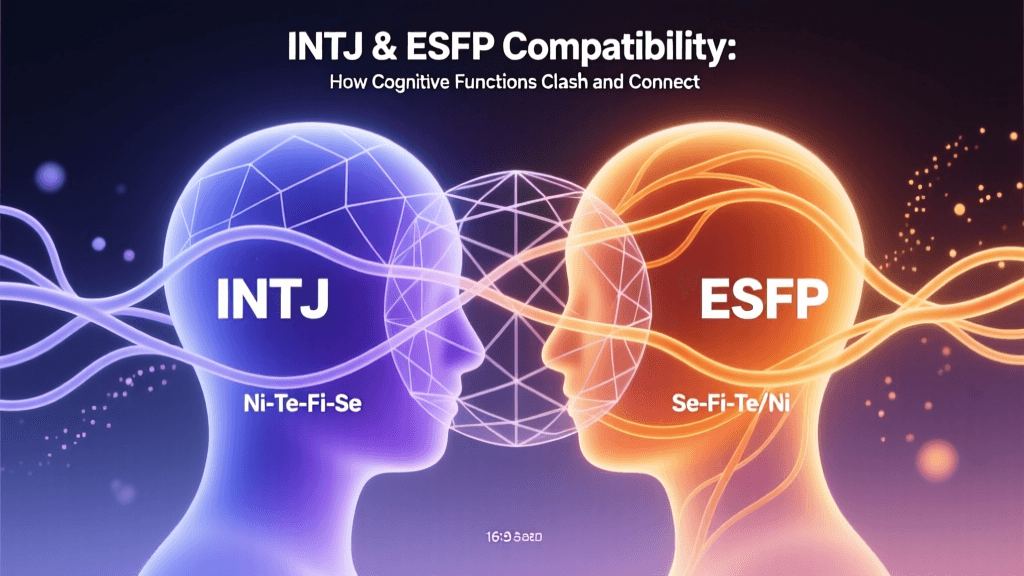
When an INTJ—the strategic architect, the long-range strategist with a mind wired for abstraction and systemic optimization—meets an ESFP—the vibrant sensor, the spontaneous life-of-the-party who lives vividly in the present moment—their connection often feels like magnetic polarity: intense, unpredictable, and profoundly illuminating. On the surface, they appear opposites in nearly every dimension: introversion vs. extraversion, intuition vs. sensing, thinking vs. feeling, judging vs. perceiving. Yet beneath this apparent dichotomy lies a rich, nuanced cognitive architecture—one that doesn’t just explain why these types struggle, but reveals precisely how their minds can complement, challenge, and even heal one another.
This article moves beyond superficial trait comparisons to examine compatibility through the authoritative lens of cognitive function theory—the foundational framework developed by Carl Gustav Jung and rigorously refined by Isabel Briggs Myers, David Keirsey, and later cognitive typologists like Linda V. Berens, Dario Nardi, and Lenore Thomson. We’ll dissect the four-function stacks of both types, map their dominant–auxiliary–tertiary–inferior interplay, identify functional alignments and friction points, uncover the surprising resonance between INTJ’s inferior Se and ESFP’s dominant Se (and INTJ’s tertiary Fi with ESFP’s auxiliary Fi), and offer concrete, functionally grounded strategies for building trust, resolving conflict, and co-creating value—in romance, friendship, and collaboration.
INTJ Cognitive Stack Overview
The INTJ personality type operates from a hierarchical stack of four cognitive functions, each playing a distinct psychological role:
- Dominant: Introverted Intuition (Ni) — The INTJ’s core lens. Ni synthesizes disparate data points into singular, forward-looking insights—‘aha’ visions of probable futures, underlying patterns, and convergent truths. It operates unconsciously, compressing complexity into symbolic foresight. As psychologist Dario Nardi explains in Neuroscience of Personality, Ni-dominant brains show heightened activity in the posterior cingulate cortex during pattern-integration tasks—suggesting a neurobiological basis for their ‘visionary compression’ capacity.
- Auxiliary: Extraverted Thinking (Te) — The executive arm. Te organizes external systems, applies logic to real-world problems, prioritizes efficiency, and implements Ni’s insights through measurable action. It values objectivity, scalability, and cause-effect precision. Te is not cold calculation—it’s the disciplined engine that turns insight into infrastructure.
- Tertiary: Introverted Feeling (Fi) — The internal moral compass. Fi holds deeply personal values, authenticity standards, and emotional integrity. Though less developed than Ni or Te, Fi emerges especially under stress or in intimate relationships—guiding decisions about loyalty, ethics, and self-respect. It’s often private, non-negotiable, and slow to articulate.
- Inferior: Extraverted Sensing (Se) — The unconscious ‘shadow’ function. Se grounds awareness in immediate sensory reality: physical presence, aesthetics, kinetics, spontaneity, and embodied experience. For the INTJ, Se is underdeveloped and easily overwhelmed—yet it carries immense latent energy. When healthy, it manifests as sudden bursts of physical confidence, appreciation for beauty or craft, or tactical adaptability in crisis. When stressed, it erupts as impulsive risk-taking, hyperfocus on bodily sensations (e.g., stress-eating, insomnia), or sensory overload.
Crucially, the INTJ’s function stack is introverted-dominant: Ni draws energy inward, seeking depth over breadth; Te then projects that inner vision outward with decisive force. This creates a ‘vision → system → execution’ loop—powerful for long-term strategy, but vulnerable to disconnection from lived, embodied experience.
ESFP Cognitive Stack Overview
The ESFP’s cognitive architecture flows in the opposite direction—extraverted-dominant, sensory-grounded, and values-driven:
- Dominant: Extraverted Sensing (Se) — The ESFP’s anchor and superpower. Se absorbs and responds to the immediate environment with astonishing acuity: colors, textures, rhythms, social cues, physical opportunities. It thrives on novelty, action, and tangible engagement. As noted by the Center for Applications of Psychological Type (CAPT), Se-dominants demonstrate superior performance in real-time perceptual-motor tasks and rapid environmental adaptation—making them exceptional crisis responders, performers, and hands-on problem solvers.
- Auxiliary: Introverted Feeling (Fi) — The ethical core beneath the sparkle. Fi provides the ESFP with strong personal convictions, empathy rooted in subjective resonance (“How does this feel to me?”), and fierce loyalty to people and causes they deem authentic. While Se seeks external harmony, Fi safeguards internal congruence—often expressed through passionate advocacy, artistic expression, or quiet moral stands.
- Tertiary: Extraverted Thinking (Te) — The pragmatic organizer. Te helps the ESFP structure their enthusiasm: planning events, optimizing routines, troubleshooting logistics, or managing resources. It’s less systematic than the INTJ’s Te—it serves Se and Fi rather than leading them—but becomes increasingly reliable with maturity.
- Inferior: Introverted Intuition (Ni) — The shadow function. Ni pulls toward future implications, symbolic meaning, and abstract convergence. For the ESFP, Ni is elusive and often experienced as unsettling premonitions, obsessive ‘what-if’ loops, or sudden existential doubt—especially during burnout or prolonged isolation. Healthy Ni integration brings foresight, depth, and strategic patience; unhealthy Ni manifests as paranoia, fatalism, or withdrawal into vague dread.
The ESFP’s stack is fundamentally present-centered and experiential. Their cognition begins with what is—not what could be—and filters all input through personal values (Fi) and practical utility (Te). This makes them exceptionally attuned to human needs in the moment—but sometimes impatient with abstract speculation or long-term trade-offs.
Where Functions Align
Despite their contrasting orientations, INTJs and ESFPs share two function pairs in identical positions—just reversed in attitude (introverted ↔ extraverted). This creates profound, often unspoken, functional alignment:
| Function Pair | INTJ Position & Attitude | ESFP Position & Attitude | Nature of Alignment |
|---|---|---|---|
| Ni / Se | INTJ: Dominant (Introverted) | ESFP: Dominant (Extraverted) | Complementary perception modes: Ni synthesizes the unseen; Se masters the seen. Together, they form a complete perceptual circuit—vision + immediacy. |
| Fi / Fi | INTJ: Tertiary (Introverted) | ESFP: Auxiliary (Introverted) | Shared value-structure: Both rely on deep, internal moral frameworks—not societal norms, but personal authenticity. This creates powerful resonance in ethics, loyalty, and identity. |
| Te / Te | INTJ: Auxiliary (Extraverted) | ESFP: Tertiary (Extraverted) | Shared problem-solving orientation: Both use objective logic to organize the external world—though INTJ applies Te systematically, while ESFP deploys it situationally. |
Let’s unpack each alignment with behavioral specificity:
Ni–Se Symbiosis: The Vision–Action Loop
INTJ’s Ni generates long-term strategic blueprints—e.g., “This nonprofit’s current model won’t scale beyond regional impact; we need a decentralized volunteer certification system by Q3 2026.” ESFP’s Se instantly perceives implementation barriers Ni missed: “The current app crashes on older Androids—volunteers in rural areas can’t access training videos,” or “The boardroom lighting makes Maria squint; she’s disengaged before you finish slide two.” Where Ni sees the destination, Se maps the terrain—potholes, detours, and scenic shortcuts. In healthy partnership, Ni trusts Se’s real-time feedback to refine the plan; Se trusts Ni’s vision to give their action purpose. A real-world example: architect INTJ and interior designer ESFP co-designing a community center—the INTJ defines spatial flow and sustainability targets; the ESFP ensures tactile materials invite touch, lighting supports emotional safety, and layout accommodates spontaneous gatherings.
Fi–Fi Resonance: Shared Moral Gravity
Though expressed differently—INTJ’s Fi is quiet, principled, and slow to voice; ESFP’s Fi is expressive, empathic, and relationship-bound—they converge on core values: integrity, authenticity, fairness, and human dignity. An INTJ may refuse a lucrative contract that compromises data ethics; an ESFP may walk off a film set where harassment is tolerated. Neither appeals to rules or consensus—they appeal to an inner ‘rightness.’ This shared Fi foundation enables deep mutual respect, even amid disagreement. As Lenore Thomson writes in Personality Types: Using the Enneagram for Self-Discovery, Fi-dominant and Fi-auxiliary types often recognize each other’s ‘moral signature’ before words are exchanged—a silent acknowledgment of aligned soul-compasses.
Te–Te Synergy: Pragmatic Execution
Both types value competence, results, and clear cause-effect reasoning. While the INTJ uses Te to build scalable systems, the ESFP uses Te to optimize human-scale operations—streamlining event logistics, improving customer service scripts, or debugging a malfunctioning sound system. They can co-lead projects where big-picture strategy (Ni) meets agile execution (Se), with Te serving as the shared language of ‘what works.’ For instance: launching a mental health podcast—INTJ designs content architecture and growth analytics; ESFP books guests, records episodes with warmth and timing precision, and edits for emotional pacing. Their Te ensures deadlines are met and quality benchmarks upheld.
Where Functions Clash
Clashes arise not from ‘incompatibility,’ but from mismatched functional priorities and developmental timing. The same functions that align also generate friction when one type over-relies on their strength while misreading the other’s need.
Ni vs. Se: The Future–Present Tension
The most visible clash: INTJ’s Ni pulls relentlessly toward abstract futures (“We must anticipate regulatory shifts in AI ethics by 2027”), while ESFP’s Se anchors fiercely in the present (“Can we fix the broken coffee maker now so the team isn’t cranky at 9 a.m.?”). To the INTJ, Se-focus feels trivializing; to the ESFP, Ni-speculation feels disembodied and anxiety-inducing. Research from the National Institutes of Health on temporal cognition confirms that chronic future-orientation correlates with higher baseline cortisol, while present-focus correlates with lower amygdala reactivity—neurologically validating why this clash triggers stress responses in both.
Te vs. Fi (Misinterpreted): Efficiency vs. Humanity
INTJ’s auxiliary Te, when under stress or poorly integrated, can override Fi—leading to blunt, impersonal directives (“That workflow is inefficient; change it by Friday”). ESFP’s auxiliary Fi interprets this as rejection of their values or personhood—not as process critique. Conversely, ESFP’s Fi-driven requests (“I need space after that meeting—I’m emotionally drained”) may register to the INTJ as illogical or disruptive to Te-plans. The clash isn’t Te vs. Fi—it’s Te deployed without Fi-awareness meeting Fi expressed without Te-translation.
Se vs. Ni (Shadow Activation): Overstimulation & Paranoia
Under stress, INTJ’s inferior Se erupts—seeking sensory relief via overwork, caffeine binges, or impulsive purchases—triggering ESFP’s dominant Se to perceive chaos or instability. Simultaneously, ESFP’s inferior Ni activates—spinning catastrophic narratives (“They’re pulling away… do they not care anymore?”)—which the INTJ’s Ni mirrors with its own worst-case projections (“Their inconsistency confirms my hypothesis they’re unreliable”). This creates a feedback loop of mutual shadow projection: Se-overload met with Ni-dread.
The Hidden Resonances (Tertiary/Inferior Function Connections)
The most transformative dynamics lie not in dominant–dominant interaction, but in the ‘hidden bridges’ between tertiary and inferior functions—where growth and healing occur.
INTJ’s Inferior Se ↔ ESFP’s Dominant Se: The Embodiment Invitation
For the INTJ, Se is the neglected gateway to aliveness—to pleasure, play, presence, and physical wisdom. The ESFP, embodying Se with grace and joy, is uniquely positioned to model healthy Se use: savoring a meal without multitasking, dancing without self-consciousness, noticing cloud shapes, or fixing a leaky faucet with focused attention. This isn’t about ‘teaching’ the INTJ to be spontaneous—it’s about creating safe, low-stakes spaces where Se can emerge organically. Practical tip: Agree on a weekly ‘Se ritual’—e.g., cooking a new recipe together (tactile, visual, gustatory), visiting a botanical garden (sensory immersion), or learning a simple juggling pattern (kinesthetic focus). No analysis. No outcomes. Just presence.
ESFP’s Inferior Ni ↔ INTJ’s Dominant Ni: The Foresight Anchor
ESFPs often dismiss Ni as ‘overthinking’—until burnout hits, and Ni floods them with paralyzing ‘what-ifs.’ Here, the INTJ’s mature Ni becomes a stabilizing resource—not by predicting doom, but by offering grounded, evidence-based scenarios. Instead of “What if we fail?”, INTJ reframes: “Based on past launches, here are three likely outcomes—and our prepared response to each.” This transforms Ni from a source of dread into a tool for security. Practical tip: Co-create a ‘Ni Brief’ before major decisions—a one-page document outlining: (1) Desired outcome, (2) 2–3 realistic pathways, (3) Early warning signs for each, (4) Pre-agreed pivot points. This gives ESFP’s Ni structure, not suppression.
INTJ’s Tertiary Fi ↔ ESFP’s Auxiliary Fi: The Authenticity Mirror
INTJ’s Fi is often buried under Te efficiency and Ni strategy. ESFP’s Fi, fluent and expressive, can gently reflect INTJ’s values back to them: “You didn’t speak up in that meeting—you looked conflicted. Was it about fairness?” or “You spent hours refining that proposal draft. What part felt non-negotiable to you?” This helps INTJ articulate Fi—turning private conviction into relational clarity. In return, INTJ’s Fi offers ESFP a stable ethical reference point during emotional turbulence—reminding them, “Your anger isn’t irrational; it’s protecting your value of respect.”
Leveraging Cognitive Diversity
Compatibility isn’t about becoming alike—it’s about designing interactions that honor each type’s cognitive strengths while mitigating blind spots. Here’s how to operationalize that:
Communication Protocols
- For Planning Conversations: Use the ‘Ni–Se Agenda.’ INTJ shares Ni-vision first (3 minutes max); ESFP responds with Se-observations (what’s working/not, who’s engaged, what’s physically feasible); then co-build next steps using Te. Avoid open-ended “What should we do?”—replace with “Given [Ni insight], what’s one Se-action we can take this week?”
- For Conflict Resolution: Pause Te-debate until Fi is acknowledged. INTJ names their Fi-value (“I felt my commitment to transparency was undermined”); ESFP names theirs (“I felt my effort wasn’t seen”). Only then engage Te to solve the structural issue.
- For Feedback Delivery: INTJ frames critiques using Se-language: “The report’s conclusion landed strongly (Se impact), but the data on slide 4 was hard to parse visually (Se clarity). Could we simplify the chart?” ESFP delivers feedback anchored in Fi: “When you interrupted, I felt unheard—which matters because I value our mutual respect.”
Collaboration Architecture
Design roles around function strengths—not stereotypes:
- INTJ as ‘Futures Architect’: Owns long-term vision, risk modeling, systems design, and knowledge synthesis. Sets quarterly goals based on Ni-forecasting.
- ESFP as ‘Human Experience Optimizer’: Owns user testing, stakeholder interviews, onboarding flow, team morale, and real-time iteration. Reports weekly Se-observations to adjust course.
- Shared ‘Te Integration Hub’: A shared dashboard (e.g., Notion or ClickUp) where Ni-insights and Se-observations converge into Te-action items—with clear owners, deadlines, and success metrics.
Growth Rituals
Integrate deliberate function-development practices:
- INTJ Weekly Se Practice: 20 minutes of pure sensory engagement—no devices, no analysis. Examples: sketching natural objects, blindfolded taste-testing, mindful walking focusing only on footfall and breath.
- ESFP Ni Journaling: Every Sunday, write three sentences: (1) One thing that went well this week (Se), (2) One value it reflected (Fi), (3) One small step next week to reinforce that value (Ni-foresight).
- Joint Fi Dialogue: Monthly 45-minute conversation using prompts: “When did I feel most authentically myself this month?” “What boundary did I honor—or neglect—and why?” “What value am I choosing to protect in our relationship right now?”
As Jungian analyst John Beebe emphasizes in Integrity: The Archetype, “The inferior function is not the enemy—it is the unlived life calling for integration.” For INTJ and ESFP, their ‘opposites’ hold the very capacities each most needs to become whole.
FAQ
Can INTJ and ESFP have a successful romantic relationship?
Yes—with intentionality. Their attraction is often immediate (Ni fascinated by Se vitality; Se drawn to Ni depth), but longevity requires explicit agreement on core needs: INTJ needs intellectual respect and autonomy; ESFP needs emotional responsiveness and shared joy. Success hinges on protecting Fi-resonance (shared values) while negotiating Ni–Se rhythms (e.g., scheduling ‘future talk’ blocks and ‘present play’ blocks). Couples who thrive treat their differences as complementary superpowers—not flaws to fix.
Why do INTJs and ESFPs often misunderstand each other’s silence?
INTJ silence = Ni processing (internal pattern-mapping) or Fi reflection (value-assessment). ESFP silence = often Se overload (sensory fatigue) or Ni intrusion (unfamiliar existential worry). Misreading silence as disengagement or judgment is common. Solution: Co-create a ‘silence code’—e.g., INTJ texts “Ni-ing—back in 20” or ESFP says “Se-reboot needed—coffee break!” Normalizing silence as functional—not personal—is key.
How can an ESFP help an INTJ develop healthier Se?
By modeling Se without pressure. Invite—not demand—sensory experiences: “I found this amazing street musician—want to listen for 10 minutes?” or “This new tea has such a bright citrus note—try it slowly.” Celebrate INTJ’s Se efforts (“You noticed the light changed—that’s beautiful attention!”) without expectation of repetition. Most importantly: never frame Se-development as ‘fixing’ the INTJ. It’s expanding their humanity—not correcting deficiency.
What’s the biggest workplace pitfall for INTJ–ESFP teams?
The ‘Efficiency Trap’: INTJ optimizes for systemic Te-efficiency (e.g., automating client onboarding), while ESFP optimizes for human Te-efficiency (e.g., simplifying forms to reduce client frustration). Without dialogue, INTJ sees ESFP’s tweaks as ‘unscalable exceptions’; ESFP sees INTJ’s systems as ‘dehumanizing bureaucracy.’ The fix: Mandate joint ‘impact mapping’—for every Te-change, assess both systemic efficiency (INTJ metric) AND human-experience impact (ESFP metric) using shared KPIs like client satisfaction score + process cycle time.