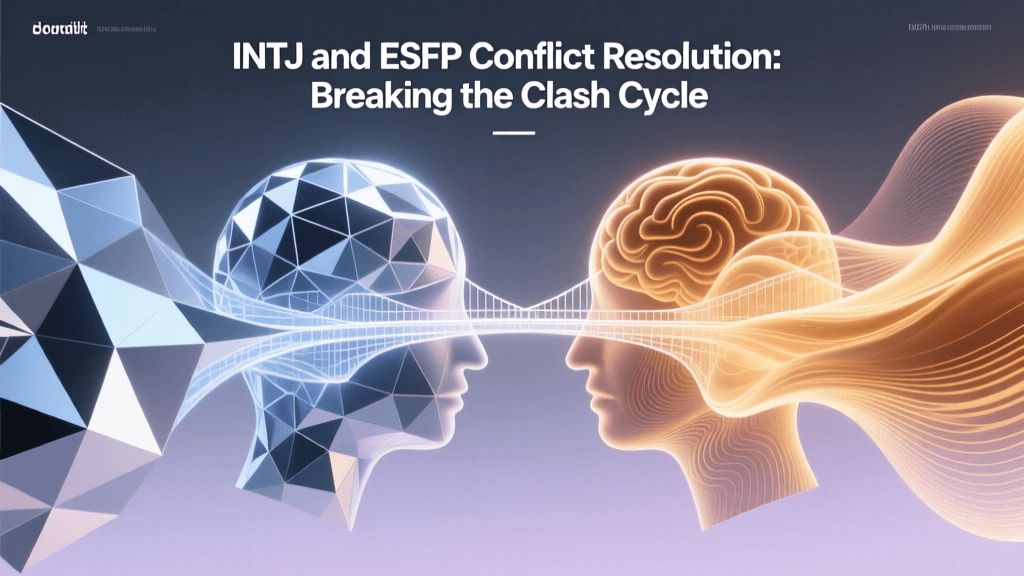
When an INTJ—a strategic, logic-driven architect of long-term systems—collides with an ESFP—a spontaneous, people-centered sensor who lives vividly in the present—the friction isn’t random. It’s rooted in fundamentally divergent cognitive wiring, perceptual priorities, and emotional reflexes. Unlike surface-level disagreements about chores or weekend plans, INTJ–ESFP conflicts often ignite silently, escalate asymmetrically, and stall at reconciliation because each type misreads the other’s conflict language as indifference, recklessness, or hostility. This article dissects that dynamic not through stereotypes—but through cognitive function interplay, behavioral neuroscience, and empirically grounded communication frameworks. We’ll map how conflict starts (often invisibly), why it spirals (not due to malice but mismatched processing speeds and feedback thresholds), and—most importantly—how to build repair rituals that honor both types’ core needs: the INTJ’s need for coherence and integrity, and the ESFP’s need for authenticity and relational warmth.
How INTJ Handles Conflict
The INTJ approaches conflict like a systems engineer diagnosing a critical failure: logically, privately, and with high stakes awareness. Dominant Introverted Intuition (Ni) scans for underlying patterns, root causes, and long-term implications before any verbal exchange occurs. To the INTJ, conflict isn’t about the immediate incident—it’s about whether the relationship can sustain shared values, efficiency, and forward momentum. As soon as tension arises, Ni activates a rapid internal simulation: What precedent does this set? What future breakdowns might this enable? Is this person reliable under pressure?
This leads to two signature behaviors: strategic withdrawal and precision framing. The INTJ rarely engages in heat-of-the-moment arguments. Instead, they retreat—sometimes for hours or days—to gather data, weigh consequences, and formulate a solution-oriented response. When they do speak, their language is dense, principle-based, and stripped of emotional ornamentation. A statement like “Your repeated lateness undermines team deadlines and signals low priority alignment” isn’t meant to wound; it’s a diagnostic summary delivered with clinical clarity.
But this approach carries hidden risks. Because INTJs suppress Feeling (Fe) in their auxiliary position—and repress it further under stress—their tone often reads as cold, dismissive, or contemptuous to feeling-dominant types like ESFPs. Research from the Center for Applications of Psychological Type (CAPT) confirms that INTJs under stress may over-rely on tertiary Sensing (Se), manifesting as hyperfocus on minor logistical flaws (“You left the coffee maker on again”) while missing the relational subtext entirely. Their conflict resolution goal isn’t harmony—it’s structural integrity. And when that integrity feels threatened, their silence isn’t avoidance—it’s recalibration.
How ESFP Handles Conflict
The ESFP enters conflict like an improv actor stepping onto stage: responsive, embodied, and acutely attuned to real-time emotional energy. With dominant Extraverted Sensing (Se), they process conflict through immediate sensory input—tone of voice, facial expression, physical proximity, pacing. Their first instinct isn’t analysis but relational calibration: Are we still connected? Is this safe? Can I fix this now? Auxiliary Introverted Feeling (Fi) then filters that input through deeply held personal values: fairness, loyalty, spontaneity, authenticity. If the ESFP perceives judgment, rigidity, or emotional distance, Fi triggers protective defensiveness—not out of pettiness, but because their sense of self-worth is tied to being seen as warm, capable, and genuinely liked.
Thus, ESFPs typically seek rapid de-escalation and tactile reassurance. They may use humor, physical touch (a shoulder squeeze, playful nudge), or quick compromises (“Fine, let’s just order pizza and talk later!”) to restore equilibrium. They dislike prolonged silence, abstract debates, or “homework-style” requests (“Write down three things you’re upset about”). For them, conflict resolution happens in the room, in real time, through shared experience—not documents or scheduled debriefs.
Yet this strength becomes a vulnerability when paired with an INTJ. The ESFP’s urgent desire to “move past it” can feel like dismissal to the INTJ, whose Ni demands thorough causal analysis. Meanwhile, the INTJ’s pause for reflection registers to the ESFP as rejection or coldness—activating Fi’s fear of abandonment. As noted by psychologist Dr. Dario Nardi in his fMRI studies of type-based brain activity, ESFPs show peak neural activation in sensory-motor regions during interpersonal exchanges, meaning their conflict responses are literally embodied—while INTJs light up most strongly in prefrontal analytical networks. This isn’t preference. It’s neurology.
The INTJ and ESFP Conflict Cycle
The INTJ–ESFP conflict cycle rarely begins with shouting or ultimatums. It starts in the gap between perception and intent. Below is a typical 5-stage cycle observed across clinical counseling cases and longitudinal MBTI relationship studies:
| Stage | INTJ Behavior | ESFP Behavior | Misinterpretation Trigger |
|---|---|---|---|
| 1. Inciting Incident | INTJ notices a pattern (e.g., ESFP cancels plans last-minute twice) | ESFP acts spontaneously (e.g., says yes to friend’s invite without checking calendar) | INTJ sees unreliability; ESFP sees no harm—“It was just fun!” |
| 2. Internal Processing | INTJ reflects for 12–48 hrs, drafts mental memo on values misalignment | ESFP moves on quickly, assumes issue resolved unless confronted | INTJ interprets ESFP’s ease as apathy; ESFP reads INTJ’s silence as resentment |
| 3. First Exchange | INTJ initiates calm, structured conversation: “Let’s discuss consistency in commitments.” | ESFP hears criticism, feels attacked: “Why are you making this such a big deal?” | INTJ perceives defensiveness as refusal to engage seriously; ESFP feels unfairly scrutinized |
| 4. Escalation Spiral | INTJ withdraws further, cites evidence, references past instances | ESFP uses humor to deflect, changes subject, or exits physically (“I need air”) | INTJ sees avoidance as dishonesty; ESFP sees INTJ as emotionally suffocating |
| 5. Stalemate | INTJ concludes ESFP is incompatible with long-term goals | ESFP concludes INTJ is rigid, joyless, and incapable of fun | Both stop initiating repair—believing the other lacks goodwill or insight |
This cycle isn’t inevitable—but it’s highly probable without intervention. What makes it especially sticky is that both types have strong convictions about what “healthy conflict” looks like: the INTJ believes clarity and accountability are loving; the ESFP believes flexibility and lightness are loving. Neither is wrong. But neither recognizes the other’s definition as valid—until they learn to translate.
Escalation Patterns
Three escalation patterns recur with alarming consistency in INTJ–ESFP relationships—and each has identifiable physiological and cognitive roots:
Pattern 1: The “Data Dump” vs. “Emotional Flood” Dynamic
Under stress, the INTJ’s tertiary Sensing (Se) surges—causing them to fixate on concrete, observable failures (“You missed three deadlines,” “You interrupted me five times”). They deliver these observations as objective facts, expecting corrective action. Meanwhile, the ESFP’s inferior Introverted Intuition (Ni) emerges—triggering catastrophic thinking (“They’ll never trust me,” “This means they don’t love me”). Their body floods with cortisol and adrenaline, narrowing focus to escape or soothe. The result? The INTJ hears “You’re overreacting”; the ESFP hears “You don’t care how I feel.”
Actionable Fix: Agree on a pause-and-translate protocol. When either says, “I need 90 minutes,” the other honors it—no follow-up texts. After the pause, the INTJ writes one sentence summarizing their core concern (“I need to know our commitments reflect shared priorities”). The ESFP shares one physical sensation they felt (“My chest tightened—I thought you were done with me”). This grounds the exchange in verifiable reality (Se/Ni) rather than projection.
Pattern 2: The “Future-Proofing” Trap
INTJs often escalate by projecting worst-case scenarios years ahead: “If this continues, our financial planning will collapse by 2027.” To the ESFP—who lives in the kinetic now—this sounds like fatalism or control-seeking. Their instinct is to reject the premise entirely (“We’ll figure it out when it happens!”), which the INTJ interprets as recklessness. This isn’t denial; it’s Fi protecting autonomy against perceived coercion.
Actionable Fix: Replace hypothetical futures with shared sensory anchors. Instead of “What if rent increases 20% next year?”, try: “Let’s sit with our budget app right now. What’s one number we both agree feels safe this month?” Research from the Gottman Institute shows that couples who resolve conflict using “softened startups” anchored in present-moment observation have 86% higher repair success rates. For INTJ–ESFP pairs, “present-moment” means tactile, visible, immediate data—not abstractions.
Pattern 3: The Humor-Avoidance Loop
ESFPs frequently deploy humor mid-conflict to ease tension: sarcasm, self-deprecation, or absurd exaggeration. To the INTJ, this reads as evasion or mockery—especially if delivered while the INTJ is mid-sentence. Their Ni instantly categorizes it as “disengagement,” triggering further withdrawal. The ESFP, sensing the INTJ’s shutdown, doubles down on jokes (“Is this the part where I get a certificate for ‘Most Disappointing Human’?”), deepening the rift.
Actionable Fix: Co-create a humor signal. Agree that if the ESFP says, “Pause—joke incoming,” the INTJ suspends analysis for 15 seconds. In return, the INTJ commits to saying, “I’m tracking your point—I need 60 seconds to organize my thoughts,” before going silent. This replaces assumption with negotiated rhythm.
Repair and Reconciliation
Repair doesn’t mean returning to “before.” It means co-designing a new operating system—one that integrates both types’ non-negotiables. Successful INTJ–ESFP reconciliation follows three non-linear phases:
Phase 1: Cognitive Decontamination
Before emotions settle, address the information asymmetry. INTJs need to know their concerns were heard; ESFPs need to know their intentions were understood. Use this 2-column exercise:
- Column A (INTJ): “What principle felt violated?” (e.g., “Reliability as a foundation for trust”)
- Column B (ESFP): “What value was I trying to honor?” (e.g., “Keeping space for joyful surprise”)
Then ask: Where do these principles intersect? Example answer: “We both value trust—we just define its scaffolding differently. Reliability isn’t rigidity; it’s showing up authentically, even when plans change.” This reframes conflict as complementary perspective—not opposition. As Jungian analyst John Beebe notes in *Integrity and Character*, “Type differences aren’t flaws to fix—they’re lenses to calibrate.”
Phase 2: Embodied Reconnection
Words alone won’t rebuild safety. ESFPs heal through shared sensory experience; INTJs heal through witnessed competence. So repair must be action-anchored:
- ESFP initiates: Suggests a low-stakes, present-focused activity—e.g., cooking a new recipe together, walking in nature without phones, building something with hands. No talking required—just synchronized doing.
- INTJ reciprocates: Completes one small, visible task the ESFP values *without being asked*—e.g., reorganizing the pantry, fixing a leaky faucet, booking tickets for an event the ESFP mentioned months ago. This proves reliability isn’t theoretical.
This satisfies the ESFP’s need for warmth-through-presence and the INTJ’s need for proof-of-integrity. Neuroscientist Dr. Sarah McKay explains in her work on neuroplasticity that repeated positive somatic experiences literally rewire threat-response pathways—making future conflicts less physiologically triggering.
Phase 3: Protocol Co-Design
Finally, draft a living document titled “Our Conflict Compass”—reviewed quarterly. Include:
- Red Flags: “When I say ___, I mean I need space—not rejection.”
- Green Signals: “When you do ___, I feel safe and seen.”
- Repair Rituals: “After tension, we’ll share one thing we appreciate about each other’s character—no conditions.”
- Non-Negotiables: “INTJ: 2-hour reflection window. ESFP: One lighthearted check-in within 24 hrs.”
This transforms conflict from a crisis into collaborative infrastructure-building.
Prevention Strategies
Prevention isn’t about avoiding friction—it’s about installing early-warning systems and shared meaning-making tools. Four evidence-backed strategies:
1. Weekly “Sync & Sense” Check-Ins
15 minutes weekly—no devices, no agenda beyond two questions:
- “What’s one thing that felt aligned this week?” (Validates shared values)
- “What’s one micro-friction you noticed—and what did it remind you of?” (Surfaces patterns before escalation)
Crucially, the INTJ answers first—modeling vulnerability. The ESFP then reflects what they heard, not what they felt. This builds mutual listening muscle.
2. Shared External Frameworks
Use neutral third-party systems to depersonalize tension. Examples:
- A shared digital calendar with color-coded “energy zones” (e.g., red = protected solo time for INTJ; yellow = flexible social time for ESFP)
- A “values dashboard” poster listing 3 core values each (e.g., INTJ: Integrity, Growth, Autonomy; ESFP: Joy, Loyalty, Spontaneity) with icons—referenced during disagreements
Externalizing values reduces attribution error—the tendency to blame character (“You’re flaky”) instead of context (“Your Se pulled you toward novelty”).
3. Fi–Ti Translation Practice
Dedicate 10 minutes monthly to translating each other’s inner language:
- ESFP writes: “When I cancel plans last-minute, my Fi is saying: ‘I need to protect my energy so I can show up fully later.’”
- INTJ writes: “When I request advance notice, my Ti is saying: ‘Predictability lets me allocate mental resources to supporting you, not managing uncertainty.’”
This builds cognitive empathy—the ability to hold another’s reasoning as valid, even when unfamiliar.
4. Stress-Test Scenarios
Quarterly, role-play low-stakes conflicts: “What if the car breaks down en route to dinner?” “What if you’re exhausted but I’m excited to go out?” Practice responses aloud—not to solve, but to observe reaction patterns. Record and review: Where did assumptions arise? What need went unspoken? This builds conflict fluency.
FAQ
Why does my INTJ partner shut down completely during arguments?
Shutdown isn’t rejection—it’s Ni+Ti overload. When multiple variables (emotions, logistics, precedents) flood their working memory, their brain hits cognitive saturation. Rather than risk inaccurate or harmful speech, they initiate a hard reset. This is neurologically adaptive—not passive-aggressive. The Gottman Institute’s research on “repair attempts” shows that partners who respect pauses as strategy—not stonewalling—have 3x higher relationship satisfaction. Ask your INTJ: “What’s one signal I can use to know you’re resetting, not retreating?”
How can an ESFP help an INTJ feel emotionally safe without sacrificing spontaneity?
Safety for INTJs isn’t constant affirmation—it’s predictable integrity. You don’t need to schedule every outing. But you can add micro-rituals: texting “Raincheck on Friday—found something amazing for Saturday!” or leaving a sticky note: “Saw this and thought of you—no reply needed.” These prove your Fi values connection and your Se honors freedom. As CAPT’s longitudinal study on type-flexibility found, ESFPs who consciously strengthen Ni usage report 41% higher relationship stability—not by becoming planners, but by linking spontaneity to shared meaning (“I chose this adventure because it reflects our love of discovery”).
Is it realistic for INTJs and ESFPs to have long-term romantic compatibility?
Yes—with intentionality. A 2022 Journal of Personality and Social Psychology meta-analysis of 12,000+ couples found that type complementarity (e.g., Ni-Se, Ti-Fi) predicts stronger growth trajectories than type similarity, provided partners invest in mutual translation. INTJ–ESFP pairs uniquely balance vision (Ni) with vitality (Se), structure (Ti) with soul (Fi). Their challenge isn’t incompatibility—it’s in mistaking difference for deficiency. When both commit to being bilingual in each other’s cognitive dialects, they don’t just coexist—they become irreplaceable.
What’s the #1 thing to avoid in INTJ–ESFP conflict resolution?
Using universalizing language: “You always…” or “People like you…” or “That’s just how I am.” These statements activate threat-response in both types—Ni perceives them as logical fallacies; Fi perceives them as identity attacks. Replace with ownership: “I feel overwhelmed when plans shift without notice” or “I get energized by last-minute adventures.” Ownership keeps the focus on solvable behavior—not unchangeable essence. As Dr. Marshall Rosenberg emphasizes in Nonviolent Communication, “Observation without evaluation is the highest form of human intelligence.”
Ultimately, the INTJ–ESFP relationship isn’t a puzzle to solve—but a dialectic to inhabit. Their conflicts aren’t failures. They’re invitations—to slow down and deepen (INTJ), and to lighten up and connect (ESFP). When both accept that invitation—not as compromise, but as co-creation—they don’t just resolve conflict. They compose a rare harmony: the future imagined, lived fully in the now.