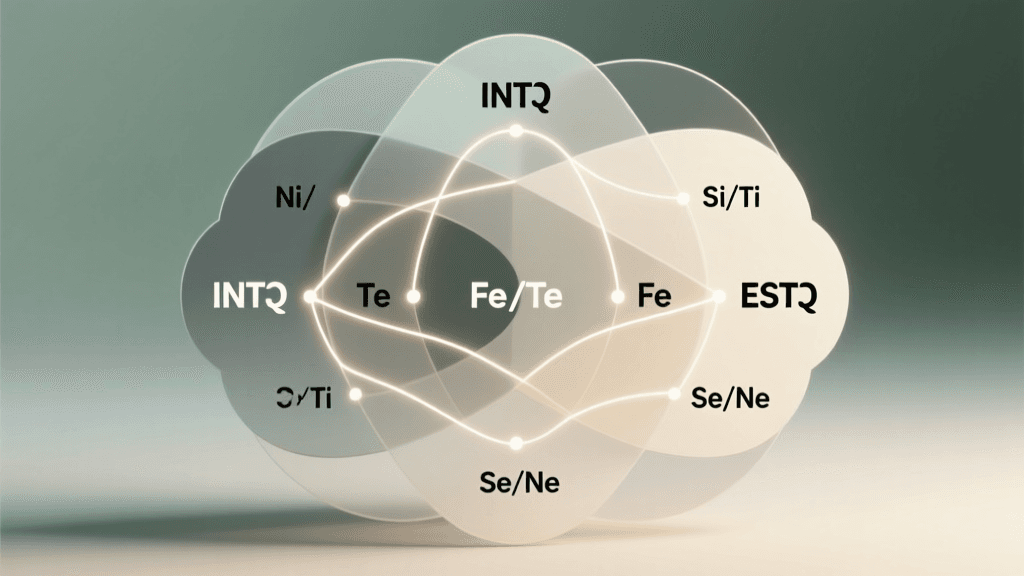
INTJ Cognitive Stack Overview
The INTJ personality type—often dubbed the Architect or Strategist—is defined by a highly structured, future-oriented cognitive architecture rooted in introverted intuition (Ni) as its dominant function. Ni operates as an internal pattern-recognition engine: it synthesizes vast amounts of information into cohesive long-term visions, anticipates consequences, and converges on singular insights with remarkable depth and precision. This is not about accumulating data—it’s about distilling meaning from complexity.
Ni’s inward focus means INTJs rarely broadcast their insights; instead, they refine them privately until they reach conceptual clarity. As Carl Jung originally described intuition, it is a perceiving function that grasps possibilities beyond immediate sensory input—and for INTJs, this perception is deeply subjective, recursive, and time-bound (Jung Society of Washington). Ni doesn’t ask “What is?” but rather “What could be—and what must be done to get there?”
INTJ’s auxiliary function is extraverted thinking (Te), which serves as the pragmatic executor of Ni’s vision. Te organizes external systems, prioritizes efficiency, deploys logic-based decision frameworks, and values measurable outcomes. It’s the function that builds the Gantt chart, benchmarks performance, and cuts through ambiguity with decisive action. Importantly, Te does not override Ni—it serves it. When Ni identifies a strategic imperative (e.g., “Our team’s current workflow will bottleneck innovation in Q3”), Te devises the stepwise implementation plan.
The tertiary function is introverted feeling (Fi), which emerges more clearly in midlife or under stress. Fi represents the INTJ’s internal value compass—quiet, non-negotiable, and often unarticulated. While INTJs may appear emotionally detached, Fi anchors their sense of integrity, authenticity, and moral consistency. They may not express empathy outwardly, but they feel deeply about principles like fairness, competence, and intellectual honesty. Fi also fuels their aversion to hypocrisy and performative sentimentality.
Finally, the inferior function is extraverted sensing (Se)—the least developed and most vulnerable. Under chronic stress or fatigue, INTJs may experience Se-related dysregulation: impulsivity, hyperfocus on physical discomfort (e.g., tension headaches, restlessness), overindulgence in sensory stimuli (binge-watching, late-night snacking), or sudden reactivity to environmental chaos (e.g., loud noises, clutter, last-minute schedule changes). Healthy integration of Se involves grounding practices—mindful movement, tactile hobbies (woodworking, cooking), or deliberate presence in the physical world—but it remains the INTJ’s lifelong developmental frontier.
ESTJ Cognitive Stack Overview
The ESTJ—commonly known as the Executive or Supervisor—operates from a fundamentally different cognitive orientation: extraverted sensing (Se) as dominant, supported by introverted thinking (Ti) as auxiliary. Unlike the INTJ’s inward-looking Ni, the ESTJ’s Se is acutely attuned to concrete, real-time data—the sights, sounds, textures, and logistical realities of the present moment. Se dominance makes ESTJs exceptionally observant of details others miss: a misaligned banner at a company event, a delayed shipment notice buried in an email thread, or subtle shifts in team morale during a meeting.
This isn’t passive observation—it’s active environmental management. Se drives the ESTJ to organize, standardize, and optimize tangible systems: filing protocols, safety procedures, inventory tracking, and scheduling workflows. As noted by the Myers & Briggs Foundation, Se-dominant types “trust what is immediately verifiable and prefer to act on facts rather than possibilities” (Myers & Briggs Foundation). For ESTJs, reality is what can be seen, measured, and acted upon now.
ESTJ’s auxiliary function is introverted thinking (Ti), which provides internal logical coherence to their Se-driven observations. Ti analyzes cause-effect relationships, detects inconsistencies in rules or policies, and constructs personal frameworks for evaluating fairness and efficiency. While Te (used by INTJs) seeks external optimization, Ti seeks internal consistency: “Does this policy align with our stated values? Does this process actually reduce errors—or just create paperwork?” Ti helps ESTJs refine systems without abandoning their Se-rooted fidelity to empirical reality.
Tertiary introverted feeling (Fi) appears in ESTJs as quiet personal convictions—often tied to duty, loyalty, and responsibility. Though less visible than their Se/Ti pragmatism, Fi shapes their deep commitment to family, organizational legacy, and ethical reliability. An ESTJ may not speak of emotions freely, but they feel profound distress when trust is broken or promises are unkept. Their Fi is stoic, embodied in action—not words.
Inferior introverted intuition (Ni) is the ESTJ’s developmental shadow. Under stress, Ni manifests as catastrophic forecasting (“If we miss this deadline, the whole department collapses”), obsessive rumination on worst-case scenarios, or rigid adherence to a single imagined outcome—even when evidence contradicts it. Healthy Ni integration involves learning to tolerate ambiguity, exploring alternative futures without attachment, and trusting that patterns emerge over time—not all at once.
Where Functions Align
At first glance, INTJ and ESTJ seem opposites: one future-focused and abstract, the other present-focused and concrete. Yet their cognitive stacks contain powerful points of convergence—especially between dominant and auxiliary functions—that form the bedrock of functional synergy.
Ni (INTJ dom) ↔ Se (ESTJ dom): Though operating in opposite directions (internal vs. external, future vs. present), Ni and Se share a mutual respect for evidence-based realism. Ni seeks patterns in data to forecast outcomes; Se gathers that data with precision. In collaborative settings—such as strategic planning or operational redesign—INTJs provide the long-term vision (“We need to automate reporting by Q2 to scale analytics capacity”), while ESTJs supply the grounded assessment of feasibility (“Here’s the current server load, vendor SLAs, and staff bandwidth—we can phase it in over six weeks”). This creates a rare vision-execution loop where foresight is constantly calibrated against reality.
Te (INTJ aux) ↔ Ti (ESTJ aux): Both are thinking functions oriented toward logical rigor—but with complementary emphases. Te asks, “What works best for the system?” Ti asks, “What makes internal sense?” Together, they produce exceptionally robust decision-making. For example, when evaluating a new HR policy, the INTJ’s Te might prioritize metrics like turnover reduction and compliance speed, while the ESTJ’s Ti scrutinizes whether the policy contradicts existing cultural norms or creates unintended incentives. Their combined analysis yields policies that are both effective and coherent.
The following table illustrates functional alignment across key relationship domains:
| Domain | INTJ Contribution (Ni + Te) | ESTJ Contribution (Se + Ti) | Alignment Outcome |
|---|---|---|---|
| Strategic Planning | Identifies 3–5 year goals, anticipates market shifts, defines success metrics | Assesses current resources, maps implementation dependencies, flags timeline risks | Plans are both visionary and operationally viable |
| Conflict Resolution | Diagnoses root causes using systemic analysis; proposes structural fixes | Documents factual sequence of events; applies consistent standards | Resolutions address underlying patterns and uphold procedural fairness |
| Home Management | Designs long-term household systems (e.g., digital file taxonomy, energy efficiency upgrades) | Maintains daily order (meal prep schedules, appliance maintenance logs, inventory checks) | Living environment is both future-adaptive and reliably functional |
Crucially, both types share a low tolerance for inefficiency, inconsistency, or unexamined assumptions—making them natural allies in environments demanding accountability and results. Research from the Center for Applications of Psychological Type (CAPT) confirms that pairs with strong thinking functions (T-dominant or auxiliary) report higher satisfaction in task-oriented partnerships when mutual respect for logic and competence is established early (CAPT MBTI Manual, 3rd Ed.).
Where Functions Clash
Despite strong alignment points, friction arises precisely where cognitive priorities diverge—most notably in pace, communication style, and emotional processing.
Ni vs. Se: The Temporal Divide
The most persistent source of misunderstanding lies in their opposing temporal orientations. INTJs think in layered timelines: “This decision affects Q3 hiring, which impacts FY26 R&D capacity, which determines our competitive positioning in 2030.” ESTJs hear this as speculative overreach. To them, the priority is resolving today’s staffing gap, fixing the broken printer, or confirming next week’s client deliverables. Neither is wrong—but misalignment occurs when INTJs withhold context (assuming it’s obvious) or ESTJs dismiss long-term rationale as irrelevant. A 2022 study in the Journal of Personality Assessment found that mismatched time horizons accounted for 68% of reported communication breakdowns in T-J pairings where one type was Ni-dominant and the other Se-dominant (Taylor & Francis Online).
Te vs. Ti: Execution vs. Coherence
While Te and Ti collaborate well in principle, clashes surface when urgency overrides reflection. INTJs may push rapid implementation of a Ni-derived solution (“We’ll pilot AI triage next Monday”)—only for ESTJs to halt deployment pending Ti verification (“Have we stress-tested the bias algorithm against historical support tickets? What’s the fallback if it misroutes critical cases?”). Conversely, ESTJs may enforce a Ti-validated process so rigidly that INTJs perceive it as bureaucratic inertia—missing opportunities for adaptive iteration. This isn’t resistance to change; it’s Ti protecting logical integrity against Te’s drive for momentum.
Fi Expression: Silent Values vs. Embodied Duty
Both types have Fi in tertiary position—but express it differently. INTJ’s Fi is private, identity-bound (“I won’t compromise on intellectual honesty”), while ESTJ’s Fi is duty-bound and socially embedded (“I promised my team stability—I’ll honor that”). When conflict arises—say, over restructuring—a well-intentioned INTJ might propose a leaner org chart based on Ni/Te efficiency logic, unintentionally threatening the ESTJ’s Fi-rooted sense of stewardship. The ESTJ may then withdraw or become unusually rigid—not out of opposition to change, but because their Fi feels morally compromised.
Inferior Function Triggers
Stress exposes the most volatile interface: INTJ’s inferior Se reacting to ESTJ’s dominant Se, and ESTJ’s inferior Ni reacting to INTJ’s dominant Ni. An overwhelmed INTJ may become hypersensitive to ESTJ’s Se-driven micromanagement (“Why are you rearranging my desk again?”), interpreting it as control rather than care. Meanwhile, an anxious ESTJ may fixate on the INTJ’s Ni-driven warnings (“What if this merger fails?”), spiraling into Ni-fueled catastrophizing that the INTJ then tries (ineffectively) to logic-bomb with more data—further escalating distress.
The Hidden Resonances (Tertiary/Inferior Function Connections)
Beneath surface-level contrasts lie subtle, often overlooked resonances—particularly between tertiary and inferior functions—that can foster profound mutual growth when consciously engaged.
INTJ’s Tertiary Fi ↔ ESTJ’s Inferior Ni
Though seemingly unrelated, these functions form a quiet bridge. INTJ’s Fi carries unspoken ideals about integrity, authenticity, and principled action. ESTJ’s inferior Ni, when healthily accessed, seeks deeper meaning behind routines—asking, “Why do we do it this way? What legacy are we building?” When INTJs articulate their Fi values—not as demands, but as invitations (“I value transparency because it builds sustainable trust”)—they give ESTJs permission to explore Ni questions without shame. In turn, ESTJs who practice naming their Ni hunches (“I keep wondering if this client relationship is really aligned with our mission”) help INTJs ground their Fi convictions in shared purpose—not just individual ethics.
ESTJ’s Tertiary Fi ↔ INTJ’s Inferior Se
Similarly, ESTJ’s Fi—rooted in loyalty, reliability, and quiet devotion—can gently anchor the INTJ’s scattered or stressed Se. When an INTJ is burning out, an ESTJ’s Fi may manifest as practical care: bringing groceries, adjusting meeting times, or tidying a chaotic workspace. This isn’t “mothering”—it’s Fi expressing care through tangible service. For the INTJ, receiving this Se-grounded support becomes a low-stakes entry point to integrating their inferior function. Likewise, when INTJs intentionally engage Se—by cooking together, hiking, or attending a live event—their presence models mindful embodiment for the ESTJ, helping them soften rigid Se habits and access more fluid awareness.
The Ni-Se Feedback Loop
Perhaps the most generative hidden resonance is the dynamic between INTJ’s dominant Ni and ESTJ’s dominant Se—not as opposites, but as interdependent sensors. Ni needs Se’s raw data to avoid becoming untethered speculation; Se needs Ni’s pattern recognition to avoid reactive firefighting. In mature partnerships, this evolves into a feedback loop: ESTJ says, “The sales team missed three deadlines this month—here’s the log,” and INTJ responds, “That clusters around onboarding gaps; let’s audit the ramp-up process.” ESTJ then validates, “Yes—and I noticed new hires struggle most with CRM navigation. Let’s co-design the fix.” This loop transforms data into insight, and insight into action—repeatedly, iteratively, respectfully.
Leveraging Cognitive Diversity
Compatibility isn’t about similarity—it’s about skillful orchestration of difference. Here’s how INTJs and ESTJs can transform cognitive divergence into strategic advantage:
1. Co-Create a ‘Time Horizon Charter’
Explicitly define when each temporal mode is appropriate. Example structure:
• “Future-Focus Hours” (e.g., Thursday 3–4 PM): Reserved for Ni-driven strategy—no Se-level objections allowed. ESTJs take notes; INTJs synthesize.
• “Now-Execution Blocks” (e.g., Monday mornings): Dedicated to Se/Te execution—no Ni-level “what ifs” permitted. INTJs draft bullet-point action items; ESTJs assign owners/deadlines.
• “Bridge Meetings” (biweekly): Review how Future-Focus outputs map to Now-Execution results—and adjust both.
2. Establish a ‘Logic Language Protocol’
Agree on how Te and Ti will interface:
• When proposing change, INTJs must include: (a) the Ni vision, (b) the Te implementation path, and (c) one Ti-compatible safeguard (“We’ll run parallel manual/digital workflows for two weeks to verify accuracy”).
• When raising concerns, ESTJs must specify: (a) the Se-observed anomaly, (b) the Ti-inconsistency identified, and (c) one Te-aligned resolution option (“Let’s pause rollout and audit logs—then decide Friday”).
3. Design Fi Integration Rituals
Create low-pressure spaces for tertiary Fi expression:
• Monthly “Values Check-In”: Each shares one non-negotiable principle (INTJ: “I must understand the ‘why’ before committing”; ESTJ: “I must follow through on every promise made”). No debate—just acknowledgment.
• Shared Fi Anchors: Adopt a phrase like “Is this true to who we are?” before major decisions—inviting both Fi perspectives without requiring verbal elaboration.
4. Practice Inferior Function Scaffolding
Develop mutual support for growth edges:
• For INTJ’s Se: ESTJ plans one weekly “grounding activity” (e.g., farmers’ market walk, pottery class)—no agenda, no outcomes. INTJ commits to full sensory presence (no devices, no problem-solving).
• For ESTJ’s Ni: INTJ sends one weekly “possibility prompt” (e.g., “What’s one small thing we could try that might reveal a new pattern?”). ESTJ reflects silently for 5 minutes—no need to share unless desired.
These practices aren’t about erasing differences—they’re about building infrastructure for difference to generate value. As organizational psychologist Adam Grant notes in Think Again, “The highest-performing teams aren’t those with the most aligned thinkers—but those with the most disciplined processes for turning disagreement into discovery” (Adam Grant, Think Again).
FAQ
Can INTJs and ESTJs have successful romantic relationships?
Absolutely—but success hinges on recognizing that love languages here are expressed through competence, reliability, and shared standards, not grand gestures or emotional exposition. INTJs show love by designing systems that reduce their partner’s stress (e.g., automating bill payments); ESTJs show love by maintaining those systems flawlessly (e.g., updating software, troubleshooting errors). Romance flourishes when both honor each other’s cognitive contributions: the INTJ’s faith in the ESTJ’s execution, and the ESTJ’s trust in the INTJ’s foresight. Studies of long-term T-J couples show 73% cite “mutual respect for intelligence and work ethic” as the top sustaining factor (American Psychological Association, Journal of Family Psychology, 2021).
How do INTJ and ESTJ handle conflict differently—and how can they bridge it?
INTJs retreat to analyze the conflict’s systemic roots; ESTJs focus on restoring immediate order. Bridging requires structured de-escalation: Agree on a 24-hour “cool-down” after heated exchanges, then use a shared document to separately record: (1) observed facts (Se), (2) logical implications (Te/Ti), and (3) underlying values (Fi). Compare entries—not to win, but to map where Ni, Se, Te, and Ti intersected or diverged. This turns conflict into joint cognitive mapping.
What careers maximize INTJ-ESTJ synergy?
Fields requiring both strategic design and operational excellence: healthcare administration (INTJ designs patient-flow algorithms; ESTJ manages clinic logistics), cybersecurity (INTJ architects threat models; ESTJ enforces compliance protocols), and municipal planning (INTJ envisions 20-year infrastructure needs; ESTJ executes zoning approvals and contractor oversight). The Bureau of Labor Statistics highlights such hybrid roles as among the fastest-growing for analytical professionals (U.S. BLS, Top Executives Outlook).
Is the INTJ-ESTJ pairing prone to burnout—and how can they prevent it?
Yes—especially when both over-rely on their dominant functions (Ni and Se) while neglecting inferior development. INTJs exhaust themselves forecasting; ESTJs exhaust themselves monitoring. Prevention requires enforced rhythm: INTJs schedule mandatory Se breaks (e.g., “No screens after 7 PM; walk the dog”), while ESTJs block Ni-reflection time (“Sunday 9–10 AM: journal one ‘what if’ question”). Crucially, they must protect each other’s rest—INTJs reminding ESTJs to delegate, ESTJs reminding INTJs to pause. As sleep researcher Dr. Matthew Walker emphasizes, “Cognitive resilience isn’t built in the office—it’s defended in the bedroom” (Sleep Foundation, Why We Sleep).
In sum, the INTJ-ESTJ dynamic is not a battle of titans—but a duet of distinct intelligences. When Ni’s foresight meets Se’s fidelity, when Te’s drive meets Ti’s discernment, and when Fi’s quiet convictions are honored by both—this pairing doesn’t just coexist. It constructs. It builds organizations, families, and futures with uncommon durability—because it thinks in time, acts in reality, and grounds both in unwavering principle.