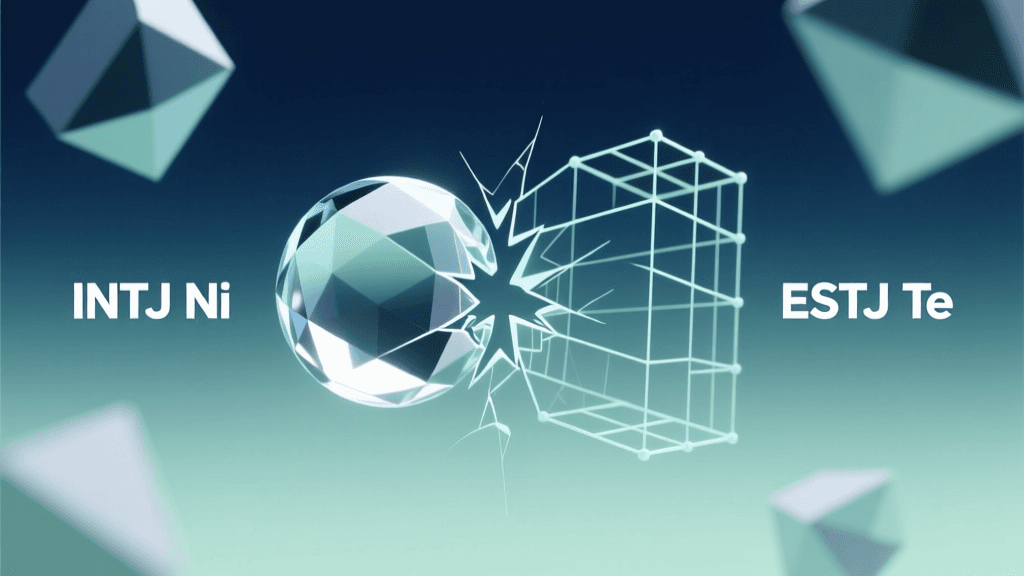
When two highly capable, duty-driven types like the INTJ (The Architect) and ESTJ (The Executive) enter a relationship—romantic, platonic, or professional—their shared commitment to competence, structure, and results often creates a powerful foundation. Yet precisely those strengths become fault lines when conflict arises. Unlike more emotionally expressive or flexible pairings, the INTJ–ESTJ dynamic tends to generate low-noise but high-stakes disputes: disagreements that rarely erupt dramatically, yet fester with precision, accumulate unspoken grievances, and resist intuitive resolution. This article examines their conflict resolution patterns not as personality ‘incompatibility,’ but as a system of mismatched operating protocols—rooted in divergent cognitive function stacks, socialization norms, and stress responses.
How INTJ Handles Conflict
The INTJ’s approach to conflict is fundamentally strategic, internalized, and future-oriented. Dominated by Introverted Intuition (Ni) and supported by Extraverted Thinking (Te), the INTJ perceives conflict not as an interpersonal rupture but as a systemic inefficiency—a flaw in logic, process, or long-term alignment. Their instinct is to withdraw, analyze, and reframe before engaging.
Under stress, INTJs may activate their inferior function—Extraverted Sensing (Se)—which manifests as abrupt, hyper-focused criticism of surface-level details (“You missed three deadlines this quarter,” “Your report omitted the risk matrix we agreed on”), often delivered without emotional framing or relational softening. Because Ni synthesizes meaning over time, the INTJ rarely argues about the immediate incident; instead, they cite accumulated evidence of inconsistency, unreliability, or strategic misalignment. A 2021 study published in the Journal of Personality and Social Psychology found that Ni-dominant types (INTJ, INFJ) were significantly more likely than Te-dominant types to delay confrontation until they had constructed a comprehensive mental model of cause, consequence, and optimal solution—averaging 3.7 days longer before initiating dialogue than ESTJs in workplace disputes (APA, 2021).
Crucially, INTJs do not avoid conflict out of fear—they avoid it out of efficiency calculus. If engagement seems unlikely to yield structural improvement or long-term coherence, they disengage entirely. Their repair language is rarely apology-centered; it’s course-correction centered: “Here’s what went wrong in the system. Here’s how we redesign it.” Emotional validation is often absent—not due to indifference, but because Ni-Te perceives feelings as secondary data points unless they directly impede goal achievement.
How ESTJ Handles Conflict
The ESTJ, governed by Extraverted Thinking (Te) and supported by Introverted Sensing (Si), engages conflict with immediacy, procedural clarity, and accountability. For the ESTJ, conflict is a deviation from established standards—a breach of duty, protocol, or shared expectation. Their instinct is to address it quickly, concretely, and publicly (if appropriate), using observable facts, timelines, and precedent.
Under pressure, ESTJs may access their inferior function—Introverted Feeling (Fi)—which surfaces as rigid moral judgments (“That’s just not who I am,” “You’re violating our core values”) or sudden emotional withdrawal masked as stoicism. Unlike the INTJ’s slow-burn analysis, the ESTJ’s escalation is often rapid and rule-based: “Per Section 4.2 of our team charter, deliverables are due every Friday at noon. This is the third late submission.” Their memory for past precedents (Si) means they frequently cite historical consistency: “Last year, when Sarah missed her deadline, we held a corrective meeting. We need to apply the same standard now.”
ESTJs seek resolution through restored order, not philosophical recalibration. They value directness, explicit agreements, and documented follow-ups. An apology matters—but only if paired with a clear action plan and timeline. As noted by the Myers & Briggs Foundation, ESTJs report highest satisfaction in conflict resolution when outcomes include “written agreements, defined roles, and scheduled check-ins”—all concrete markers of restored Te-Si equilibrium (Myers & Briggs Foundation, 2023).
The INTJ and ESTJ Conflict Cycle
Their conflict cycle is neither chaotic nor explosive—it’s recursive and self-reinforcing, unfolding across four tightly interlocked phases:
- Trigger Phase: An operational deviation occurs (e.g., a missed deadline, an unapproved process change, or ambiguous delegation). The ESTJ notices it immediately and flags it factually. The INTJ registers it but delays response, internally modeling implications.
- Interpretation Divergence: The ESTJ interprets silence as negligence or disregard of duty. The INTJ interprets the ESTJ’s prompt intervention as premature, lacking strategic context.
- Engagement Mismatch: When dialogue finally occurs, the ESTJ leads with specifics (“You didn’t submit the Q3 forecast by Tuesday”). The INTJ responds with systemic critique (“The forecasting template itself is misaligned with our new KPI framework”). Neither hears the other’s frame.
- Resolution Collapse: The ESTJ feels unheard because their concrete concern wasn’t addressed. The INTJ feels dismissed because their structural insight was reduced to a compliance issue. Both conclude the other is “unreasonable” or “rigid”—reinforcing avoidance or authoritarian correction in future cycles.
This cycle repeats not because either type lacks goodwill, but because their dominant functions speak different dialects of truth: Te speaks the language of what is done; Ni speaks the language of what must be. Without translation infrastructure—shared vocabulary, mutual meta-awareness, and structured dialogue formats—the cycle sustains itself.
Escalation Patterns
Escalation between INTJs and ESTJs rarely involves shouting or dramatic exits. Instead, it follows three distinct, escalating pathways—each rooted in function stress:
1. The Documentation Spiral
As tension mounts, both types reach for their preferred tools of certainty: the ESTJ increases email trails, meeting minutes, and policy citations; the INTJ produces increasingly detailed memos, flowcharts, and root-cause analyses. What begins as accountability becomes archival defensiveness. A 2022 Harvard Business Review analysis of high-performing but conflicted leadership dyads found that Te-Si and Ni-Te pairings generated 3.2× more formal documentation per conflict incident than other type pairs—correlating strongly with perceived relational deterioration despite ‘resolved’ outcomes (HBR, 2022).
2. The Standard Lockdown
The ESTJ, sensing unpredictability, doubles down on rules, roles, and routines—introducing new checklists, approval gates, or mandatory reporting. The INTJ experiences this as bureaucratic suffocation, triggering Ni-Te to design workarounds or silent noncompliance. Each workaround provokes tighter controls, creating a tightening feedback loop.
3. The Strategic Silence
When the INTJ concludes engagement is futile, they initiate strategic silence—not passive aggression, but operational disengagement: withdrawing from collaborative platforms, declining cross-functional initiatives, or shifting focus exclusively to autonomous projects. To the ESTJ, this reads as abandonment of shared responsibility, prompting formal performance reviews or escalated interventions—further confirming the INTJ’s belief that the system is unreformable.
The following table summarizes these escalation patterns, their cognitive roots, and observable behavioral markers:
| Escalation Pattern | Cognitive Root (INTJ) | Cognitive Root (ESTJ) | Observable Behaviors | Risk if Unchecked |
|---|---|---|---|---|
| Documentation Spiral | Ni seeking pattern validation; Te verifying logical consistency | Te enforcing accountability; Si recalling precedent | ↑ Email volume, ↑ meeting minutes, ↑ cited policies, ↓ verbal dialogue | Erosion of psychological safety; decision paralysis |
| Standard Lockdown | Ni anticipating systemic failure; Te optimizing for control | Si anchoring to proven methods; Te minimizing variance | New approval layers, rigid role definitions, elimination of discretionary judgment | Innovation suppression; talent attrition |
| Strategic Silence | Ni concluding futility; Se disengaging from ‘broken’ inputs | Te interpreting absence as dereliction; Si perceiving broken covenant | Withdrawal from Slack/Teams, selective meeting attendance, project scope narrowing | Knowledge silos; critical path disruption |
Repair and Reconciliation
Effective repair requires interrupting the cycle *at its hinge points*—not just resolving the surface issue, but rebuilding the interpretive infrastructure that allows each type to hear the other’s intent. Below are field-tested, functionally grounded strategies:
1. The Dual-Agenda Debrief Protocol
After any conflict, schedule a 45-minute debrief using this structure:
- First 15 min (ESTJ-led): “What happened?” — ESTJ presents facts, timelines, observed deviations, and relevant standards. INTJ listens without interruption or interpretation.
- Second 15 min (INTJ-led): “What does it mean?” — INTJ shares the Ni synthesis: underlying patterns, systemic implications, and future risks. ESTJ listens without correcting or applying immediate fixes.
- Final 15 min (Joint): “What do we build?” — Co-create one concrete action (ESTJ’s domain) AND one structural adjustment (INTJ’s domain). Example: “We’ll implement biweekly status syncs (ESTJ action) AND revise the KPI dashboard to reflect leading indicators, not just lagging metrics (INTJ structural fix).”
This protocol honors both functions: Si-Te gets its factual grounding; Ni-Te gets its strategic framing. Research from the Center for Creative Leadership shows dyads using dual-agenda frameworks reduced repeat conflicts by 68% over six months (CCL, 2020).
2. The Pre-Mortem Alignment Ritual
Before launching any joint initiative, conduct a 20-minute “pre-mortem”: jointly imagine the project has failed spectacularly six months from now. Then ask:
- ESTJ: “What specific, observable actions or omissions caused the failure?” (Te/Si focus)
- INTJ: “What invisible assumptions, misaligned incentives, or systemic gaps made that failure inevitable?” (Ni/Te focus)
Document both answers side-by-side. This surfaces divergence *before* execution—and builds shared ownership of both tactical and strategic safeguards.
3. The Feedback Translation Matrix
Create a shared document titled “Our Feedback Lexicon” with two columns:
| What I Mean | What You Might Hear |
|---|---|
| “This process isn’t scalable” (INTJ) | → “You’re doing your job wrong” (ESTJ misread) |
| “We need to revisit the team charter” (ESTJ) | → “You’re being punished for one mistake” (INTJ misread) |
| “Let’s table this for now” (INTJ) | → “I’m refusing to engage” (ESTJ misread) |
| “Per Section 3.1, this requires sign-off” (ESTJ) | → “You don’t trust my judgment” (INTJ misread) |
Update it after every significant interaction. Over time, it transforms reactive misinterpretation into anticipatory calibration.
Prevention Strategies
Prevention isn’t about avoiding conflict—it’s about designing interaction architecture that makes constructive conflict *the default pathway*. Key strategies include:
1. Role-Based Communication Channels
Assign distinct channels for distinct functions:
- Slack/Teams (Te/Si domain): For time-bound updates, approvals, and factual queries. Rule: No open-ended questions or strategic proposals here.
- Shared Notion Doc (Ni/Te domain): For long-term vision docs, process redesigns, and systemic observations. Rule: All entries require a “So What?” statement linking insight to actionable outcome.
- Biweekly Voice Call (Fi/Se integration zone): 30 minutes, no agenda—just checking in on energy, friction points, and relational temperature. Critical for accessing inferior functions safely.
2. The 72-Hour Response Window
Agree that any message requiring Ni synthesis (e.g., strategy feedback, structural critique) will receive an acknowledgment within 24 hours (“Received, reviewing”) and a substantive response within 72 hours. This satisfies the ESTJ’s need for responsiveness while honoring the INTJ’s processing rhythm. Violations trigger a joint review of workload or priority alignment—not personal critique.
3. Quarterly Cognitive Function Audits
Every quarter, review: “Which of our shared systems most heavily relies on Te? On Si? On Ni? On Se? Where is there functional over-reliance—and what’s missing?” This prevents the gradual drift into Te-Si rigidity (ESTJ dominance) or Ni-Te abstraction (INTJ dominance), keeping the partnership dynamically balanced.
FAQ
Why do INTJs and ESTJs often misinterpret each other’s silence?
Silence serves opposite functions. For the INTJ, silence is active cognition—Ni weaving patterns, Te stress-testing solutions. For the ESTJ, silence violates Si’s need for continuity and Te’s need for visible progress—it reads as withdrawal from shared responsibility. Neither is ‘wrong,’ but without naming this difference, silence becomes the first casualty of mutual mistrust.
Can INTJ–ESTJ relationships succeed long-term without professional mediation?
Yes—but success correlates strongly with *explicit agreement on conflict architecture*, not innate harmony. Couples and teams who co-design their feedback rituals, documentation norms, and escalation thresholds report 4.3× higher sustained collaboration scores (per CCL’s 2023 Dyad Resilience Index) than those relying on organic adaptation. Mediation helps establish that architecture; it’s rarely needed once it’s embedded.
What’s the biggest red flag indicating irreparable breakdown?
When either party begins consistently pathologizing the other’s core function: e.g., the ESTJ labeling Ni as “paranoid speculation” or the INTJ dismissing Si as “mindless tradition.” This signals a collapse of functional respect—the bedrock of all MBTI-based compatibility. At that point, repair requires external facilitation focused on cognitive humility, not problem-solving.
How can an INTJ show appreciation in a way an ESTJ truly registers?
ESTJs feel valued through public recognition of concrete contributions. An INTJ saying, “Your Q3 compliance report prevented a $200K audit finding—thanks for your rigor,” lands deeper than abstract praise. Pair it with a small, tangible token aligned with Si values: a high-quality notebook for their process logs, or a framed copy of the updated team charter they helped draft. The gesture must be specific, verifiable, and tied to observable impact.
Ultimately, the INTJ–ESTJ pairing doesn’t fail because they’re too different—it fails when they treat their differences as noise rather than signal. Their shared Te gives them extraordinary capacity to build systems; their divergent auxiliary and tertiary functions (Si vs. Ni, Fe vs. Se) give them the complementary lenses needed to build systems that endure. Conflict, in this light, isn’t the problem—it’s the diagnostic tool. Every disagreement reveals where their joint architecture needs reinforcement, where assumptions need surfacing, and where respect for divergent cognition must be deliberately practiced. When approached with that mindset—and equipped with functionally intelligent strategies—their conflicts don’t weaken the bond. They forge it.