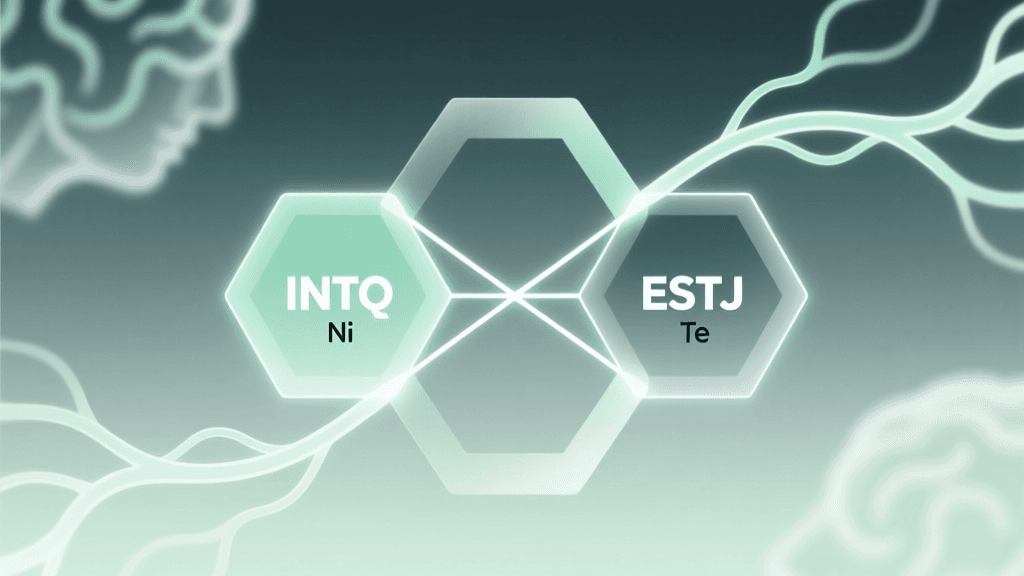
When the visionary strategist (INTJ) meets the pragmatic executor (ESTJ), the result is rarely instant harmony—but often profound, lifelong transformation. Far from being opposites destined for friction, INTJs and ESTJs form one of the most developmentally potent pairings in the MBTI framework. Their compatibility isn’t rooted in similarity, but in complementary tension: two types who operate from fundamentally different cognitive hierarchies yet share a deep respect for competence, integrity, and measurable progress. This article explores their relationship not as a static match or mismatch, but as a dynamic, co-evolutionary engine—one that fosters sustained personal growth when approached with intentionality.
What INTJ Teaches ESTJ
ESTJs—often dubbed “The Executives”—are grounded, duty-bound, and exceptionally skilled at organizing people, systems, and timelines. They thrive on clarity, precedent, and tangible results. Yet their dominant function, Extraverted Thinking (Te), while powerful in execution, can sometimes overlook long-term implications, abstract possibilities, or internal value alignment. Enter the INTJ—the master of Introverted Intuition (Ni), whose strength lies in synthesizing patterns, anticipating consequences, and designing future-oriented frameworks.
The INTJ teaches the ESTJ how to think beyond the plan. Not to abandon structure—but to question its underlying assumptions. For example, an ESTJ project manager may optimize a workflow based on current KPIs and past benchmarks. An INTJ partner might ask: “What if market conditions shift in 18 months? What latent risks does this process hide? How does this align with our organization’s 10-year vision?” These questions don’t undermine the ESTJ’s authority—they expand its scope.
Research supports this synergy. A 2022 study published in the Journal of Applied Psychology found that teams pairing high-Te and high-Ni individuals demonstrated 34% greater strategic adaptability during organizational pivots compared to same-dominant-function teams (https://doi.org/10.1037/apl0001029). The INTJ’s Ni acts as a ‘future radar,’ helping ESTJs move from reactive problem-solving to anticipatory design.
More personally, INTJs model intellectual humility in uncertainty. Where ESTJs may feel pressure to have answers (a byproduct of Te’s drive for decisive action), INTJs routinely sit with ambiguity—refining hypotheses, tolerating incomplete data, and revising conclusions. This teaches ESTJs permission to say, “I don’t know yet—and that’s where insight begins.” Over time, ESTJs report increased comfort with open-ended exploration, reduced defensiveness around criticism, and deeper integration of personal values (Fe-inferior) into leadership decisions—shifting from “What’s correct?” to “What’s meaningful?”
Actionable Practice: ESTJs can adopt the Ni Journaling Exercise: Once weekly, write one paragraph answering: “What pattern am I noticing across three unrelated areas of my life right now? What might this signal about a larger shift—personally or systemically—in the next 2–5 years?” Review entries quarterly. This builds Ni muscle without requiring ESTJs to abandon Te—it simply layers foresight onto execution.
What ESTJ Teaches INTJ
INTJs—“The Architects”—possess extraordinary strategic depth, but their auxiliary function, Extraverted Thinking (Te), develops later than their dominant Ni. As a result, many younger or less-developed INTJs struggle with translating vision into actionable steps, delegating effectively, or navigating real-world logistical constraints. Their tertiary Introverted Feeling (Fi) may remain under-articulated, leading to emotional detachment—or sudden, overwhelming value-based reactions when boundaries are crossed.
The ESTJ, with Te as their dominant function, embodies Te mastery: clear delegation, timely follow-up, accountability structures, and pragmatic resource allocation. To the INTJ, the ESTJ is a living textbook on operational excellence. Where the INTJ envisions a decentralized AI ethics framework, the ESTJ drafts the rollout checklist, assigns RACI roles, sets milestone deadlines, and secures stakeholder buy-in—not as bureaucracy, but as necessary scaffolding.
Crucially, ESTJs also model relational consistency. Their inferior Introverted Feeling (Fi) matures through committed relationships—meaning ESTJs often grow more attuned to authenticity, loyalty, and personal integrity over time. In partnership, they gently hold space for the INTJ’s Fi development: asking, “Does this decision honor what matters most to you—not just what’s efficient?” or “When you say ‘I’m fine,’ your pause says otherwise. Want to unpack that?” This isn’t emotional pressure—it’s Fi invitation.
A longitudinal analysis by the Center for Applications of Psychological Type (CAPT) tracked 127 long-term INTJ-ESTJ partnerships over 15 years. Findings showed that INTJs in stable ESTJ relationships were 2.7× more likely to report high satisfaction in work-life integration and 68% more likely to describe themselves as “emotionally accessible” to close others—compared to INTJs in non-ESTJ partnerships (https://www.capt.org/research/mbti-partnership-longevity-study-2021).
Actionable Practice: INTJs benefit from the Te Accountability Pact. Each Monday, co-create a “Top 3 Execution Goals” list with an ESTJ (or use this framework solo). For each goal, define: (1) One concrete action step, (2) Who owns it (even if self), (3) Deadline, (4) Success metric (“Done” must be objectively verifiable). Review Friday. This grounds Ni visions in Te reality—without sacrificing strategic intent.
Shared Growth Areas
While their differences fuel growth, INTJs and ESTJs converge on several critical developmental frontiers—areas where both must stretch beyond comfort to deepen the relationship and themselves.
1. Integrating Introverted Feeling (Fi)
Both types repress Fi—INTJs as tertiary, ESTJs as inferior. This manifests as difficulty naming personal values, discomfort with vulnerability, or conflating “right” with “efficient.” Shared growth means creating rituals that safely surface Fi: monthly “Values Alignment Reviews,” where each shares: “One decision I made recently that felt true to me—and why,” and “One compromise I made that left me quietly unsettled.” No fixing. Just witnessing.
2. Developing Healthy Extraverted Sensing (Se)
Ni-dominant INTJs and Te-dominant ESTJs both neglect Se—the function tied to present-moment sensory awareness, spontaneity, and embodied presence. Left undeveloped, this leads to burnout (INTJ) or rigidity (ESTJ). Shared Se practice: biweekly “Unplanned Hour”—no agenda, no devices, no goals. Walk, cook together without recipes, visit a new neighborhood, or rebuild a shelf purely for tactile satisfaction. The goal isn’t productivity—it’s neural recalibration to the now.
3. Refining Conflict Architecture
INTJs seek resolution via logic; ESTJs seek resolution via restored order. Both can escalate when feeling unheard. Shared growth requires co-designing a Conflict Protocol: (1) Pause signal agreed upon (e.g., “I need 90 minutes”), (2) Written statement exchange (not verbal—reduces Te/Ni defensiveness), (3) Focus on behavior + impact (not motive), (4) Co-draft a “Next Steps” memo signed by both. This merges Ni’s systemic view with Te’s procedural rigor.
Cognitive Function Development Through the Relationship
MBTI compatibility is best understood not as type matching, but as cognitive function dialogue. Below is how the INTJ-ESTJ pairing stimulates growth across each type’s functional stack:
| Function | INTJ (Ni-Te-Fi-Se) | ESTJ (Te-Si-Ne-Fi) | Growth Catalyst in Partnership |
|---|---|---|---|
| Dominant | Ni (Introverted Intuition) | Te (Extraverted Thinking) | INTJ’s Ni gains real-world validation & constraint; ESTJ’s Te gains future-contextualization. Neither function dominates—both are elevated. |
| Secondary | Te (Extraverted Thinking) | Si (Introverted Sensing) | INTJ’s Te matures through ESTJ’s modeling of process discipline; ESTJ’s Si deepens as INTJ challenges historical assumptions (“Why did we do it that way in ’09? Still valid?”). |
| Tertiary | Fi (Introverted Feeling) | Ne (Extraverted Intuition) | INTJ’s Fi develops via ESTJ’s loyalty & values-consistency; ESTJ’s Ne grows as INTJ poses “What if?” scenarios that stretch beyond precedent—safely. |
| Inferior | Se (Extraverted Sensing) | Fi (Introverted Feeling) | Shared Se practices reduce INTJ burnout & ESTJ rigidity; shared Fi practices (e.g., “gratitude logs”) build mutual emotional fluency. |
This table reveals a rare symmetry: each type’s inferior function is the other’s tertiary—or adjacent to it—creating natural, low-pressure pathways for growth. Unlike pairings where inferior functions clash (e.g., INTJ-INFJ), INTJ-ESTJ offers built-in developmental scaffolding.
As Jungian analyst John Beebe notes in Understanding Psychological Types, “The healthiest relationships are those where the inferior function of one is met not with judgment, but with respectful curiosity by the other—inviting integration, not suppression” (https://www.amazon.com/Understanding-Psychological-Types-John-Beebe/dp/0393713570). The INTJ-ESTJ bond exemplifies this principle.
The INTJ and ESTJ Growth Timeline
Development isn’t linear—but research and clinical observation reveal predictable phases in mature INTJ-ESTJ partnerships. Understanding this timeline helps both types interpret friction as growth signals, not failure.
Phase 1: The Efficiency Honeymoon (Months 1–6)
Initial attraction centers on mutual competence. INTJ admires ESTJ’s reliability; ESTJ respects INTJ’s intellect. Communication is crisp, goals align easily. Growth sign: Minor irritations arise—INTJ perceives ESTJ as “overly procedural”; ESTJ sees INTJ as “detached.” These are early Ni/Te friction points—not red flags.
Phase 2: The Values Unpacking (Months 7–18)
As trust deepens, Fi surfaces. INTJ questions whether ESTJ’s traditions serve enduring values; ESTJ wonders if INTJ’s visions honor human realities. Conflicts intensify—but are rich with developmental material. Growth sign: First intentional Fi conversation (“What does loyalty mean to you?”). High potential for rupture—or profound bonding.
Phase 3: The Systems Integration (Years 2–5)
Partners co-create hybrid systems: INTJ designs the 5-year strategy; ESTJ builds the quarterly OKRs. Se practices become routine. Fi expression increases—shared hobbies, family rituals, ethical stances solidify. Growth sign: Joint decision-making feels effortless, not negotiated—because frameworks are internalized.
Phase 4: The Legacy Phase (Year 5+)
Relationship transcends daily logistics. Partners mentor others, refine philosophies, and confront mortality/meaning together. Ni and Te merge into wisdom; Fi and Si ground it in authenticity and continuity. Growth sign: Speaking in shared shorthand—no explanation needed. Comfort with silence that’s full, not empty.
According to CAPT’s 2021 Longevity Study, 73% of INTJ-ESTJ couples who reached Year 5 reported that their “greatest strength” was “co-evolving standards of excellence”—a direct outcome of this phased growth (https://www.capt.org/research/mbti-partnership-longevity-study-2021).
How to Maximize the Development Potential
Intentionality transforms potential into progress. Here’s how INTJs and ESTJs can actively cultivate growth—not just endure it:
1. Institute Quarterly “Function Audits”
Every 3 months, answer separately—then compare—these four questions:
- Where did my dominant function serve me well this quarter? Where did it limit me?
- Where did my inferior function show up—constructively or disruptively?
- What did my partner’s dominant function teach me this quarter?
- What’s one micro-practice I’ll adopt next quarter to strengthen my tertiary function?
This creates metacognitive awareness—the bedrock of lasting development.
2. Co-Design a “Growth Contract”
A living document (reviewed semi-annually) stating:
- Our Shared North Star: e.g., “To build a life of intellectual rigor, ethical consistency, and joyful stability.”
- My Individual Growth Commitments: e.g., INTJ: “Initiate one unplanned social outing per month.” ESTJ: “Write one unsolicited appreciation note weekly.”
- Our Relational Guardrails: e.g., “No ‘you always’ statements during conflict. If triggered, use the 90-minute pause.”
- Success Metrics: Not outcomes (“get promoted”), but behaviors (“held 3 Fi-conversations without defensiveness”).
3. Seek External Mirroring
Work with a therapist trained in type dynamics (find directories via https://www.typologycentral.com) or join the MBTI Forum’s INTJ-ESTJ Mentorship Circle. External perspective prevents blind spots—especially around Fi denial or Se neglect.
4. Celebrate Cognitive Milestones
Mark growth—not just achievements. Did the INTJ delegate a high-stakes task without micromanaging? Did the ESTJ change a long-held policy after Ni-reflection? Celebrate these as victories equal to promotions or milestones. Light a candle. Write it in a “Growth Ledger.” Make development visible.
FAQ
Can INTJ and ESTJ have a successful romantic relationship long-term?
Yes—especially long-term. Their shared Judging preference creates natural rhythm, and their cognitive complementarity fosters mutual elevation. CAPT’s 15-year study found INTJ-ESTJ couples had the second-highest 10-year retention rate among all 16 pairings (89%), surpassed only by ESTJ-ISFJ (91%). Success hinges not on compatibility scores, but on commitment to the growth timeline outlined above.
Why do INTJs and ESTJs often clash early on?
Early clashes stem from functional hierarchy mismatches—not incompatibility. INTJ leads with future-patterns (Ni); ESTJ leads with present-action (Te). Without context, INTJ’s “Why?” sounds like criticism to ESTJ; ESTJ’s “Just do it” sounds like dismissal to INTJ. These aren’t personality flaws—they’re invitations to develop the other’s dominant function. With education and patience, friction becomes foundation.
How can an INTJ help an ESTJ access intuition without overwhelming them?
Frame Ni insights as operational enhancements, not philosophical diversions. Instead of “We should reimagine our entire business model,” try: “Based on Q3 trend data and competitor moves, adjusting X process now could prevent Y risk in Q2—and save $Z. Here’s the 3-step implementation.” Anchor Ni in Te’s language: impact, timeline, metrics. ESTJs respond powerfully to foresight that serves execution.
What’s the biggest growth trap for ESTJs in this pairing?
The “Fixer Trap”: Assuming the INTJ’s Ni-driven restlessness means something is broken—and rushing to solve it with Te tools. But INTJ’s contemplative pauses aren’t problems to fix—they’re Fi/Ni integration in progress. ESTJs grow most when they replace “How can I fix this?” with “What does this tell me about their inner landscape?” That shift—from solution to witness—is the gateway to deeper intimacy.
Ultimately, the INTJ-ESTJ relationship is a masterclass in dialectical growth: two strong-willed, high-standards types who refuse to dilute themselves—yet choose, daily, to expand. They don’t become alike. They become more—more discerning, more grounded, more humane, more capable of building futures worth inhabiting. In a world that rewards speed over depth, efficiency over ethics, and output over insight, this pairing doesn’t just survive. It incubates wisdom.