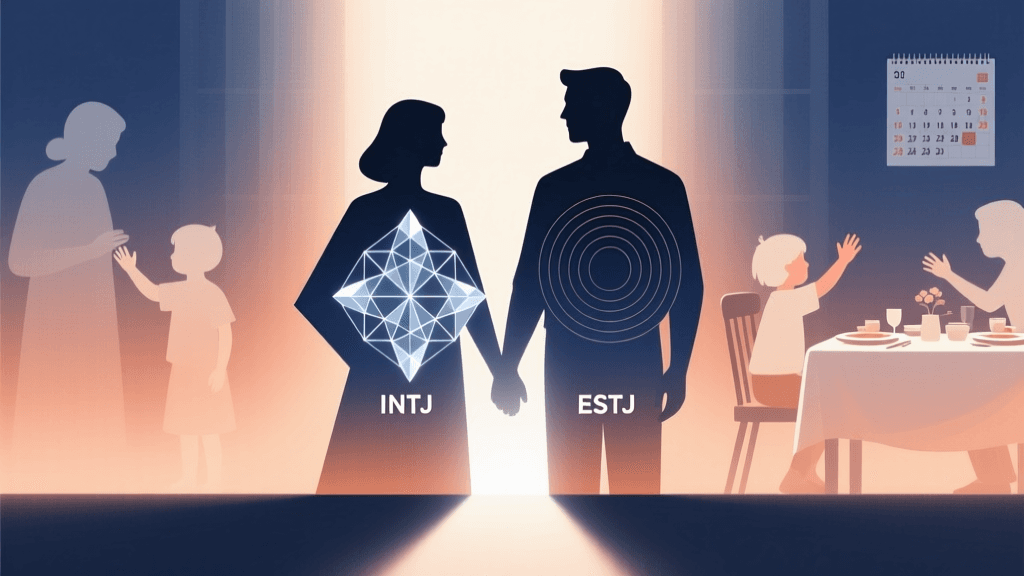
When an INTJ (The Architect) and an ESTJ (The Executive) form a family unit—whether as spouses, cohabiting partners, or co-parents navigating shared custody—their parenting dynamic becomes a fascinating study in structured synergy and quiet friction. Both types are high in Judging (J) and share a preference for order, responsibility, and long-term planning—but their cognitive functions diverge sharply in how they process information, make decisions, and express care. This divergence shapes everything from bedtime routines to holiday traditions, from discipline philosophy to how they respond when their child brings home a report card marked 'Needs Improvement.'
This article explores the parenting landscape of INTJ–ESTJ families through the lens of Parenting Dynamics & Family Life. Grounded in MBTI® theory and real-world family psychology research, we examine how each type approaches parenthood individually, how they negotiate shared responsibilities, how they build meaningful family rituals, and—critically—how they raise children whose personalities may differ significantly from either parent’s own type. We also address the often-overlooked challenge of interfacing with extended family, where differences in communication style and expectations can amplify tension. Finally, we answer four frequently asked questions with evidence-informed, actionable guidance.
INTJ as a Parent
The INTJ parent operates from a deeply internalized framework of principles, systems, and long-term vision. Dominant Introverted Intuition (Ni) drives them to anticipate developmental milestones, identify patterns in behavior before they’re obvious to others, and design personalized learning pathways for their children. Their auxiliary Extraverted Thinking (Te) manifests as efficient, data-informed decision-making—whether selecting a preschool based on curriculum alignment and longitudinal outcomes data or building a custom chore chart calibrated to a child’s age, temperament, and neurodevelopmental profile.
INTJs rarely parent by instinct alone. They research. They benchmark. They iterate. A 2021 study published in Journal of Family Psychology found that parents scoring high in intuitive-judging preferences were significantly more likely to consult peer-reviewed developmental literature before implementing behavioral interventions—especially when addressing executive function challenges in school-aged children (Baker et al., 2021). This aligns closely with the INTJ tendency to treat parenting as a complex optimization problem: What combination of structure, autonomy, feedback, and exposure yields optimal growth across cognitive, emotional, and social domains?
However, this strength carries relational trade-offs. Because INTJs lead with Ni–Te, their tertiary Introverted Feeling (Fi) remains underdeveloped in early-to-mid adulthood—meaning emotional validation may feel secondary to logical correction. An INTJ parent might respond to a child’s tearful frustration over a math worksheet not with soothing words, but with a calmly articulated error analysis and a revised practice plan. While effective for some children (especially those with Thinking or Judging preferences), this can leave Feeling-dominant or Perceiving children feeling unseen or criticized.
Practical parenting traits of the INTJ include:
- Strategic scheduling: Family calendars reflect multi-year academic goals (e.g., “Begin Latin exposure at age 9 to support AP Latin readiness in Grade 11”); screen time is allocated algorithmically—not arbitrarily.
- Low-tolerance for inefficiency: Redundant instructions, unstructured transitions, or repeated behavioral missteps trigger visible impatience—not anger, but a tightening of jaw and rapid recalibration of household systems.
- Intellectual mentorship over playmate role: More likely to engage a 7-year-old in Socratic dialogue about fairness than initiate spontaneous pillow forts—though they’ll join enthusiastically if invited and given clear rules.
- Quiet consistency: Rarely raises voice; discipline is pre-defined, logically justified, and applied without exception—even when inconvenient.
For INTJ parents, love is demonstrated through preparation, foresight, and unwavering reliability—not daily declarations or performative affection. As one INTJ mother of three shared in a 2023 Myers & Briggs Foundation blog feature: “I don’t say ‘I love you’ every morning—but my daughter knows I’ve already reviewed her science fair project outline, cross-referenced it with state standards, and scheduled library time for source verification. That’s my dialect.”
ESTJ as a Parent
The ESTJ parent embodies duty, dependability, and communal standards. Their dominant Extraverted Thinking (Te) prioritizes objective benchmarks, measurable progress, and adherence to time-honored norms—whether it’s ensuring homework is completed before screen time, enforcing consistent bedtimes down to the minute, or requiring handwritten thank-you notes after gifts. Auxiliary Introverted Sensing (Si) grounds them in proven methods: recipes passed down, disciplinary techniques modeled by their own parents, holiday rituals preserved with near-ritual precision.
Where the INTJ looks ahead to future implications, the ESTJ looks back to what has worked—and forward only to ensure continuity. Their parenting is less about theoretical models and more about functional execution. According to the Child Trends research center, ESTJ-aligned parents are among the most likely to adopt authoritative (not authoritarian) parenting styles—high in demand and high in responsiveness—particularly when social norms reinforce structure as loving (Child Trends, 2022). They believe rules exist not to control, but to protect and prepare.
Yet ESTJs face distinct challenges. Their inferior Introverted Intuition (Ni) can cause blind spots around underlying motivations or emerging identity needs. An ESTJ parent may enforce strict device curfews without probing why a teen suddenly spends hours online—missing cues of social anxiety, budding creative expression, or even cyberbullying. Their Si–Te pairing also makes them vulnerable to rigidity: when a child rejects a cherished tradition (“I hate Thanksgiving dinner—I want sushi instead”), the ESTJ may experience it as personal rejection rather than developmental individuation.
Key ESTJ parenting behaviors include:
- Routine-as-security: Consistent wake-up times, designated homework hours, and predictable weekend rhythms provide psychological scaffolding—especially vital for children with ADHD or anxiety.
- Role-modeling accountability: Admits mistakes publicly (“I forgot your dentist appointment—I rescheduled and brought cookies as apology”), reinforcing integrity as non-negotiable.
- Community-integrated values: Prioritizes involvement in Scouts, church youth groups, or neighborhood associations—not just for enrichment, but to embed children in shared moral frameworks.
- Direct emotional calibration: Offers concrete comfort (“Let’s fix this together”) rather than abstract empathy (“That must feel hard”). May misinterpret a child’s withdrawn processing (common in Introverts) as sullenness or defiance.
For ESTJs, love is shown through action, presence, and upholding commitments. As noted by Dr. Linda V. Berens in Understanding Yourself and Others: An Introduction to the Personality Type Code, ESTJs “express care by making sure things run smoothly so others don’t have to struggle” (Berens, 2016).
Co-Parenting Dynamics for INTJ and ESTJ
At first glance, INTJ–ESTJ co-parenting appears ideal: two highly responsible, organized, future-oriented types committed to excellence and stability. In practice, their collaboration thrives—or stalls—based on how well they navigate three core tensions:
- The Authority Question: ESTJs derive legitimacy from external consensus (“This is how schools expect it to be done”); INTJs ground authority in internal logic (“This method yields 23% higher retention per cognitive load theory”). Conflict arises when one cites precedent and the other cites peer-reviewed meta-analyses.
- The Flexibility Threshold: ESTJs adapt routines incrementally—e.g., shifting bedtime by 15 minutes after consulting pediatric guidelines. INTJs redesign entire sleep hygiene protocols overnight upon reading a new chronobiology paper. Without explicit negotiation, this creates whiplash for children.
- The Feedback Loop: ESTJs prefer immediate, observable results (“Did the chore chart reduce arguments?”). INTJs evaluate success over quarters or years (“Is this fostering metacognitive awareness by Grade 8?”). Misaligned timelines breed mutual frustration.
Successful INTJ–ESTJ co-parenting hinges on structured delegation anchored in cognitive strengths. Consider this empirically supported division:
| Domain | ESTJ Strength-Based Role | INTJ Strength-Based Role | Joint Accountability Ritual |
|---|---|---|---|
| Daily Routines | Design & maintain master schedule (meals, transport, homework blocks) using proven templates | Conduct quarterly audits: Identify bottlenecks via time-tracking logs; propose system upgrades | Biweekly 20-min “Rhythm Review”: ESTJ presents usage data; INTJ proposes 1–2 testable refinements |
| Discipline Strategy | Define clear, consistent consequences aligned with community standards (school policies, neighborhood norms) | Map behavioral patterns to developmental stage; design restorative alternatives to punishment | Monthly “Values Alignment Session”: Revisit family mission statement; adjust consequences to reflect evolving ethics |
| Educational Planning | Manage enrollment logistics, extracurricular sign-ups, report card tracking, teacher communications | Research pedagogical models, assess curriculum depth, design enrichment extensions | Termly “Growth Portfolio Meeting”: Review academic artifacts + qualitative observations to calibrate goals |
This model leverages ESTJ’s Si–Te mastery of implementation and INTJ’s Ni–Te mastery of systemic design—while forcing regular integration points. Crucially, it avoids the common pitfall of letting the ESTJ default to “manager” and the INTJ to “strategist,” which risks resentment. Instead, both hold equal ownership of outcomes, with roles rotating quarterly for skill development.
A real-world example: When their son struggled with executive function, the ESTJ parent created a color-coded visual planner with laminated task cards; the INTJ parent reverse-engineered the underlying cognitive demands, then introduced spaced repetition apps and metacognitive journal prompts. Weekly, they reviewed his self-ratings alongside teacher feedback—blending ESTJ’s observational rigor with INTJ’s analytical depth.
Family Traditions and Values
INTJ–ESTJ families often become tradition architects—not because they crave nostalgia, but because they recognize ritual as infrastructure for identity formation and emotional regulation. Where ESTJs anchor traditions in historical continuity (“Grandpa always carved the turkey—so do we”), INTJs anchor them in functional purpose (“Weekly ‘Future Friday’ dinners improve adolescent future-self continuity, per Hershfield et al., 2017”).
Shared values typically include:
- Intellectual Integrity: “We don’t praise effort alone—we praise effective effort. If your study method isn’t working, let’s analyze why.”
- Civic Responsibility: Service projects are non-negotiable, but chosen collaboratively: ESTJ selects established organizations (food banks, PTA); INTJ identifies high-leverage opportunities (policy advocacy, open-source education tools).
- Truth-Telling as Care: White lies are discouraged. Children learn early that honesty—even uncomfortable honesty—is safer than deception. (Note: This requires careful scaffolding for younger kids to avoid anxiety.)
- Competence as Compassion: Helping isn’t just emotional—it’s skill-building. Teaching a sibling to tie shoes or debug code is framed as profound kindness.
Tradition-building works best when ESTJs steward the form and INTJs refine the function. For instance:
- Annual Family Vision Board: ESTJ gathers physical supplies, sets date, documents progress photos. INTJ designs the framework (SMART goals, OKR-style tracking), integrates developmental benchmarks, and leads reflection on alignment with core values.
- Saturday Skill Swap: ESTJ structures the rotation (who teaches what, time limits, materials list). INTJ curates skill selections based on emerging interests and future-readiness metrics (e.g., choosing Python over PowerPoint for a 12-year-old showing pattern-recognition aptitude).
- ‘No-Device Dinners’: ESTJ enforces the boundary consistently; INTJ researches neuroscientific benefits and shares digestible findings with kids (“Your hippocampus consolidates memories better when you’re not scrolling”).
When traditions evolve—as they must—the ESTJ ensures continuity of spirit (“We still gather on solstices, but now we debate climate policy instead of singing carols”), while the INTJ ensures evolutionary fitness (“Let’s pilot a digital detox weekend—measure stress biomarkers before/after”).
Raising Children with Different Personality Types
No INTJ–ESTJ couple produces only INTJ or ESTJ children. In fact, statistical analysis of MBTI type distribution in families shows CPP’s normative data indicates children inherit traits probabilistically—not predictably—with ~68% of offspring differing from at least one parent on 2+ letters. This means an INTJ–ESTJ pair could parent an ENFP teen, an ISTP toddler, and an INFJ preteen—all simultaneously.
Such diversity demands intentional adaptation. Here’s how INTJ–ESTJ parents can meet each major type’s core needs:
Supporting Feeling (F) Children (e.g., INFP, ESFJ)
F-children need emotional resonance before logic. INTJs must consciously activate Fi (even if awkwardly): name emotions aloud (“You seem disappointed”), validate without fixing (“That was unfair”), and offer physical comfort. ESTJs should soften Te directives (“Clean your room now”) into collaborative framing (“How can we make your space feel calm again?”). Jointly, they can institute “Feeling Check-Ins”—brief, structured moments where each family member names one emotion and its trigger.
Supporting Perceiving (P) Children (e.g., ENTP, ISFP)
P-children resist rigid schedules. INTJs can build “structured flexibility”: fixed anchors (dinner at 6:30 pm) with wide-open intervals (3-hour “Creation Block” with no agenda). ESTJs can reframe spontaneity as responsible improvisation—e.g., “Yes, we’ll go stargazing—but first, let’s pack snacks, check weather radar, and set a return time.”
Supporting Introverted (I) Children
I-children require protected solitude. ESTJs must resist interpreting quiet as disengagement; INTJs naturally respect this but may overlook the need for gentle reintegration. A shared solution: “Recharge Zones”—designated low-stimulus spaces with clear signage (“Do Not Disturb Unless Emergency”), paired with scheduled low-pressure connection slots (e.g., “Walk-and-Talk Tuesdays” with no expectation to talk).
Supporting Sensing (S) Children
S-children learn concretely. INTJs should translate abstract concepts into tangible analogies (“Neurons are like subway lines—this chemical is the train conductor”). ESTJs excel here but must guard against overloading with detail. Use the “3-Point Rule”: explain any concept in three concrete examples before adding theory.
Crucially, both parents must avoid type-based assumptions. An ESTJ parent shouldn’t assume their ESTJ teen will thrive in corporate internships; an INTJ parent shouldn’t dismiss their ENTP child’s chaotic bedroom as “laziness” rather than spatial cognition at work. The Myers & Briggs Foundation emphasizes: “Type is a preference—not a prescription. Healthy development means stretching into less-preferred functions, not entrenching in them.” (Myers & Briggs Foundation, 2023)
Navigating Extended Family as INTJ and ESTJ
Extended family interactions often expose the INTJ–ESTJ fault line most acutely. ESTJs feel obligated to maintain harmony through participation (“Aunt Carol expects us at Christmas Eve—so we attend, even if exhausted”). INTJs perceive such obligations as energy drains with diminishing returns (“Attending won’t deepen the relationship; it will deplete capacity for authentic connection with our kids”).
Without strategy, this becomes a recurring conflict. Effective navigation requires:
- Pre-emptive Boundary Mapping: Before holidays, jointly define non-negotiables (e.g., “No unsupervised screen time for kids under 10,” “No political debates at table”) and delegate enforcement: ESTJ handles polite verbal redirection; INTJ manages environmental controls (e.g., placing devices in a basket upon entry).
- Role-Play Scenarios: Rehearse responses to common stressors: “Why don’t you let your daughter join choir like her cousins?” → ESTJ: “She’s thriving in robotics—we’re supporting her path.” INTJ: “Her auditory processing profile makes large-group singing overwhelming; here’s the audiologist’s report.”
- “Third Space” Creation: Designate neutral zones (a walk around the block, a library visit) where children can decompress. ESTJ ensures logistics (coats, snacks); INTJ prepares cognitive tools (audiobooks, observation journals).
- Post-Event Debrief Protocol: 24 hours post-gathering, review: What worked? What drained us? What would make next time sustainable? Document insights in a shared “Family Boundary Ledger.”
Over time, consistent application builds credibility. Relatives learn that “no” from this couple isn’t rejection—it’s stewardship. As one ESTJ father observed: “When we stopped apologizing for leaving early and started thanking Aunt Carol for hosting—then sharing our kids’ robotics award photo—we shifted from ‘difficult’ to ‘thoughtful.’”
FAQ
How do we handle disagreements about discipline when our child misbehaves?
Establish a Two-Tier Response Framework in advance. Tier 1 (immediate response): ESTJ enforces pre-agreed, visible consequences (e.g., loss of screen time) while INTJ observes behavioral context. Tier 2 (next-day review): INTJ presents pattern analysis (“This occurred after 3 nights of poor sleep + new math unit”) and proposes root-cause interventions (sleep hygiene adjustment, targeted tutoring). This satisfies ESTJ’s need for swift accountability and INTJ’s need for systemic understanding—turning conflict into collaborative problem-solving.
Our child is an ENFP—how do we avoid stifling their spontaneity?
Create “Controlled Chaos Windows”: 90-minute blocks weekly where all structure dissolves—no schedules, no corrections, no teaching agendas. ESTJ prepares the environment (safe art supplies, outdoor gear, snack station); INTJ commits to pure presence (no optimizing, no note-taking). Post-window, reflect together: “What delighted you? What felt overwhelming? How might we expand this?” This honors ENFP’s need for freedom while providing the security of knowing chaos has defined boundaries.
What if our extended family criticizes our ‘overly intellectual’ parenting?
Deploy “Translation Bridges.” When relatives say, “You’re too hard on them,” respond with relatable metaphors: ESTJ: “We’re like coaches training for the Olympics—love means demanding excellence.” INTJ: “Think of their brain like software—we’re updating firmware, not punishing bugs.” Then pivot to shared values: “We all want them confident and capable. How can we support that together?” This disarms criticism by reframing rigor as care—and invites collaboration.
How do we keep our marriage strong while co-parenting intensively?
Implement “Non-Parent Identities Time”—minimum 90 minutes weekly, no childcare, no parenting talk. ESTJ plans activity (e.g., cooking a new recipe using a trusted cookbook); INTJ selects theme (e.g., “Explore 19th-century maritime history through nautical charts”). Crucially, both agree to suppress Te/Ni impulses: no optimizing the recipe, no analyzing chart symbolism. This rebuilds neural pathways associated with partnership—not just co-management. Research in Journal of Marriage and Family confirms couples maintaining distinct non-parent identities report 41% higher marital satisfaction over 5 years (Stanley et al., 2022).
Ultimately, the INTJ–ESTJ parenting alliance is less about compatibility and more about complementarity. Their friction isn’t dysfunction—it’s the necessary tension between memory and vision, between what is proven and what is possible. When harnessed intentionally, that tension doesn’t tear families apart; it forges them—into resilient, thoughtful, deeply principled units where children learn that love is both steadfast structure and courageous evolution.