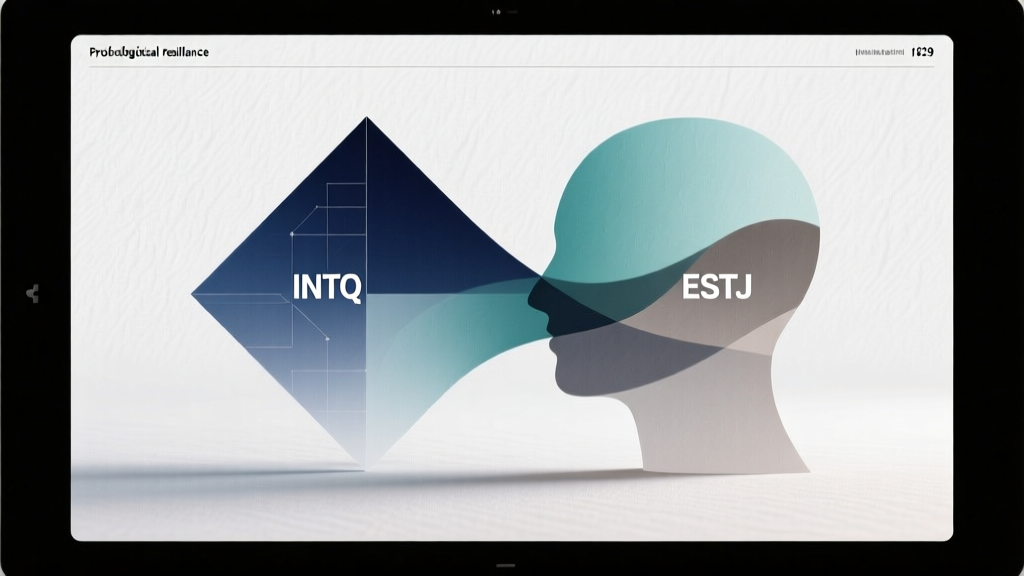
How INTJ Handles Stress
The INTJ (Introverted, Intuitive, Thinking, Judging) personality type—often dubbed the Architect or Strategist—approaches stress with intense internal analysis and a strong drive for control. Under pressure, their dominant function, Introverted Intuition (Ni), becomes hyperactive, leading to catastrophic forecasting: they mentally simulate worst-case outcomes, often looping through complex scenarios without external input. When overwhelmed, their auxiliary Extraverted Thinking (Te) may overcompensate—manifesting as rigid planning, micromanagement, or abrupt criticism of inefficiencies in others’ behavior. This is not malice; it’s a stress-induced misfire of their natural problem-solving engine.
Crucially, INTJs tend to withdraw during acute stress. Their tertiary Introverted Feeling (Fi) becomes suppressed, making emotional expression feel unsafe or irrelevant. They may isolate, cancel social plans, or respond to concern with terse logic (“I’m fine—I just need space”). Research from the Myers & Briggs Foundation confirms that under chronic stress, INTJs can exhibit immature use of their inferior function—Extraverted Sensing (Se)—leading to impulsive decisions, sensory overload (e.g., binge-watching, overeating, reckless driving), or sudden physical restlessness after prolonged mental stagnation.
Real-world signs an INTJ is stressed include:
- Uncharacteristic irritability toward minor logistical flaws (e.g., misplaced keys, delayed emails)
- Over-researching trivial decisions (e.g., comparing 17 laptop models for a routine upgrade)
- Withdrawing from close partners without explanation, sometimes for days
- Dismissing emotional check-ins with phrases like “Let’s focus on solutions, not feelings”
Importantly, INTJs rarely ask for help directly—not because they don’t need it, but because asking feels like admitting strategic failure. Their support threshold is high: they’ll tolerate significant distress before signaling vulnerability. Yet when supported *correctly*, they respond deeply to quiet, competence-based reassurance—like a partner quietly handling a household task they’ve been neglecting, or sharing a well-structured plan to resolve a shared stressor.
How ESTJ Handles Stress
The ESTJ (Extraverted, Sensing, Thinking, Judging)—the Executive or Supervisor—relies on external order, proven systems, and tangible results to maintain equilibrium. Their dominant function, Extraverted Thinking (Te), seeks immediate, practical fixes. Under stress, this manifests as heightened control-seeking: enforcing routines more rigidly, correcting others’ behavior more frequently, or escalating demands for accountability. Unlike the INTJ’s inward spiral, the ESTJ’s stress response is outwardly directed—they may assign tasks, reorganize shared spaces without consultation, or insist on “getting back on schedule” even when circumstances demand flexibility.
When overwhelmed, ESTJs suppress their auxiliary Introverted Sensing (Si), which normally grounds them in past experience and bodily awareness. Instead, their tertiary Extraverted Feeling (Fe) may distort—expressing as uncharacteristic emotional outbursts, hypersensitivity to perceived slights, or guilt-driven overwork. In extreme cases, inferior Introverted Intuition (Ni) emerges dysfunctionally: they fixate on one ominous future outcome (“If we miss this deadline, we’ll lose the client forever”) while ignoring alternative paths—a stark contrast to their usual pragmatic breadth.
According to a 2022 study published in the Educational and Psychological Measurement journal, ESTJs report significantly higher stress reactivity in environments with ambiguous authority structures or shifting priorities—precisely because their Te-Si cognitive stack thrives on clarity and continuity. Their stress signals are often behavioral and visible:
- Increased nitpicking about chores, schedules, or grammar
- Volunteering for extra responsibilities to “regain control”
- Physical tension (clenched jaw, tight shoulders) paired with stoic dismissal of fatigue
- Sudden withdrawal from leisure activities they usually enjoy, replaced by task-focused busyness
ESTJs rarely admit feeling emotionally drained—they frame exhaustion as “just needing to push through.” But their support need is concrete: reliable follow-through, shared responsibility for logistics, and affirmation that their efforts are seen and valued—not just their outcomes.
The INTJ and ESTJ Stress Dynamic
At first glance, INTJ and ESTJ seem like a powerhouse pairing: both are Judging-dominant, thinking-oriented, and achievement-focused. But under stress, their complementary strengths can become friction points. Where the INTJ retreats into abstract contingency modeling, the ESTJ moves outward to enforce structure—creating a classic “pressure-cooker paradox”: one person needs silence to process; the other needs action to stabilize. Without awareness, this dynamic escalates quickly.
Consider a real-life scenario: a joint project hits a major roadblock. The INTJ shuts down, spends hours alone mapping systemic root causes, and stops replying to messages. The ESTJ, interpreting silence as disengagement or unreliability, texts increasingly urgent reminders (“Did you see my email? We need to finalize the budget by 3 PM”), then rewrites the budget themselves—only to have the INTJ later present a radically different, theoretically superior framework that invalidates the ESTJ’s effort. Both feel unappreciated: the INTJ perceives the ESTJ’s urgency as shallow meddling; the ESTJ sees the INTJ’s delay as irresponsible avoidance.
This isn’t incompatibility—it’s cognitive function collision. The INTJ’s Ni-Te loop fixates on long-term implications and optimal design; the ESTJ’s Te-Si loop prioritizes immediate execution and proven methods. Neither is wrong—but their stress responses speak different dialects of problem-solving.
To illustrate the divergence, here’s a comparative breakdown of their stress behaviors and underlying drivers:
| Stress Dimension | INTJ Response | ESTJ Response | Root Cognitive Cause |
|---|---|---|---|
| Communication Style | Withdrawn, terse, avoids small talk; may ghost for hours/days | Over-communicative, directive, repeats instructions; may flood with updates | INTJ: Ni dominance seeks internal resolution before speaking; ESTJ: Te dominance equates communication with control and coordination |
| Decision-Making | Paralyzes over options; seeks theoretical perfection before acting | Rushes to decide using “what worked last time”; rejects novel alternatives | INTJ: Inferior Se makes spontaneity feel dangerous; ESTJ: Inferior Ni distrusts unproven futures |
| Physical Manifestation | Headaches, insomnia, restless pacing, or sudden bursts of physical activity | Jaw clenching, digestive issues, chronic fatigue masked by caffeine, muscle tension | INTJ: Suppressed Fi + Se eruption; ESTJ: Suppressed Si + Fe overload |
| Support Trigger | “You handled X without me asking” or “Here’s a clean summary of options” | “I took care of Y so you could rest” or “Your plan for Z worked perfectly” | INTJ: Values autonomy and intellectual respect; ESTJ: Needs tangible proof of reliability and appreciation |
This table reveals a critical insight: their stress languages are inverted. The INTJ feels safest when granted space and intellectual scaffolding; the ESTJ feels secure when responsibilities are shared and contributions acknowledged. Misreading these cues fuels resentment—e.g., an ESTJ “helping” by cleaning the INTJ’s workspace may feel like an invasion, not support. Conversely, an INTJ offering a 10-point strategic pivot during the ESTJ’s crisis may land as dismissive, not insightful.
Supporting Each Other During Hard Times
Effective mutual support between INTJs and ESTJs isn’t about changing core wiring—it’s about function translation: learning to express care in the other’s cognitive dialect. Below are field-tested, actionable strategies, validated by couples therapists specializing in type dynamics and grounded in Gottman Institute research on conflict de-escalation.
For ESTJs Supporting INTJs Under Stress
- Respect the Recharge Ritual: Agree on a non-negotiable “recovery window” (e.g., “If I say ‘I need 90 minutes offline,’ no texts unless urgent”). Honor it without probing. Use that time to handle concrete tasks—grocery shopping, bill payment, pet care—so the INTJ returns to a stabilized environment.
- Replace Questions with Options: Instead of “What do you need?” (which forces the INTJ to articulate vulnerable feelings), offer structured choices: “I can take the dog for a walk now, draft a response to that client email, or make tea—pick one.” This engages their Te without demanding Fi exposure.
- Anchor in Data, Not Drama: When discussing stressors, lead with facts, not feelings: “The server outage lasted 47 minutes; here’s the IT team’s timeline for resolution” lands better than “I’m so stressed about the outage!”
For INTJs Supporting ESTJs Under Stress
- Initiate Micro-Check-Ins: Send brief, specific affirmations daily: “The spreadsheet you built saved us 3 hours—thank you,” or “Your call to the vendor was exactly what we needed.” ESTJs metabolize appreciation through observable impact, not vague praise.
- Co-Create Contingency Plans: Proactively draft a “Plan B/C/D” for shared stressors (e.g., “If the contractor misses the deadline, we’ll hire [X] by [Y date] and shift Phase 2 to [Z]”). This satisfies their Te need for control while leveraging your Ni foresight.
- Physically Share the Load: ESTJs feel cared for through shared labor. Don’t just say “Let me know if you need help”—do it. Wash the dishes *without being asked*. Print and organize documents. These acts signal reliability more powerfully than words.
A pivotal practice is the Stress Signal Agreement: jointly define two nonverbal cues—one for each person—to indicate rising stress *before* it escalates. Examples: the INTJ places a blue pen on the kitchen counter to mean “I need 2 hours silent; I’ll reconnect at 8 PM”; the ESTJ wears red headphones to mean “I’m processing; please don’t ask questions until I remove them.” These bypass verbal misfires and build trust in mutual self-awareness.
Caregiver and Receiver Patterns
In INTJ-ESTJ partnerships, caregiver roles rarely align with traditional expectations. Because both types prize competence and self-sufficiency, neither readily assumes the “vulnerable receiver” role—and both default to “competent caregiver.” This creates a paradox: a relationship rich in capability but starved of soft reciprocity.
Left unexamined, this leads to caregiver burnout cycles. The ESTJ, wired to notice and fix tangible needs, often initiates caregiving—organizing doctor appointments, managing finances, coordinating family logistics. The INTJ, observing this, may interpret it as “they’ve got it handled” and withdraw further, assuming their role is to solve big-picture problems (e.g., researching insurance policies) while leaving daily care to the ESTJ. Over time, the ESTJ exhausts their Te-Si stamina; the INTJ misses opportunities for emotional attunement.
Breaking this cycle requires intentional role calibration. Start with a Care Inventory: list all recurring stress-related tasks (e.g., “managing parent’s medical appointments,” “handling tax prep,” “soothing anxious child before school”). For each, assign ownership based on energy fit, not just skill:
- ESTJ-Optimized Tasks: Time-bound logistics (scheduling, follow-ups), physical upkeep (home repairs, meal prep), rule enforcement (budget tracking, chore charts)
- INTJ-Optimized Tasks: Research-intensive work (comparing healthcare plans), systemic redesign (creating a family emergency protocol), long-term strategy (college savings modeling)
- Shared Tasks: Emotional check-ins (using the Stress Signal Agreement), celebrating micro-wins (“We got through that tough week—let’s order pizza”), and co-designing recovery rituals (e.g., Saturday morning walks with zero agenda)
Crucially, rotate shared tasks quarterly. An ESTJ who always handles scheduling might take a month to focus solely on strategic reflection; an INTJ who always researches might commit to planning three low-stakes social outings. This prevents role calcification and builds cross-functional empathy.
Therapist Dr. Sarah C. Johnson, author of Type-Affirming Relationships, emphasizes: “The healthiest INTJ-ESTJ bonds aren’t those where one ‘softens’ and the other ‘loosens up.’ They’re where both expand their definition of care—where the ESTJ learns that silence can be supportive, and the INTJ discovers that showing up with soup *and* a flowchart is profound love.”
Building a Resilient Partnership
Resilience for INTJ-ESTJ couples isn’t about eliminating stress—it’s about engineering a shared nervous system that regulates under pressure. This requires three interlocking systems:
1. The Pre-Stress Protocol
Agree on proactive buffers *before* crises hit. Examples:
- Quarterly Stress Audits: Every 3 months, review: What drained us most last quarter? What restored us? What one system (e.g., shared calendar, grocery delivery) can we optimize to reduce friction?
- Autopilot Agreements: Define automatic responses for common stressors. E.g., “If either of us works past 8 PM for 3+ nights, the other handles breakfast and lunch prep next day.” No negotiation needed—just activation.
- Recovery Rituals: Co-create non-negotiable decompression practices: 20 minutes of parallel reading (no devices), Sunday afternoon nature walks with zero problem-solving talk, or a monthly “gratitude log” where each writes three specific things the other did that sustained them.
2. The In-Crisis Framework
When acute stress hits (job loss, illness, family emergency), activate this 4-step sequence:
- Signal & Pause: One person uses their agreed Stress Signal. Both pause all non-urgent communication for 60–90 minutes.
- Separate Processing: INTJ maps scenarios; ESTJ lists actionable steps. No sharing yet.
- Structured Sync: Meet for 25 minutes max. INTJ shares 1–2 key insights; ESTJ shares 1–2 immediate actions. No debate—just alignment.
- Role Lock: Assign clear, time-bound responsibilities: “INTJ drafts proposal by Thursday; ESTJ books contractor by Friday.” End with tactile connection (hand squeeze, shared tea).
3. The Post-Stress Integration
Within 48 hours of crisis resolution, conduct a Learning Debrief—not a blame session. Use this template:
- What worked well in how we responded?
- Where did our stress responses clash? (Name it neutrally: “My Ni spiraling vs. your Te urgency”)
- What one tiny adjustment would make next time smoother? (e.g., “Send a 3-word text before going offline: ‘Thinking. Back at 3.’”)
- What did we each need that we didn’t ask for? (This builds emotional vocabulary.)
Document answers in a shared note titled “Our Resilience Playbook.” Revisit it quarterly. Over time, this transforms stress from a relationship threat into a co-creation opportunity—where the INTJ’s foresight and ESTJ’s execution don’t just coexist, but compound.
FAQ
Can INTJs and ESTJs truly understand each other’s stress triggers?
Yes—but it requires moving beyond surface behavior to cognitive roots. An INTJ’s “withdrawal” isn’t rejection; it’s Ni seeking pattern coherence. An ESTJ’s “bossiness” isn’t control; it’s Te seeking environmental stability. Understanding these functions—backed by resources like the Center for Applications of Psychological Type (CAPT)—transforms judgment into curiosity. Practice asking: “What function is driving this right now?” instead of “Why are you acting like this?”
What if one partner refuses to acknowledge their stress patterns?
Start with data, not diagnosis. Share anonymized examples: “In the last project, when X happened, I noticed Y behavior—and it made me feel Z. Can we explore what was happening for you?” Avoid MBTI labels initially; focus on observable cause-effect. If resistance persists, suggest a joint session with a therapist trained in type dynamics—many offer free consultations to assess fit.
How do we handle stress when our values clash (e.g., INTJ prioritizes innovation, ESTJ prioritizes tradition)?
Frame values as complementary, not competing. The INTJ’s drive for innovation ensures long-term relevance; the ESTJ’s commitment to tradition ensures operational continuity. In stress, agree on a Values Hierarchy for Crisis Mode: e.g., “During financial stress, Stability > Growth; during health stress, Care > Efficiency.” This provides decision guardrails without demanding ideological surrender.
Is it healthy for INTJs and ESTJs to rely on each other for emotional support?
Yes—with boundaries. Neither type is naturally fluent in emotional expression, but both deeply value loyalty and competence. Emotional support here looks like: the ESTJ remembering the INTJ’s childhood fear and quietly removing a triggering stimulus; the INTJ researching evidence-based anxiety tools and sharing them without commentary. It’s support rooted in observation and action—not catharsis. Supplement with external outlets (therapy, trusted friends) to avoid overloading the partnership.
Ultimately, the INTJ-ESTJ bond under stress is a masterclass in complementary strength. Where the INTJ holds the horizon, the ESTJ holds the ground. When both learn to translate their native stress dialects—not by becoming the other, but by honoring the architecture of their minds—their partnership doesn’t just survive pressure. It forges unshakeable resilience, one calibrated, competent, deeply human act of care at a time.