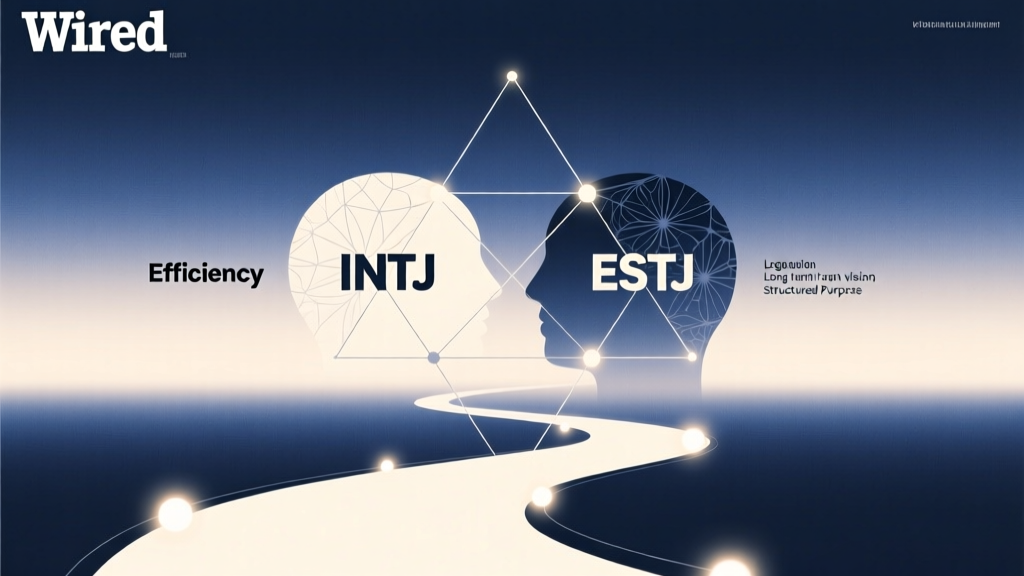
Core Values of INTJ
The INTJ (Introverted, Intuitive, Thinking, Judging) personality type—often dubbed the Architect or Strategist—is defined not by emotion-driven ideals but by a deeply internalized, rigorously examined value system rooted in intellectual integrity, long-term efficacy, and systemic coherence. Unlike types that prioritize social harmony or tradition as ends in themselves, INTJs treat values as hypotheses to be stress-tested against evidence, logic, and real-world outcomes.
At the heart of the INTJ value structure lies autonomy. This is not mere independence—it’s the non-negotiable right to govern one’s own cognition, time, and moral reasoning without external coercion or unexamined dogma. As noted by the Myers & Briggs Foundation, INTJs “seek competence, mastery, and clarity above all else,” and their ethical compass is calibrated through what philosopher John Rawls called reflective equilibrium: a continuous process of balancing principles with lived experience and logical consistencyMyers & Briggs Foundation.
INTJs highly prize intellectual honesty—the willingness to discard cherished beliefs when contradicted by superior evidence. This manifests in skepticism toward inherited norms, resistance to performative morality, and discomfort with platitudes that lack operational definition. For example, an INTJ may reject the phrase “family first” unless it’s accompanied by concrete behavioral standards (e.g., weekly check-ins, financial support thresholds, conflict-resolution protocols). Their commitment to truth is not abstract; it’s procedural, iterative, and often uncomfortable.
Another cornerstone is strategic purpose. INTJs rarely ask, “What feels right?” Instead, they ask, “What serves the highest-order objective over time?” This leads them to value efficiency, scalability, foresight, and systems-level impact. A career in policy reform, AI ethics research, or sustainable infrastructure design may appeal not because it’s prestigious—but because it advances a coherent, future-oriented vision of human flourishing. As cognitive scientist David Epstein observes in Range, INTJs exemplify the “lateral thinking” needed to synthesize cross-domain knowledge into actionable long-term strategyPenguin Random House – Range.
Spiritually, many INTJs are either secular humanists, agnostic rationalists, or adherents of philosophically rigorous traditions (e.g., Stoicism, Zen Buddhism, or certain strands of Unitarian Universalism) that emphasize self-discipline, epistemic humility, and ethical naturalism. Rituals hold little intrinsic value unless they demonstrably reinforce cognitive clarity or moral resilience. Prayer, if practiced, is more likely to resemble structured reflection than petitionary supplication.
Core Values of ESTJ
The ESTJ (Extraverted, Sensing, Thinking, Judging)—known as the Executive or Supervisor—grounds values in observable reality, communal accountability, and time-tested functionality. Where the INTJ asks, “Does this principle hold under logical scrutiny?”, the ESTJ asks, “Has this worked consistently across generations and contexts?” Their moral framework is less abstract and more institutional: built on duty, reciprocity, fairness-as-consistency, and fidelity to shared social contracts.
Responsibility is the gravitational center of the ESTJ value system. This includes personal accountability (meeting deadlines, honoring commitments), civic duty (voting, jury service, neighborhood stewardship), and familial obligation (providing stability, modeling reliability, upholding traditions). According to research published by the Center for Applications of Psychological Type (CAPT), ESTJs demonstrate the highest preference for structured ethics—moral reasoning anchored in rules, roles, and reciprocal expectationsCAPT – MBTI Manual, 3rd Ed.. They do not view rules as constraints but as scaffolding for trust and predictability.
Practical integrity is another defining value: doing what you say you’ll do, paying debts on time, showing up—even when inconvenient. An ESTJ may decline a high-profile speaking engagement if it means missing their child’s school play—not out of sentimentality alone, but because integrity is measured in follow-through, not intention. Their version of virtue is performative in the best sense: visible, verifiable, and socially legible.
ESTJs also place high value on social continuity—preserving institutions, customs, and narratives that bind communities across time. This isn’t blind traditionalism; it’s cost-benefit analysis applied to culture. If a holiday ritual strengthens intergenerational bonds, it’s retained. If a corporate policy erodes team morale, it’s revised—not because it offends ideology, but because it fails its functional test. As organizational psychologist Adam Grant notes in Think Again, ESTJs excel at “operational wisdom”: knowing which norms deserve preservation and which require pragmatic updatingAdam Grant – Think Again.
Spiritually, ESTJs are more likely to affiliate with organized religion, civic faith communities (e.g., Rotary, PTA, veterans’ groups), or philosophical frameworks that emphasize duty, service, and embodied practice (e.g., Confucianism, Catholic social teaching, or military codes of honor). Meaning is derived less from metaphysical speculation and more from contribution—measured in tangible outcomes: a repaired roof, a balanced budget, a graduate’s diploma.
Where Values Align for INTJ and ESTJ
Despite surface differences—INTJ’s abstract futurism versus ESTJ’s grounded pragmatism—their shared Thinking-Judging (TJ) axis creates profound alignment on foundational value dimensions. Both types prioritize objectivity over sentiment, structure over spontaneity, and long-term consequences over short-term comfort. This shared cognitive architecture fosters mutual respect—and often deep admiration—when each recognizes the other’s integrity within their respective domains.
Consider their shared reverence for competence. An INTJ admires an ESTJ’s ability to execute complex logistical operations flawlessly—a flawless wedding planning, a regulatory compliance overhaul, a multi-state relocation executed on schedule. Conversely, the ESTJ respects the INTJ’s capacity to diagnose root causes, anticipate second-order effects, and redesign flawed systems (e.g., optimizing a nonprofit’s donor retention algorithm or re-engineering municipal permitting workflows). Neither sees competence as optional; both treat it as the baseline for trust.
Both also share a strong commitment to truthfulness—though expressed differently. The INTJ tells hard truths to preserve intellectual coherence; the ESTJ tells hard truths to preserve relational and institutional integrity. When an ESTJ says, “We need to address the budget shortfall now,” and the INTJ responds with a data-backed restructuring plan, they’re speaking the same language of factual accountability—even if their delivery styles differ.
Perhaps most significantly, INTJs and ESTJs converge on life purpose as disciplined contribution. Neither seeks meaning in passive consumption or hedonic indulgence. The INTJ finds purpose in designing frameworks that elevate collective capability; the ESTJ finds it in implementing those frameworks with fidelity and care. One builds the bridge; the other maintains it, inspects it, and ensures traffic flows safely across it. This symbiosis is rare—and powerful—when recognized and honored.
To illustrate these alignments concretely, here’s a comparative table of overlapping value priorities:
| Value Dimension | INTJ Expression | ESTJ Expression | Shared Ground |
|---|---|---|---|
| Integrity | Intellectual consistency; revising beliefs in light of new evidence | Behavioral consistency; honoring commitments regardless of mood or convenience | Unwavering fidelity to internal standards—whether cognitive or conduct-based |
| Efficiency | Optimizing systems to eliminate redundancy and maximize strategic leverage | Streamlining processes to reduce waste, delay, and ambiguity in daily operations | Deep aversion to unnecessary friction—whether conceptual or procedural |
| Duty | Obligation to use one’s intellect to improve societal structures | Obligation to fulfill role-based responsibilities (parent, citizen, employee) | Recognition that privilege (of insight, position, or resources) entails responsibility |
| Legacy | Designing enduring ideas, institutions, or technologies that outlive the self | Building stable families, businesses, or community institutions that endure across generations | Investment in outcomes that transcend individual lifespan—measured in impact, not applause |
This alignment doesn’t guarantee effortless harmony—but it provides fertile soil. When both partners understand that their partner’s “stubbornness” is actually principled consistency, and their “coldness” is actually protective focus, resentment dissolves into strategic partnership.
Navigating Value Differences
Despite strong common ground, INTJ–ESTJ value divergence can trigger profound friction—if left unexamined. Three fault lines warrant intentional navigation:
1. The Authority of Tradition vs. The Authority of Logic
For the ESTJ, tradition carries evidentiary weight: “This custom persists because it solved real problems for real people.” For the INTJ, tradition is neutral data—neither inherently valid nor invalid. Its merit must be re-evaluated in current context. A disagreement over whether to hold a formal family Thanksgiving (ESTJ: “It reinforces belonging and continuity”) versus rotating hosts and experimenting with plant-based menus (INTJ: “Rituals should evolve with ethics and ecology”) isn’t about food—it’s about epistemology.
Actionable Strategy: Institute a “Tradition Audit” every 18 months. Together, list 5–7 recurring practices (e.g., holiday routines, financial habits, communication norms). For each, answer: (1) What problem did this originally solve? (2) Is that problem still present? (3) Does this practice still solve it effectively? (4) What would a logically optimized alternative look like? This transforms value conflict into collaborative systems engineering.
2. Moral Certainty vs. Moral Iteration
ESTJs tend toward moral closure: once a principle is validated (e.g., “Honesty requires full disclosure”), it becomes a rule. INTJs operate with moral iteration: “Honesty serves trust—but trust also requires discretion; therefore, full disclosure is context-dependent.” This can make the ESTJ feel the INTJ is ethically slippery; the INTJ may perceive the ESTJ as rigid or naive.
Actionable Strategy: Co-create a “Moral Decision Tree” for high-stakes choices (e.g., workplace whistleblowing, parenting discipline, end-of-life care). Define 3–4 universal anchors (e.g., “Does this preserve dignity?”, “Does this uphold long-term relational safety?”, “Is this defensible to a panel of impartial experts?”). Use these as non-negotiable filters—regardless of whether the conclusion aligns with precedent or intuition.
3. Autonomy Boundaries
The INTJ’s need for cognitive sovereignty (“I must decide my own beliefs”) can clash with the ESTJ’s expectation of shared public alignment (“We present a united front to our community”). An INTJ quietly revising their stance on climate policy may frustrate an ESTJ who’s already committed the couple to a local sustainability coalition. Conversely, an ESTJ publicly endorsing a political candidate without consulting their INTJ partner may breach the INTJ’s boundary around ideological self-determination.
Actionable Strategy: Establish a “Values Covenant”—a written agreement outlining: (1) Which values require unanimous public alignment (e.g., child-rearing ethics, financial transparency); (2) Which allow private divergence with respectful non-disclosure (e.g., metaphysical beliefs, aesthetic preferences); (3) The protocol for renegotiating the covenant (e.g., biannual review, triggered by major life events). This honors both the ESTJ’s need for reliability and the INTJ’s need for intellectual sovereignty.
Spiritual and Philosophical Compatibility
Spiritual compatibility between INTJs and ESTJs is less about shared doctrine and more about shared epistemic posture—how each approaches ultimate questions of meaning, mortality, and transcendence. While one may attend church weekly and the other meditate in silence, their compatibility hinges on whether they respect each other’s path as authentic, rigorous, and morally generative.
Research from the Pew Research Center shows that 68% of Americans who identify as “spiritual but not religious” still engage in disciplined practices (prayer, journaling, nature immersion) aimed at cultivating virtue and perspectivePew Research Center – Religion in America. This mirrors the INTJ–ESTJ dynamic: both may reject dogmatic certainty, yet commit deeply to practices that shape character and clarify purpose.
A spiritually compatible INTJ–ESTJ pair often co-creates hybrid frameworks. Examples include:
- The Ethical Audit Practice: Monthly 90-minute sessions where each shares: (1) One decision they made that aligned with their deepest values; (2) One compromise they made—and whether it strengthened or weakened their integrity; (3) One emerging question about meaning or responsibility. No solutions offered—only witnessing and inquiry.
- The Legacy Project: Jointly designing a tangible contribution to outlive them—e.g., an open-source curriculum for critical thinking in public schools, a scholarship fund for first-generation college students, or a neighborhood tool-lending library. The ESTJ manages rollout and sustainability; the INTJ designs the pedagogical or operational architecture.
- Ritual Re-engineering: Taking an inherited ritual (e.g., Sunday dinner, New Year’s resolutions) and collaboratively redesigning it to reflect current values—e.g., replacing obligatory small talk with “one meaningful question” (INTJ) while preserving the consistent timing and hospitality (ESTJ).
Critically, spiritual compatibility requires distinguishing between disagreement and disrespect. An ESTJ can fully support their INTJ partner’s atheism if they see it as a conclusion reached through earnest inquiry—not dismissal. An INTJ can honor their ESTJ partner’s prayer practice if they recognize it as a discipline of attention and surrender—not superstition. As theologian Karen Armstrong argues in The Case for God, “All great spiritual traditions began as practical disciplines for transforming consciousness—not as metaphysical assertions to be believed”Penguin Random House – The Case for God. Framing spirituality as practice—not proposition—creates common ground.
Building a Shared Life Vision
A shared life vision between INTJ and ESTJ isn’t a vague aspiration (“be happy,” “have a good life”)—it’s a living document: precise, scalable, and iteratively refined. It answers three questions with equal rigor: What world do we want to help create? How will we measure progress? What specific roles will each of us play?
Start with vision mapping. Using a whiteboard or digital tool (e.g., Miro), co-create four concentric circles:
- Core Principles (Innermost): 3–5 non-negotiable values (e.g., “Truth over comfort,” “Stewardship over ownership,” “Growth requires friction”).
- Domain Priorities (2nd ring): Key life areas (Family, Career, Community, Health, Learning) ranked by shared priority—not individual preference.
- 10-Year Benchmarks (3rd ring): Concrete, observable outcomes (e.g., “Our children independently manage 80% of their academic logistics by age 16,” “Our household carbon footprint reduced by 65% vs. 2025 baseline,” “We’ve co-authored one peer-reviewed paper on urban education equity”).
- Annual Levers (Outermost): Specific, accountable actions—each assigned to INTJ, ESTJ, or shared—with quarterly review dates (e.g., “ESTJ schedules quarterly financial reviews; INTJ researches tax-advantaged impact investment vehicles by March 15”).
This structure satisfies the INTJ’s need for systemic coherence and the ESTJ’s need for executable clarity. Crucially, it prevents vision drift: when disagreements arise (“Should we move for a job?” “Do we adopt?”), the couple consults the map—not just feelings or pressures.
Also vital is role calibration. INTJs often default to “architect” and ESTJs to “executor”—but this can calcify into inequity. Intentionally rotate lead responsibilities: Let the ESTJ design the family’s 5-year educational roadmap (leveraging their strength in sequencing and resource mapping), while the INTJ implements the first year’s curriculum (applying their capacity for adaptive iteration). This builds mutual fluency and prevents resentment.
Finally, embed failure protocols. Agree in advance: What constitutes a failed experiment? (e.g., “If our new morning routine causes >3 weekday meltdowns/month for 2 consecutive months, we pause and diagnose.”) What’s the reset process? (e.g., “One 60-minute ‘blameless post-mortem’ using the 5 Whys technique, followed by a 72-hour solo reflection period.”) This transforms setbacks from value betrayals into data points—honoring both types’ commitment to learning.
FAQ
Can INTJ and ESTJ have compatible spiritual beliefs if one is religious and the other is atheist?
Yes—provided both treat belief as a disciplined practice, not a tribal identity. Compatibility hinges on mutual respect for the *function* of the other’s framework: the ESTJ may value their partner’s atheism as evidence of intellectual courage and ethical self-reliance; the INTJ may honor their partner’s faith as a scaffold for compassion, consistency, and communal belonging. Studies show interfaith couples with high “epistemic humility” (acknowledging limits of one’s own worldview) report stronger marital satisfaction than ideologically aligned couples lacking that humilityAmerican Psychological Association – Journal of Family Psychology.
How do INTJ and ESTJ handle disagreements about parenting values?
They thrive when they apply their shared TJ strengths: define first principles (e.g., “Our goal is resilient autonomy, not obedience”), then co-design evidence-informed protocols (e.g., screen-time rules based on AAP guidelines, conflict-resolution scripts modeled on restorative justice). The ESTJ ensures consistency and documentation; the INTJ researches developmental outcomes and adjusts frameworks as new data emerges. Avoid value debates (“Is strictness good?”); focus on functional outcomes (“What behavior change does this produce, and is it aligned with our principles?”).
Why do INTJ and ESTJ sometimes feel morally alienated from each other?
Because their moral languages differ fundamentally: ESTJs speak the grammar of duty (“I must because I promised”), while INTJs speak the grammar of consequence (“I must because it prevents harm”). Without translation, each hears hypocrisy in the other’s stance. Bridge this by practicing “moral bilingualism”: When the ESTJ says, “We owe it to Grandma to visit monthly,” the INTJ responds, “What specific emotional or practical need does that meet for her—and is there a higher-leverage way to meet it?” When the INTJ says, “This policy is logically unsound,” the ESTJ asks, “What real people will be hurt if we change it—and how do we mitigate that?”
What’s the biggest risk in an INTJ–ESTJ values partnership?
The “Competence Trap”: assuming shared values because both are highly capable and principled—while overlooking divergent foundations. An INTJ may assume an ESTJ’s adherence to rules implies shared intellectual values; an ESTJ may assume an INTJ’s strategic vision implies shared loyalty to institutions. This leads to shock when the INTJ resigns from a respected organization over an ethical inconsistency the ESTJ considers minor—or when the ESTJ enforces a family rule the INTJ deems logically indefensible. Prevention requires explicit, ongoing dialogue about *why* each holds their values—not just *what* they are.
In sum, the INTJ–ESTJ values partnership is not for the casually committed—it demands intellectual bravery, emotional precision, and relentless curiosity about the other’s inner logic. But for those willing to do the work, it offers something rare: a life vision forged in the fire of mutual challenge, tempered by unwavering respect, and built to last.