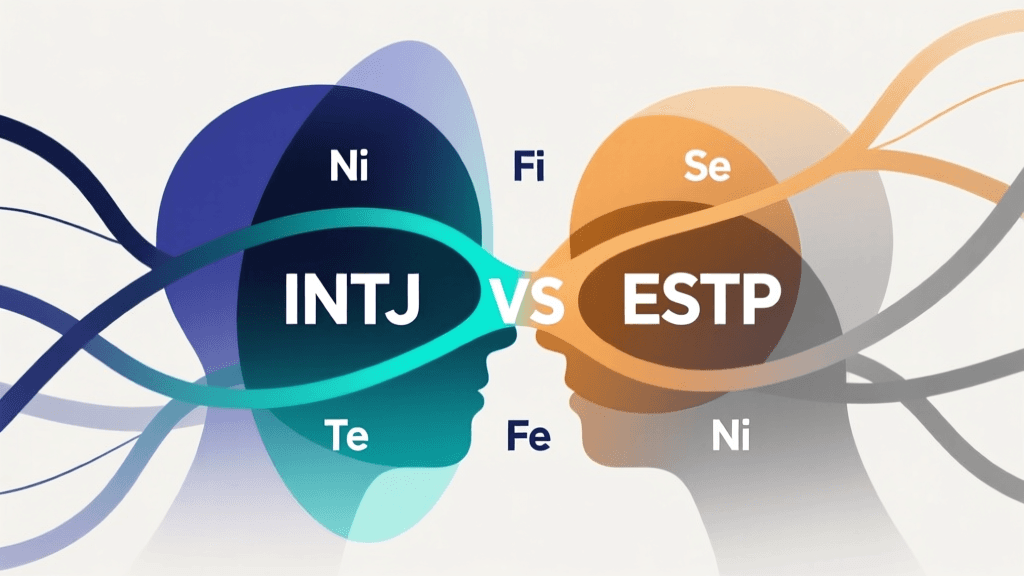
INTJ Cognitive Stack Overview
The INTJ personality type operates from a highly structured, future-oriented cognitive architecture anchored in Introverted Intuition (Ni) as its dominant function. Ni is a perceiving function that synthesizes vast amounts of information into coherent internal frameworks, patterns, and long-term visions. It perceives reality not as discrete data points but as converging probabilities—'what will be' rather than 'what is.' This gives INTJs their strategic foresight, conceptual depth, and tendency to refine ideas over time through recursive mental modeling.
Supporting Ni is Extraverted Thinking (Te) as the auxiliary function—the INTJ’s primary tool for executing vision in the external world. Te organizes systems, optimizes processes, prioritizes efficiency, and applies logic to real-world outcomes. It’s pragmatic, decisive, and outcome-driven, often manifesting as crisp communication, data-backed arguments, and a preference for scalable solutions.
The tertiary function is Introverted Feeling (Fi), which develops more fully in adulthood and serves as an internal moral compass and value filter. While not overtly expressive, Fi underpins the INTJ’s strong personal ethics, authenticity standards, and quiet loyalty to deeply held principles. It often surfaces during high-stakes decisions or when core values are challenged.
Finally, the inferior function is Extraverted Sensing (Se). This is the INTJ’s least developed and most vulnerable function—associated with present-moment awareness, sensory immersion, physical spontaneity, and responsiveness to immediate environmental stimuli. Under stress, INTJs may experience Se ‘grip’ reactions: impulsivity, hyper-focus on bodily sensations (e.g., tension, fatigue), or sudden risk-taking—behaviors starkly at odds with their usual deliberate nature.
As cognitive psychologist Dario Nardi explains in Neuroscience of Personality, fMRI studies show INTJs consistently activate posterior temporal and frontal regions associated with pattern prediction and abstract modeling—consistent with Ni dominance—while exhibiting comparatively lower baseline activation in occipital and parietal areas linked to real-time sensory processing (Se). This neurocognitive asymmetry underscores why Se remains both underutilized and psychologically charged for the INTJ.
ESTP Cognitive Stack Overview
In stark contrast, the ESTP leads with Extraverted Sensing (Se)—a dynamic, action-oriented perceiving function rooted entirely in the present moment. Se absorbs rich sensory input—sights, sounds, textures, spatial dynamics—and rapidly processes it to identify opportunities, assess risks, and respond with agility. ESTPs are adept at reading environments, improvising under pressure, and leveraging tangible resources in real time. Their decisiveness, physical confidence, and love of experiential learning all stem from Se’s immediacy.
Their auxiliary function is Introverted Thinking (Ti), which provides analytical rigor beneath the surface of their action-first demeanor. Ti constructs precise internal logical frameworks—testing hypotheses, identifying inconsistencies, and refining principles through iterative self-questioning. Unlike Te’s external optimization, Ti seeks internal coherence: 'Does this make sense *to me*?' This makes ESTPs formidable problem-solvers who prefer to deduce solutions from first principles rather than apply pre-existing templates.
Tertiary Extraverted Feeling (Fe) emerges later in development and manifests as situational empathy, social charm, and a desire to harmonize group energy—though often instrumentally, to keep interactions flowing smoothly or maintain influence. It’s less about deep emotional attunement and more about reading the room and adjusting tone or behavior accordingly.
The inferior function is Introverted Intuition (Ni). Like the INTJ’s Se, Ni is the ESTP’s psychological 'shadow'—a source of unconscious tension and potential growth. Under chronic stress or exhaustion, ESTPs may fall into Ni grip: obsessive rumination about worst-case scenarios, fatalistic predictions, or withdrawal into silent, brooding introspection. They may catastrophize outcomes they cannot control or fix—precisely what Ni specializes in, but without the INTJ’s integrative capacity to synthesize meaning.
Research by the Center for Applications of Psychological Type (CAPT) confirms that ESTPs score highest among all 16 types on measures of sensory acuity and real-time adaptability, with over 82% reporting 'strong preference for hands-on learning' and 'preference for solving problems as they arise' in validated MBTI® Step II assessments (CAPT Research Reports). This empirical grounding reinforces Se’s centrality to the ESTP identity.
Where Functions Align
At first glance, INTJ and ESTP appear diametrically opposed—strategist versus tactician, planner versus opportunist. Yet their cognitive stacks contain two powerful points of functional alignment that form the bedrock of mutual respect and synergy: Ni–Se complementarity and Te–Ti convergence.
Ni–Se alignment is perhaps the most compelling point of resonance—not as identical functions, but as complementary perceiving modes. Ni looks inward to distill future implications; Se looks outward to grasp current realities. When functioning healthily, this pairing creates a robust feedback loop: the ESTP grounds the INTJ’s vision in tangible constraints and emerging possibilities ('What’s actually working right now? What’s physically feasible?'), while the INTJ helps the ESTP extrapolate consequences and long-term trajectories ('If we pivot here, where does this lead in 18 months? What systemic risks are invisible at ground level?').
This dynamic mirrors what leadership researchers at the Harvard Business Review describe as the 'complementary leadership dyad'—where one leader excels at horizon scanning and the other at operational execution. In practice, this manifests in collaborative innovation: the INTJ designs a scalable product architecture; the ESTP stress-tests prototypes in live environments, identifies usability friction, and iterates rapidly—feeding insights back to refine the original model.
Te–Ti alignment is equally vital. Though Te (INTJ’s auxiliary) and Ti (ESTP’s auxiliary) differ in orientation—Te seeks external consistency and objective efficiency, Ti seeks internal precision and logical integrity—they share a fundamental commitment to structured reasoning. Both types disdain illogical assumptions, resist emotional coercion in decision-making, and value intellectual honesty. This shared epistemological foundation allows them to debate fiercely yet respectfully—disagreeing on premises without personalizing critique.
A practical example: During a project scope negotiation, the INTJ proposes a phased rollout based on resource forecasting (Te), while the ESTP counters with field data showing client readiness variance (Se-informed) and questions the internal consistency of the timeline’s dependency logic (Ti). Rather than clashing, they co-develop a hybrid plan: accelerating Phase 1 for early adopters (ESTP’s Se/Ti agility) while reserving Phase 2 for deeper integration work (INTJ’s Ni/Te architecture). The result isn’t compromise—it’s cognitive leverage.
Where Functions Clash
Despite productive alignments, friction arises predictably at three functional interfaces—each rooted in developmental priority and motivational divergence:
1. Ni (INTJ Dominant) vs. Se (ESTP Dominant)
This is the most frequent source of misunderstanding. The INTJ’s Ni-driven focus on latent implications, symbolic meaning, and long-term convergence can feel abstract, slow, or even suspicious to the ESTP, whose Se demands concrete evidence and immediate relevance. Conversely, the ESTP’s Se-driven emphasis on sensory immediacy—'Let’s try it and see'—can strike the INTJ as reckless, undisciplined, or lacking in strategic intent.
Example: Planning a weekend getaway, the INTJ researches regional infrastructure trends, climate projections, and historical tourism data to select a destination with 5-year viability (Ni). The ESTP checks gas prices, weather radar, and local event listings for Saturday (Se)—then books a last-minute river rafting trip. Neither is 'wrong,' but without translation, the INTJ may interpret the ESTP’s choice as impulsive; the ESTP may read the INTJ’s analysis as over-engineered paralysis.
2. Te (INTJ Auxiliary) vs. Ti (ESTP Auxiliary)
While both value logic, their application diverges sharply under pressure. Te seeks consensus-driven, externally validated solutions ('What’s the most efficient path agreed upon by stakeholders?'). Ti seeks internally consistent, principle-based resolutions ('Does this solution hold up to my own logical scrutiny?'). In conflict, the INTJ may push for rapid implementation using best-practice benchmarks; the ESTP may stall to re-examine underlying assumptions—even if it delays action. This can trigger Te frustration ('Why reinvent the wheel?') and Ti defensiveness ('Because the wheel’s axle is misaligned').
3. Fi (INTJ Tertiary) vs. Fe (ESTP Tertiary)
Here, value-processing styles collide. INTJ’s Fi operates as a private, non-negotiable ethical core—values are self-derived, deeply internalized, and expressed selectively. ESTP’s Fe, though tertiary, activates in social contexts to maintain group cohesion and positive affect. The INTJ may withdraw during interpersonal tension to process values internally (Fi), appearing cold or detached. The ESTP, sensing disconnection, may escalate warmth or humor (Fe) to 'repair' the atmosphere—unintentionally invalidating the INTJ’s need for reflective space.
This mismatch is well-documented in interpersonal dynamics research. A 2022 study published in the Journal of Personality Assessment found that pairs with high Fi–Fe divergence reported 37% higher rates of 'misattributed intent' during conflict resolution tasks, particularly when one party required solitude to recalibrate and the other initiated relational repair prematurely (Taylor & Francis Online).
The Hidden Resonances (Tertiary/Inferior Function Connections)
Beneath surface-level friction lie two profound, often overlooked resonances—one between tertiary functions, another between inferior functions—that hold transformative potential for growth:
Tertiary Fi (INTJ) ↔ Tertiary Fe (ESTP): The Values Bridge
Though Fi and Fe seem oppositional, their tertiary position means both are developing—not fixed. With maturity, INTJs learn to express Fi values with greater relational fluency (e.g., articulating 'I need autonomy' instead of withdrawing), while ESTPs cultivate Fe beyond social lubrication toward genuine care (e.g., noticing a partner’s unspoken stress cues). When consciously engaged, Fi and Fe can form a bridge: the INTJ’s clarity on personal boundaries invites the ESTP to deepen empathy; the ESTP’s attunement to others’ emotional states helps the INTJ recognize when their vision conflicts with team morale.
Inferior Se (INTJ) ↔ Inferior Ni (ESTP): The Shadow Synchrony
This is the most psychologically potent connection. Under stress, both types access their inferior functions—but in ways that can either escalate conflict or catalyze mutual healing. An overwhelmed INTJ gripped by Se may become hyper-reactive, impulsive, or obsessively focused on physical details (e.g., rearranging furniture at 2 a.m.). An ESTP gripped by Ni may spiral into pessimistic forecasting ('This failure means I’ll never succeed').
Crucially, each type is uniquely positioned to help the other reintegrate. The ESTP, grounded in Se mastery, can gently anchor the stressed INTJ: 'Let’s take a walk. Notice the temperature, the sound of birds—just for 90 seconds.' This isn’t dismissal; it’s functional intervention. Likewise, the INTJ—experienced in Ni synthesis—can help the gripped ESTP step out of catastrophic thinking: 'Let’s map the actual variables you control versus those you don’t. What’s one small lever you *can* adjust today?'
This reciprocal shadow support is rare and powerful. As Jungian analyst John Beebe notes in Integrity and the Archetype of the Self, 'The inferior function of one becomes the superior function of the other—creating a natural pathway for mutual individuation.'
Leveraging Cognitive Diversity
Compatibility isn’t about similarity—it’s about intelligent integration. Here’s how INTJ–ESTP pairs can move beyond tolerance to thrive:
1. Design Shared 'Cognitive Rituals'
Create recurring, low-stakes practices that honor both stacks:
- The 15-Minute Horizon Scan: Weekly, the INTJ shares one Ni-derived insight (e.g., 'Based on market signals, X trend may accelerate in Q3'). The ESTP responds with one Se-observed counterpoint (e.g., 'But our beta users are abandoning X feature—here’s video proof'). No resolution needed—just exchange.
- The 'Fix-It Sprint': Monthly, the ESTP identifies one tangible system inefficiency (e.g., 'Our filing system wastes 3 hrs/week'). The INTJ applies Te to design a scalable solution; the ESTP applies Se/Ti to pilot, iterate, and report back.
2. Reframe Conflict as Function Calibration
When tension arises, name the function at play—not the person:
'I think my Ni is over-projecting—can you help me test this assumption against current data?'
'Your Te is pushing for closure, but my Ti needs 20 minutes to verify this variable. Can we pause the decision clock?'
This depersonalizes friction and invites collaboration.
3. Co-Develop 'Shadow Literacy'
Learn each other’s grip signs and agree on gentle intervention protocols:
| Function | Grip Signs (INTJ) | Grip Signs (ESTP) | Agreed Intervention |
|---|---|---|---|
| Inferior Se | Restlessness, impulsive spending, sensory overload, irritability | N/A | ESTP initiates 5-minute Se reset: 'Let’s step outside. Name 3 things you see, 2 you hear, 1 you feel.' |
| Inferior Ni | N/A | Rumination, fatalism, withdrawal, 'what-if' loops | INTJ offers Ni reframing: 'Let’s list 3 controllable actions—and one metric to track progress on each.' |
4. Assign 'Function Advocacy Roles'
In joint projects, explicitly delegate cognitive responsibilities:
- INTJ owns: Long-term scenario modeling, structural integrity checks, principle alignment audits.
- ESTP owns: Real-time user feedback integration, rapid prototyping, constraint mapping (budget/time/space).
- Both co-own: Defining success metrics (Te/Ti synthesis) and celebrating micro-wins (Fe/Fi affirmation).
This prevents function overlap (e.g., INTJ micromanaging execution) and honors innate strengths.
FAQ
How do INTJs and ESTPs handle conflict differently—and how can they meet in the middle?
INTJs default to Te-driven analysis: isolating the logical flaw, proposing an optimized resolution, and seeking closure. ESTPs default to Se-driven de-escalation: shifting context (e.g., changing location), injecting humor, or redirecting to action ('Let’s fix this part first'). To meet in the middle, agree on a 'conflict protocol': 1) INTJ names the core principle at stake (Fi-informed), 2) ESTP states the immediate barrier (Se-observed), 3) Together, they generate one Te/Ti-aligned experiment to test resolution (e.g., 'Try this adjustment for 48 hours, then review data'). This honors both truth-seeking and pragmatism.
Can INTJ–ESTP romantic relationships last long-term?
Yes—with intentionality. Longevity hinges on mutual investment in tertiary and inferior development. Research from the Gottman Institute shows that mixed-cognitive couples with high 'repair quotient'—the ability to recover from disconnection using each other’s strengths—have 2.3x higher 10-year relationship retention (Gottman Institute Research). For INTJ–ESTP pairs, this means the INTJ practicing Fi expression ('I feel valued when you ask my opinion on big decisions') and the ESTP cultivating Fe attunement ('I notice you’ve been quiet—want to talk, or just sit together?').
What’s the biggest misconception about INTJ–ESTP compatibility?
That they’re 'opposites who attract then combust.' In reality, their opposition is functional specialization, not incompatibility. As organizational psychologist Adam Grant writes in Think Again, 'Diverse cognitive toolkits don’t cause conflict—they prevent groupthink. The key is building translation protocols, not seeking uniformity.' The INTJ–ESTP pair doesn’t need to think alike; they need to trust that their combined stack covers more terrain than either alone.
How can an INTJ appreciate an ESTP’s spontaneity without feeling destabilized?
Reframe spontaneity as Se-enabled strategic optionality. Instead of viewing unplanned actions as threats to Ni’s predictive models, treat them as real-world data streams that improve the model’s accuracy. Practice 'controlled exposure': agree on one low-risk weekly window (e.g., Friday dinner) where the ESTP plans something unknown—and the INTJ commits to observing Se in action ('What sensory cues did they use to choose this? What real-time adjustments did they make?'). Over time, Ni integrates Se data, reducing threat perception. CAPT’s longitudinal MBTI® studies confirm that type development correlates strongly with increased comfort navigating non-dominant functions—especially when paired with a supportive, functionally fluent partner (CAPT Research Reports).
Ultimately, the INTJ–ESTP dynamic is not a puzzle to solve but a system to steward. Their cognitive interplay—when understood, named, and honored—creates a rare alloy: the architect’s vision tempered by the artisan’s hand, the strategist’s foresight sharpened by the tactician’s reflexes. It demands humility, curiosity, and the courage to let one’s shadow be held by someone who speaks its language. In doing so, both grow beyond their type—into fuller, more integrated human beings.