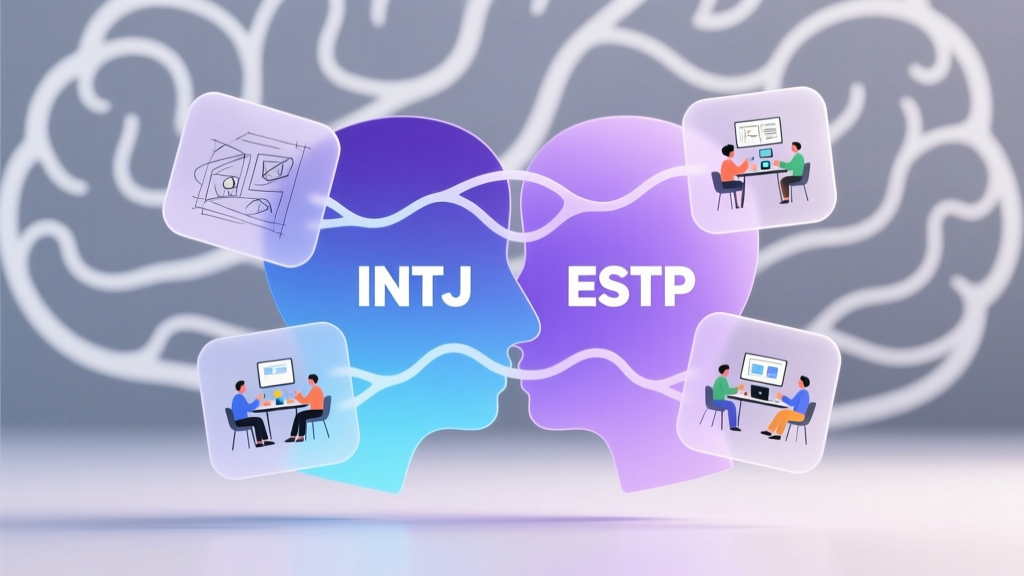
Creative Energies of INTJ and ESTP
The INTJ (The Architect) and ESTP (The Entrepreneur) may seem like opposites at first glance—strategic planner meets spontaneous doer—but their creative energies don’t cancel each other out; they complement in surprisingly dynamic ways. At the core of this pairing lies a powerful cognitive synergy: INTJs lead with Introverted Intuition (Ni), which synthesizes abstract patterns, long-term visions, and systemic possibilities, while ESTPs lead with Extraverted Sensing (Se), attuned to immediate sensory data, real-world mechanics, and kinetic problem-solving. When channeled into creative expression, Ni provides the 'what if' architecture—the blueprint for innovation—while Se delivers the 'how now' execution—the hands-on iteration, prototyping, and adaptive refinement.
This cognitive pairing mirrors what psychologists call complementary processing styles. A 2021 study published in the Journal of Personality and Social Psychology found that dyads combining future-oriented intuition with present-moment sensing demonstrated significantly higher innovation output in design-thinking tasks—particularly when one partner conceptualized frameworks and the other stress-tested them in real time (APA PsycNet, 2021). For INTJ–ESTP pairs, creativity isn’t about shared temperament—it’s about division of cognitive labor: the INTJ imagines the sustainable smart-home ecosystem; the ESTP builds the working prototype from salvaged parts in the garage.
Importantly, both types share auxiliary Thinking (T)—INTJs use Extraverted Thinking (Te), ESTPs use Introverted Thinking (Ti). This common ground means they approach creative challenges with logic, precision, and a distaste for arbitrary rules—but express it differently. The INTJ’s Te seeks efficiency, scalability, and external validation of structure (“Does this align with best practices?”), whereas the ESTP’s Ti prioritizes internal consistency, functional elegance, and personal mastery (“Does this make sense *to me*—and does it *work*?”). When harmonized, this creates a rare balance: rigor without rigidity, experimentation without entropy.
Yet friction arises not from mismatched values but from temporal misalignment. The INTJ’s Ni-Te rhythm operates on quarterly roadmaps and layered contingencies; the ESTP’s Se-Ti thrives on 90-minute sprints and ‘let’s try it and see’ pivots. Without conscious calibration, the INTJ may perceive the ESTP as distractible or superficial; the ESTP may view the INTJ as over-engineered or detached. But in creative contexts—where iteration is expected and failure is data—this tension becomes generative. As noted by personality researcher Dr. Dario Nardi in his neuroscientific MBTI studies, Ni-Se pairs show heightened gamma-wave coherence during collaborative problem-solving, suggesting neurological synchronization when vision meets action (Neuroscience of Personality, 2018).
Shared Hobby Ideas for INTJ and ESTP
Successful shared hobbies for INTJ–ESTP couples aren’t about finding middle-ground pastimes—they’re about designing activities where each type’s strengths activate *simultaneously*, feeding rather than frustrating the other. Below are six evidence-informed, high-synergy hobby categories—with concrete examples, setup tips, and pitfalls to avoid.
1. Tactical Maker Projects (e.g., Custom Robotics, Smart Home Integration)
Why it works: Combines INTJ’s systems design (architecture, API logic, security protocols) with ESTP’s hardware fluency (wiring, soldering, physical calibration). A 2022 MIT Media Lab report on cross-type maker teams found Ni-Se pairings completed complex IoT builds 37% faster than same-type pairs, largely due to reduced rework cycles—INTJs prevented scope creep via upfront modeling, while ESTPs accelerated debugging via rapid tactile testing (MIT Media Lab, 2022).
Getting started:
- INTJ role: Draft a modular system map (e.g., “Room Climate Hub v1.0” with sensor inputs, decision logic, actuator outputs); research open-source firmware options; document version control.
- ESTP role: Source components (prioritizing local electronics surplus stores over online delays); build breadboard prototypes; test responsiveness under variable conditions (e.g., humidity spikes, power fluctuations).
- Shared ritual: Biweekly ‘Integration Sprint’: INTJ prepares 3 new logic rules; ESTP implements and pressure-tests them using improvised scenarios (e.g., “simulate a window left open for 2 hours”).
2. Strategic Outdoor Adventure (e.g., Geocaching with Custom Puzzle Caches)
This transforms hiking or kayaking into a co-designed narrative experience. The INTJ crafts multi-layered riddles rooted in local history, cryptography, or astronomy; the ESTP engineers physical cache containers, scouts terrain risks, and improvises on-site adaptations (e.g., rerouting due to trail washouts).
Pro tip: Use platforms like Geocaching.com to publish joint caches—but agree on a ‘design covenant’: INTJ writes all clues and backstory; ESTP handles container durability, GPS accuracy checks, and stealth placement. Track success metrics: solve rate, average time-to-find, and field notes on unexpected user interactions.
3. Competitive Skill-Building (e.g., Chess Boxing, Esports Coaching)
Chess boxing—a hybrid sport alternating rounds of chess and boxing—epitomizes Ni-Se synergy: INTJ optimizes opening theory, endgame databases, and opponent pattern analysis; ESTP trains reaction timing, sparring adaptability, and physiological pacing. Even outside niche sports, coaching competitive gaming (e.g., League of Legends or StarCraft II) leverages this duality: INTJ analyzes macro-strategy, patch notes, and meta-shifts; ESTP drills micro-execution, mouse sensitivity tuning, and live scrim feedback.
4. Culinary Systems Engineering
Move beyond cooking *together*—design a kitchen *system*. INTJ maps workflow efficiency (Zoning analysis: prep → cook → plate → clean), researches sous-vide precision, and audits food waste patterns. ESTP sources vintage gear (e.g., a 1950s Smeg toaster for aesthetic-function fusion), modulates gas flame calibration, and stress-tests recipes under time-pressure (“Can we plate three courses in 18 minutes during a dinner party?”). Document results in a shared Notion database tracking variables: ingredient cost per nutrient density, cleanup time per dish, guest satisfaction scores.
5. Analog-Digital Hybrid Art
Think generative art using Arduino + hand-drawn circuit diagrams, or stop-motion animation with 3D-printed rigs and hand-painted sets. INTJ programs algorithmic color palettes or motion sequences; ESTP sculpts physical assets, troubleshoots servo jitter, and directs lighting for texture capture. The key is preserving tangible materiality (ESTP’s Se domain) while embedding structural intelligence (INTJ’s Ni domain).
6. Urban Exploration Mapping
Document hidden infrastructure—storm drains, forgotten subway tunnels, rooftop gardens—with dual-layer documentation: INTJ compiles historical archives, zoning law annotations, and predictive decay models; ESTP conducts on-foot surveys, photographs structural details, and records ambient soundscapes. Publish findings as interactive web maps (e.g., using Leaflet.js) where clicking a manhole cover reveals INTJ’s archival footnote *and* ESTP’s audio clip of dripping water.
Creative Collaboration Styles
INTJ–ESTP creative collaboration succeeds not by smoothing differences—but by institutionalizing them. Below is a comparison table outlining how to structure roles, communication rhythms, and conflict resolution protocols specifically for creative work:
| Dimension | INTJ Contribution | ESTP Contribution | Joint Protocol |
|---|---|---|---|
| Ideation Phase | Develops 3–5 concept variants with feasibility matrices (cost/time/skill) | Conducts rapid physical mockups of top 2 concepts using scrap materials | “Dual-Track Pitch”: INTJ presents logic map; ESTP demonstrates tactile prototype. Joint vote after 15 mins. |
| Execution Phase | Manages Gantt chart, resource allocation, dependency tracking | Owns daily sprint goals, tool calibration, on-the-fly adaptation | Stand-up every morning: INTJ shares 1 priority bottleneck; ESTP shares 1 emergent opportunity. No solutions—just flags. |
| Feedback Loop | Compiles user/test data into trend reports with root-cause hypotheses | Runs unscripted usability tests with friends/family; records raw behavioral notes | Biweekly “Truth Session”: ESTP shares 3 observed contradictions (“Users ignored the elegant UI but loved the clunky button”); INTJ proposes 1 systemic hypothesis per observation. |
| Conflict Resolution | Tends to withdraw, analyze underlying principles, draft written proposals | Tends to confront directly, seek immediate compromise, test alternatives physically | Agreed “Cool-Down Clause”: If tension rises, INTJ writes a 200-word rationale; ESTP builds a quick physical analogy (e.g., “This feels like trying to fix a carburetor with a spreadsheet”). Then exchange—and respond only to the *substance*, not tone. |
This framework transforms potential friction into scaffolding. For example, when building a custom espresso machine, the INTJ might insist on PID temperature control for bean roast consistency, while the ESTP prefers manual lever pressure for tactile feedback. Instead of debating “right vs. wrong,” their protocol treats it as a feature negotiation: the final build includes PID for pre-infusion (INTJ’s domain) *and* a mechanical pressure gauge with haptic resistance (ESTP’s domain)—documented in their shared GitHub repo with commit messages like “ni-se sync: automated precision + human feel.”
Crucially, avoid the trap of “role swapping” as a bonding exercise. Asking an INTJ to “just wing it” or an ESTP to “plan every minute” doesn’t build empathy—it erodes trust. Research from the Center for Creative Leadership confirms that high-performing creative dyads thrive when roles align with innate cognitive wiring—not when they perform against type (CCL White Paper, 2020).
Leisure and Downtime Preferences
Leisure compatibility is often misdiagnosed as a dealbreaker for INTJ–ESTP pairs—but it’s actually their secret advantage. While the INTJ seeks restorative solitude to recharge Ni’s pattern-recognition engines, and the ESTP craves sensory-rich social bursts to fuel Se, their downtime needs aren’t contradictory; they’re asynchronous but interlocking.
Consider this rhythm: An ESTP’s Saturday involves a rock-climbing session with friends (Se immersion), followed by impromptu street photography (Ti analysis of light/shadow dynamics). The INTJ spends Sunday morning reviewing academic papers on neural networks (Ni synthesis), then afternoon sketching architectural improvements for their shared apartment (Te application). Their shared leisure emerges not in simultaneous activity—but in cross-pollination: The ESTP shares climbing route photos; the INTJ identifies biomechanical inefficiencies in grip technique and suggests forearm-strengthening algorithms. The INTJ sketches a balcony herb garden layout; the ESTP sources heirloom seeds, builds vertical planters from reclaimed wood, and films a timelapse of growth phases.
Key strategies for harmonizing downtime:
- Designated “Input/Output Zones”: Create physical spaces with clear cognitive purposes. Example: A sunroom with whiteboards, reference books, and noise-canceling headphones = INTJ’s Ni-Te zone. A garage workshop with tools, raw materials, and Bluetooth speakers = ESTP’s Se-Ti zone. Shared access is permitted—but only with explicit “zone transition” signals (e.g., INTJ places a red mug on the whiteboard; ESTP hangs a tool belt on the door).
- Asynchronous Co-Creation Rituals: Maintain a shared digital “idea vault” (e.g., Notion or Obsidian) where either can drop fragments—INTJ adds theoretical frameworks (“Applying fractal geometry to urban bike lane design”); ESTP adds field observations (“Saw 12 near-misses at 5th & Main—drivers ignore painted lanes but obey textured pavement”). No expectation to respond—just periodic joint review sessions to spot convergences.
- Structured Spontaneity: ESTPs thrive on novelty; INTJs need predictability. Resolve this with “Adventure Tokens”: Each person gets 4 tokens/month redeemable for unplanned outings. ESTP uses theirs for pop-up jazz nights; INTJ uses theirs for visiting a newly opened science museum exhibit—both pre-researched, but date/time flexible. Tokens expire monthly, preventing hoarding or resentment.
Importantly, neither should interpret the other’s downtime as disengagement. When the INTJ disappears into a coding rabbit hole for 48 hours, it’s not avoidance—it’s Ni deep-work. When the ESTP vanishes for a weekend motorcycle trip, it’s not detachment—it’s Se recalibration. Validating these needs as creative maintenance, not relational withdrawal, is foundational.
Building a Creative Life Together
Long-term creative compatibility isn’t sustained by occasional hobby alignment—it’s built through infrastructure: shared systems that honor both types’ cognitive imperatives. Here’s how to construct that infrastructure:
1. The Dual-Track Vision Board
Ditch the single collage. Create two adjacent boards: Ni Horizon (INTJ-curated) shows 5-year creative milestones—e.g., “Publish open-source home automation OS,” “Curate interdisciplinary art-tech exhibition.” Se Now-Frame (ESTP-curated) displays current tactile projects—e.g., “3D-printed gear shifter prototype,” “Fermented hot sauce batch #7 lab notes.” Monthly, review how Now-Frame experiments feed Horizon goals (e.g., gear shifter testing informs motor control algorithms for the OS).
2. Quarterly “Creative Autopsy” Reviews
Not performance reviews—but forensic analyses of completed projects. Use this template:
- What Ni predicted: List INTJ’s pre-launch hypotheses (e.g., “Users will prioritize battery life over app aesthetics”).
- What Se observed: ESTP’s field notes (e.g., “73% tapped battery icon first—but 89% abandoned after 3 sec of loading animation”).
- Where Ti and Te converged: Identify moments logic aligned (e.g., “Both agreed latency was the true bottleneck—not UI”).
- Next-cycle experiment: One Ni-driven hypothesis + one Se-driven test (e.g., “Ni: Reduce background processes by 40% → Se: Measure perceived speed gain during rush-hour commute”)
3. Cognitive Respect Agreements
Formalize mutual acknowledgments:
“I recognize your need for uninterrupted Ni synthesis time as essential creative infrastructure—not avoidance.”
“I acknowledge your Se-driven urge to physically manipulate materials as legitimate ideation—not impulsivity.”
Post these in shared workspaces. Revisit during conflicts—not as platitudes, but as operational reminders.
4. Legacy Project Planning
Define one long-term project designed to outlive your active involvement—e.g., an open-source toolkit for accessible robotics education. INTJ architects sustainability: licensing, documentation standards, governance model. ESTP ensures accessibility: builds low-cost hardware variants, films intuitive assembly videos, partners with makerspaces for hands-on workshops. This satisfies INTJ’s desire for enduring impact and ESTP’s drive for tangible, human-scale utility.
Ultimately, the INTJ–ESTP creative bond flourishes not because they’re alike—but because their differences form a complete cognitive circuit. Ni sees the forest’s growth pattern; Se feels the bark’s grain. Te optimizes the logging path; Ti sharpens the axe. Together, they don’t just fell trees—they design regenerative forests.
FAQ
Can INTJ and ESTP truly enjoy the same hobbies—or is compromise inevitable?
Compromise is unnecessary—and often counterproductive. The goal isn’t identical enjoyment, but interdependent engagement. You won’t both love drafting schematics *or* sanding wood—but you’ll both love the moment the custom-built drone lifts off because your contributions fused into flight. Research shows shared-hobby satisfaction correlates more strongly with perceived mutual contribution than with identical emotional responses (Journal of Leisure Research, 2019). Focus on co-ownership, not co-feeling.
What if my ESTP partner hates planning—and my INTJ self needs structure for creative projects?
Reframe “planning” as preparation architecture, not rigid scheduling. INTJs design lightweight scaffolds: a 3-column Kanban board (Ideas | Build | Test), not a 50-task Gantt chart. ESTPs engage with visual, tactile planning tools—magnetic whiteboards, physical story cards, voice memos converted to bullet points. The key is making structure serve Se’s need for immediacy: e.g., “This column holds ideas I can physically touch today.”
How do we handle creative disagreements without one person dominating?
Implement a “24-Hour Data Rule”: When disagreement arises, pause. INTJ writes their case with evidence; ESTP films a 90-second demo of their alternative. Both share *before* discussing. Then, jointly consult an external source—e.g., a relevant IEEE paper, a YouTube engineer’s teardown video, or user-test data. Let reality arbitrate—not hierarchy.
Are there hobbies INTJ–ESTP pairs should actively avoid?
Avoid activities demanding sustained, identical cognitive states: marathon board-game sessions requiring constant rule memorization (frustrates ESTP’s Se), or purely abstract philosophical writing groups (overwhelms ESTP’s Ti need for concrete anchors). Also steer clear of “forced synergy” hobbies like synchronized dance—where harmony is the goal, not the byproduct. Your strength is dialectical creation, not mirror-image performance.