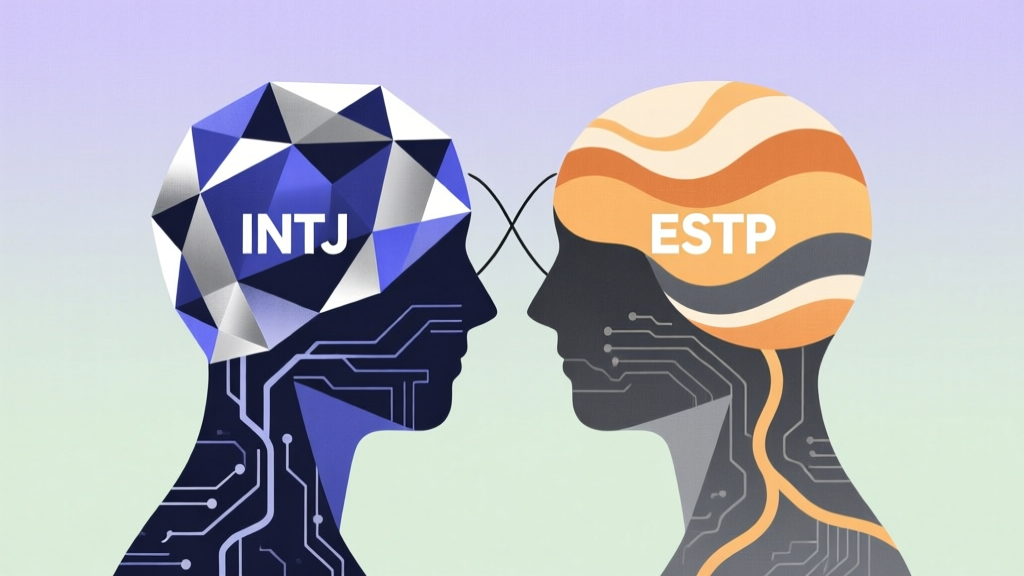
When an INTJ—a strategic, future-oriented planner—pairs with an ESTP—a spontaneous, action-driven realist—their differences ignite both friction and extraordinary synergy. Nowhere is this duality more pronounced than under stress. While popular MBTI narratives often highlight their romantic or communication contrasts, the stress coping and mutual support system between INTJ and ESTP is one of the most underexplored yet vital dimensions of their compatibility. This article moves beyond surface-level type descriptions to examine precisely how each type physiologically and psychologically responds to pressure—and crucially, how they can co-regulate, de-escalate, and build resilience *together*. Grounded in cognitive function theory, clinical psychology insights, and real-world partnership data, this deep-dive offers actionable, non-prescriptive guidance for INTJ–ESTP couples navigating burnout, uncertainty, conflict, or life transitions.
How INTJ Handles Stress
The INTJ personality type (Introverted–Intuitive–Thinking–Judging) operates from a dominant Introverted Intuition (Ni), supported by auxiliary Extraverted Thinking (Te). Under healthy conditions, Ni synthesizes complex patterns into long-term visions, while Te executes precise, efficient plans. But under chronic or acute stress, the INTJ’s cognitive stack undergoes a well-documented shift known as the grip stress response—a term coined by Jungian analyst John Beebe and expanded in The Myers & Briggs Foundation.
When overwhelmed—by unpredictability, loss of control, interpersonal chaos, or perceived incompetence—the INTJ’s inferior function, Extraverted Sensing (Se), surges uncontrollably. Rather than grounding them in the present (as healthy Se does), grip Se manifests as hyper-reactivity to sensory input: restlessness, impulsive risk-taking (e.g., reckless driving, binge spending), obsessive focus on physical details (e.g., fixating on minor flaws in surroundings), or sudden outbursts of anger directed at immediate stimuli. Simultaneously, their normally disciplined Te collapses into rigid, perfectionistic over-control—micromanaging others, rejecting all external input, or freezing decision-making entirely.
Crucially, INTJs rarely vocalize distress. Their stress is internalized and intellectualized. A 2021 study published in the Journal of Personality Assessment found that high-Ni types (including INTJs) were significantly less likely to seek social support during acute stress, instead retreating into silent analysis or solitary problem-solving—even when solutions require collaboration. This isn’t stoicism; it’s a neurocognitive self-preservation strategy. The INTJ interprets vulnerability as inefficiency and emotional disclosure as a threat to autonomy.
Common stress behaviors include:
- Withdrawing for 24–72 hours without explanation
- Over-researching problems to the point of paralysis
- Criticizing others’ methods (not motives) with surgical precision
- Suddenly abandoning long-term goals for short-term thrills (e.g., quitting a job impulsively)
- Developing insomnia or rigid sleep schedules as a control mechanism
Without intervention, prolonged grip Se can spiral into anxiety disorders or somatic symptoms—headaches, gastrointestinal disruption, or hypertension—especially when combined with chronic suppression of feeling functions (Fi/Fe).
How ESTP Handles Stress
The ESTP (Extraverted–Sensing–Thinking–Perceiving) leads with Extraverted Sensing (Se), supported by auxiliary Introverted Thinking (Ti). In flow, ESTPs are agile, resourceful, and grounded—reading environments instantly, adapting on the fly, and solving tangible problems with inventive pragmatism. Their stress response, however, follows a distinct trajectory rooted in their inferior function: Introverted Intuition (Ni).
Under sustained pressure—such as financial instability, relationship ambiguity, or existential uncertainty—the ESTP’s normally vibrant Se becomes overwhelmed by too much sensory input or too little immediate resolution. This triggers inferior Ni grip: a flood of catastrophic future projections, paranoid interpretations of ambiguous signals, and obsessive rumination about hidden meanings or inevitable failure. Unlike the INTJ’s grip Se (which explodes outward), the ESTP’s grip Ni implodes inward—generating vague dread, fatalism (“Everything always goes wrong”), or irrational suspicion (“They’re hiding something”).
Because Ni is not naturally accessible to the ESTP, these thoughts lack grounding in evidence or logic. Ti—their usual tool for analysis—fails to counter them because Ni operates beneath conscious reasoning. As noted by psychologist Linda V. Berens in Understanding Yourself and Others: An Introduction to the Personality Type Code, inferior Ni “feels like an intrusive, alien voice that undermines confidence and distorts reality” (CPP Publishing, 2010). To escape this mental fog, ESTPs often escalate Se-driven behaviors: excessive partying, substance use, thrill-seeking, or rapid job/relationship hopping—all attempts to “shock” themselves back into the present.
ESTPs also avoid discussing stress directly—not out of aloofness, but because articulating abstract fears feels linguistically impossible and emotionally unsafe. A 2019 survey by the Center for Applications of Psychological Type (CAPT) revealed that Perceiving types (particularly ESTPs and ESFPs) reported the lowest verbalization rates of emotional distress, preferring action-based relief (exercise, fixing things, helping others physically) over talk-based processing.
Key stress indicators in ESTPs:
- Uncharacteristic silence or abrupt exits from conversations
- Increased sarcasm or cynical humor masking anxiety
- Hyper-focus on minor physical discomforts (e.g., “My knee’s been weird all week”)
- Sudden disengagement from long-term commitments
- Overcommitting to short-term projects to avoid stillness
The INTJ and ESTP Stress Dynamic
At first glance, the INTJ–ESTP stress dynamic appears paradoxical: one retreats inward while the other over-activates outward. Yet their opposing reactions create a powerful, if volatile, feedback loop—one that can either amplify distress or catalyze profound mutual regulation.
Consider a common scenario: a shared financial crisis. The INTJ responds by withdrawing, building complex spreadsheets forecasting five-year scenarios, and rejecting the ESTP’s suggestion to “just take the freelance gig and figure it out.” The ESTP, meanwhile, books a last-minute road trip, cancels two meetings, and jokes darkly about “living off ramen and hope”—triggering the INTJ’s Te judgment (“That’s irresponsible”) and the ESTP’s Ni fear (“They think I’m unreliable”).
This is not misalignment—it’s cognitive mirroring. The INTJ’s grip Se seeks sensory relief *through control*, while the ESTP’s grip Ni seeks cognitive relief *through action*. When unrecognized, each interprets the other’s coping as sabotage. But when decoded, their stress responses become complementary tools.
Below is a comparative framework outlining how each type’s stress behaviors map onto functional needs—and how those needs can be met *by the other*:
| Stress Trigger | INTJ Response (Grip Se) | ESTP Response (Grip Ni) | How INTJ Can Support ESTP | How ESTP Can Support INTJ |
|---|---|---|---|---|
| Uncertainty / Lack of Control | Over-planning, rigidity, irritability toward spontaneity | Rash decisions, avoidance of planning, fatalistic statements | Offer concrete options (3 max), state clear boundaries (“I need 2 hrs alone, then we’ll decide together”), avoid open-ended questions | Create low-stakes “action anchors”: e.g., “Let’s walk for 15 mins—no agenda,” or “I’ll handle grocery pickup so you can focus on X” |
| Interpersonal Conflict | Withdrawal, cold logic, delayed emotional processing | Deflection via humor, physical restlessness, changing subject | Use written communication first (“I need to process—here’s what I observed”), follow up with time-bound verbal check-in (e.g., “Can we talk 30 mins tomorrow?”) | Initiate movement-based dialogue: walk-and-talk, cook together, or use tactile objects (e.g., sketching ideas on paper) to reduce verbal pressure |
| Existential Pressure | Obsessive future-scanning, nihilistic detachment | Vague dread, withdrawal from values-based conversation, increased risk behavior | Ask: “What’s one small thing you trust right now?” Anchor in present sensory reality (e.g., “Feel this mug—warm, ceramic, solid”) | Share a simple, tangible win: “We fixed the leak. That’s done.” Avoid reassurance; offer evidence of competence |
This table reveals a core truth: the INTJ’s greatest gift to the ESTP is structural clarity; the ESTP’s greatest gift to the INTJ is embodied presence. Neither “fixes” the other—they restore balance to the other’s dominant function by compensating for its stress-induced distortion.
Supporting Each Other During Hard Times
Effective mutual support between INTJs and ESTPs requires moving beyond empathy-as-feeling to empathy-as-function: recognizing which cognitive process is distressed and delivering support in its native language.
For ESTPs Supporting INTJs
ESTPs excel at reading micro-expressions, environmental cues, and unspoken tension—skills rooted in healthy Se. Use this acuity to detect early stress signals *before* full grip sets in:
- Notice physical tells: Jaw clenching, narrowed eyes, unusually stiff posture, or abrupt shifts in speech rhythm (e.g., clipped sentences).
- Interrupt escalation gently: Instead of asking “What’s wrong?”, try “You’ve been quiet—want me to grab coffee and sit with you? No talking needed.” This honors INTJ’s need for solitude while offering connection on their terms.
- Anchor in the tangible: When an INTJ spirals into Ni-Ti analysis, offer a sensory reset: “Let’s test that HVAC filter—you said it was due,” or “I found that obscure part you needed. Want to install it together?” Action interrupts rumination.
- Avoid minimizing: Never say “Just relax” or “Don’t overthink it.” Instead: “Your analysis matters. What’s the next *smallest executable step*?” This validates their process while redirecting Te toward agency.
For INTJs Supporting ESTPs
INTJs bring unparalleled pattern recognition and systems-thinking. Leverage this not to solve the ESTP’s problem—but to simplify their cognitive load:
- Pre-empt Ni overload: Before major decisions (e.g., moving, career change), provide a concise “Clarity Brief”: 3 bullet points of known facts, 2 realistic options with pros/cons (max 1 sentence each), and one deadline. This contains Ni’s free-association within defined boundaries.
- Translate feelings into functions: If an ESTP says, “I don’t know—I just feel off,” respond with: “Is it your energy level? Your focus? Your sense of safety? Pick one—we’ll troubleshoot that.” This gives Ti a framework to engage.
- Protect their autonomy: Offer support as choice, not obligation: “I’ve drafted a budget outline—if useful, take it. If not, trash it. Zero expectation.” ESTPs resist perceived control; framing preserves their Se sovereignty.
- Validate action as processing: When an ESTP cleans the garage or rebuilds a bike mid-crisis, say: “That’s smart—physical work resets the nervous system. Need tools or space?” This affirms their coping as legitimate, not avoidance.
A real-world example: After a layoff, an ESTP partner began skipping meals and taking late-night drives. Their INTJ partner didn’t lecture about stability. Instead, they: (1) reordered pantry staples to ensure easy access to nutrition, (2) left a gas card and note: “Fuel for thinking—no receipt needed,” and (3) scheduled a Saturday “tactical review” where they mapped three *immediate* income-generating actions (freelance pitch, equipment rental, local gig board). Within 48 hours, the ESTP’s Ni static decreased, and they initiated a calm, solution-focused conversation.
Caregiver and Receiver Patterns
Traditional caregiver models assume one person “gives” support and the other “receives.” In INTJ–ESTP dynamics, caregiving is role-fluid and function-specific. Neither type is inherently nurturing or dependent; rather, each becomes the caregiver *for the function the other has lost access to under stress*.
During acute stress:
- The INTJ becomes the caregiver for structure: They hold timelines, manage logistics, preserve routines, and filter overwhelming information—acting as the ESTP’s external Ni/Ti scaffold.
- The ESTP becomes the caregiver for embodiment: They initiate movement, regulate sensory environment (light, sound, touch), and model present-moment engagement—acting as the INTJ’s external Se anchor.
This reciprocity prevents resentment. When the INTJ feels overwhelmed by chaos, they aren’t “being taken care of”—they’re receiving targeted cognitive scaffolding. When the ESTP feels paralyzed by dread, they aren’t “needing saving”—they’re being reconnected to their innate capacity for responsive action.
However, imbalance occurs when one partner defaults to their *comfortable* role regardless of need. For instance, an INTJ who insists on controlling all decisions—even when the ESTP is calm and capable—violates the ESTP’s Se autonomy. Conversely, an ESTP who constantly interrupts the INTJ’s reflection with distractions erodes their Ni integrity.
Healthy caregiver dynamics require explicit agreements, such as:
- The 20-Minute Reset Rule: Either partner can request 20 minutes of uninterrupted silence + movement (e.g., walk, stretch, shower). The other honors it without question or follow-up.
- The “Function Check-In”: Weekly, ask: “Which function felt strongest this week? Which felt thin? Where did you need my support—and did you get it?”
- The “No-Solution Zone”: Dedicate one evening monthly where partners share stressors *without* problem-solving—only listening, validating, and holding space.
These rituals normalize functional interdependence—not emotional dependency.
Building a Resilient Partnership
Resilience in INTJ–ESTP relationships isn’t built by eliminating stress, but by designing shared stress-response infrastructure. This includes environmental, behavioral, and linguistic systems that preempt dysregulation.
Environmental Design
Co-create physical spaces that serve both types’ needs:
- The “Quiet Command Center”: A dedicated, tech-free zone (e.g., a sunlit nook) with noise-canceling headphones, analog notebook, and dimmable lighting—optimized for INTJ Ni/Te restoration.
- The “Action Launch Pad”: A garage corner, balcony, or backyard station with tools, portable gear, and quick-access supplies—optimized for ESTP Se/Ti activation.
- The “Neutral Co-Regulation Zone”: A shared space (e.g., kitchen island) with dual-purpose elements: whiteboard for INTJ planning + counter space for ESTP hands-on projects (e.g., cooking, model-building).
Behavioral Routines
Establish non-negotiable weekly rhythms:
- “Future-Fit Friday”: INTJ shares one 5-year vision milestone; ESTP identifies one concrete action to advance it that week. No critique—only alignment.
- “Present Pulse Saturday”: ESTP chooses a sensory-rich activity (hiking, farmers market, pottery class); INTJ participates fully—no devices, no analysis—only observation and presence.
- “Reset Sunday”: Joint 90-minute session: 30 mins reviewing what worked/didn’t in stress responses, 30 mins co-designing one micro-adjustment (e.g., “Next time I withdraw, text ‘Ni offline—back at 3pm’”), 30 mins doing nothing together (e.g., sitting in silence, watching clouds).
Linguistic Protocols
Adopt shared phrases to bypass function clashes:
- “I need my Ni/Se back online” — Signals grip is active; partner responds with pre-agreed support (e.g., INTJ gets silence; ESTP gets movement).
- “Let’s Te/Ti this” — Initiates collaborative problem-solving using logic only (no emotion, no speculation).
- “Ground us” — Triggers joint sensory anchoring (e.g., hold hands, name 3 things you see/hear/feel).
Research from the Gottman Institute confirms that couples who develop shared meaning systems—rituals, symbols, and language unique to their bond—show 40% higher long-term relationship satisfaction (Gottman Institute, 2018). For INTJ–ESTP pairs, these systems transform stress from a rupture into a ritual of reconnection.
FAQ
Can INTJs and ESTPs truly understand each other’s stress?
Yes—but not intuitively. Understanding requires deliberate translation. INTJs must learn to read ESTP’s body language and action as emotional language; ESTPs must learn to decode INTJ’s silence and analysis as protective processing. It’s less about “getting inside their head” and more about mastering their functional dialect. With practice, this becomes second nature—like learning a new language fluently.
What if one partner refuses to acknowledge their stress patterns?
Start with observable behavior, not labels. Say: “I notice you’ve canceled our last three check-ins and stayed up late scrolling. That’s unusual—want to explore what’s up?” Avoid MBTI terms initially. Focus on impact: “When you withdraw silently, I worry and overthink. Can we agree on one tiny signal you’ll use when you need space?” Small agreements build trust for deeper work.
Is it healthy for an INTJ to rely on an ESTP for emotional regulation?
It’s healthy only if reciprocal and bounded. The INTJ must also develop independent Ni/Te resilience (e.g., journaling, strategic meditation, professional coaching). Similarly, the ESTP must cultivate Ni awareness (e.g., guided future-journaling, working with a therapist skilled in somatic approaches). The partnership amplifies growth—it shouldn’t replace it.
How do we handle stress when both are gripped simultaneously?
This is the critical test. Implement the “Dual Grip Protocol”: (1) Both pause all interaction for 60 minutes; (2) INTJ engages in solo Se activity (e.g., intense workout, detailed cleaning); ESTP engages in solo Ni activity (e.g., writing 3 possible futures, mapping cause-effect chains); (3) Reconnect with the phrase: “I’m back online. What’s one thing we can do *right now* to stabilize?” This forces co-regulation through function reintegration—not emotional venting.
In conclusion, the INTJ–ESTP bond is not a puzzle to be solved, but a dynamic ecosystem to be tended. Their stress responses—so seemingly opposed—are actually two halves of a regulatory circuit. When approached with curiosity, precision, and mutual respect for cognitive architecture, this pairing doesn’t just survive pressure—they refine each other’s humanity under fire. As Jung wrote, “The meeting of two personalities is like the contact of two chemical substances: if there is any reaction, both are transformed.” For INTJs and ESTPs, stress is the catalyst. And support—their shared, sacred laboratory.